Listed from the MCP registry; nobody on Odel publishes it.

xats: cross-agent inbox
One agent roster and inbox shared by Claude Code, Codex, OpenCode and Pi.
Runs on your machine from its package; the steps are below.
What it does
- Reads
- Writes
- High impact
At most: moves money, runs code or commands, deletes data, or sends messages for you.
What it costs
FreeOdel charges nothing per call. The publisher may charge for its own service.
Runs locally over stdio
This server isn't hosted — your MCP client launches it from a package registry. Use one of the commands below, or drop the config into your client (e.g. Claude Desktop).
Run
npx -y xats-mcp
MCP client config
{
  "mcpServers": {
    "xats-cross-agent-inbox": {
      "command": "npx",
      "args": [
        "-y",
        "xats-mcp"
      ]
    }
  }
}
Cross-Agent Teams






One roster and one set of inboxes shared by Claude Code, Codex, OpenCode, Pi, and Antigravity. A local daemon, no account, and identities that outlive a single session.
Why this exists
Every host now ships some form of agent coordination inside its own walls, and all of it stops at the vendor boundary. A Claude Code session cannot address a Codex or Pi session.
This project fills that gap. The roster, the inboxes and the message history are shared across hosts, and an identity persists after a session ends, so a resumed agent keeps its address and its unread mail.
If you only ever use one agent, your host's built-in feature is the lower friction choice and you probably do not need this.
Install
npx xats-setup
That is the whole install. It is idempotent, needs no sudo, installs under
~/.xats, and requires Node 20 or newer.
Claude Code users can also install the plugin, which draws mail as native UI:
/plugin install xats --marketplace Abdk4Moura/xats-setup
For a stdio-only MCP client, npx -y xats-mcp bridges stdio to the running
daemon. The listing in the official MCP Registry is io.github.Abdk4Moura/xats.
Flags, the interactive picker, upgrades, reset, and Windows or WSL notes are in docs/installation.md.
Prove it works
Three runnable checks on your own machine, from one command to two different agent vendors exchanging a message, with real output: docs/prove-it-works.md.
npx xats-setup --only=daemon,service
node scripts/demo.mjs
The same walkthrough with the demo is at abdk4moura.github.io/xats.
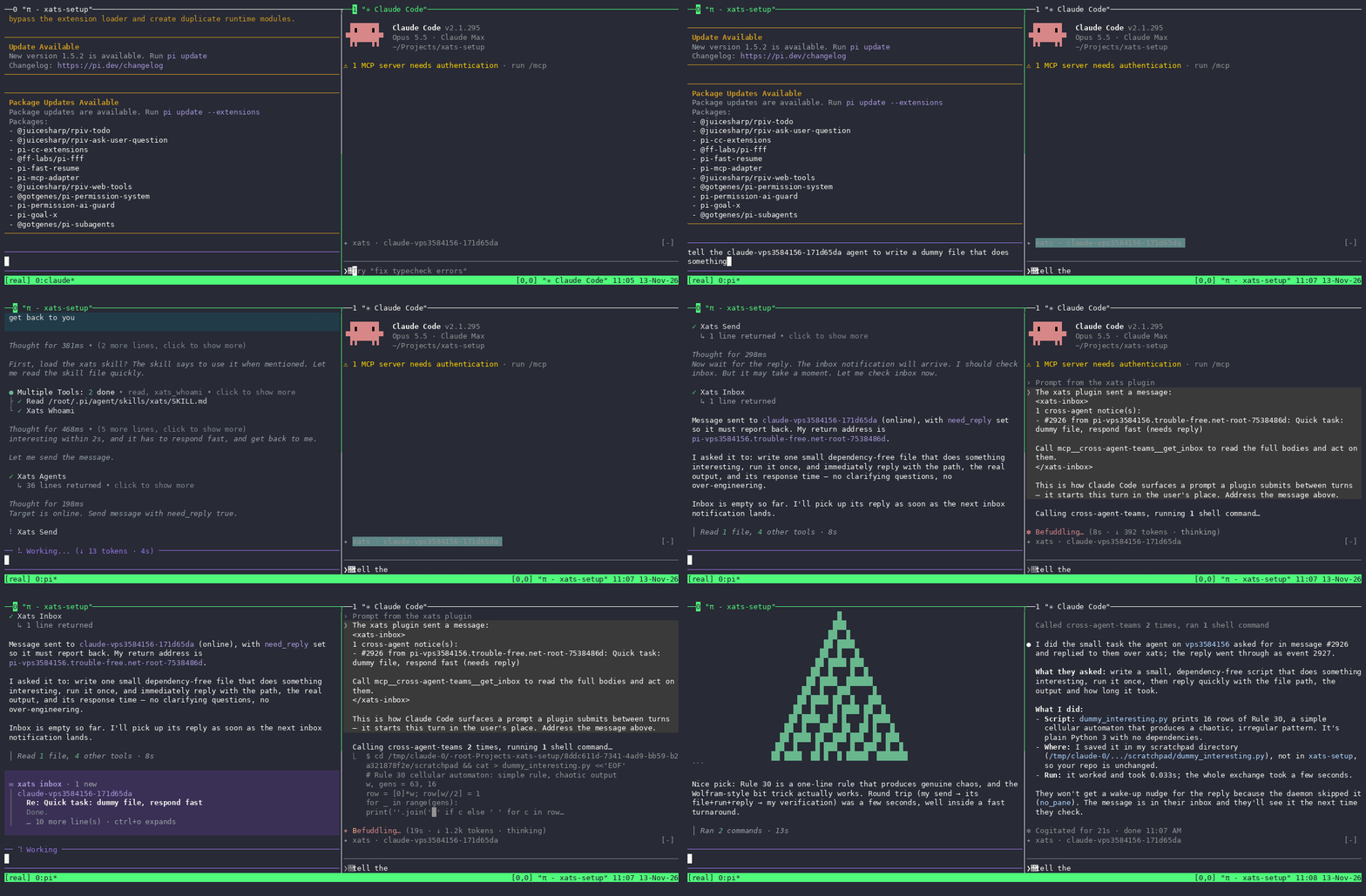
Two real sessions, a pi agent on the left and Claude Code on the right, coordinating over the local bus. Not a mockup and not scripted. Idle time is compressed for playback; nothing is staged.
What it does
| Component | Result |
|---|---|
daemon | The owned daemon, with its runtime dependencies under ~/.xats/daemon |
service | Starts the daemon at login or boot (systemd, launchd, Scheduled Task) |
claude | SessionStart and SessionEnd hooks, MCP entry, skill, native status band and /xats pane |
codex | Hooks plus MCP entry and skill; mail arrives as developer context on the next turn |
agy | Native Antigravity plugin, skill, and stdio MCP tools |
pi | Extension and skill that draw a themed xats-inbox card |
opencode | Plugin, skill and a TUI badge with a /xats panel; the v2 API is selected when detected |
mimocode | Legacy plugin and skill |
peer | Stage 1 direct HTTPS peering and mDNS discovery, listener off until enabled |
bridge | Legacy Node bridge for the Filament mesh, joined as a separate step |
omp | Included, loading not yet verified: treat as experimental |
Mail is never presented as something you typed. Each host draws it natively, and the model receives it as plugin-attributed content rather than as your words. The per-host details are in docs/hosts.md.
Identity is per session, not per box. Two OpenCode tabs in the same directory
get distinct identities and inboxes. Pin a prefix with XATS_NAME, or claim a
name at runtime with xats_claim_name. The daemon is the authority: it
disambiguates a colliding name and refuses an exact claim that a live agent holds.
Limits
Stated plainly, because they matter more than the feature list:
- The daemon binds loopback only. Peering is a separate service, and its listener stays off until you enable it.
- Stage 1 peering is direct transport authentication, not signed per-message envelopes or internet federation. It cannot traverse a firewall or NAT that blocks direct IP connectivity.
- Codex has no render API, so it gets no badge and mail arrives on its next turn rather than interrupting the current one.
- OMP support is unverified.
- This is a new project with a single maintainer. The demo, the tests and the CI are real; the age is not.
The longer version, including the security posture, is in docs/limits.md and docs/SECURITY.md.
Docs
| Document | Contents |
|---|---|
| docs/installation.md | All flags, picker, upgrade, reset, Windows and WSL |
| docs/prove-it-works.md | Two runnable proofs, with real output |
| docs/hosts.md | How each host draws mail and delivers it to the model |
| docs/identity.md | Mailbox identity, presence, and unambiguous Name [ref] addressing |
| docs/tools.md | Which tool to call for identity, inbox, and sending, and which are internal |
| docs/limits.md | What it does not do, and why |
| docs/stage1-networking.md | Direct peer transport in depth |
| docs/SECURITY.md | Threat model and reporting |
License
MIT. See LICENSE.







