Listed from the MCP registry; nobody on Odel publishes it.

dofleet
Let AI agents borrow DigitalOcean droplets with expiry timers and a budget, never your token.
Runs on your machine from its package; the steps are below.
What it does
- Reads
- Writes
- High impact
At most: moves money, runs code or commands, deletes data, or sends messages for you.
What it costs
FreeOdel charges nothing per call. The publisher may charge for its own service.
Runs locally over stdio
This server isn't hosted — your MCP client launches it from a package registry. Use one of the commands below, or drop the config into your client (e.g. Claude Desktop).
Run
uvx dofleet
MCP client config
{
  "mcpServers": {
    "dofleet": {
      "command": "uvx",
      "args": [
        "dofleet"
      ]
    }
  }
}
dofleet





Disposable DigitalOcean droplets that delete themselves. · Droplet DigitalOcean pakai-buang yang memadam dirinya sendiri.
PyPI · MCP server · reaper · Bahasa Melayu · Built in Malaysia by Aiman Malib · Sasa Teguh
Every droplet dofleet creates carries an expiry timer, and a reaper deletes it when the timer runs out, whether or not you remember. You see what a batch costs before you confirm, a month budget stops you before you pass it, and a sold-out size falls back to the next one in your preset instead of failing.
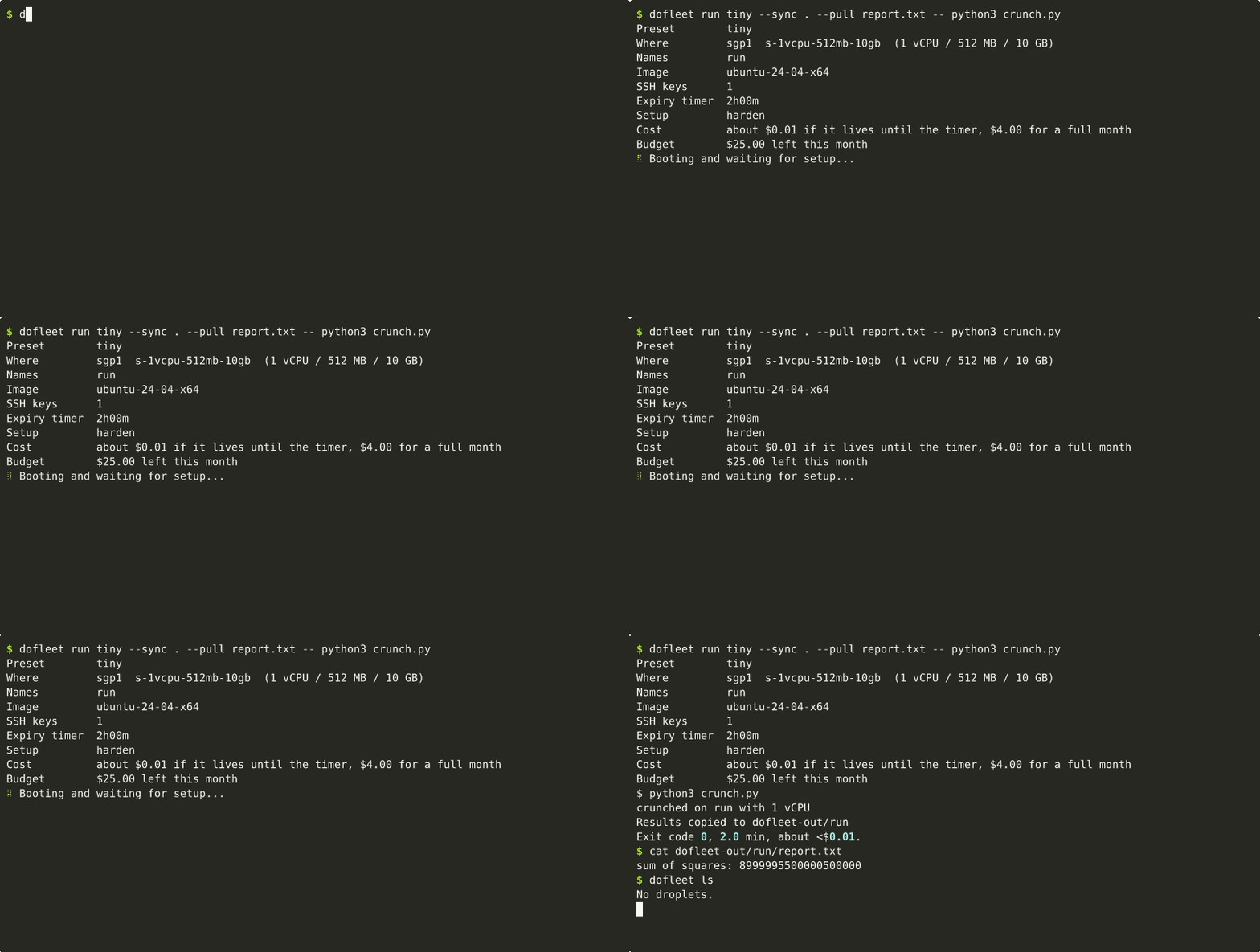
Recorded on a real account; waiting time is shortened. The droplet existed for 2 minutes and cost under a cent.
When the job ends, the droplet is gone and so is the bill.
What it does
- Timers and a reaper. Each droplet is tagged with its expiry time.
dofleet reapdeletes expired ones from cron, ordofleet install-reaperruns it inside your DigitalOcean account as a scheduled Function, so nothing has to stay on. - Jobs.
dofleet runboots a droplet, copies a folder up, runs one command with live output, copies results back and deletes everything. - Money. Cost before create, spend so far in
ls, abudget_usdceiling that blocks new droplets and (optionally) deletes running ones once the month's usage reaches it. GPU sizes cannot be created without a timer. - For AI agents.
dofleet mcpis an MCP server: Claude or another agent can borrow a droplet, run commands on it and give it back, inside limits you set. The agent never sees your token. - Fast boots.
dofleet bakesnapshots a finished setup;up --bakedboots from it in about 40 seconds instead of 2 to 3 minutes. - CI and previews. A GitHub Action creates a droplet per job or pull request and deletes it after, with the timer as a backstop.
- Sane setup. Hardened Ubuntu (sudo user, firewall, fail2ban, key-only login), Docker, a remote desktop over RDP, or your own script. "Ready" means the setup finished, not only that port 22 opened.
Why not just doctl?
doctl is the official CLI and covers the whole API. dofleet covers one job doctl leaves to you: short-lived machines that must not outlive their purpose.
| doctl | dofleet | |
|---|---|---|
| Expiry timer + reaper (local cron or DigitalOcean Functions) | no | yes |
| Month budget that blocks creates and can stop the fleet | no | yes |
| One-command jobs: boot, copy, run, copy back, delete | no | yes |
| MCP server so AI agents can use droplets under a policy | no | yes |
Cost before create, spend so far in ls | no | yes |
| Sold-out fallback across sizes and regions | no | yes |
| Waits until cloud-init has finished | no | yes |
| Volumes created, mounted and deleted with the droplet | no | yes |
| English and Bahasa Melayu output | English | both |
| Everything else in the DigitalOcean API | yes | no |
If you already use doctl, dofleet reads its token, so there is nothing to set up.
Install
pipx install dofleet # or: uv tool install dofleet
Python 3.11 or newer, plus ssh and tar for run. Latest main instead of the release: pipx install git+https://github.com/aimanmalib/dofleet.
Token
Create a token at https://cloud.digitalocean.com/account/api/tokens (custom scopes, checked against DigitalOcean's scope list: full droplet, block_storage, ssh_key, tag, snapshot and function, plus actions:read, account:read, billing:read, sizes:read, regions:read and image:read; or simply read + write), then export DIGITALOCEAN_TOKEN=dop_v1_..., or keep using an existing doctl auth init login. dofleet whoami shows the account and where the token came from. More than one account: add profiles to the config and pass -p <profile>.
Commands
| Command | What it does |
|---|---|
dofleet | Numbered menu (in a terminal) |
dofleet up [preset] -n NAME -c N | Create droplets. --ttl 2h, --keep (no timer), -r sgp1, -s s-2vcpu-4gb, --volume 100, --baked, --var user=dev, --dry-run |
dofleet run PRESET -- COMMAND | One job on a fresh droplet. --sync DIR, --pull PATH, --env K=V, --keep-on-fail |
dofleet ls [-m] | Droplets with IP, age, spend so far, price per month, time left |
dofleet extend NAME --ttl 4h | Push the timer out (dofleet droplets only). --keep removes it |
dofleet reap [--yes] [--dry-run] | Delete expired dofleet droplets, orphan volumes, and everything once over budget |
dofleet down NAME... [--yes] | Delete by name, id or pattern ('web-*'), with their dofleet volumes. Patterns only match dofleet droplets unless --any; --missing-ok for cleanup jobs |
dofleet ssh NAME [-- command] | SSH in as the user the preset created, or run one command |
dofleet bake NAME / dofleet snapshots | Snapshot a finished droplet for fast boots / list those snapshots |
dofleet install-reaper / uninstall-reaper | Reaper as a scheduled DigitalOcean Function. --every 10m, --region, --notify-url, --token-env |
dofleet mcp | MCP server on stdio for AI agents |
dofleet cost | Usage this month, budget left, what the fleet costs per day and month, orphan volumes |
dofleet sizes [-r REGION] [-f basic|premium|cpu|memory|gpu|all] | Sizes in stock, cheapest first |
dofleet restart NAME... [--hard], presets, init, whoami | Reboot, list presets, write a starter config, check the token |
Put --json before any command for machine-readable output and --lang ms or --lang en to pick the language (default follows LANG).
The reaper
Pick one, or both (they do not get in each other's way):
dofleet install-reaper --every 10m # runs in your DigitalOcean account, nothing local
*/10 * * * * DIGITALOCEAN_TOKEN=dop_v1_... /home/you/.local/bin/dofleet reap --yes >> ~/.dofleet-reap.log 2>&1
It only touches droplets tagged dofleet with a passed dofleet-exp-<unix time> tag (re-read just before deleting, in case someone extended it), their dofleet volumes, and dofleet volumes that have been attached to nothing for over an hour, counted from when a reaper first saw them detached, so a volume you just moved is safe. Droplets you made by hand are never touched. DigitalOcean keeps a tag after the last thing carrying it is gone, so the reaper also deletes empty dofleet-exp-* and dofleet-detached-* tags once their time is an hour past; other tags stay. The Function version stores the token in your own Functions namespace; give it a separate token with --token-env if you prefer. --notify-url posts a short report to a Slack or Discord style webhook; locally, notify_cmd in the config runs any command:
[defaults]
notify_cmd = ["/usr/local/bin/notify.sh", "{message}", "{level}"]
{message} and {level} can sit in any argument. {level} is info when droplets were deleted because their timer ran out (expected, nothing to do), warn when the month budget made the reaper delete them, and critical when a delete failed and the droplet is still running. Without {message} the message is added as the last argument, as before.
Budget
[defaults]
budget_usd = 50          # this month's DigitalOcean usage ceiling
budget_action = "reap"   # at the ceiling: "reap" deletes every dofleet droplet, "warn" only reports
up, run and agent requests refuse anything that would pass the ceiling: usage so far, plus what running droplets will still cost until their timers (or month end without one), plus the new batch. A sold-out fallback to a dearer size is checked again. The reaper applies budget_action once usage reaches it. DigitalOcean refreshes the month-to-date figure only a few times a day (measured: 19 hours old), so treat the budget as a guard against runaway spend, not a real-time meter; the cost of droplets still running is counted live. dofleet cost shows how old the figure is. Sizes listed in require_ttl_for (GPU by default) cannot be created without a timer.
Jobs with run
dofleet run docker --sync . --pull dist -- bash -c "docker build -t app . && docker save app > dist/app.tar"
dofleet run scratch --volume 200 --env DATASET=2026-11 -- python3 crunch.py
The folder is copied to ~/work on the droplet, the command runs there with its output streamed to your terminal, --pull paths come back to dofleet-out/<name>/, and the droplet and its volumes are deleted. The exit code is the command's. The droplet still has its timer, so if your laptop dies mid-job the reaper cleans up.
AI agents (MCP)
Add dofleet to an MCP client, for example Claude Code's .mcp.json:
{ "mcpServers": { "dofleet": { "command": "dofleet", "args": ["mcp"],
    "env": { "DIGITALOCEAN_TOKEN": "dop_v1_..." } } } }
The agent gets six tools: dofleet_list, dofleet_create, dofleet_exec, dofleet_extend, dofleet_delete, dofleet_cost. Their argument descriptions carry your limits (allowed presets, longest timer), so the agent knows them before it asks. The server starts without a token too, so clients can list the tools; each call then says the token is missing. The policy is enforced by dofleet, not by the agent:
[mcp]
presets = ["tiny", "quick", "docker", "scratch"]   # what the agent may create
max_ttl = "4h"                                    # every agent droplet has a timer no longer than this
max_droplets = 3                                  # dofleet droplets at once
exec_timeout_s = 600
The agent only ever sees droplets it created itself (tagged dofleet-mcp); droplets you made with dofleet up are invisible to it, so it cannot run commands on, extend or delete them. scope = "all" widens that on purpose. The month budget applies to creates and extends, and a malformed request gets an error reply instead of stopping the server.
GitHub Action
name: preview
on: pull_request
jobs:
  preview:
    runs-on: ubuntu-latest
    steps:
      - uses: actions/checkout@v4
      - id: box
        uses: aimanmalib/dofleet@main
        with:
          token: ${{ secrets.DIGITALOCEAN_TOKEN }}
          preset: docker
          name: pr-${{ github.event.number }}
          ttl: 1d
      - run: echo "Preview at http://${{ steps.box.outputs.ip }}"
For anything that matters, pin a release tag or a commit SHA instead of @main. Delete the droplet when the pull request closes with command: down and the same name (a droplet that is already gone is not an error); if that never runs, the timer does it. command: run takes args as one shell command, pipes and && included. config takes a config file's contents (presets, budget). The runner's SSH key is added to the account for the step and removed again when the step ends (the droplet keeps it, so later steps can still SSH in), inputs reach the shell only as environment variables, and a generated password is masked in the log and left out of the step outputs.
Presets
| Preset | Size chain | Setup | Timer |
|---|---|---|---|
quick | s-4vcpu-8gb, then the AMD and Intel twins, Singapore then Bangalore | harden | 8h |
tiny | the cheapest sizes | harden | 2h |
docker | s-2vcpu-4gb | docker | 1d |
scratch | s-4vcpu-8gb + a 100 GB volume | harden | 6h |
desktop | s-4vcpu-8gb | desktop (XFCE over RDP) | 8h |
gpu | H100, then L40S, then RTX 4000 Ada (needs GPU access on the account) | harden | 2h |
Change them or add your own in ~/.config/dofleet/config.toml (dofleet init writes a commented starter):
[presets.worker]
description = "Build worker"
regions = ["sgp1", "blr1"]
sizes = ["s-2vcpu-4gb", "s-2vcpu-4gb-amd"]
image = "ubuntu-24-04-x64"
cloud_init = "docker"      # a bundled template, or a path to your own script
ttl = "12h"
volumes = [50]
tags = ["ci"]
vars = { user = "dev" }
A key you set overrides the bundled one; everything else stays as shipped.
Setup, keys, volumes, snapshots
- Templates are shell scripts cloud-init runs once:
harden(sudo user with your keys, ufw, fail2ban, automatic security updates, key-only login),docker(harden + Docker Engine and compose),desktop(harden + XFCE over RDP; the password is generated and shown once).#include <name>composes them and${user}-style values come fromvars. Your own file works the same way. - SSH keys. If the account has none, dofleet adds your first local public key (named after its hash). With no key anywhere, DigitalOcean emails a root password and dofleet keeps root and password login on so you are not locked out. Each droplet gets its own known_hosts entry, because DigitalOcean reuses IP addresses.
- Volumes are formatted on first boot, mounted under
/mnt/<volume name>(DigitalOcean shows the name with underscores), and deleted with the droplet bydown,runand the reaper. Volumes you attached yourself are left alone. - Snapshots.
dofleet bake NAMEkeeps the newestbake_keepsnapshots per preset and deletes older ones (snapshots bill per GB per month).up --bakedskips the setup template, which already ran.
Security model
- The token never leaves your machine, except into your own DigitalOcean Functions namespace if you install the Function reaper (
--token-envlets that use a separate, narrower token). - Destructive commands only act on droplets tagged
dofleetunless you name a droplet exactly or pass--any;extendrefuses other droplets, because a timer would hand them to the reaper. - Files coming back from a droplet in
runare unpacked with Python's tarfiledatafilter: no absolute paths, no.., no links pointing out, no device files. - SSH is trust-on-first-use with one known_hosts file per droplet, since DigitalOcean reuses IP addresses.
- Known limit: the
desktoppassword travels in the droplet's user data, which any process on that droplet can read from the metadata service. Change it after the first login if other people or containers share the box.
Notes
- Costs shown are estimates from list prices. Backups, snapshots and bandwidth overage are not included.
dofleet costshows the real month-to-date figure. - A create request is never retried after a server error, because DigitalOcean may already have made the droplets. Reads and deletes are retried with backoff.
- Volume deletion and some listings settle on DigitalOcean's side a minute or two after the call returns.
- What was tested against a live account, and what changed because of it, is in the design decisions.
Development
uv venv && uv pip install -e '.[dev]'
.venv/bin/pytest
The tests run against an in-memory fake of the DigitalOcean API and never touch a real account. User-facing text lives in src/dofleet/locales/*.json; a test fails if the English and Malay files drift apart.
License
MIT. Made by Aiman Malib at Sasa Teguh.
Work with Sasa Teguh

I built this project. I run Sasa Teguh, a studio in Malaysia that builds websites found on Google and in AI answers, and sets up systems like this one for businesses.