
🔄 Synced from a monorepo — but with a live history.
wardenmirrors the canonical AI-Factory monorepo. History here is append-only (no force-push). Pull requests are welcome — merged PRs are imported back into the monorepo and re-synced here, so your contribution becomes canonical. 💬 Issues · Pull requests both welcome.
WARDEN — MCP server







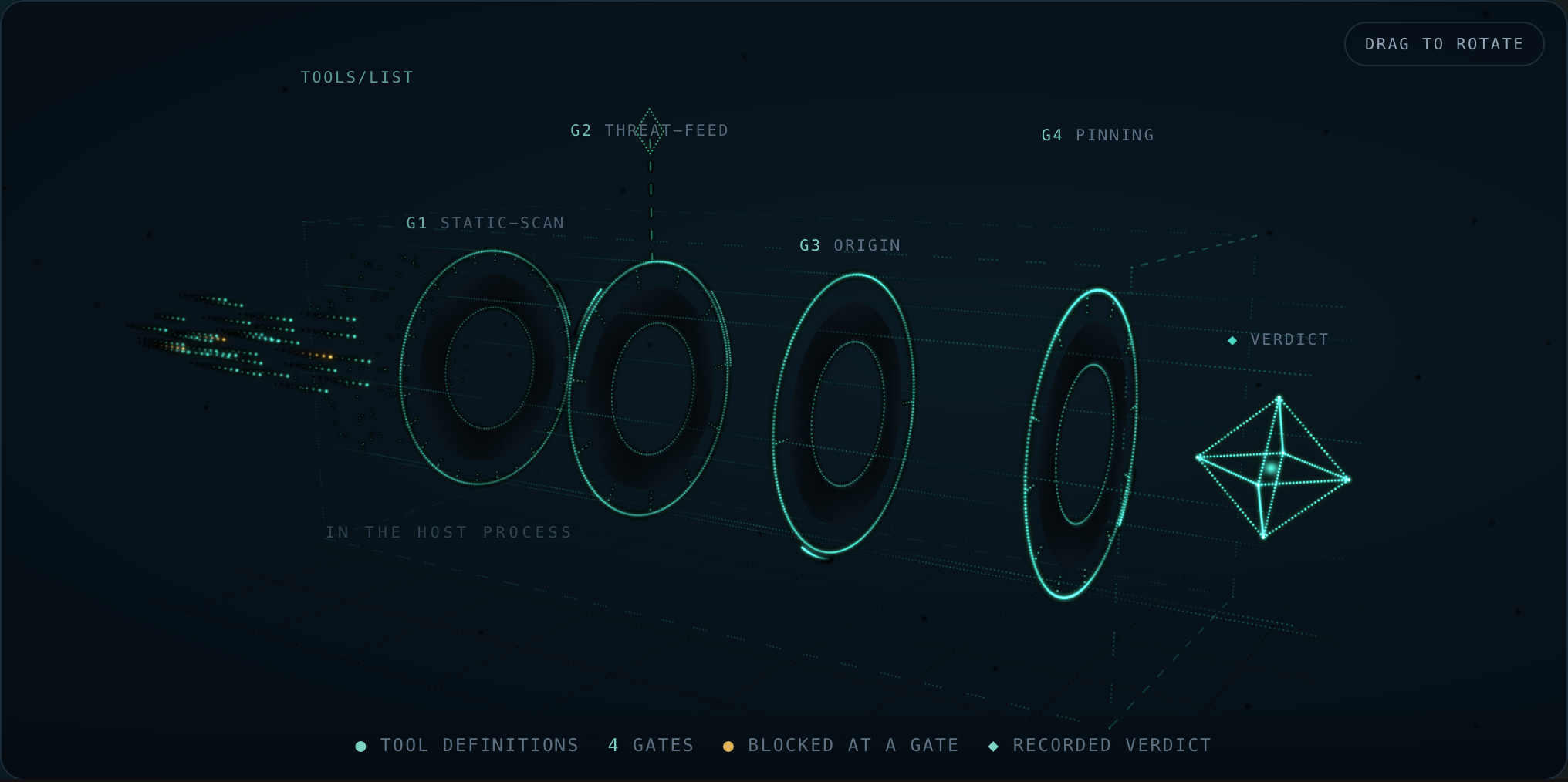
One MCP server. Security firewall for advertised tool definitions. Library included.
Transport: stdio (npx -y @aimarket/warden / node dist/mcp-server.js). Compatible hosts:
Claude Desktop, Cursor, Glama, and any MCP client that speaks stdio. No API keys.
| Item | Location |
|---|---|
| MCP entrypoint (stdio) | warden-mcp → src/mcp-server.ts |
| Tools | vet_mcp_server, static_scan_tools, classify_sensitive_tools, check_egress_url, canonicalize_json, list_scan_rules |
| Library | import { Warden } from "@aimarket/warden" |
| Glama / Docker (stdio) | Dockerfile, glama.json |
| Official MCP Registry | server.json → io.github.alexar76/warden |
| Smithery | smithery.yaml |
An MCP server tells your agent what its tools do. The agent believes it — that sentence is the
attack surface. A tool description is prompt text delivered by a third party straight into your
model's context, and a schema field named api_key is a request for your secrets phrased as an API.
WARDEN vets a server before any of its tools reach the model, and returns a verdict you can record: allow/block, a 0..1 score, the findings that produced it, a per-tool partition, and the exact rule table that was in force.
Zero npm runtime dependencies. The library's only import is node:crypto. The stdio MCP
server adds other node: builtins (fs, path, process) and still pulls in no packages. It is
the firewall out of ARGUS, extracted so you can put it in front
of your own MCP host without adopting an agent.
Run as MCP server (stdio)
npx -y @aimarket/warden            # bin: warden-mcp
# from this repo:
npm run build && node dist/mcp-server.js
Claude Desktop / Cursor (mcpServers entry):
{
  "mcpServers": {
    "warden": {
      "command": "npx",
      "args": ["-y", "@aimarket/warden"]
    }
  }
}
The process never starts, proxies, or sandboxes another MCP server — you pass a tools/list dump
in, you get a verdict out.
| Tool | When to use |
|---|---|
vet_mcp_server | Full gate chain on a server identity + advertised tools |
static_scan_tools | Injection / exfil scan only (no origin / pinning / threat feed) |
classify_sensitive_tools | Operator glob split — not an injection scan |
check_egress_url | Hostname allowlist (empty list denies every host) |
canonicalize_json | RFC 8785 bytes for feeds and pins |
list_scan_rules | Published rule table + digest |
Glama TDQS: MCP annotations (readOnly / destructive / idempotent / openWorld), when-to-use /
when-not naming siblings, every inputSchema property described, outputSchema on every tool.
Publish on Glama
Listing: glama.ai/mcp/servers/alexar76/warden
Same pattern as ARGUS and
aimarket-mcp: repo-root glama.json +
Dockerfile + node dist/mcp-server.js. Admin form values: docs/GLAMA.md.
Library (embed in your host)
npm install @aimarket/warden
import { Warden, ThreatFeed, silentLogger } from "@aimarket/warden";

const threatFeed = new ThreatFeed({ feedPublicKey: process.env.FEED_PUBKEY });
await threatFeed.load(process.env.FEED_URL); // omit → built-in deny-list only, no network

const pins = new Map();
const warden = Warden.create({
  policy: {
    blockAtSeverity: "high",
    sensitiveToolPatterns: ["*delete*", "*transfer*", "*key*"],
    allowUnknownServers: false, // fail-closed: only servers you declared
    pinToolDefs: true,
  },
  threatFeed,
  store: {
    getPin: async (id) => pins.get(id),
    putPin: async (p) => void pins.set(p.serverId, p),
  },
  log: silentLogger(), // or your own logger
});

const verdict = await warden.vet(server, await client.listTools());

if (!verdict.allow) throw new Error(`blocked by ${verdict.decidedBy}`);
const usable = verdict.allowedTools; // a poisoned tool can be quarantined alone
await warden.approve(server, tools); // pin what the user accepted
vet() performs no network I/O. The only request WARDEN ever makes is the threat-feed fetch you
asked for by passing a URL to load().
The gate chain
flowchart LR
  T["tool defs<br/>from the server"] --> S["static scan<br/>25 rules"]
  S --> F["threat feed<br/>11 built-ins + signed"]
  F --> O["origin<br/>declared vs catalog"]
  O --> P["pinning<br/>drift vs approval"]
  P --> V["verdict<br/>allow · score · findings<br/>allowedTools / blockedTools"]
| Gate | What it decides | Network | Fatal? |
|---|---|---|---|
| static-scan | Injection, exfiltration, credential requests and hidden-Unicode/base64 tells in the tool name, its description and its inputSchema — 25 rules, v4, of which 15 can block and 10 are advisory-only, 17 also cover the name, and 12 carry a context guard | none | no |
| threat-feed | Known-bad server identity or tool, from 11 built-in records plus an optional signed feed | only the feed fetch | yes, for a server-scoped critical |
| origin | Whether the operator declared this server or it arrived from a remote catalog | none | yes, under allowUnknownServers: false |
| pinning | Whether the tool defs still match what the user approved | none | yes, under pinToolDefs: true |
The composite score is the product of gate contributions, so one bad gate drags the whole server
down rather than being averaged away. Severity and blocking are separate axes: an advisory finding
is reported and never blocks and never costs a tool, at any blockAtSeverity — because "how much
attention does this deserve" and "is this a defect at all" are different questions, and encoding the
second as a low severity made it blocking again for anyone who tightened the threshold.
The verdict is meant to be recorded
{
  allow: false,
  score: 0,
  decidedBy: "threat-feed",
  findings: [{ gate, severity, code: "THREAT_TOOL_MATCH", message, tool, advisory? }],
  allowedTools: ["add"],
  blockedTools: ["sweeper"],
  rulesets: { staticScan: { version: "4", digest: "sha256-klRyTiD3…" } }
}
rulesets is not decoration. The same server scores differently under a later rule table, and
without the version and a digest over the rules there is no way to tell that apart from the server
having changed. A stored scan without them is not reproducible.
Signed threat feed
WARDEN will not read an unsigned remote feed. The contract is deliberately boring:
GET <your feed url>
{ "records": [ {pattern, severity, code, reason, source, scope}, … ],
  "timestamp": 1786205907380,   // epoch ms, integer — required
  "signature": "f588d5a4…"      // Ed25519 (hex) over the RFC 8785 canonical
}                               // form of {records, timestamp}
Three properties are checked, and any failure keeps the built-in floor rather than degrading to no protection:
- authenticity — Ed25519 against the key you pinned in advance (
feedPublicKey); - freshness — the signed timestamp must be inside
maxAgeMs(24 h by default), so whoever serves the URL cannot replay a months-old snapshot and silently erase every record added since. A signature says who wrote a document, never when you were handed it; - determinism — RFC 8785 canonical bytes, so publisher and verifier agree regardless of JSON key order.
MOMUS is a reference publisher of this contract
(/warden/threat-feed) if you want something to point load() at.
Also in the box
EgressGuard— an outbound allowlist to wrap any request a tool makes. A tool reaching a host you never listed is the classic phone-home tell.*.example.commatches subdomains; an empty allowlist blocks everything rather than allowing everything.isSensitiveTool/classifyTools— glob classification of tools that must require per-call approval. Sensitive tools stay advertised; they just cannot run unattended.canonicalize/parseJsonStrict— a strict RFC 8785 (JCS) implementation, also exported as@aimarket/warden/jcsso another implementation can be byte-checked against it. Integers only beyondMAX_SAFE_JSON_INTEGER, refusal (not escaping) on lone surrogates, and a reason code on every refusal.
Documentation
| The gate chain | Every rule tier, every finding code, how the composite score is built, and how to add a gate |
| The signed threat feed | The wire contract, the three checks, and how to publish a feed WARDEN will accept |
| Integration guide | Wiring WARDEN into your own MCP host, policy choices, and what to record |
| Field survey: 1 108 public MCP servers | What WARDEN decided on real third-party tool definitions — 50 servers blocked, 4 substantiated, and the six ways the rest were wrong |
| Glama / Docker | stdio MCP server, health check, admin Build steps / CMD |
| MCP registries | Official Registry, Smithery, mcp.so / Pulse |
| Security | How to report a firewall bypass |
| Contributing | Zero-dep rule, ruleset PRs |
What this is not
- Not a sandbox. These are in-process JS decisions. OS-level confinement of the MCP child
process (seccomp/Landlock,
sandbox-exec) is not here. - Not a model. No LLM is called anywhere in the chain. That is why
vet()is fast, offline and deterministic — and why the static scan is regex-shaped and will miss a paraphrase no rule covers. - Not a reputation service. An earlier version had a gate that asked a trust oracle for a score
it had no data to compute, then reported the oracle as unreachable without having sent a request.
It was removed, and
test/no-phantom-gate.test.tsfails if any gate ever claims unreachability again. - Not a substitute for reading the tool defs. 11 built-in threat records is a floor, not a catalog.
- Not a proxy. The stdio MCP entry inspects advertised definitions you pass it. It does not connect to, fetch, or execute the server under scan.
Development
npm install && npm run build && npm test # 166 tests
test/packaging.test.ts is what keeps the headline honest: it fails if an npm runtime dependency
appears, if any source file imports outside the package (except node: builtins), or if the entry
point stops exporting the enforcement surface. test/mcp-server.test.ts is the Glama health
check: initialize + tools/list + a tools/call.
Used by ARGUS (the reference host), MOMUS (the publisher side), and the AICOM MCP-security course.
MIT © AICOM (alexar76)