
anon.li
Manage anon.li email aliases, recipients and encrypted file drop metadata over OAuth.
One address for any MCP client. You sign in at anon.li once, after adding it.
What it does
- Reads
- Writes
- High impact
At most: only reads or looks up information.
What it costs
FreeOdel charges nothing per call. The publisher may charge for its own service.
What it asks for at sign-in
| Access to | Read | Change |
|---|---|---|
| Anon | Not stated: anon.li:aliases, anon.li:drops, anon.li:forms | |
From the sign-in at anon.li, as the endpoint publishes it. You approve it there.
Tools
None listed · checked 23 Oct 2026Odel could not list its tools without signing in.
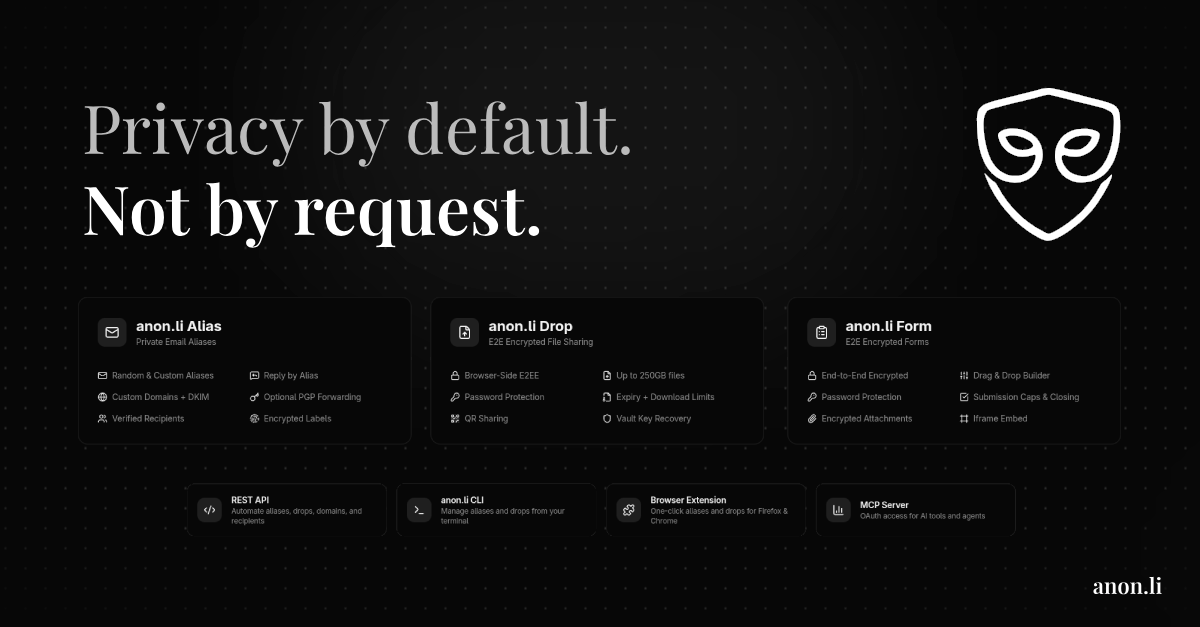
Open-source email aliasing, end-to-end encrypted file sharing, and encrypted forms. Privacy by default.
👋 Welcome! If you prefer a visual tour, check out our 2-minute intro video on YouTube.


Why anon.li?
We built anon.li because we were tired of handing our sensitive files and real email addresses to black-box companies.
- Email aliases that protect your real inbox - without switching email providers. Keep using Gmail, Proton, or Fastmail; we just sit in the middle and block the spam.
- AES-256-GCM encrypted file sharing - we can't read your files, by design. Your browser encrypts the file before it ever hits the network. The decryption key lives in the URL fragment, so it is never transmitted to our servers.
- Encrypted forms - collect sensitive responses without putting plaintext in the database. Form answers and attachments are encrypted in the submitter's browser for the form owner or team.
- Open-source web application (AGPL v3) - verify the implementation. Audit the browser cryptography, access controls, REST API, MCP server, and application data model in this repository.
Products
Alias - Anonymous Email Forwarding
Create unique aliases for every service. Reply from your aliases without ever exposing your real identity. Emails pass through our servers for forwarding instead of being stored in a hosted mailbox.
- 10 random + 1 custom alias on Free; unlimited random + 100 custom aliases on Pro
- Anonymous replies via SRS
- Optional PGP encryption per recipient
- Custom domain support on paid plans
- Encrypted labels and notes in your vault
- One-click disable to instantly stop spam
Drop - End-to-End Encrypted File Sharing
Share files securely. Everything is encrypted in your browser using AES-256-GCM.
- Zero-knowledge architecture
- Automatic expiration (1–30 days)
- Download limits and password protection
- File previews count as downloads because they expose full encrypted file bytes
- Up to 250GB per transfer (Pro)
- No account required for the recipient to download
Form - End-to-End Encrypted Data Collection
Build forms whose responses are encrypted in the respondent's browser. The application stores ciphertext and encrypted owner keys; authorized owners decrypt responses locally after unlocking their vault.
- Text, choice, rating, scale, and file-upload fields
- Per-owner and shared-team encryption keys
- Retention and submission limits enforced server-side
- Encrypted CSV/ZIP export in the browser
Important
This repository contains the Next.js web application and control plane. The production SMTP/Haraka delivery pipeline that receives and forwards alias email is a separate service and is not included here. You can run and develop Alias management locally, but end-to-end email forwarding requires your own compatible mail transport.
Quick Start
anon.li is an integration-backed application and deliberately fails fast when required infrastructure is missing. Local development requires Bun >= 1.4.3, Node.js 24, and credentials for the services below.
| Service | Purpose | Required |
|---|---|---|
| PostgreSQL | Application data and encrypted metadata | Yes |
| Private Cloudflare R2-compatible bucket | Drop/Form ciphertext | Yes |
| Upstash Redis REST | Rate limits, locks, and webhook idempotency | Yes |
| Resend | Authentication and transactional email | Yes |
| Cloudflare Turnstile | Bot protection | Yes |
| Stripe | Billing client and webhooks | Yes |
| NOWPayments | Cryptocurrency checkout | No |
| GitHub/Google OAuth | Optional login providers | No |
| PostHog | Product analytics and error reporting | No |
PostgreSQL, an S3-compatible stand-in for R2, and an Upstash-compatible Redis REST endpoint can run locally with docker compose up -d (or podman compose); see the local development guide for the matching .env values, Turnstile test keys, Stripe CLI webhooks, and current limitations.
git clone https://github.com/anondotli/anon.li.git
cd anon.li
bun install            # also generates the Prisma client
cp .env.example .env

# Fill every required value in .env, then apply the committed migrations
bun run db:migrate:deploy

# Start the development server
bun dev
Open http://localhost:3000. Blank optional provider variables are normalized as disabled; required variables are validated at startup. Use independent generated values for AUTH_SECRET, CRON_SECRET, IP_HASH_PEPPER, REPORT_ENCRYPTION_KEY, and DKIM_ENCRYPTION_KEY as documented in .env.example.
When you change prisma/schema.prisma, create a migration with bun run db:migrate --name concise_migration_name and commit it. Avoid bun run db:push except on a throwaway database: it skips objects that exist only in migration SQL (such as the partial unique index domains_domain_verified_key) and leaves no migration history, so db:migrate:deploy can no longer be applied to that database.
Before opening a pull request, run the same checks enforced by CI:
bun run audit
bun run check  # lint, type-check, dead-code check, tests, and production build
Production deployment
Production databases must be updated with the committed Prisma migrations. Do not use prisma db push in production; it bypasses the reviewed migration history.
bun install --frozen-lockfile
bun run build
bun run db:migrate:deploy
bun run start
Set every required variable documented in .env.example in the deployment platform, back up the database before applying migrations, and run bun run db:migrate:deploy once per release before starting the new application version. The build command regenerates the Prisma client automatically. Use HTTPS for every public service origin; plain HTTP is accepted only for loopback development endpoints.
Vercel deployments also require CRON_SECRET and Upstash Redis. The production schedules are intentionally limited to Hobby-compatible daily/weekly expressions; see the cron operations runbook for the schedule, rollout checks, and failure handling.
Client-IP rate limits trust one edge only. Vercel is detected automatically. On a self-hosted origin behind Cloudflare, set TRUSTED_PROXY_PROVIDER=cloudflare and restrict direct origin traffic to Cloudflare's network; otherwise forwarding headers are spoofable.
One-time Cloudflare R2 setup
anon.li Drop uploads and downloads blob data directly between the browser and R2 via S3 presigned URLs, avoiding server-side relay bottlenecks. Download URLs are short-lived; multipart upload URLs are bound to an upload ID, part number, and exact encrypted byte length and last up to seven days so very large transfers can complete.
- Create an R2 bucket and keep it private. Disable its public
r2.devURL and do not attach a public custom domain. Public object access would bypass Drop expiry, revocation, recipient, and download-limit checks. - Create R2 API credentials with object read/write access to that bucket, then set
R2_ACCESS_KEY_ID,R2_SECRET_ACCESS_KEY,R2_BUCKET_NAME, and the account S3 API endpoint (R2_ENDPOINT=https://<account_id>.r2.cloudflarestorage.com) in.env. - Configure the bucket's CORS rules to allow
GET,HEAD, andPUTfrom your application origin and expose theETagresponse header. Browser transfers still go directly to R2; R2 does not charge internet egress fees.
Cloudflare presigned URLs are supported on the S3 API domain, not on custom domains. Treat private-bucket access as a security requirement, not only a deployment preference.
Architecture and trust boundaries
Browser (plaintext + keys)
  ├─ HTTPS → Next.js app (auth, policy, metadata, presigned capabilities)
  └─ presigned HTTPS → private R2 bucket (ciphertext only)

Next.js app
  ├─ PostgreSQL (accounts, policy metadata, ciphertext metadata, wrapped keys)
  └─ Redis REST (rate limits, locks, webhook idempotency)

External providers: Resend, Stripe, Turnstile, optional NOWPayments/PostHog/OAuth
Separate deployment: inbound/outbound alias mail transport
- Drop and Form content is encrypted with Web Crypto in the browser. Share-link keys stay in URL fragments, which browsers do not send in HTTP requests.
- The application server is trusted for authentication, authorization, quotas, expiry, download counters, and encrypted-key distribution. It must never receive ordinary Drop/Form plaintext keys.
- R2 must remain private. Clients receive short-lived, operation-specific presigned URLs only after application policy checks.
- PostgreSQL stores account data, policy metadata, ciphertext metadata, and wrapped keys. Redis is availability- and abuse-sensitive, so security-critical limits fail closed when it is unavailable.
- Alias forwarding is not zero-knowledge: a compatible mail transport necessarily handles message content while forwarding it. See the security documentation for the production retention model.
Tech Stack
Next.js 16 (App Router) · React 19 · PostgreSQL + Prisma · Better Auth (magic links, email/password, TOTP 2FA) · Cloudflare R2 · Stripe · Upstash Redis · Resend · Tailwind CSS + shadcn/ui
Links
- Live site: anon.li
- Security architecture: anon.li/security
- API docs: anon.li/docs/api
- Service status: status.anon.li
- Contributing: CONTRIBUTING.md
- Source code: github.com/anondotli/anon.li
- Report vulnerabilities: security@anon.li
Legal & License
Jurisdiction: Liechtenstein · Privacy Policy · Terms · AUP · DMCA
GNU Affero General Public License v3.0 - Copyright © 2026 anon.li.