Listed from the MCP registry; nobody on Odel publishes it.

Kotlin & Java Library Sources
Kotlin/Java library sources, public API and KDoc from the real Maven sources jar, for AI agents
Runs on your machine from its package; the steps are below.
What it does
- Reads
- Writes
- High impact
At most: only reads or looks up information.
What it costs
FreeOdel charges nothing per call. The publisher may charge for its own service.
Runs locally over stdio
This server isn't hosted — your MCP client launches it from a package registry. Use one of the commands below, or drop the config into your client (e.g. Claude Desktop).
Run
docker run -i --rm ghcr.io/aoreshkov/kotlin-lib-mcp:0.10.1
MCP client config
{
  "mcpServers": {
    "kotlin-java-library-sources": {
      "command": "docker",
      "args": [
        "run",
        "-i",
        "--rm",
        "ghcr.io/aoreshkov/kotlin-lib-mcp:0.10.1"
      ]
    }
  }
}kotlin-lib-mcp





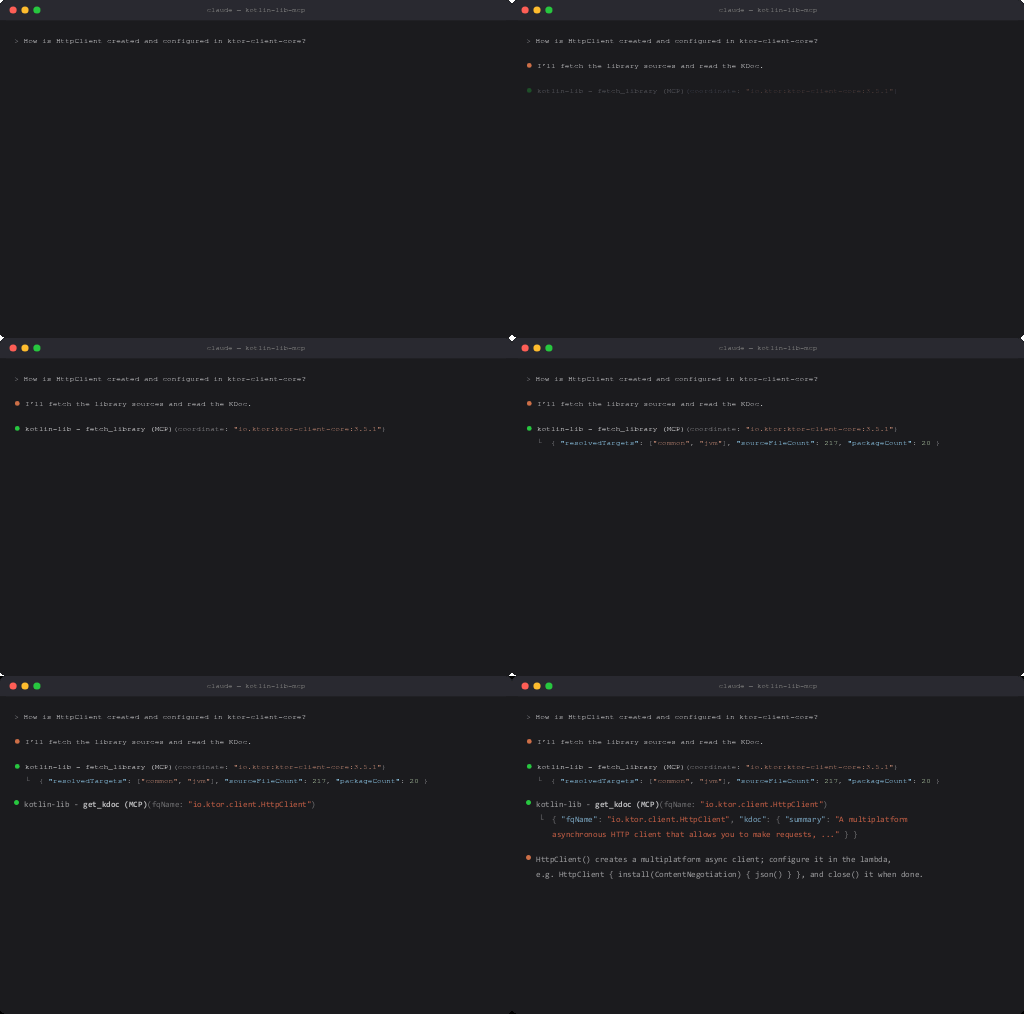
Give your AI agent the real sources of any Maven-published Kotlin/Java library.
An MCP server that, on request, downloads the sources of a
library (e.g. io.ktor:ktor-client-core:3.5.1), parses them with the Kotlin Analysis API
(standalone K2/FIR mode), and exposes structured information — public API surface, KDoc,
dependencies/metadata, raw source + search — to MCP clients: Claude Code, Claude Desktop,
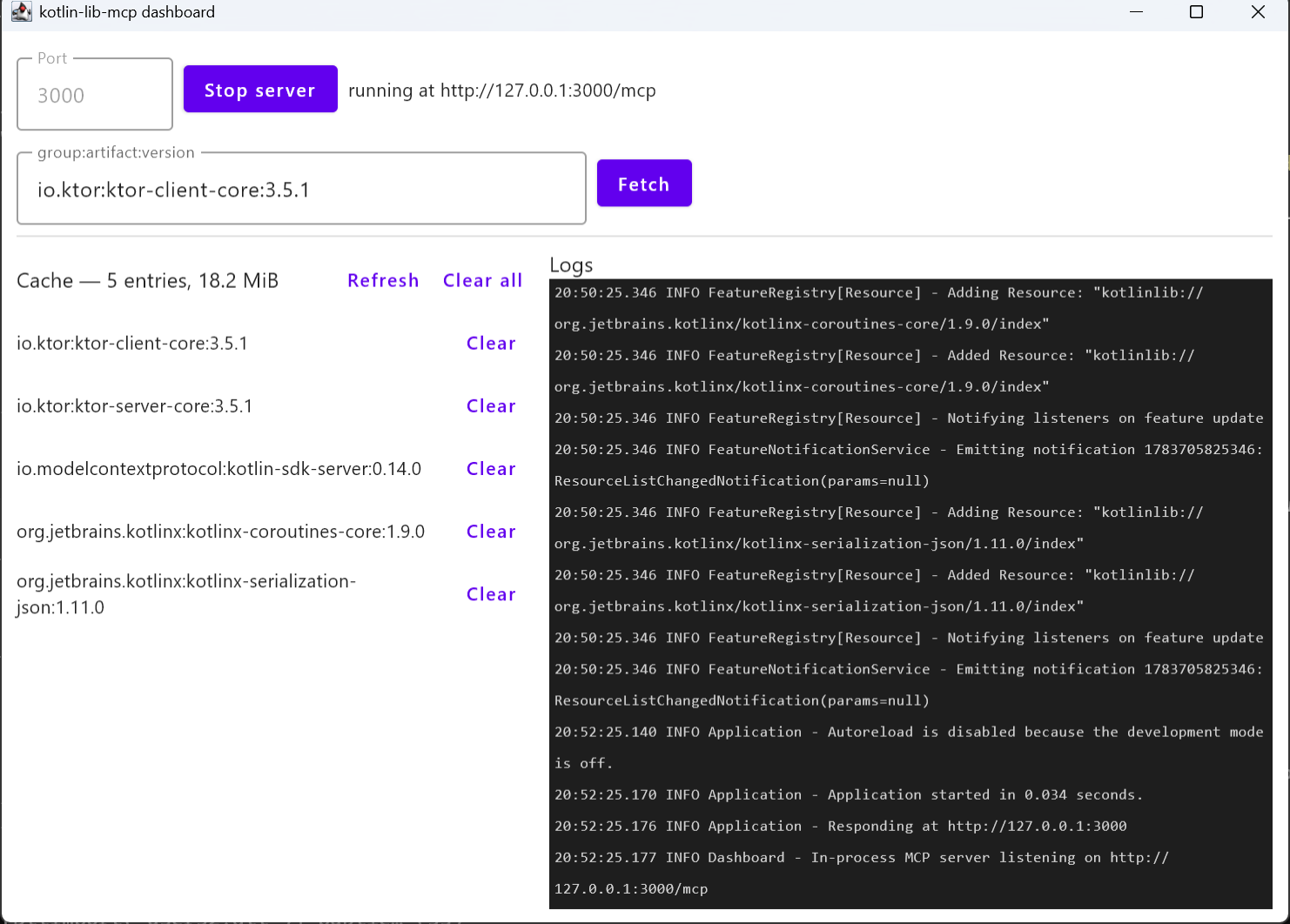
IntelliJ IDEA (AI Assistant / Junie), VS Code and GitHub Copilot. An optional Compose Desktop
dashboard runs the same server in-process.
Tools — fetch_library · list_packages · list_declarations ·
get_api_signature · get_kdoc · get_source · search_source · diff_versions · diff_api ·
get_dependencies · list_versions · get_latest_version — plus MCP resources and a prompt.


Those install the Docker image. For the Claude Code plugin (which runs on your JDK), IntelliJ IDEA, or to run the release zip without Docker, see Quick start.
Compose Desktop dashboard
Why this and not a docs-lookup server?
Most documentation MCP servers scrape rendered doc sites or feed the model pre-digested summaries. This one works from the published sources jar — the ground truth:
- Resolved signatures, not regex guesses. Declarations are analyzed with the same
Analysis API that powers the Kotlin IDE, so
get_api_signaturereturns real, type-resolved signatures (with graceful best-effort fallback when transitive dependencies are missing). - KMP-aware. Kotlin Multiplatform libraries publish per-target sources jars; these are
resolved properly via
.moduleGradle metadata, and every symbol is tagged with its targets. - KDoc as data. Summaries, descriptions and tags are extracted per declaration — not whole HTML pages.
- Exact version you asked for, offline after the first fetch. Everything is cached on
disk keyed by
group/artifact/version; no re-downloads, no drift between the docs and the version you actually depend on. - Raw source when you need it.
get_sourceand boundedsearch_sourcelet the agent read the actual implementation, not just the API.
Quick start (no build required)
Option 1 — Claude Code plugin. The server plus skills that make Claude reach for it, two
commands (/kotlin-lib:api, /kotlin-lib:migrate) and a setup helper. Needs a JDK 25+ — the one on
your PATH, or any other set by path in the plugin's java option; no Docker. It downloads the
release zip on first use:
/plugin marketplace add aoreshkov/kotlin-lib-mcp
/plugin install kotlin-lib@kotlin-lib-mcp
See plugin/README.md for what it bundles.
Option 2 — release zip. Download the latest release, unzip (needs a Java 25+ runtime), then:
claude mcp add kotlin-lib -- /path/to/kotlin-lib-mcp-server-<version>/bin/server --transport stdio
Option 3 — Docker.
claude mcp add kotlin-lib -- docker run -i --rm -v kotlin-lib-mcp-cache:/home/mcp/.cache ghcr.io/aoreshkov/kotlin-lib-mcp
Other clients. IntelliJ IDEA, Android Studio, Junie, Claude Desktop and MCP registry installs are
covered in guide/clients.md.
Tools
All tools take a Maven coordinate (group:artifact:version). Call fetch_library first —
it downloads, extracts and analyzes the sources once; every other tool answers from the cached
index. fetch_library, list_versions and get_latest_version also accept group:artifact, and
fetch_library accepts group:artifact:latest to resolve the latest stable release.
| Tool | Purpose |
|---|---|
fetch_library | Download + analyze + cache; returns a summary. Idempotent. Version may be omitted or latest |
list_packages | Packages with declaration counts and KMP targets; paged |
list_declarations | Declarations with signatures and deprecations; filter by package, visibility and deprecated; paged |
get_api_signature | Resolved signature of one declaration by FQ name, with its deprecation and ReplaceWith |
get_kdoc | KDoc (summary, description, tags) of one declaration |
get_source | Raw source of a file (path) or one declaration (fqName); paged by line |
search_source | Substring/regex search; bounded, returns file:line snippets |
diff_versions | Unified diff between two fetched versions; summary-first, paged, path-filtered |
diff_api | Public-API changes between two fetched versions — added, removed, changed, deprecated (with ReplaceWith); summary-first, paged, package- and change-filtered |
get_dependencies | Dependency tree from .pom/.module; bounded depth and maxNodes |
list_versions | Published versions from maven-metadata.xml, newest-first; paged |
get_latest_version | Latest stable release (and newest overall) from maven-metadata.xml |
Every tool declares a title, behavior annotations, a typed outputSchema and an icon, and returns
compact JSON text with matching structuredContent. Symbols whose types can't be resolved (missing
transitive dependencies) degrade to bestEffort: true PSI signatures instead of failing.
Going further
- Clients: IntelliJ IDEA, Android Studio, Junie,
.mcp.json, MCP registries - Configuration: Streamable HTTP, command-line flags, cache location
- Protocol features: tool metadata, elicitation, tasks, resources, prompt, icons
- Telemetry: OpenTelemetry traces with
--otel
Privacy
Nothing about you is collected, stored remotely, or shared. There is no analytics, no phone-home, no account, and no credential of any kind.
- What leaves your machine. Only requests to the Maven repositories you point it at (Maven
Central, plus any
--repo;--no-maven-centraldrops Central): themaven-metadata.xml,.pom/.modulemetadata and sources jar for the coordinates you ask about. Those repositories see the coordinate and your IP, under their own privacy policies. Pulling the Docker image likewise talks to GHCR, and the Claude Code plugin's launcher talks to this repository's GitHub releases (the releases API at most once a day, and a download when there is a new server). That is the complete list of outbound traffic. - What it reads. Downloaded library sources only. It does not read, index or transmit your project's code — it has no access to it.
- What it stores, and where. Downloaded artifacts and the parsed index, on your disk only,
under the OS cache directory (see Cache) or
--cache-dir. Under--tasks, task records live in atasks/subdirectory. Nothing is written anywhere else. - Retention. Cached libraries stay until you delete them — the directory is browsable and safe to remove at any time. Task records are dropped once their TTL elapses (10 minutes by default, 1 hour maximum).
- Logs. stderr on your machine.
--forward-logs-to-client(opt-in) mirrors them to your MCP client;--otel(opt-in) exports trace spans to the OTLP collector you configure, and carries no personal data — method names, tool names, session id, transport. Both are off by default. - Contact. Questions: open an issue. Security or privacy reports: private vulnerability reporting.
Contributing
Contributions welcome: CONTRIBUTING.md also covers building from source. Release history lives in CHANGELOG.md, help is described in SUPPORT.md, and security reports go through private vulnerability reporting.
Sponsor
If kotlin-lib-mcp saves you time, consider
sponsoring its maintenance. Sponsorship funds
keeping the Analysis API version-lock current with new Kotlin releases and the
supply-chain-hardened release pipeline. Every tier is appreciated.