Listed from the MCP registry; nobody on Odel publishes it.

EtherPK
Read, search and edit an EtherPK knowledge graph of Markdown notes, synced or in a folder.
Runs on your machine from its package; the steps are below.
What it does
- Reads
- Writes
- High impact
At most: creates or changes data: records, files, settings.
What it costs
FreeOdel charges nothing per call. The publisher may charge for its own service.
Runs locally over stdio
This server isn't hosted — your MCP client launches it from a package registry. Use one of the commands below, or drop the config into your client (e.g. Claude Desktop).
Run
npx -y @appsoftwareltd/etherpk-mcp
MCP client config
{
  "mcpServers": {
    "etherpk": {
      "command": "npx",
      "args": [
        "-y",
        "@appsoftwareltd/etherpk-mcp"
      ]
    }
  }
}EtherPK Client



The source of the EtherPK Client and Headless Client, available under the Elastic License 2.0.
Try the demo from etherpk.com. It runs in your browser and needs no account (data remains in your browser).
One Markdown Notes App For Everything
Fast, Private, Secure Knowledge Management
Write, think, link your ideas, manage tasks, hand work to AI agents, publish to the web. Your data stays yours.
EtherPK is a notes app and PKMS with a lot to offer.
- Long-form prose and outliner features in the same documents
- Robust wikilinking and aliasing
- Plain local markdown files, or Sync+ with export
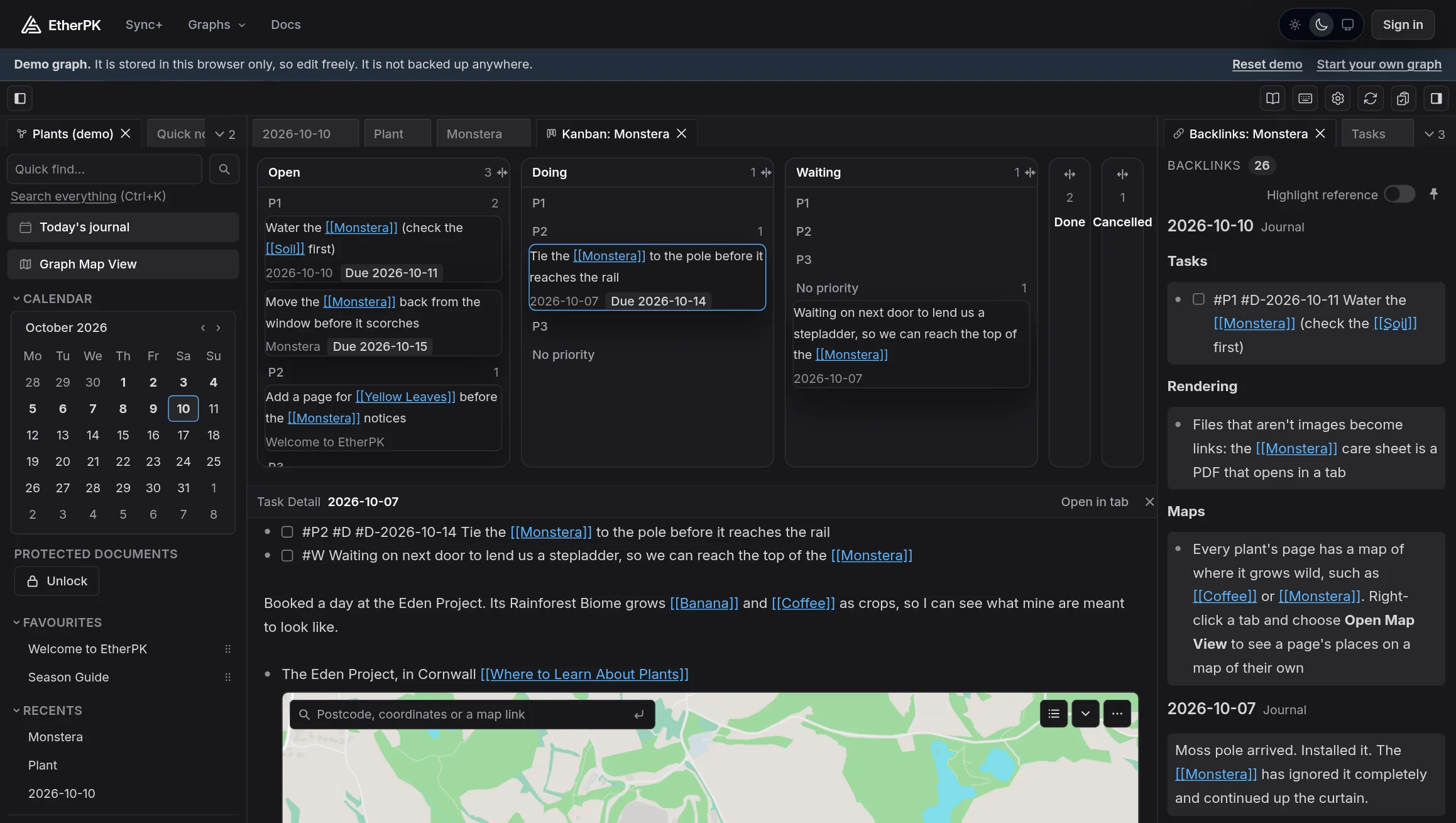
- Task management and Kanban boards
- PDF and EBook Reader
- Document Versioning
- Real-time collaboration
- Quick Notes, with sharing from other apps
- End-to-end encryption
- Static site publishing
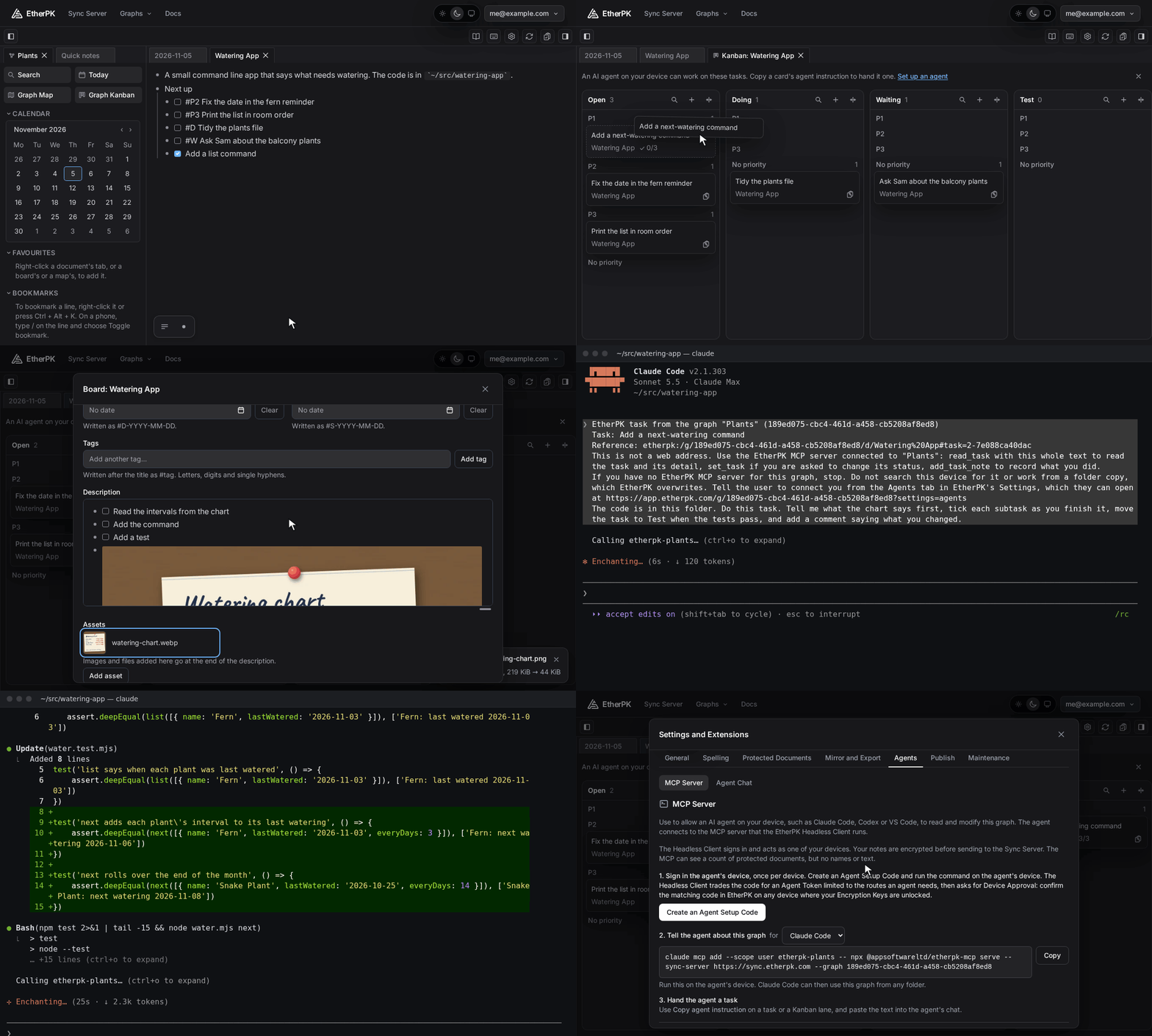
- AI agent integration
- Source-available Client
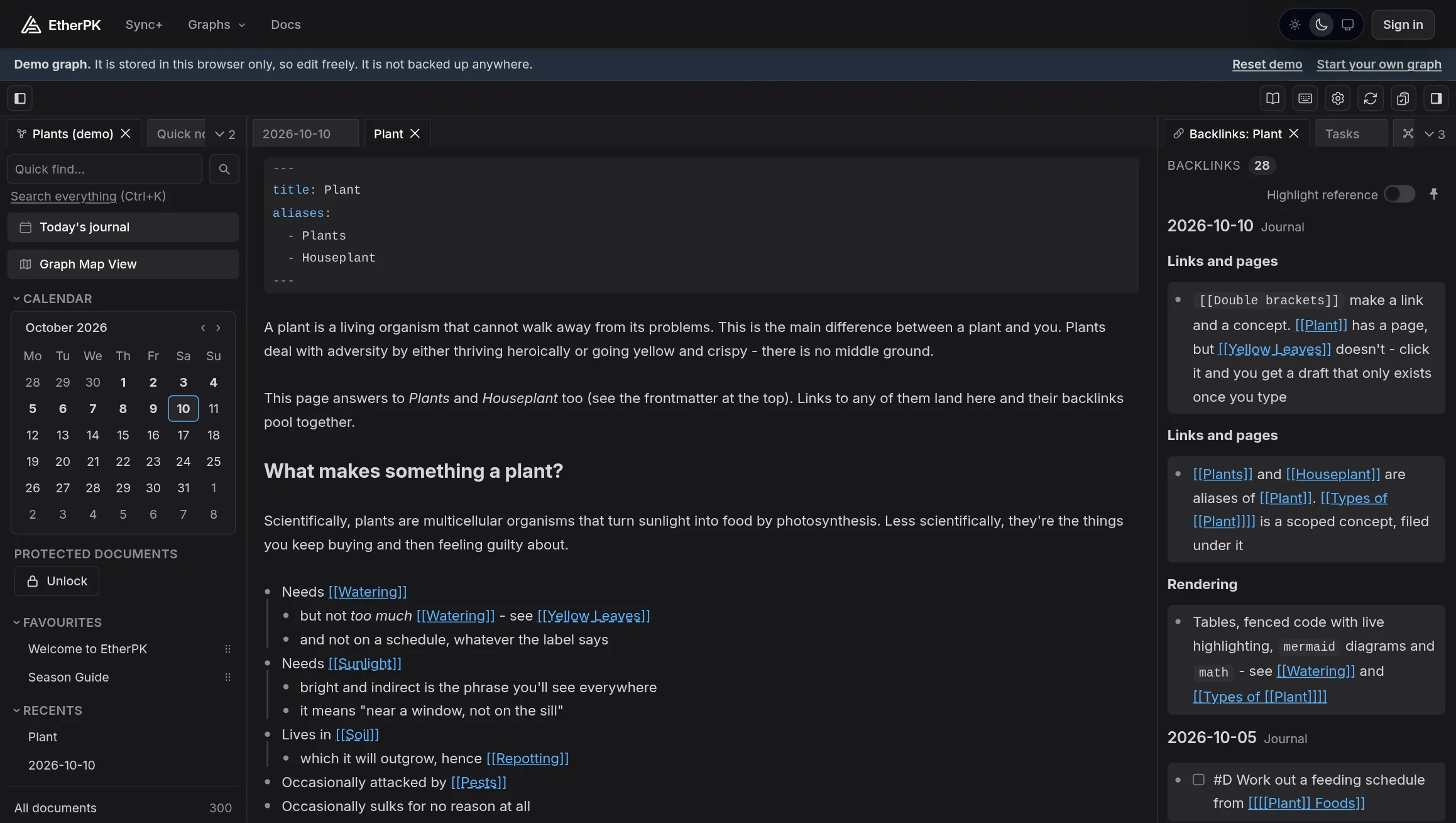
Document Editor (Prose and Outliner Blocks)
Task Kanban View
Handing a Task to a Coding Agent
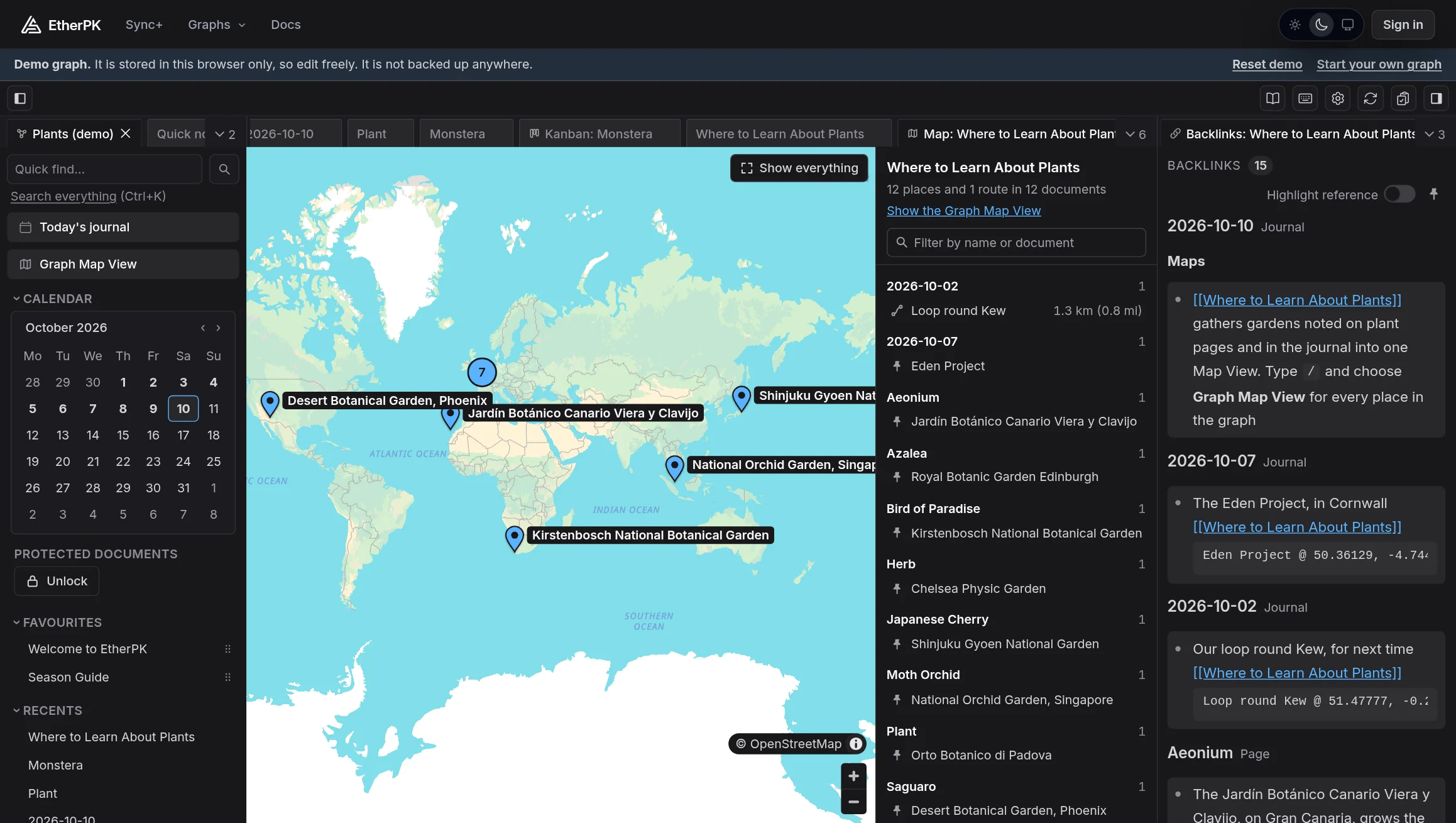
Aggregate Map View
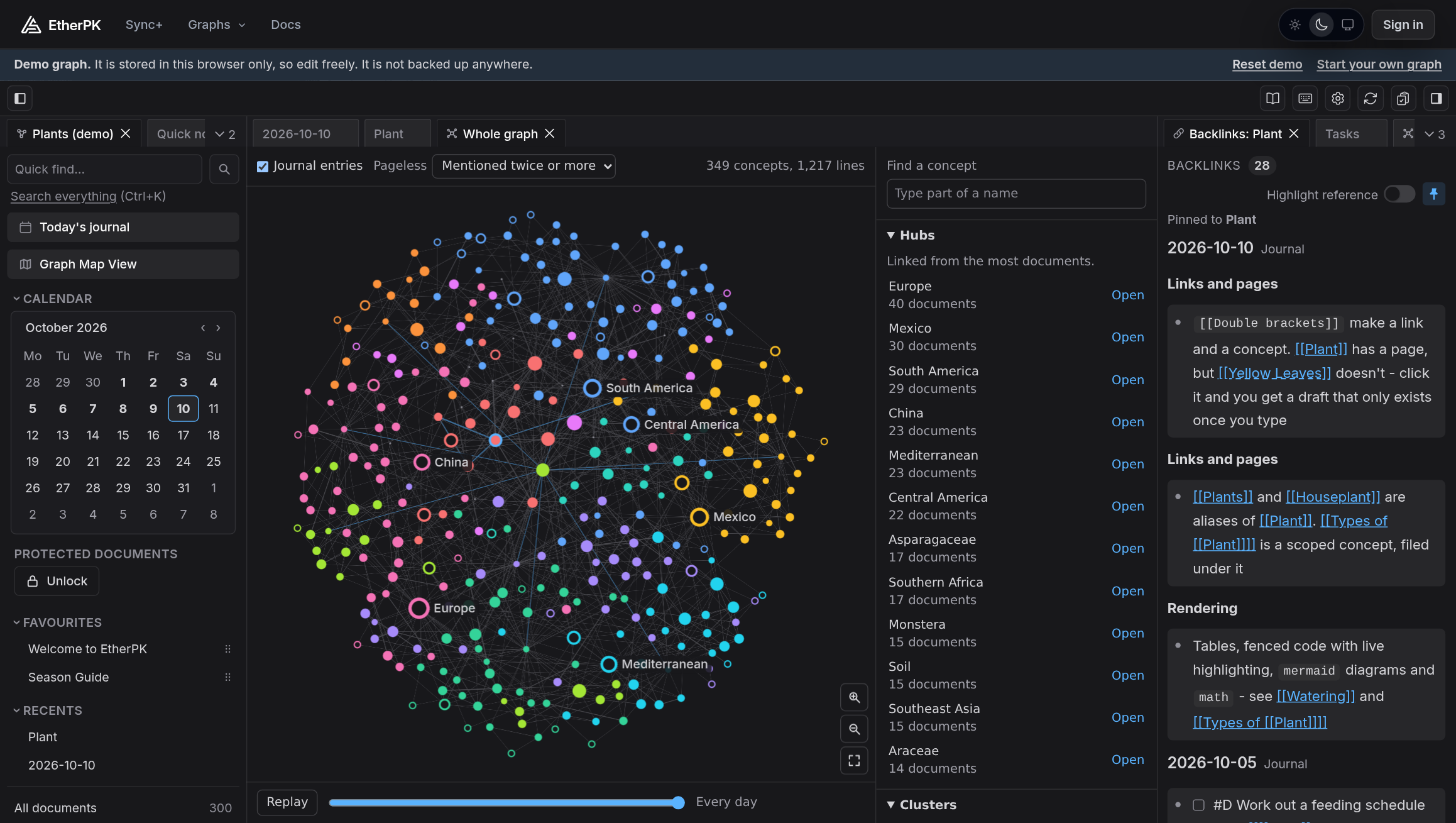
Graph View
EtherPK is a personal knowledge base in plain Markdown. Journal entries hold daily thinking, pages
hold what outlives a day, and [[wikilinks]] tie them into a knowledge graph. The Client is the
editor: a SvelteKit app that opens a graph from a folder on your device, or from a Sync Server
that stores graphs end-to-end encrypted and cannot read them. It also edits any folder of Markdown
files where it is, as a Plain Folder, without making it a graph. The Headless Client is the same
engine without an editor: an MCP server that gives an AI agent one of your graphs.
User documentation is at https://docs.etherpk.com.
A graph folder is written in the EtherPK Format: Markdown files a person and a coding agent
can both read and write. Its specification says how a
program reads and writes one, and format/ holds an example folder with the
result a reader gets from that folder.
Use it from Claude Code
The EtherPK plugin for Claude Code gives Claude one of your graphs, synced or a folder, and the
etherpk agent skill. In Claude Code:
/plugin install etherpk --marketplace appsoftwareltd/etherpk-client
Then set the plugin's options with /plugin: the name of a synced graph, or a graph folder. A
synced graph needs a one-time sign-in on the device first, from the graph's Settings → Agents
tab in EtherPK. See Claude Code Plugin.
Licence
The Elastic License 2.0 lets you use, copy, modify and self-host this software. It does not let you offer it to others as a hosted or managed service. It is a source-available licence, not an open source one.
The EtherPK Format's specification, its example folder, the EtherPK section of AGENTS.md and the
agent skill's starter folders are under the MIT License.
Contents
| Path | Contents |
|---|---|
apps/client | The Client |
apps/mcp | The Headless Client / MCP Server, published to npm as @appsoftwareltd/etherpk-mcp (README) |
packages/shared | Code the Client shares with the Sync Server: the sync protocol, UI components and auth pages |
packages/themes | The site themes the publisher bundles |
packages/extension-api | The Extension API every EtherPK extension is written against, MIT licensed, published to npm as @appsoftwareltd/etherpk-extension-api |
extensions | The extensions that come with the Client: Agent Chat, Excalidraw drawings, the Graph View, Kanban boards and maps |
format | An example graph folder in the EtherPK Format, and the result a program gets from reading it (README) |
skills/etherpk | The agent skill: how an AI agent makes, edits and publishes EtherPK graph folders (SKILL.md) |
.claude-plugin | The Claude Code plugin's marketplace file. The plugin is the skills/ folder, whose .claude-plugin/plugin.json starts the Headless Client for the graph a person chooses |
Run it
Docker image
docker run --rm -p 3000:3000 ghcr.io/appsoftwareltd/etherpk-client:latest
Every tag is listed on the image's package page.
Open http://localhost:3000. With no settings the Client works with graph folders on your
device and offers a Custom server form for connecting to a Sync Server by its address. The
settings it reads are listed, with their defaults, in
apps/client/.env.example - pass them with --env-file.
An example Docker Compose file is in Running EtherPK With Docker.
Node bundle
Each release attaches etherpk-client-<version>.tar.gz, which runs on Node.js 24 or later on
Windows, macOS and Linux, with nothing to install:
tar -xzf etherpk-client-<version>.tar.gz
cd etherpk-client
HOST=127.0.0.1 PORT=3000 node build
The full guide, including Windows commands, is Running EtherPK On Your Own Device.
Windows, Linux and Android apps
Each release attaches installers that need no browser and no server:
| Platform | File |
|---|---|
| Windows 10 and 11 (x64) | EtherPK-windows-x64.exe |
| Linux (x64), any distribution | EtherPK-linux-x64.AppImage |
| Debian and Ubuntu (x64) | EtherPK-linux-x64.deb |
The app for Android 11 and later, EtherPK-android.apk, is not on every release yet. The
releases page lists each release's files:
take the APK from the newest release that lists one.
The Windows and Linux files are not signed by a certificate authority, so Windows shows "Windows protected your PC" at the first start: select More info, then Run anyway. Check a download against the release before you run it, with either command:
sha256sum --check --ignore-missing SHA256SUMS
gh attestation verify EtherPK-windows-x64.exe --repo appsoftwareltd/etherpk-client
On Ubuntu 24.04 and later, install the .deb rather than the AppImage: the system lets the AppImage
start only with part of Chromium's sandbox off, and the app says so.
The apps check a feed signed by App Software for newer versions, and offer a version some time after
its release. The Graphs page's This Device tab says when there is one. In the Windows app and the
AppImage, select Update, then Restart and update once it has downloaded. The .deb and the
Android app open the release page for you to download it.
Headless Client / MCP Server
Published to npm as
@appsoftwareltd/etherpk-mcp.
npx @appsoftwareltd/etherpk-mcp --help
Setup for each kind of graph is in apps/mcp/README.md.
Agent skill
The etherpk skill teaches an AI agent (Claude Code, Codex, Cursor and the others the
skills CLI supports) to make a blog, docs site or wiki
folder in EtherPK's format inside any project, to write and edit its pages, to check it with a dry
run of the publish, and to publish it. For a synced graph it sends the agent to the Headless
Client's tools. Install it in the project the agent works in:
npx skills add appsoftwareltd/etherpk-client
Add -g to install it for every project. The skill is installed from this repository's main
branch, and npx skills add appsoftwareltd/etherpk-client#v<version> pins it to a release.
npx skills update brings it up to date.
Build from source
You need Node.js 24 or later and pnpm - corepack enable provides the pnpm version that
package.json names.
pnpm install --frozen-lockfile
pnpm dev          # the Client on http://localhost:5173
pnpm check        # type check
pnpm lint
pnpm test         # Vitest unit suites
pnpm build        # the Client and the Headless Client
docker build -f apps/client/Dockerfile -t etherpk-client .
Copy apps/client/.env.example to apps/client/.env to change the development settings.
To develop an extension against the Client, build it and start the development server with its
folder named in ETHERPK_DEV_EXTENSIONS (several are separated by commas). It is loaded like an
extension the Client ships, and one with the same id replaces it:
ETHERPK_DEV_EXTENSIONS=/path/to/my-extension pnpm dev
Versions and releases
- Every commit on
mainpublishes images taggededgeandsha-<commit>. The image of a commit that is not a release is deleted after 30 days, except the newest three, so pin a version tag. - A release is a
v<version>tag. It publishes images tagged<version>,<major>.<minor>andlatest, a GitHub Release with the Node bundle attached, and@appsoftwareltd/etherpk-mcpand@appsoftwareltd/etherpk-extension-apiat the same version on npm. - The Windows and Linux installers are attached to the same release when they pass their tests on GitHub's machines, and the Android APK too once releases are signed for Android. A release that is missing an installer it should have is not marked Latest until it has them all.
- The Client and the Headless Client share one version number with EtherPK's Sync Server, and only matching versions are tested together. A Client and a Sync Server on different sync protocol versions refuse to sync, and the Client says which side needs upgrading.
- CHANGELOG.md lists what changed in the Client and the Headless Client in each release.
How this repository is maintained
This repository is a one-way copy of App Software's private EtherPK repository, exported on every
change there. Each commit here is one export - its GitOrigin-RevId trailer names the private
commit it came from. Code comments cite design records (ADR 0072) and glossary terms
([[Knowledge Graph]]) that live in the private repository and are not published here.
Issues are welcome. Pull requests are not merged here - CONTRIBUTING.md explains why and what happens instead. Report security issues as SECURITY.md describes.