Listed from the MCP registry; nobody on Odel publishes it.
negaresh
Persian (Farsi) writing rules and checks: natural sentences, grammar, orthography.
Runs on your machine from its package; the steps are below.
What it does
- Reads
- Writes
- High impact
At most: only reads or looks up information.
What it costs
FreeOdel charges nothing per call. The publisher may charge for its own service.
Runs locally over stdio
This server isn't hosted — your MCP client launches it from a package registry. Use one of the commands below, or drop the config into your client (e.g. Claude Desktop).
Run
uvx negaresh
MCP client config
{
  "mcpServers": {
    "negaresh": {
      "command": "uvx",
      "args": [
        "negaresh"
      ]
    }
  }
}negaresh (نگارش)


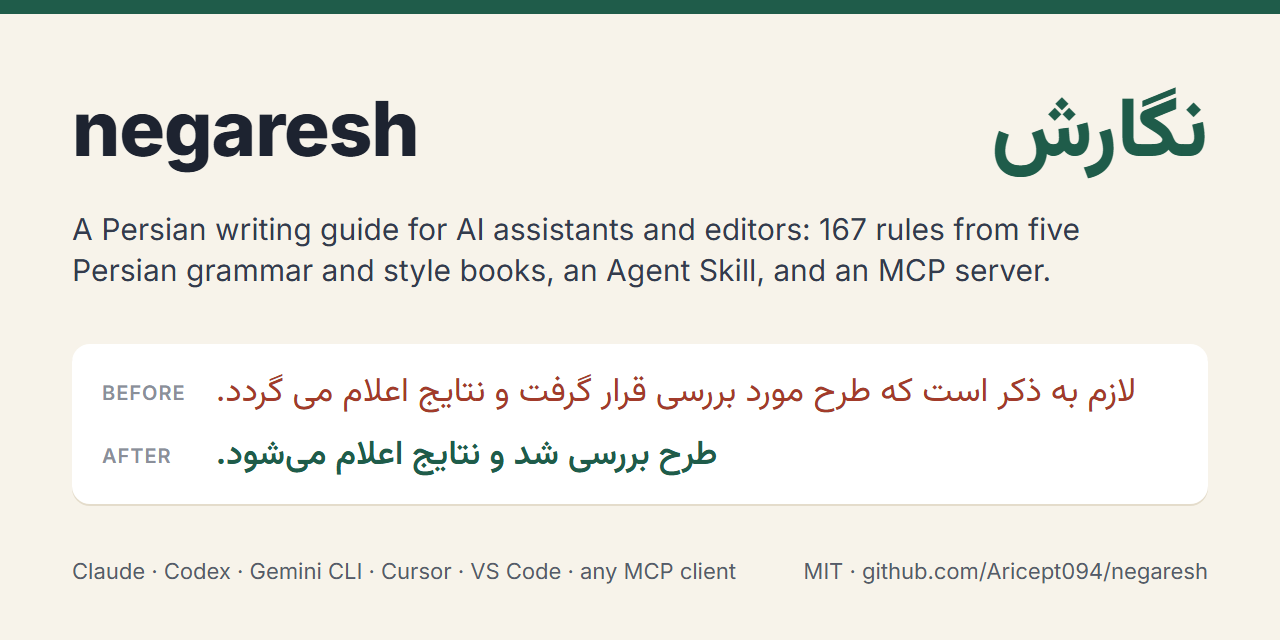
A Persian (Farsi) writing guide for AI assistants and editors. It has three parts that work together or alone:
- A rule set: 180 rules for Iranian standard Persian. They cover sentence structure and natural word order, verb tense and mood, paragraph flow, removing translated or machine-like Persian, grammar, usage, punctuation, numbers and citations, Academy orthography (نیمفاصله), and meaning preservation. Each rule has guidance and examples. The corpus marks 174 rules as sourced and 6 as editorial practice.
- A skill (standard Agent Skills
SKILL.mdfolder) for Claude, Codex and other agents: how to write, copyedit, proofread or naturalize (روانسازی) a Persian text with the rules. - An MCP server (stdio and Streamable HTTP) for Claude, ChatGPT, Codex, Gemini CLI, Cursor, VS Code and any MCP client: deterministic checks (Arabic letters and letters of other languages, digits and number separators, spacing, half-spaces, quotes, invisible direction marks, variant spellings, listed calques, and sentence shapes typical of machine Persian), rule search, and validation of edits before they are applied.
A Persian section is below.
At a glance
A typical machine-written sentence, the checker's findings, and the edit. Each change names the rule and the book it comes from.
Before
لازم به ذکر است که این طرح در جلسهٔ دیروز مورد بررسی قرار گرفت و نتایج آن به زودی اعلام می گردد. كارشناسان گزارش ها را خوانده اند.
After
این طرح در جلسهٔ دیروز بررسی شد و نتایج آن بهزودی اعلام میشود. کارشناسان گزارشها را خواندهاند.
| Change | Rule | Source | Found by |
|---|---|---|---|
| «لازم به ذکر است که» removed: the sentence is complete without it | STY-020 | Samiee, «نگارش و ویرایش», pp. 176–178 | checker (M16) |
| «مورد بررسی قرار گرفت» → «بررسی شد» | USG-021 | Samiee, pp. 154–161 | checker (M15) |
| «می گردد» → «میشود» | STY-004, ORT-002 | Samiee, pp. 175–177; Academy «دستور خطّ فارسی», pp. 39–40 | checker (M16, M08) |
| «كارشناسان» (Arabic «ك») → «کارشناسان» | PUN-011 | Unicode and W3C Persian layout notes (editorial rule) | checker (M01, automatic fix) |
| «گزارش ها» → «گزارشها» | ORT-003 | Academy, pp. 40–41 | checker (M08) |
| «خوانده اند» → «خواندهاند», «به زودی» → «بهزودی» | ORT-016, ORT-007 | Academy, pp. 38 and 42–43 | the model, with the rules |
The checker found six of the eight changes on its own and fixes only the safe one (the Arabic letter) by itself; the rest are flags for the model or the editor to decide. The edited sentence gets no findings. A longer, paragraph-level example is in Example: before and after.
به فارسی
«نگارش» راهنمای نوشتن فارسی معیار برای دستیارهای هوش مصنوعی و ویراستاران است. ۱۸۰ قاعده دارد دربارهٔ ساخت جمله و ترتیب طبیعی اجزا، زمان و وجه فعل، پیوند بندها، زدودن نثر ترجمهای و ماشینی، دستور، کاربرد، نشانهگذاری و دستور خط فرهنگستان. در این مجموعه، ۱۷۴ قاعده منبعدارند و شش قاعده جمعبندی ویراستاریاند.
منابع: «دستور خطّ فارسی» فرهنگستان (ویراست ۱۴۰۱)، «دستور زبان فارسی ۱ و ۲» انوری و احمدی گیوی، «دستور زبان فارسی امروز» ارژنگ و «نگارش و ویرایش» سمیعی. متن کتابها در این بسته نیست و مهارت و سرور نمیتوانند آنها را بخوانند؛ فقط قاعدهها را به کار میبرند.
سه بخش دارد:
- مهارت (skill) برای Claude و دستیارهای دیگر: نوشتن، ویرایش، غلطگیری و روانسازی متن فارسی با همین قاعدهها.
- بررسیکنندهٔ خودکار که روی رایانهٔ خودتان اجرا میشود و برای کار به اینترنت نیاز ندارد. در Claude Code مهارت فقط هنگام نیاز آن را اجرا میکند و چیزی در پسزمینه نمیماند؛ در ابزارهای دیگر به صورت سرور MCP وصل میشود. حرف عربی، نیمفاصله، فاصلهگذاری، رقم، گیومه و چند ساخت رایج نثر ماشینی را پیدا میکند و پیش از اعمال اصلاحها، آنها را میسنجد.
- خود قاعدهها به صورت JSON و کتاب قاعدهها به فارسی (docs/RULEBOOK.md).
نصب در Claude Code:
/plugin marketplace add Aricept094/negaresh
/plugin install negaresh@negaresh
در Claude.ai فایل negaresh-skill.zip را از آخرین نسخه بگیرید و در Settings → Capabilities → Skills بارگذاری کنید. نصب در ابزارهای دیگر در بخش Install آمده است.
پس از نصب کافی است بنویسید «این متن را ویرایش کن»، «روانش کن» یا «غلطگیری کن».
Sources
The rules were built from five books: the Academy's «دستور خطّ فارسی» (1401), Anvari and Ahmadi-Givi's «دستور زبان فارسی» 1 and 2, Arzhang's «دستور زبان فارسی امروز», and Samiee's «نگارش و ویرایش». The author bought the books, scanned them with OCR, extracted the rules, and rewrote and tuned them to the author's needs. The books are not included, and the skill and server cannot read or search them; the skill applies the rules, not the books.
Some rules also cite journal articles and editing columns: corpus studies of written and spoken Persian and of translated Persian, and published before-and-after edits. Their findings are summarized in the author's own words. A human editor checked each cited finding against the article. Full titles of the books and articles are in NOTICE.md.
What it does
| Task | Ask for | What happens |
|---|---|---|
| Write | «این را به فارسی بنویس» / "write this in Persian" | The model writes with a real subject and a finite verb for each action, no stock frames, natural order and tense. |
| Copyedit | «ویرایش کن» | Grammar, usage and spelling are fixed. Sentences with machine or translated shapes get a proposed rebuild. |
| Naturalize | «روانش کن»، «طبیعیترش کن»، «ترجمهای است» | Sentences and paragraphs are rebuilt from their meaning. Facts, hedges, actors, numbers and names are kept. |
| Proofread | «غلطگیری کن» | Characters, spacing, half-spaces, spelling and punctuation only. |
| Ask | «این درست است؟» | The rule is found and cited. |
Example: before and after
A paragraph from an academic introduction, naturalized with the skill (profile: academic). The mechanical check found nothing in either version; the changes are sentence rebuilds that the rules ask for. Citations, hedges and technical terms are unchanged.
Before
اختلال مصرف تنباکو و نیکوتین همچنان یکی از مهمترین اختلالات مزمن و عودکننده در طب اعتیاد به شمار میرود. در بسیاری از بیماران، حتی با وجود انگیزه جدی برای ترک، تداوم مصرف تنها ناشی از وابستگی فیزیولوژیک نیست، بلکه پیامد تعامل پیچیده میان ولع مصرف (craving)، یادگیری شرطی، نشانههای محیطی و نقص در کنترل اجرایی است (1, 2).
در این میان، ولع القاشده با نشانه (cue-induced craving) از اهمیت ویژهای برخوردار است، زیرا بسیاری از موارد عود بالینی در پاسخ به محرکهای دیداری، بویایی، اجتماعی و موقعیتی مرتبط با سیگار رخ میدهند، حتی زمانی که علائم حاد ترک چندان برجسته نیستند (3, 4). از این رو، درک و تعدیل واکنشپذیری به نشانه (cue reactivity) نهتنها از منظر نظری، بلکه از دیدگاه درمانی نیز اهمیت بسزایی دارد.
مطالعات مرتبط با واکنشپذیری به نشانه در سالهای اخیر نشان دادهاند که مواجهه با محرکهای مرتبط با سیگار میتواند بهطور همزمان، هم در سطح ذهنی موجب افزایش میل آنی به مصرف شود و هم در سطح عصبی، شبکههای مرتبط با برجستگی محرک، ارزشگذاری پاداش، ادراک درونی و کنترل شناختی را درگیر کند (5, 6).
After
اختلال مصرف تنباکو و نیکوتین همچنان یکی از مهمترین اختلالات مزمن و عودکننده در طب اعتیاد به شمار میرود. بسیاری از بیماران حتی با انگیزهٔ جدی برای ترک به مصرف ادامه میدهند، و علت آن تنها وابستگی فیزیولوژیک نیست، بلکه تعامل پیچیدهٔ ولع مصرف (craving)، یادگیری شرطی، نشانههای محیطی و نقص در کنترل اجرایی است (1, 2).
ولع القاشده با نشانه (cue-induced craving) اهمیت ویژهای دارد، زیرا بسیاری از عودهای بالینی در پاسخ به محرکهای دیداری، بویایی، اجتماعی و موقعیتی مرتبط با سیگار رخ میدهند، حتی وقتی علائم حاد ترک چندان برجسته نیستند (3, 4). از این رو درک و تعدیل واکنشپذیری به نشانه (cue reactivity) هم از نظر نظری و هم برای درمان اهمیت بسزایی دارد.
مطالعات سالهای اخیر دربارهٔ واکنشپذیری به نشانه نشان دادهاند که مواجهه با محرکهای مرتبط با سیگار میتواند همزمان در سطح ذهنی میل آنی به مصرف را افزایش دهد و در سطح عصبی شبکههای دخیل در برجستگی محرک، ارزشگذاری پاداش، ادراک درونی و کنترل شناختی را درگیر کند (5, 6).
What changed, and why
| Before | After | Rule |
|---|---|---|
| «در بسیاری از بیماران ... تداوم مصرف ... ناشی از ... نیست، بلکه پیامد ... است» | «بسیاری از بیماران ... به مصرف ادامه میدهند، و علت آن ... نیست، بلکه ... است» | STY-019, STY-003: the patients become the subject and get a verb; the abstract noun «تداوم مصرف» goes. The contrast «تنها ... نیست، بلکه» stays. |
| «از اهمیت ویژهای برخوردار است» | «اهمیت ویژهای دارد» | STY-019: a padded verb replaced by the plain one. |
| «در این میان،» at the start of a paragraph | (removed) | GRM-029: an opening connector with no real turn. «زیرا» and «از این رو» mark real cause and result and stay. |
| «موجب افزایش ... شود» | «... را افزایش دهد» | STY-004: a long verb phrase replaced by the verb. |
| «بهطور همزمان» | «همزمان» | STY-004: «به طورِ + adjective» shortened. |
| «مطالعات مرتبط با ...»، «شبکههای مرتبط با ...» | «مطالعات ... دربارهٔ ...»، «شبکههای دخیل در ...» | STY-009: «مرتبط با» appeared four times. The technical term «محرکهای مرتبط با سیگار» keeps its wording. |
| «مطالعات ... در سالهای اخیر نشان دادهاند» | «مطالعات سالهای اخیر ... نشان دادهاند» | GRM-039: the time phrase sits next to the noun it limits, not between subject and verb. |
| «نهتنها از منظر نظری، بلکه از دیدگاه درمانی نیز» | «هم از نظر نظری و هم برای درمان» | USG-023: a simpler pair. The original is also correct if the "not only… but also" stress is wanted. |
| «بسیاری از موارد عود»، «حتی زمانی که» | «بسیاری از عودها»، «حتی وقتی» | STY-001: words that add nothing. |
| «انگیزه جدی»، «پیچیده میان»، «از این رو،» | «انگیزهٔ جدی»، «پیچیدهٔ»، «از این رو» | ORT-019: the ezafe mark after a silent «ه»; no comma after a short connector. |
Requirements
- For the MCP server: Python 3.11 or later and uv (
uvxmust be on the PATH). The server needs no network access while it runs. - The skill and the rule set need nothing.
Install
The server is on PyPI and in the official MCP Registry as io.github.Aricept094/negaresh. The command is the same everywhere:
uvx negaresh serve
Claude Code (plugin)
The plugin installs the skill. It starts no server: when a check is needed, the skill runs uvx --from "negaresh>=0.4.2" negaresh check or … validate, which exits as soon as it is done. The version floor makes uv fetch the new commands even if an older negaresh is cached. In Claude Code:
/plugin marketplace add Aricept094/negaresh
/plugin install negaresh@negaresh
Or from a terminal:
claude plugin marketplace add Aricept094/negaresh
claude plugin install negaresh@negaresh
If you want the MCP tools in every session instead, add the server yourself (it then runs for as long as each session is open):
claude mcp add negaresh -- uvx negaresh serve
Claude Desktop
Add the server to claude_desktop_config.json (Settings → Developer → Edit Config) and restart the app:
{
  "mcpServers": {
    "negaresh": {
      "command": "uvx",
      "args": ["negaresh", "serve"]
    }
  }
}
For the skill, upload negaresh-skill.zip from the latest release under Settings → Capabilities → Skills.
Claude.ai
Upload negaresh-skill.zip from the latest release under Settings → Capabilities → Skills. The skill works without the server.
ChatGPT
Two ways, both in clients/chatgpt: an MCP connector in developer mode (run the server with --http behind an HTTPS tunnel), or a custom GPT with the rule files as knowledge.
Codex CLI
codex mcp add negaresh -- uvx negaresh serve
For the skill, copy skills/negaresh to ~/.codex/skills/negaresh.
Gemini CLI
gemini extensions install https://github.com/Aricept094/negaresh
Cursor
Install in Cursor, or add the JSON block above to ~/.cursor/mcp.json.
VS Code
Install in VS Code, or:
code --add-mcp "{\"name\":\"negaresh\",\"command\":\"uvx\",\"args\":[\"negaresh\",\"serve\"]}"
Any other MCP client
- stdio:
uvx negaresh serve - Streamable HTTP:
uvx negaresh serve --http --port 8000, then connect tohttp://127.0.0.1:8000/mcp. Use--allowed-host <name>for a proxy or tunnel host. - With pip:
pip install negaresh, thennegaresh serve. - Development version from GitHub:
uvx --from git+https://github.com/Aricept094/negaresh negaresh serve.
Skill only (any client that reads Agent Skills)
The skill is a standard SKILL.md folder: skills/negaresh. Copy it into the client's skills folder (~/.claude/skills/, ~/.codex/skills/, or the client's own location).
Rule set only
corpus/rules/*.json: the rules as JSON (one array per category).docs/RULEBOOK.md: the full rule book in Persian.corpus/lexicon/: variant spellings, listed expressions and sentence-shape patterns.
MCP tools
| Tool | Use |
|---|---|
search_rules | Find rules by Persian or English words. |
get_rule | One rule in full. |
get_profile | Conventions for a kind of text (academic, journalistic, literary, ...). |
check_mechanics | Checks M01 to M16. It returns findings with exact offsets, candidate patches, and a low-risk auto_patch_set. |
validate_patches | Checks that a set of edits applies cleanly and leaves URLs, code and other protected text unchanged. |
search, fetch | Over HTTP only: the search-and-read pair that ChatGPT connectors use. |
All tools are read-only. The server stores no text on disk. Each call takes up to 12,000 Unicode code points.
Command line
negaresh doctor
negaresh check draft.txt --profile academic
negaresh validate draft.txt patches.json --out revised.txt
negaresh search "نیمفاصله می"
negaresh rule ORT-002
negaresh profile academic
Each command prints the same JSON as the matching MCP tool, runs once and exits. validate takes the exact text you checked and a JSON file with a list of patches (or {"patches": [...], "protected_spans": [...]}), and writes the revised text only when every patch is valid.
Rule families
| Prefix | Family | Rules | Main sources |
|---|---|---|---|
| ORT | Orthography and spacing | 44 | Academy «دستور خطّ فارسی» (1401) |
| GRM | Grammar, word order, tense and mood | 44 | Anvari and Ahmadi-Givi 1 and 2; Arzhang; Samiee; corpus studies |
| USG | Usage and calques | 26 | the three grammars; Samiee |
| STY | Style and sentence building | 21 | Samiee; editorial synthesis; translation studies |
| PUN | Punctuation and characters | 18 | Samiee |
| TRM | Numbers, dates, citations, notes, names | 10 | Samiee |
| INT | Meaning preservation | 8 | Samiee; editorial synthesis |
| DSC | Paragraphs and discourse | 9 | Samiee; Anvari and Ahmadi-Givi 2 |
Each rule has a severity (error, convention, advisory) and an evidence class. sourced rules name the book and page they come from, and some also name a journal article; editorial_synthesis rules reflect editorial judgment, sometimes with citations for context. The evidence class tells you how to cite a rule; the severity tells you how firmly to apply it.
Edit the rules
- Edit the JSON in
corpus/rules/. - Run
python tools/build.py. It validates the corpus and regenerates the bundle, the skill references and the rule book. - Run
pytest.
Do not edit generated files: src/negaresh/data/corpus.json, skills/negaresh/references/rules-*.md, docs/RULEBOOK.md.
To make the release files (wheel, skill zip, clean folder): python tools/package.py.
Limits
- The mechanical checker sees characters, listed expressions and a few sentence shapes. No finding does not mean that the prose is natural. Sentence and paragraph rebuilding is done by the model with the rules.
- The «می» half-space check uses a closed list of verb stems.
Licence
MIT. See LICENSE.