Listed from the MCP registry; nobody on Odel publishes it.
Is this yours? Claim it
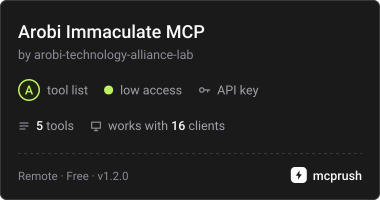
Arobi Immaculate MCP
Pre-action AI governance verdicts, grant revocation, model routing and evidence verification.
One address for any MCP client. No sign-in needed on this server.

What it does
1 read2 act1 other
Grouped by tool name. At most: creates or changes data: records, files, settings.
What it costs
FreeOdel charges nothing per call. The publisher may charge for its own service.
Tools
4 · grouped by tool name · checked 20 Nov 2026Read · 1Look things up
- arobi_verify_chain
Act · 2Change something
- arobi_authorize
- arobi_route_grant
Other · 1Neither hinted nor named
- arobi_classify_and_route
Arobi Immaculate MCP — Pre-Action AI Governance & Evidence Server


Official MCP Registry ID: io.github.Arobi-Technology-Alliance-Lab/immaculate · Glama Remote Connector: glama.ai/mcp/connectors/io.github.Arobi-Technology-Alliance-Lab/immaculate
Arobi Immaculate MCP is a self-contained, zero-dependency Model Context Protocol (MCP) server (stdio / Docker) built by Arobi Technology Alliance, Inc..
It executes 100% locally and offline using Node.js built-in node:crypto (Ed25519 signatures + canonical SHA-256 hash chains) so MCP clients can issue bounded route grants, revoke them before they expire, evaluate pre-action authority checks (GRANTED, DENIED, or ESCALATED), select policy-justified models, and check that a chain of sealed records is intact and who signed it, without an API key or external network calls.
- Local Implementation:
src/engine.mjs+src/index.mjs(Node.js ≥ 18, zero external runtime dependencies, includesDockerfileandnpm test) - Hosted Cloud Option (
Streamable HTTP):https://aura-genesis.org/api/v1/mcp(Documentation & 110 Free Credits) - Published Benchmarks (SHA-256 verifiable): https://aura-genesis.org/benchmarks/immaculate/
- Live Service Status: https://aura-genesis.org/status/
Included Tools (Local Execution)
| Tool | Purpose |
|---|---|
arobi_route_grant | Seals WHO granted WHAT authority to WHICH workflow (scope.actions, scope.category_caps, attenuation, expires_at) with an Ed25519 signature and hash-chained ROUTE_GRANT record. |
arobi_revoke_grant | Ends a grant this server sealed before it expires: seals a hash-chained ROUTE_REVOKE record, after which arobi_authorize DENIES the grant (GRANT_REVOKED). A grant that is unsigned, signed by another key, sealed with revocable: false, expired or already revoked is REFUSED with a reason code, and nothing is sealed. |
arobi_authorize | Verifies that the grant was sealed by this server and not revoked (an unsigned grant, one signed with any other key, or a revoked one is DENIED), then its expiry, action allowlist, category caps, and consequence-tier auth freshness before execution — returning GRANTED, DENIED, or ESCALATED with a hash-chained AUTHORIZATION record. |
arobi_classify_and_route | Classifies prompt complexity, filters capable candidates, picks the lowest-cost capable model or applies an explicit quality_exception uplift rule, detects repeated work, and optionally seals a ROUTING_DECISION record. With escalation set, it pays for a dearer capable candidate only when the predicted chance it beats the cheapest capable one on this request reaches your cost threshold (learned escalation, below). |
arobi_record_route_outcome | Teaches learned escalation: records how a routed request turned out (quality 0 to 1, or ok) and, optionally, how it compared with another candidate on the same request. Seals a hash-chained ROUTE_OUTCOME record and returns the run's routing stats (escalated share, mean quality per candidate). |
arobi_verify_chain | Re-derives canonical SHA-256 prev_hash / record_hash continuity and Ed25519 signatures across an ordered array of records, requires one signer for the whole chain (and, with expected_signer_kid, the signer you trust), and pinpoints the first broken index and the reason. |
Learned escalation (after RouteLLM)
arobi_classify_and_route always starts from the cheapest capable candidate. With escalation, it may pay for a
dearer one, following RouteLLM (Ong et al., RouteLLM: Learning to Route LLMs with Preference Data, ICLR 2025,
arXiv:2406.18665):
- Win prediction. It estimates P(the dearer candidate's answer beats the cheapest capable one's on this request).
The estimate comes from the evidence recorded with
arobi_record_route_outcome, plus anypreference_historyyou pass in, weighted by how similar each past request was. The weights follow the paper's similarity-weighted ranking,10 * 10^(sim / max_sim).- Pairwise results (win, loss, tie) give a Bradley-Terry-style win share.
- Single outcomes give
0.5 + (s_dearer - s_cheapest) / 2, which is the win chance plus half the tie chance when the two outcomes are independent. - With no evidence about the pair, a stated prior by complexity answers instead (0.25, 0.5 or 0.75), and the result says it did.
- Cost threshold. It escalates only when that probability is at least
cost_threshold. A higher threshold escalates less and saves more. Alternatively, givetarget_strong_rate(the share of requests you want escalated); after 20 decisions the threshold is calibrated to the1 - ratequantile of the run's past win probabilities, as RouteLLM'scalibrate_thresholddoes. - Bounds.
- It never picks a candidate missing a
required_capabilitiesentry. - It never exceeds
escalation.max_premium_usd. - It only adds escalation: it never undoes an explicit
quality_exception. - Every decision records the probability, its source, the threshold and its source in the sealed
ROUTING_DECISION.
- It never picks a candidate missing a
- No prompt text kept. A request becomes eight content-free numbers: length, code, math, deep-reasoning and task markers, structured output, several questions, and non-ASCII text. Only those numbers and the outcomes are remembered. The prompt itself is only hashed, as before.
- Scope. The evidence lasts for the run, like the signing key. To carry it across runs, keep the
featureseach answer returns together with your outcomes, and pass them back aspreference_history. Quality judgments are yours: the engine learns from what you record and makes no model calls of its own. Withoutescalation, routing and the sealed records are exactly as in 1.2.0.
The local engine and the hosted service
- Two implementations. The local engine is a separate, smaller implementation for offline development, testing and evaluation, and its rules are the ones above (see
src/engine.mjs). The hosted service applies its own policy and records each decision to your workspace's ledger, so for the same input its verdict can differ from the local engine's. - Keys. The local engine makes a new Ed25519 signing key each time it starts. Its grants are honoured only by the run that sealed them, and every record names its signer in
signer_kid. A chain shows who signed it only when it is checked against a signer you trust (expected_signer_kid); without that, it shows that the chain is intact as signed. - Not an independent check. Whoever runs the local server holds its key and controls what it is told. For decisions that must be checked by someone other than the agent's operator, use the hosted service.
- Tools. Both have
arobi_route_grant,arobi_revoke_grant,arobi_authorize,arobi_classify_and_routeandarobi_verify_chain. The hosted service addedarobi_revoke_grantin its version 1.1.0 (2026-11-21) and the local engine in 1.2.0. Learned escalation andarobi_record_route_outcomeare in the local engine from 1.3.0 and not in the hosted service yet. A local revocation, like the local key, lasts for the run that made it: a local grant ends when it is revoked, when it expires, or when the run that sealed it stops. Neither one lists or searches sealed records yet: records come back with each decision, and the hosted service keeps them in your workspace's ledger.
Run Locally (Node.js ≥ 18)
git clone https://github.com/Arobi-Technology-Alliance-Lab/immaculate-mcp.git
cd immaculate-mcp
npm test
npm start
Stdio MCP Client Config (Claude Desktop, Cursor, Claude Code, Windsurf)
{
  "mcpServers": {
    "arobi-immaculate": {
      "command": "node",
      "args": ["/absolute/path/to/immaculate-mcp/src/index.mjs"]
    }
  }
}
Run via Docker
docker build -t arobi-immaculate-mcp .
docker run -i --rm arobi-immaculate-mcp
Use with gnosh
gnosh reads MCP servers in Claude Code's shape, so Immaculate needs no adapter. Add the local engine for every project (gnosh's user scope), then check that gnosh connects to it:
gnosh mcp add -s user arobi-immaculate -- node /absolute/path/to/immaculate-mcp/src/index.mjs
gnosh mcp list
gnosh mcp list should show the server as connected with five tools. Without -s user the server is added for the current folder only (gnosh's local scope). With -s project it goes into the project's .mcp.json, which gnosh reads once you trust the folder.
To use the hosted connector, pipe the entry in on standard input, so the key never appears on the command line:
echo '{"type": "http", "url": "https://aura-genesis.org/api/v1/mcp", "headers": {"X-Arobi-Tenant-Key": "${AROBI_TENANT_KEY}"}}' \
  | gnosh mcp add-json -s user arobi-immaculate-cloud -
The single quotes keep ${AROBI_TENANT_KEY} as written. gnosh fills it in from your environment when it connects, so the key itself stays out of the file too.
In a gnosh session the tools are named mcp__arobi-immaculate__arobi_authorize, mcp__arobi-immaculate__arobi_route_grant, mcp__arobi-immaculate__arobi_revoke_grant, mcp__arobi-immaculate__arobi_classify_and_route and mcp__arobi-immaculate__arobi_verify_chain. gnosh's /mcp shows each server's state.
Checked on 2026-11-21 with gnosh built from its main branch (b09df22) on Linux (Ubuntu 24.04): after the add above, gnosh mcp list showed arobi-immaculate as connected with its four tools (version 1.1.0; 1.2.0 adds arobi_revoke_grant as the fifth), and the hosted connector connected the same way, with gnosh's mcp.json keeping the key as ${AROBI_TENANT_KEY}. gnosh runs on Linux and macOS.
Optional Managed Cloud Endpoint (Streamable HTTP)
Teams that want persistent multi-tenant cloud storage, dashboards, and hosted Streamable HTTP access can also connect directly to Arobi's hosted connector (https://aura-genesis.org/api/v1/mcp, free tier starts with 110 credits at aura-genesis.org/immaculate/mcp):
{
  "mcpServers": {
    "arobi-immaculate-cloud": {
      "url": "https://aura-genesis.org/api/v1/mcp",
      "headers": {
        "X-Arobi-Tenant-Key": "<your-arobi-tenant-key>"
      }
    }
  }
}
Verification, Scope Boundary & License
Arobi provides technical verification, policy enforcement, and tamper-evident evidence tooling. Arobi is not an insurer or a certification body; licensed insurers, regulators, and independent reviewers retain their own decisions.
Everything in this repository (src/engine.mjs, src/index.mjs, tests, Dockerfile, manifest, and documentation) is proprietary to Arobi Technology Alliance, Inc. under the Arobi Proprietary License (see LICENSE), as is the optional hosted service at https://aura-genesis.org/api/v1/mcp. Use is governed by the Arobi Terms of Service.







