Listed from the MCP registry; nobody on Odel publishes it.

Personal
Personal desktop assistant + IsItMe? outage triage (DNS, TLS, HTTP, e-mail auth, cloud status).
Runs on your machine from its package; the steps are below.
What it does
- Reads
- Writes
- High impact
At most: moves money, runs code or commands, deletes data, or sends messages for you.
What it costs
FreeOdel charges nothing per call. The publisher may charge for its own service.
Runs locally over stdio
This server isn't hosted — your MCP client launches it from a package registry. Use one of the commands below, or drop the config into your client (e.g. Claude Desktop).
Run
uvx personal-mcp-arun
MCP client config
{
  "mcpServers": {
    "personal": {
      "command": "uvx",
      "args": [
        "personal-mcp-arun"
      ]
    }
  }
}Personal MCP + IsItMe?
An MCP server that does two jobs:
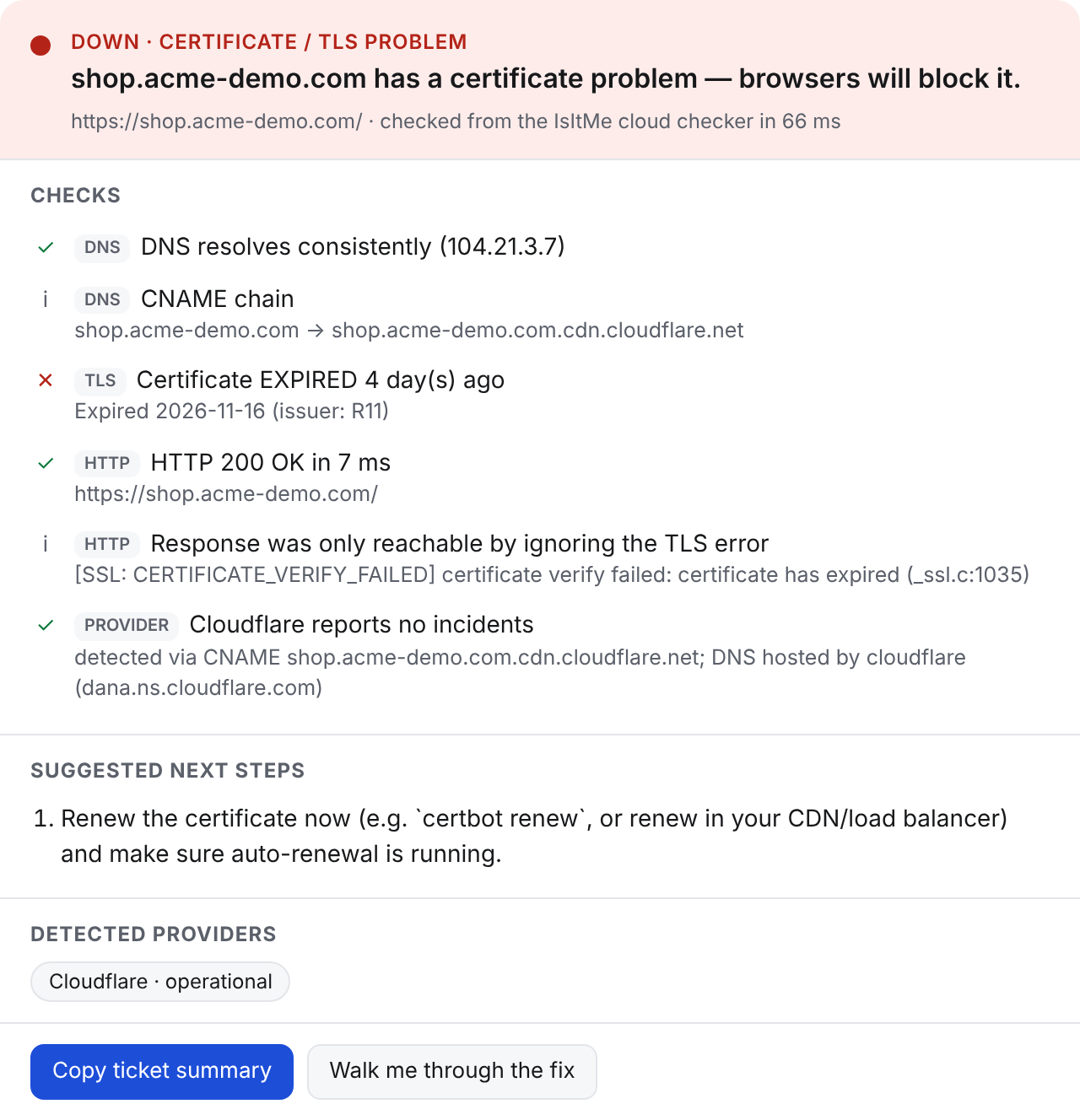
- IsItMe? — outage triage for IT people. "Is it down, or is it just me?" One call checks DNS, the TLS certificate, the HTTP response and the hosting provider's status page, then returns a verdict, the likely cause, next steps and a ticket-ready summary. Also available as a ChatGPT app.
- Personal desktop assistant. Files, shell, clipboard, screenshots, apps, Gmail, Google Calendar, notifications and more — for Claude Desktop, Claude Code and other local MCP clients.
Install
pip install personal-mcp-arun            # core + IsItMe? triage tools
pip install "personal-mcp-arun[all]"     # + Gmail/Calendar, desktop (psutil, clipboard, screenshots), Twitter/X
Python 3.10+. Requires the MCP Python SDK 2.x (installed automatically).
Claude Desktop / Claude Code
{
  "mcpServers": {
    "personal": { "command": "personal-mcp" }
  }
}
Claude Code: claude mcp add personal -- personal-mcp
IsItMe? triage tools
| Tool | What it does |
|---|---|
diagnose(url) | One-shot outage diagnosis with a verdict card: DNS + TLS + HTTP + provider status, likely cause, fixes, ticket summary |
check_dns(name, record_types) | A/AAAA/CNAME/MX/TXT/NS/CAA/SOA from Google + Cloudflare DNS (and your own resolver locally), consistency check |
check_tls(url) | Certificate expiry, hostname match, issuer, chain trust, protocol |
check_http(url) | Status, redirect chain, latency, CDN headers, explanations of 5xx / Cloudflare 52x |
check_email_auth(domain) | MX, SPF (incl. 10-lookup limit), DMARC policy, DKIM under common selectors |
vendor_status(vendors) | Live status of AWS, Azure, GCP, Cloudflare, GitHub, Slack, Jira, Zoom, Vercel, Netlify, OpenAI, … |
Local vs. cloud view. Run locally, the checks run from your network (and can reach internal hosts). Set
PERSONAL_MCP_CLOUD_URL=https://<your-hosted-isitme> and call diagnose(url, compare_cloud=true) to also run them
from the internet — if it works from the cloud but not from you, the verdict is "your network".
Personal assistant tools
System info, IP addresses, disk usage, port check, shell commands · list/read/write/search/move/delete files · clipboard, screenshots · open URLs, web search, fetch URL · open apps, list/kill processes · Gmail inbox/read/send · Calendar today/upcoming/create · notifications, reminders · Twitter/X post · date/time, calculator, text-to-speech.
Safe mode: set PERSONAL_MCP_SAFE_MODE=1 to not register tools that run commands, write/move/delete files,
kill processes, send e-mail or post to social media.
Gmail/Calendar: put a Google OAuth Desktop app client file at ~/.personal-mcp/gmail_credentials.json
(or set GMAIL_CREDENTIALS_PATH). The first call opens a browser to sign in.
Run modes
personal-mcp             # stdio (default) — all tools
personal-mcp --http      # streamable HTTP on 127.0.0.1:8000 — all tools, local clients only
personal-mcp --hosted    # public server on 0.0.0.0:$PORT — ONLY the read-only IsItMe? tools
--hosted is what powers the ChatGPT app. It never registers personal tools, only checks public internet
addresses on ports 80/443/8080/8443 (private, loopback, link-local and cloud-metadata addresses are refused, and
every connection is pinned to a verified IP to stop DNS-rebinding), rate-limits per client, caches results for 60 s
and logs no checked URLs. Deploy with the included Dockerfile (see PUBLISHING.md).
Development
pip install -e ".[dev]"
pytest -q
Tests spin up local HTTPS servers with valid, expiring, expired, wrong-host and self-signed certificates, and exercise the MCP protocol in-process, over streamable HTTP and over stdio.
License
MIT © Arun






