Listed from the MCP registry; nobody on Odel publishes it.

IPCC AR6 Climate Retrieval
Search IPCC AR6 WG1 and answer with page-level citations, or refuse when unsupported.
Runs on your machine from its package; the steps are below.
What it does
- Reads
- Writes
- High impact
At most: only reads or looks up information.
What it costs
FreeOdel charges nothing per call. The publisher may charge for its own service.
Runs locally over stdio
This server isn't hosted — your MCP client launches it from a package registry. Use one of the commands below, or drop the config into your client (e.g. Claude Desktop).
Run
docker run -i --rm ghcr.io/aswanisahoo/climate-ipcc-rag-mcp:0.1.0
MCP client config
{
  "mcpServers": {
    "ipcc-ar6-climate-retrieval": {
      "command": "docker",
      "args": [
        "run",
        "-i",
        "--rm",
        "ghcr.io/aswanisahoo/climate-ipcc-rag-mcp:0.1.0"
      ]
    }
  }
}Climate-Risk Analyst Agent





Ask a plain-language question about heat, extreme rain or wind anywhere on Earth, and get back a typed, cited risk report built from live forecast data, 60+ years of ERA5 extremes and IPCC AR6. When a question falls outside what it can check, it refuses instead of guessing.
Live demo: https://climate-risk-agent-714882950125.us-central1.run.app/ (a public Google Cloud Run deployment).
What it does
- Answers for any location: type a place name to geocode it, or enter a latitude and longitude directly.
- Puts a live forecast next to 60+ years of ERA5 annual maxima at that point, and cites the IPCC AR6 pages it used by number.
- Bands the risk on that location's own return-level curve instead of a fixed threshold.
- Reports a confidence that says what it is made of: measured forecast skill at that lead day, the climatology fit, and whether a citation backed the answer.
- Quotes the AR6 Chapter 12 projected change for the reference region containing the point, verbatim, where a Chapter 12 sentence states one that the parser can attribute to that region (34 of the 138 region and hazard pairs in the shipped precompute).
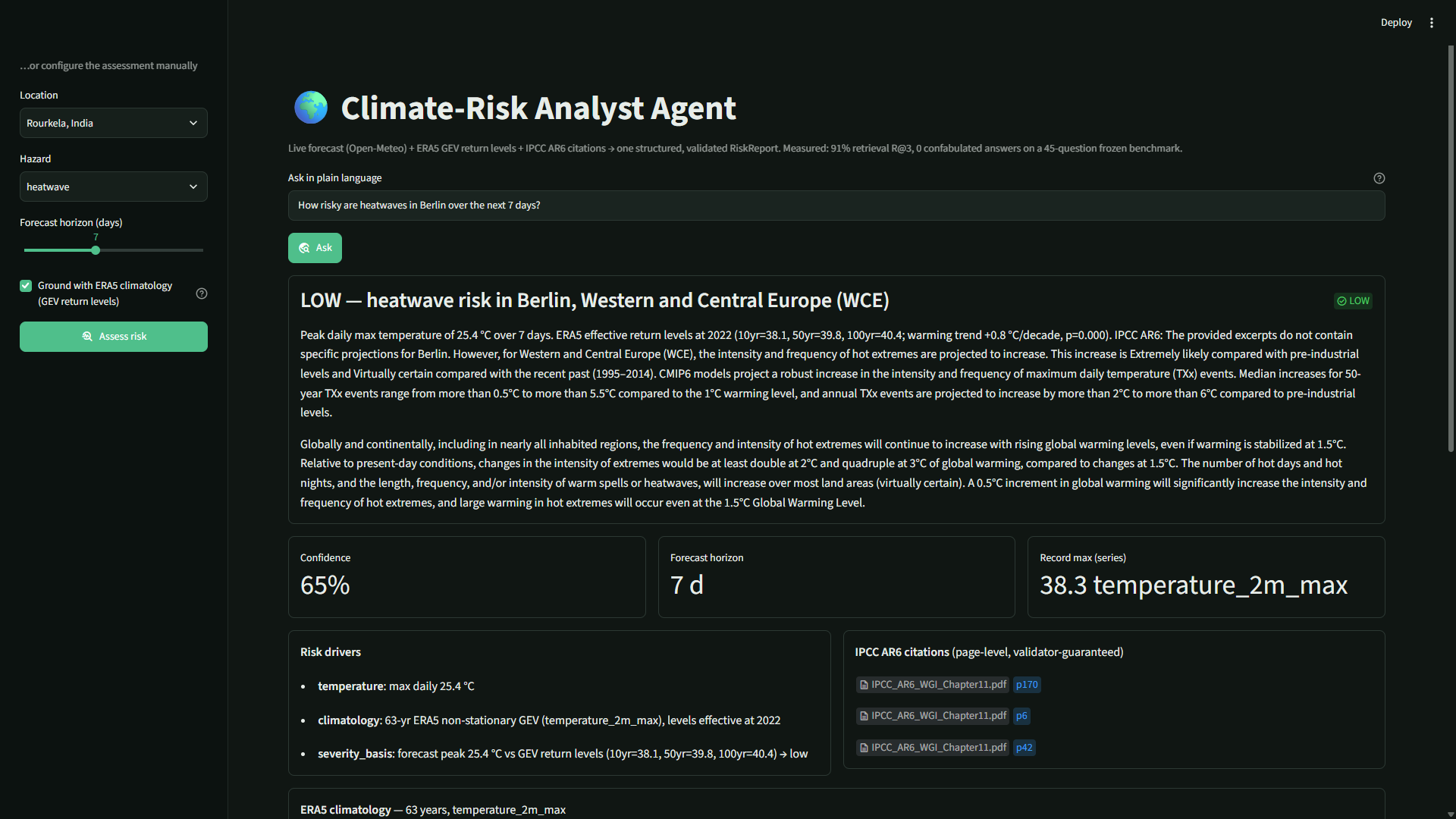
The measurement moat
- ERA5 GEV hazard statistics. Every hazard number comes from a Generalized Extreme Value distribution fitted to 60+ years of ERA5 annual maxima at the query location. Every return level ships with a 90% bootstrap confidence interval.
- Risk levels are local rarity, not a fixed threshold. The band is the return period of the forecast peak on that location's own curve: below the 2-year level is low, 2 to 10 years moderate, 10 to 50 high, at or above 50 severe. The same 46 °C peak can band low where an ordinary year already reaches it and severe where it is unprecedented, off the same code. Each report carries the sentence the band was decided on, naming the bracketing levels and the estimated return period. A location with no fitted climatology falls back to absolute cutoffs and says so rather than passing them off as local.
- Non-stationary GEV. Alongside the stationary fit, a drifting-location GEV checks whether the climate at that location is actually warming, using a likelihood-ratio test to decide. When the trend is real, return levels are reported "effective" at the latest year rather than averaged across six decades. Berlin comes back at about +0.75 °C per decade (p < 0.0001) with effective levels. Delhi comes back stationary, with no significant trend at either Delhi point the app uses (p = 0.46 at the UI's preset Delhi point, p = 0.84 at the geocoded city point about 5 km away), which agrees with the published literature on aerosol masking suppressing South Asian heat trends. The slopes, p-values, exact coordinates and code version are in
evals/results/warming-trend-2026-10-21.json, written byscripts/measure_warming_trend.pyfrom a fresh ERA5 1960 to 2022 fit. - IPCC AR6 RAG with citations that have to hold up. Every citation is checked structurally against the pages actually retrieved for that question. If the model cites an excerpt it was not given, or answers without citing one, the answer is discarded: the report ships without an IPCC statement or citations, never with a citation that failed the check.
- Projected change, quoted rather than generated. Where Chapter 12 states one, a report carries the AR6 WG1 Chapter 12 climatic impact-driver projection for the reference region containing the point: one verbatim Ch.12 sentence, its direction, the IPCC's own calibrated confidence phrase, and the warming level or period it names. All of it is extracted by regex from retrieved chunks, with no model in the loop. A clause counts only when it names the region, a direction and a confidence phrase itself. The clause split cuts a list written as "Name (ACR), Name (ACR)" into one clause per region, so those regions lose the shared verb and phrase and get nothing; acronyms inside one bracket stay one clause, which then counts for each region it names: the shipped extreme precipitation projections for NEU, WCE and EEU all quote one sentence ("... in the northern, central and eastern European regions (NEU, WCE, EEU) and in the Alpine area."). In the shipped precompute (
tools/cache_seed/ipcc.json) 34 of 138 region and hazard pairs have a projection; for the rest the section is absent and the report says no regional projection was found in the corpus.
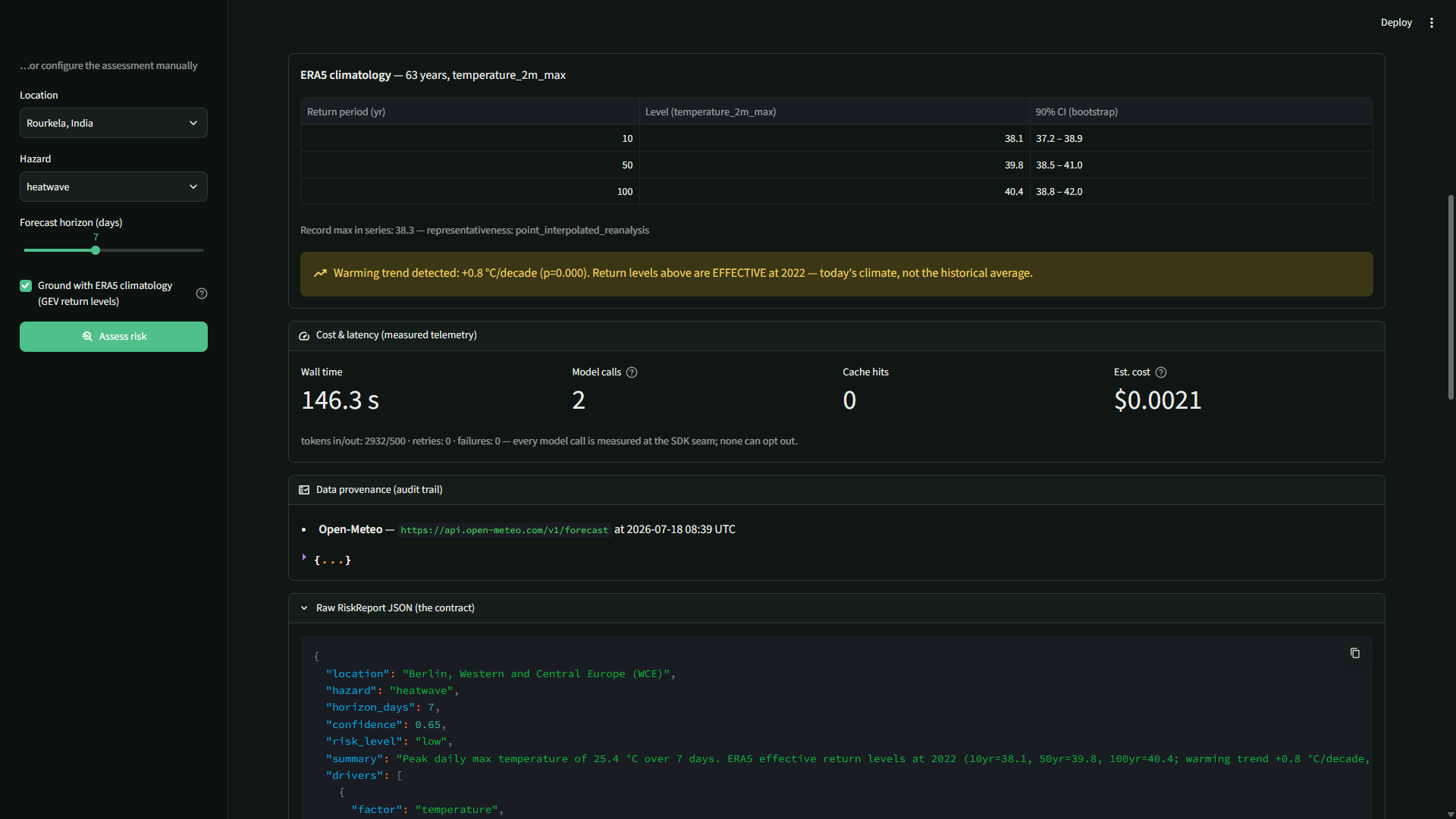
The same report, scrolled down: the ERA5 return-level table with bootstrap confidence intervals, the warming-trend banner, and the measured cost and latency for that run.
How it works
A free-text question moves through parsing, geocoding and AR6 region mapping before it reaches the agent, and that is where an unanswerable question is refused: an unsupported hazard, no hazard the parser can identify, or no place it can find or resolve each returns a typed refusal before any forecast is fetched (POST /report, which takes a hazard directly, answers HTTP 422 for one outside the three). The ERA5 climatology is fitted next, also before the agent, and handed to it. From there a five-node LangGraph agent (plan, call, research, project, synthesize) produces a typed RiskReport. plan would refuse a hazard with no data path, but all three hazards the contract accepts have one, so today it never does.
flowchart LR
    Q[free-text question] --> PARSE[parse<br/>location · hazard · horizon]
    PARSE -->|unsupported or no hazard, no place| REFUSE[refusal<br/>valid typed output]
    PARSE --> GEO[geocode<br/>Open-Meteo]
    GEO -->|place not found| REFUSE
    GEO --> REGION[map to IPCC AR6 region<br/>reference regions v4]
    PLAN[agent: plan<br/>data-path check] --> CALL[agent: call<br/>forecast]
    CALL --> RESEARCH[agent: research]
    RESEARCH --> PROJECT[agent: project<br/>AR6 Ch.12 CID projection]
    PROJECT --> SYNTH[agent: synthesize]
    SYNTH --> REPORT[RiskReport<br/>typed · cited · grounded]

    subgraph HAZARD [ERA5 to GEV hazard statistics, fitted before the agent]
        ERA5[ERA5<br/>60+ yr annual maxima] --> GEV[stationary + drifting-location GEV]
        GEV --> LRT[likelihood-ratio test<br/>is the trend real?]
        LRT --> LEVELS[return levels + 90% bootstrap CI<br/>effective at latest year if trend holds]
    end
    REGION --> HAZARD
    HAZARD --> PLAN
    HAZARD -.-> SYNTH

    subgraph RAG [IPCC AR6 RAG]
        HYBRID[BM25 + dense hybrid<br/>RRF fusion] --> VALID[citations validated<br/>against retrieved pages]
    end
    RESEARCH -.-> RAG
    RAG -.-> SYNTH
The UI shows the same run as seven named steps, in this order (agent/progress.py): resolving location, fitting 60 years of ERA5 extremes, checking the question is in scope, fetching the forecast, searching IPCC AR6, reading Chapter 12 projections for your region, writing the cited report.
Evaluation
- Dev set: 60 questions, used to steer development choices like chunking and retrieval configuration. The 15
cid-tablequestions arrived with the Chapter 12 projection layer, and the set was re-frozen under a new SHA-256. - Test set: 105 new questions, written after the dev set existed, never used to tune anything, frozen by SHA-256 so neither set can quietly change. 70 are answerable (24 single-page, 22 regional table, 15 multi-page, 9 duplicate region) and 35 are built to be refused (17 premise injection, 10 out-of-scope hazard, 8 out-of-corpus).
Dev-set retrieval, all 60 questions (49 answerable), measured 2026-09-02:
| retriever | R@3 | R@5 | R@10 | MRR |
|---|---|---|---|---|
| BM25 only | 76% | 82% | 88% | 0.68 |
| dense only | 61% | 69% | 86% | 0.59 |
| hybrid (shipped) | 82% | 90% | 94% | 0.70 |
Per slice, hybrid R@3: single-page 92% (n=12), regional table 90% (n=10), multi-page 80% (n=10), premise injection 75% (n=4), cid-table 67% (n=15). cid-table is the weakest slice and is why the headline is 82% across all 60 questions where it was 88% across the original 45 (30 of 34 answerable).
Dev-set end-to-end, all 60 questions (gemini-2.5-flash on Vertex, top_k 8, scope guard stage 2 off, fenced prompt, measured 2026-11-11):
| cell | count |
|---|---|
| correct answer | 46 |
| correct refusal | 11 |
| false refusal | 3 |
| false answer | 0 |
Citation validity 39/46 (85%). Numeric provenance 41/46 (89%). Grounded refusals 3/4. Same-day repeats moved false refusals between 2 and 4 under both the fenced and the previous prompt, and no run gave a false answer (evals/results/prompt-fence-ab-2026-11-11.md). The 2026-09-02 run, before the fence and on another backend, had 48, 11, 1 and 0.
Held-out results, on the configuration this release deploys:
- Retrieval, hybrid, on the 70 answerable questions (measured 2026-09-07): R@3 87%, R@5 91%, R@10 96%, that is 61, 64 and 67 of 70.
- End-to-end, all 105 questions (gemini-2.5-flash on Vertex, top_k 8, fenced prompt, measured 2026-11-11): 52 correct answers, 35 correct refusals, 18 false refusals, 0 false answers. All 35 questions built to be refused were refused; the price is 18 of the 70 answerable questions refused as well.
- Citation validity 50/52 correct answers (96%). Numeric provenance 42/52 (81%), down from 88% in the previous run.
- The IPCC answer step cost $0.26 for the run, about $0.0025 per question, p50 generation latency 4.1 s.
- The previous run (2026-07-22, before the fence): 49 correct answers, 35 correct refusals, 21 false refusals, 0 false answers, citation validity 47/49, numeric provenance 43/49.
- Exposures: end-to-end runs on 2026-07-18, 2026-07-22 and 2026-11-11, retrieval runs on 2026-07-18, 2026-09-07 and 2026-11-11 (
evals/results/retrieval-test-*.json), Jev triage on 2026-11-11 (37 questions), and an offline lexical-parser confirmation run at 2026-11-11T20:02Z (report; no question left the machine). A first 2026-11-11 attempt stopped after 12 model calls on a local call cap and was discarded, so those questions reached the model twice that day.
Reranking and query rewriting: measured, kept off. Both are wired as HybridRetriever keyword arguments and both default to off. Measured on the 45-question dev set (34 answerable), before the cid-table questions landed:
| arm | R@3 | R@5 | R@10 | MRR | p50 | cost per question |
|---|---|---|---|---|---|---|
| hybrid (shipped) | 88% | 94% | 94% | 0.76 | 40 to 48 ms | $0 |
| + MiniLM cross-encoder | 79% | 85% | 91% | 0.68 | 4.0 s | $0 |
| + Gemini reranker | 82% | 94% | 94% | 0.74 | 38 s | $0.0123 |
| + query rewrite | 79% | 79% | 88% | 0.74 | 6.1 s | $0.0013 |
| + Gemini reranker and rewrite | 74% | 79% | 85% | 0.65 | 39 s | $0.0127 |
No arm beat the baseline at any k, and the cheapest of them costs about 100 times the latency. The seams stay in the code because the measurement is what makes leaving them off defensible.
Semantic scope guard, stage 2: measured, kept off. Stage 1 is lexical and runs before any model call. Stage 2 (rag/scope_semantic.py, CRG_SCOPE_STAGE2=off|embed|llm) reads only the questions stage 1 leaves undecided. Measured on the 45-question dev set, as correct answer / correct refusal / false refusal / false answer:
| arm | matrix | added latency per question | added cost per question |
|---|---|---|---|
| off (shipped) | 34/11/0/0 | 0 | $0 |
| embed | 33/11/1/0 | 24 ms | $0 |
| llm | 34/11/0/0 | 2.8 s | $0.00025 |
Zero false answers in every arm, and no arm gained anything, so the default stays off. The embed arm's one false refusal carries lexical hazard vocabulary and never reached stage 2. embed is the arm to promote, once a held-out run confirms the matrix holds. The full reasoning is in LIMITATIONS.md.
Jev question triage and citation check: measured, kept off. CRG_JEV=off|triage|verify|all (default off) lets TypeSafe's Jev, a model that answers typed questions with probabilities instead of text, do two jobs. Triage reads the questions stage 1 cannot see: it can refuse a confident off-topic one before retrieval, or name the hazard in a question whose words name none, which the front door refuses with the flag off. The citation check asks, for each cited page, whether it supports the IPCC statement, and annotates the report with a strength per citation. Stage 1 stays first and final, code decides on fixed thresholds, and any Jev failure falls back to today's behaviour (adr/0002). Measured on 2026-11-11 on the dev set and the 14 stage-2 paraphrase probes, through the Experiential Labs gateway (JEV_BASE_URL=https://api.experientiallabs.ai, model jev-latest; report):
| measure | lexical only, 2026-11-11 | with Jev |
|---|---|---|
| scope decided right, dev set | 58/60, no false refusals | 60/60, no false refusals |
| scope decided right, the 14 paraphrase probes | 7/14 | 14/14 |
| hazard named by the front door, dev questions with one | 39/42 | 41/42, none wrong |
| hazard named, in-scope paraphrase probes | 1/7 | 6/7, none wrong |
Since 2026-11-12 the lexical parser also reads everyday words (windy, gusty, gale, hot, scorching, sweltering, deluge, cloudburst), but only where the scope guard names no unsupported hazard. With the flag off the front door now names 41/42 dev and 6/7 probe hazards, the sets the words were chosen on and the same items as with Jev, and 63/77 on the held-out set against 57/77, none wrong and no out-of-scope refusal lost (report).
The two policy questions that only Gemini refused today (an NDC pledge and GDP lost to warming) are now refused before retrieval, and no decision changed with the option order reversed or across two uncached runs. Live Jev calls took a median 627 ms and a p95 of 1,881 ms (all 244 calls of the dev run, triage and citation check together; the report does not split them), and triage calls Jev only for a question with no hazard word, or with one the front door cannot map to a hazard ("temperature extremes"). On 110 mechanically labelled citation pairs, Jev's top answer matched the label on 105 and its strength label on 101 (AUC 0.9955); two of the misses point at what look like wrong Chapter 12 labels in the dev set rather than at Jev. 244 calls cost $0.009 at the list price, and the gateway's free plan reported $0. Re-run with uv run python -m evals.run_jev_eval --task all --order-check --repeats 2 (dev set only, $2 and token caps, paced for the gateway's 10-a-minute plan). With the flag on, POST /triage reads a question (hazard, horizon, place, and the refusal /query would give) without running the report, and the UI reads the question before the run, refuses an out-of-scope one at once, shows a hazard Jev named with its probability and any other hazard one click away, and labels each citation's evidence (docs/jev-ui-integration.md).
Both stay off. Aswani accepted triage's gateway latency, but the one-time held-out check (evals/run_jev_heldout.py, 2026-11-11, report), which sent only the 37 of 105 held-out questions that triage itself would send, failed the ADR's hard gate of no new false refusal: SP2-08, an answerable question on 2020 COVID-19 emission cuts, air pollution and radiative forcing, was refused at the guard as air quality. Otherwise it held: no wrong hazard (73/77 named, against 57/77 for the lexical parser that day), 98/105 decided right at scope against 97/105, and 36 of 37 decisions kept with the options reversed. Its p95 latency per call was 2,855 ms, against 1,881 ms for the dev run's calls. Of the two suspect citation labels, CID-06's parsed sentence states river flooding, not heavy precipitation, and CID-11's ESAF clause states cyclone landfalls, not mean wind speed; rag/cid.py misread the second, and now leaves such a clause out. With the labels corrected, a re-run met both accuracy gates (12 of 14 true Chapter 12 claims strong, 18 of 18 flipped claims and premises contradicted, 37 of 38 cross pairs weak, AUC 0.998, report), but the check on real Gemini answers has not run. Both runs together cost $0.008 at the list price.
Every eval artifact records the model that produced it, because a model swap is invisible to a test suite. When the answering model was changed without re-running these evals, the benchmark caught a usefulness regression that the unit tests did not: see adr/0001-answering-model-selection.md.
Refusals are scored on a 4-cell confusion matrix (correct answer, correct refusal, false refusal, false answer). One false answer on that matrix blocks release.
The gate: it is an exit code, not an eyeball. The build fails on any false answer, on any e2e question whose call errored (--max-errors, default 0), on headline R@3 falling more than 3 points below the last committed run of the same eval set, retriever and arm, or on the hybrid retriever being missing from the artifact, which would mean the run silently measured BM25-only. See DEPLOY.md.
Forecast skill
Every hazard number rests on a forecast, and a peak predicted six days out is not the same claim as one predicted tomorrow. That gap is measured rather than assumed. scripts/measure_forecast_skill.py reads Open-Meteo's Previous Model Runs API, which archives what the model had predicted for each hour 1 to 7 days before it happened, and scores every lead time against the model's own day-0 run over 2024-01-01 to 2025-12-31 at 13 cities on six continents, about 9,200 city-days per lead day.
| Hazard | MAE, day 1 | MAE, day 7 | Extreme days caught, day 1 → day 7 |
|---|---|---|---|
| Daily max temperature | 0.70 °C | 1.93 °C | 85% → 47% |
| Daily precipitation total | 2.03 mm | 3.03 mm | 53% → 3% |
| Daily max wind | 2.16 km/h | 4.68 km/h | 71% → 29% |
| Daily max gust | 3.47 km/h | 8.26 km/h | 69% → 34% |
"Extreme days caught" is how often a day above that location's own 95th percentile was also forecast above it. The frozen numbers sit in tools/forecast_skill_table.json next to their provenance, and tools.forecast_skill.skill_for(hazard, horizon_days) reads them, clamping horizons past day 7, where the archive stops, and flagging them as extrapolated.
The report spends those numbers rather than displaying them. Confidence is min(0.75, 0.3 * w + climatology bonus + 0.1 if IPCC-cited), where w = min(hit rate over lead days 1..L) / hit rate at day 1 is the share of day-1 extreme detection still standing at lead day L. A day-1 heat report keeps the full 0.3 forecast term; a day-7 one keeps 0.56 of it. Every report carries a forecast_skill driver naming the number that did it: "Day-7 temperature forecasts hit the local extreme 47% of the time (GFS Global vs its own day-0 run, 13 cities, 2024-2025), so forecast evidence is down-weighted to 0.56 of its day-1 value." The running minimum in w is deliberate. Precipitation detection measures 1.7% at day 6 and 3.5% at day 7, which is sampling noise on ~458 extreme days rather than a forecast improving with lead time, and the minimum is what keeps confidence monotone, so a longer horizon is never reported as surer.
Three caveats travel with these numbers. The reference series is the model's own latest run rather than station observations, so they are run-to-run consistency errors and a floor on true forecast error. The measurement is pinned to GFS Global because Open-Meteo's default best_match splices different models across lead offsets and fabricates biases that read like skill: at Delhi it placed the day-1 wind forecast 5.3 km/h off while the day-7 forecast landed within 0.1 km/h. The live forecast is not pinned (tools/forecast.py sends no models, so Open-Meteo serves best_match), so the weight approximates the skill of the forecast the agent actually uses. And GFS drops from hourly to 3-hourly output past forecast hour 120, which flattens daily rainfall totals, so the collapse in precipitation detection after day 4 is partly output resolution and not only the forecast missing the storm.
Operations
- One shared cache sits behind the climatology fit, the forecast and the answer cache. Entries shipped in
tools/cache_seed/answer first. Behind them: withCRG_CACHE_GCS_BUCKETset, this instance's disk and then that Cloud Storage bucket; otherwise Upstash Redis over REST, with disk as its fallback, whenUPSTASH_REDIS_REST_URLandUPSTASH_REDIS_REST_TOKENare set; otherwise disk alone.tools/cache_backend.pylogs the backend it chose, andscripts/prewarm.pyfills it before a demo. - Structured logging and per-request telemetry, measured at the two seams model calls pass through (
rag/gemini_client.pyfor Gemini,rag/jev_client.pyfor Jev): latency, tokens, retries and cost. Reasoning tokens are counted as billed output. A model with no price entry is logged as an unknown cost and listed undercost_incomplete_unpriced_modelsin the/metricsrollup, but the per-request telemetry that the API responses and the UI show counts it as $0 (a known gap, see LIMITATIONS.md). The in-memory event ring is bounded; the JSONL sink keeps the long history. - Cloud Run idle cost per min-instance shape, the measured 30-day load and the resize plan are in DEPLOY.md.
- Async FastAPI service (
POST /report,POST /query, andPOST /triagefor reading a question without running it) with per-request API-key access control and a/metricsendpoint. - Two MCP servers (weather, IPCC RAG) exposing the same tools over the Model Context Protocol.
CRG_BOOTSTRAP_Nsets the GEV bootstrap refits per fit (defaults: 300 stationary, 200 trend-adjusted); it is read at import, is part of the hazard-fit cache key, and trades confidence-interval precision for fit time.- Docker image measured at 0.31 GB locally.
ci.ymlruns ruff, mypy and pytest on every push tomainand every pull request;evals.ymlruns both evals on av*tag push or on demand, against a pre-built embedding cache downloaded as a release asset, so cutting a release never re-embeds the corpus.
Run it
uv sync
uv run streamlit run ui/app.py
Ask in plain language, or use the sidebar to pick any point on Earth: type a
place name to geocode it, or enter latitude and longitude directly. Example
buttons load six preset cities. The image ships ERA5 fits for the Berlin preset
only, so the others fit on first use unless a cache already holds them
(scripts/prewarm.py fills one before a demo). A map shows the selected point
(display-only) along with its IPCC AR6 region, or a notice when the point has
none.
While a request runs, a live progress panel names the step it is on, shows the seconds each one took, and badges any step served from cache with the tier that served it.
The first report for a new place takes roughly 1 to 2 minutes, because 60+ years
of ERA5 daily extremes are fetched and the GEV fitted once for that point.
Afterwards the fit is cached, on disk and in the Cloud Storage bucket when
CRG_CACHE_GCS_BUCKET is set, in Redis when that is configured instead, and on
disk otherwise, and repeat visits return in well under a second.
With Docker:
docker build -t climate-risk-agent .
docker run -p 7860:7860 -e GEMINI_API_KEY=... climate-risk-agent
The live demo runs on Google Cloud Run. For deployment (Cloud Run, or local Docker and other hosts), see DEPLOY.md.
Use the MCP servers
Both servers speak stdio. From the repo root, point any MCP client at them:
{
  "mcpServers": {
    "climate-weather": {
      "command": "uv",
      "args": ["run", "--no-sync", "python", "-m", "tools.weather_mcp"]
    },
    "climate-ipcc-rag": {
      "command": "uv",
      "args": ["run", "--no-sync", "python", "-m", "tools.ipcc_mcp"]
    }
  }
}
| Client config key | Server name | Tools |
|---|---|---|
| climate-weather | weather | forecast, hazard_climatology |
| climate-ipcc-rag | ipcc-rag | search_ipcc, answer_ipcc |
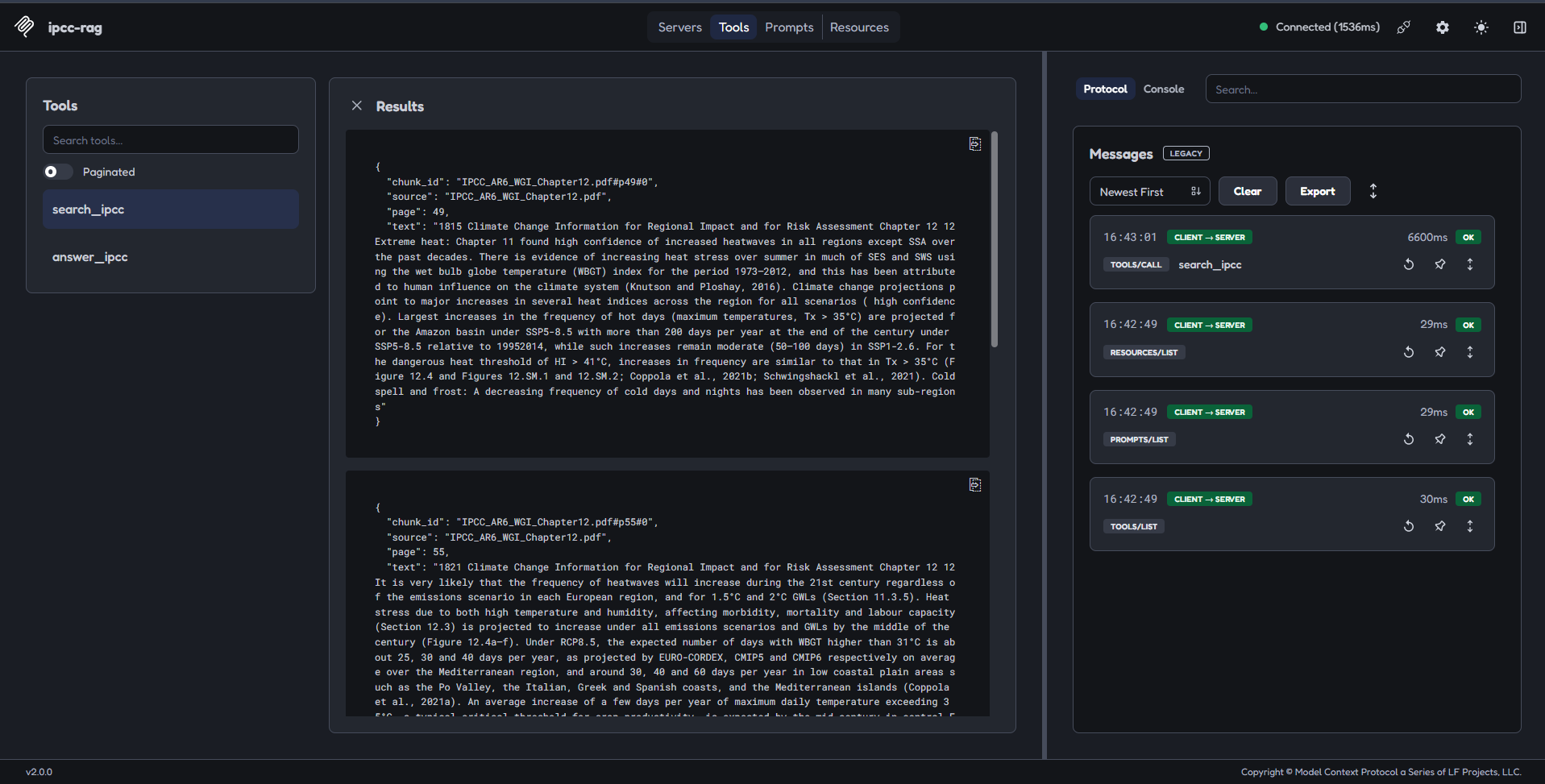
Both servers target MCP protocol 2026-07-28 (mcp 2.3.0 in uv.lock), the
current revision. Every tool is annotated read-only with a human-readable title
and an open- or closed-world hint, publishes an outputSchema, and is listed in
a deterministic order. Two tests boot each server as a real subprocess and speak
the protocol to it, rather than calling the tool functions in-process.
Retrieval is hybrid, so both IPCC tools embed the query with credentials in the
server process: either GOOGLE_GENAI_USE_VERTEXAI=true with
GOOGLE_CLOUD_PROJECT, or GEMINI_API_KEY. Without them search_ipcc still
answers, BM25-only and logged as such (dev-set R@3 76% against 82% hybrid), and
answer_ipcc can only refuse out-of-scope questions or return a cached answer.
A client does not hand the server your shell. It passes a short allow-list of
variables (PATH, APPDATA, TEMP, ...) so that a server cannot harvest your
secrets, which means a client-launched server starts with no credentials. Supply
them either in the client's own env block, or by copying .env.example to
.env: the IPCC server reads that at startup and never overrides a value the
client did pass.
To explore the tools by hand: uv run mcp dev tools/ipcc_mcp.py.
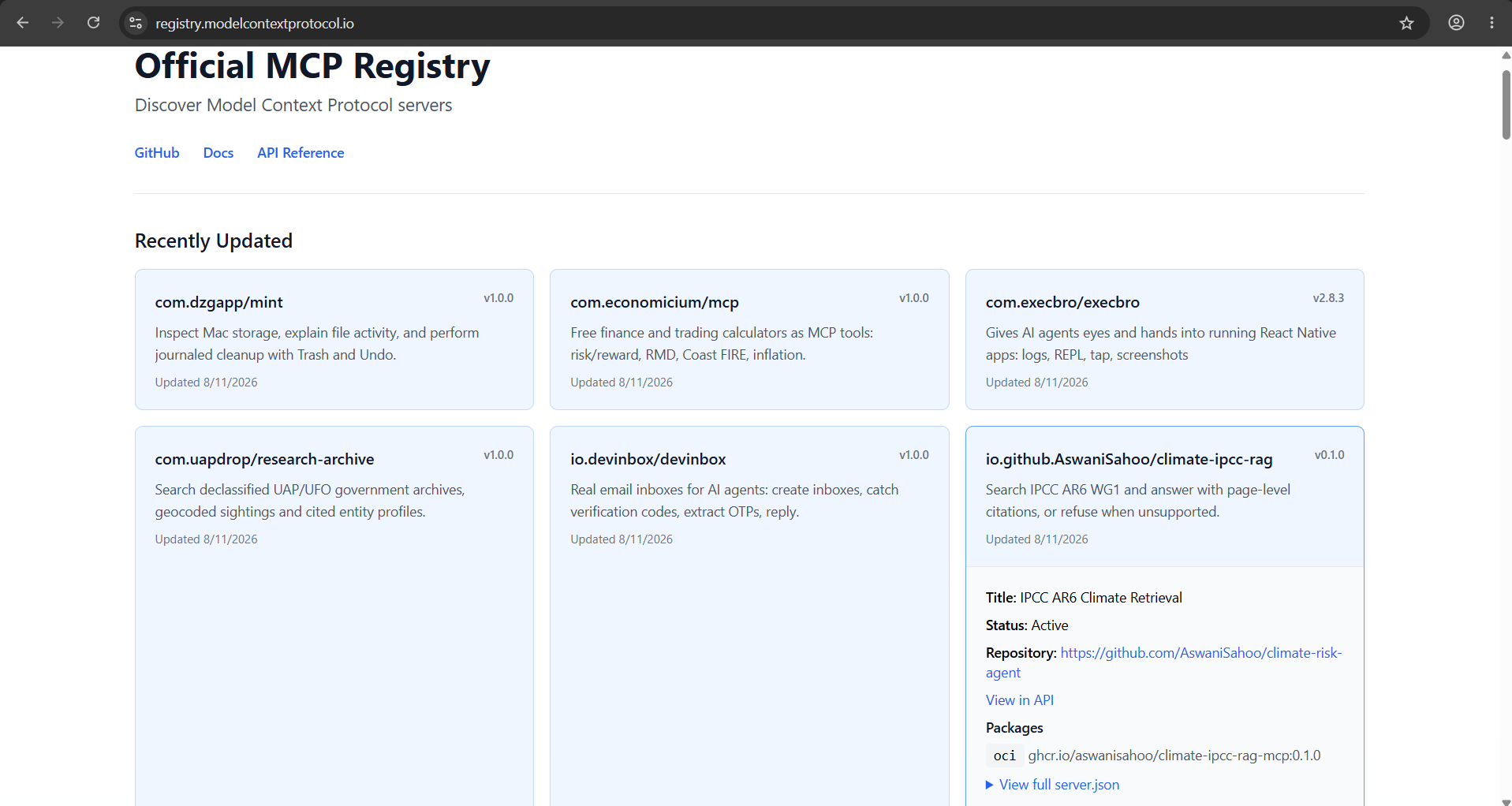
Published on the official MCP registry

The IPCC RAG server is published on the
official MCP registry as
io.github.AswaniSahoo/climate-ipcc-rag (v0.1.0). The listing points at the OCI
image ghcr.io/aswanisahoo/climate-ipcc-rag-mcp:0.1.0 on GHCR, which is not
publicly pullable at the moment: an anonymous pull is refused (checked
2026-11-13), so installing the server from the registry fails today. Run it
from a clone instead: uv sync, then the climate-ipcc-rag entry in the client
config above (uv run --no-sync python -m tools.ipcc_mcp). To run the image,
build it locally with the two docker build commands in
DEPLOY.md.
Contributing
Setup, the exact CI commands, the eval release gate, and PR expectations are in CONTRIBUTING.md; participation is covered by the Code of Conduct. Issues use templates for bugs, data correctness, and questions. A wrong return level, a wrong page citation, or a wrong region mapping is a first-class bug here, so please report it as one.
Tech stack
Python, LangGraph, Google Gemini (generation) + gemini-embedding-2 (dense) on Vertex AI (global endpoint), BM25 + dense hybrid retrieval (RRF fusion), TypeSafe Jev (optional triage and citation check, off by default), Pydantic, FastAPI, Streamlit, MCP Python SDK, scipy, Docker, GitHub Actions.
Limitations
- ERA5 is gridded reanalysis, not station observations. Hazard stats describe an interpolated grid cell near the query location, not a measurement taken there.
- Scope is heat, extreme precipitation, and wind. Anything else should get a refusal, not an answer.
- Coverage is global, but IPCC AR6 regional context is not. Points outside every AR6 land region (open ocean) still get a forecast and hazard stats, with a notice that the regional context is missing.
- The scope guard that keeps out-of-scope hazards away from the LLM is lexical (keyword-based). A paraphrase that avoids the known vocabulary could slip past it.
Data sources and licences
- Forecasts: Open-Meteo, CC BY 4.0.
- ERA5 daily extremes: ERA5 reanalysis, served through the Open-Meteo archive under the same licence. The return levels and trends are fitted here from that series. Contains modified Copernicus Climate Change Service information 2026 (Licence to use Copernicus Products, 5.1.2).
- Climate assessment: IPCC AR6 WG1 SPM, Chapter 11 and Chapter 12 PDFs, reused for research under IPCC's terms.
- AR6 reference-region polygons: bundled from the IPCC WGI Atlas in
tools/ar6/under CC BY 4.0. Required citation: Iturbide, M., Fernández, J., Gutiérrez, J.M. et al. Implementation of FAIR principles in the IPCC: the WGI AR6 Atlas repository. Scientific Data 9, 629 (2022). https://doi.org/10.1038/s41597-022-01739-y
See LIMITATIONS.md for the full list and SECURITY.md for the threat model. Shipped features and what's next: ROADMAP.md.