Listed from the MCP registry; nobody on Odel publishes it.

Avalanche
Scaffold a dapp, deploy contracts and send contract calls (for example mint) on the Fuji testnet.
Runs on your machine from its package; the steps are below.

What it does
- Reads
- Writes
- High impact
At most: moves money, runs code or commands, deletes data, or sends messages for you.
What it costs
FreeOdel charges nothing per call. The publisher may charge for its own service.
Runs locally over stdio
This server isn't hosted — your MCP client launches it from a package registry. Use one of the commands below, or drop the config into your client (e.g. Claude Desktop).
Run
npx -y @avakit/mcp
MCP client config
{
  "mcpServers": {
    "avalanche": {
      "command": "npx",
      "args": [
        "-y",
        "@avakit/mcp"
      ]
    }
  }
}AvaKit 🔺
The open-source, AI-native developer toolkit for Avalanche.






Scaffold a social-login dapp, deploy-ready, with agent context baked in. One core, four surfaces. No seed phrases, no boilerplate.
avakit.dev · Documentation · Templates
Try it
Three ways in. None of them needs a wallet extension, a private key of your own or an account with AvaKit or Avalanche.
-
No install: open avakit.dev/new. The page deploys an NFT contract to the Fuji testnet and mints from it, in your browser.
-
One command:
npm create avalanche-app@latest. It scaffolds a Next.js dapp from one of eight templates and installs it with the package manager you launched it with. -
From a coding agent:
claude mcp add avakit -- npx -y @avakit/mcp, then paste the prompt below. The agent scaffolds the app, deploys its contract and mints the first token, in three tool calls.Create an NFT app called my-first-dapp with AvaKit, deploy its contract to Fuji and mint the first NFT. Give me the explorer links.
What pays for the first transaction: a temporary test wallet (in the browser for the first two ways, in the MCP server's memory for the third) that receives a little test AVAX from AvaKit's shared Fuji faucet. Both exist for a first run only; see Status and limits.
▶ Watch the 90-second demo — one command to a live, social-login Avalanche dapp: sign in with Google, deploy an NFT from the browser, and mint it on Fuji.
Then deploy an NFT contract and mint it, straight from the browser, on Fuji:
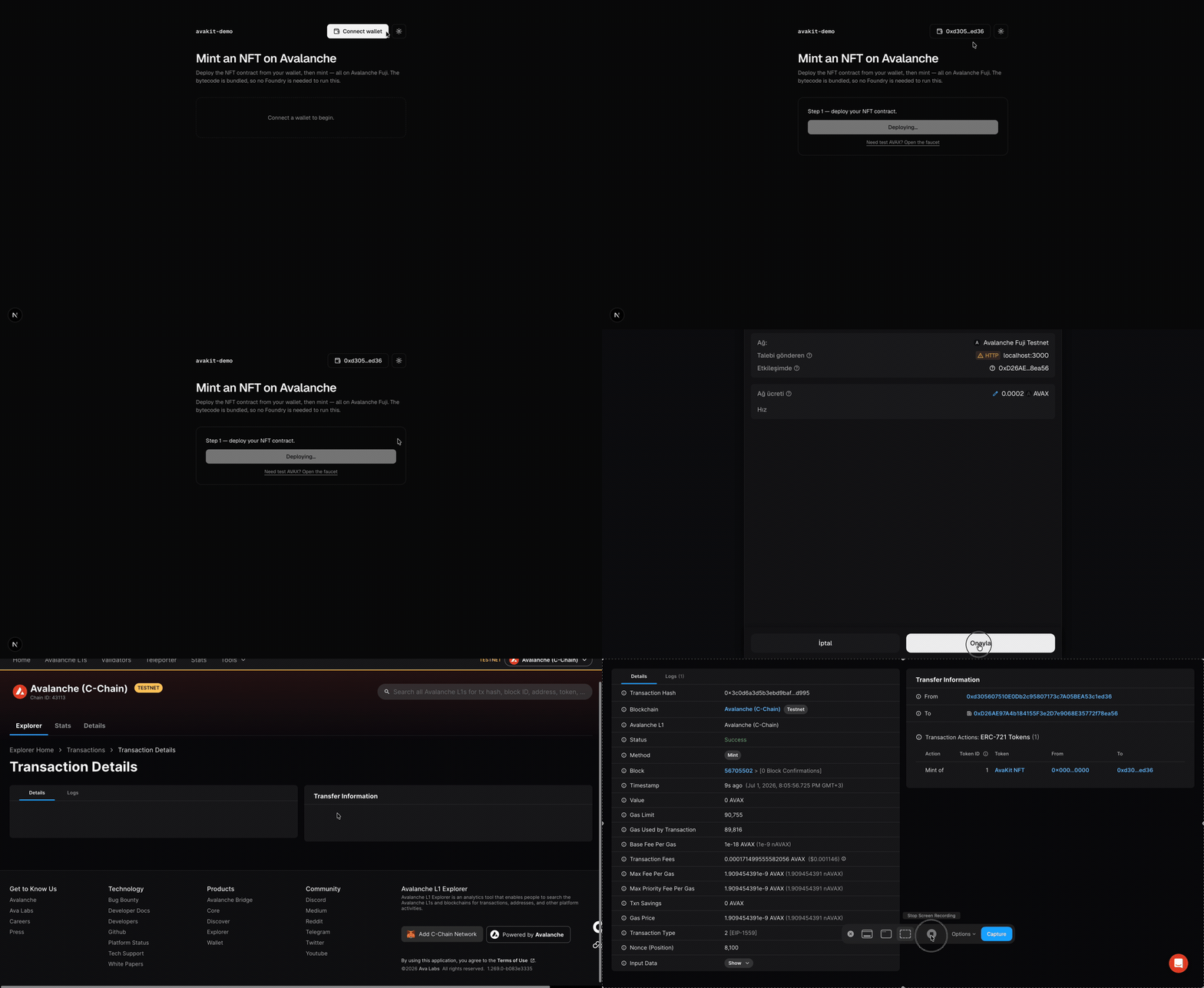
Proven live on Fuji. The mint in that clip is a real on-chain transaction; view it on Snowtrace (contract
0x7612…7786). No Foundry, no backend: the bytecode is bundled and deployed from the user's wallet.
How this relates to the official tools
Ava Labs maintains the official Avalanche tooling. Builder Hub has a hosted prompt-to-contract flow in its Console (Studio, behind a Builder Hub sign-in), and the official MCP server gives an agent read access to Avalanche. AvaKit is an independent, open-source project that covers the local side of the same job: the app is created in your own folder, the MCP server runs on your own machine next to your coding agent, and on the Fuji testnet it can also deploy a contract and call it. AvaKit builds on the official stack (the public RPC endpoints, the AvaCloud Data API, Avalanche CLI) and links to Builder Hub for the faucet, the explorer and the documentation.
Why AvaKit
Avalanche's C-Chain is EVM-compatible, and wallets such as Core already give end users a seedless social login. The setup work that remains is on the developer side: a new dapp needs wallet onboarding, a chain configuration, a contract to deploy and a UI before its first transaction. AvaKit ships those wired together.
- Zero-setup onboarding: a temporary in-browser wallet appears so a newcomer can try a real Fuji transaction with nothing installed, and social login (Google, no seed phrase) or Core/MetaMask is the upgrade — for those, keys stay with the wallet provider and AvaKit never touches them. (The temporary wallet is a deliberate exception, and holds its key in
localStorage— see SECURITY.md.) - AI-native by default: every generated app ships
CLAUDE.md,llms.txt, and.cursor/rules, and@avakit/mcplets Claude Code / Cursor scaffold an app, deploy its contract, call it and read chain state for you. On Fuji that needs no key. - shadcn/ui, themed: a clean design system with dark/light from day one. Copy-in components, no vendor lock-in.
- Deploy-ready: contracts compile to bundled bytecode, so you can deploy straight from the browser. Fuji testnet by default.
- Safe defaults: testnet-first, mainnet is explicit opt-in, secrets stay in env.
- Wrap, don't rewrite: built on viem, Web3Auth, and Foundry.
Packages
| Package | What it is |
|---|---|
@avakit/core | Framework-agnostic kernel: viem clients, wallet adapters, deploy helpers, chain data |
@avakit/react | <ConnectAvalanche> social-login widget, <TransactionButton>, and hooks, built on shadcn/ui |
create-avalanche-app | Batteries-included scaffolder (8 templates) |
@avakit/mcp | MCP server: scaffold, deploy, call contracts (for example mint), and read Avalanche from Claude Code / Cursor |
@avakit/studio | Local dev dashboard: spin up devnets, send Interchain messages, inspect data (npx @avakit/studio); also an MCP server |
Templates
npm create avalanche-app@latest my-app -- --template nft-mint
| Template | What you get |
|---|---|
minimal | Social-login wallet, balance, and a first transaction |
nft-mint | Deploy an ERC-721 from the browser, then mint |
token-gated-app | Unlock content for holders of an access-pass NFT |
erc20-token | Deploy an ERC-20, mint supply, and transfer |
icm-messenger | Send a message between two Avalanche L1s over Interchain Messaging, on a one-command local devnet |
eerc-token | Register, mint, and privately transfer tokens with hidden balances (Encrypted ERC) |
l1-launch | Launch your own Avalanche L1 with one command, then explore it in a built-in dashboard |
token-bridge | Bridge an ERC-20 between two Avalanche L1s with Interchain Token Transfer (ICTT) |
Every template ships with a wallet chooser (a zero-setup temporary wallet and Core/MetaMask, plus social login in the five Fuji templates), shadcn/ui (black & white, dark/light), and AI context files.
The first transaction is funded on Fuji. In minimal, nft-mint, token-gated-app, erc20-token and eerc-token, a new temporary wallet with an empty balance is sent test AVAX from AvaKit's shared faucet. The app shows what the faucet is doing; when the faucet refuses, it shows the reason, a Try again button and a link to the official Fuji faucet, which needs a free Builder Hub sign-in. Set NEXT_PUBLIC_AVAKIT_FAUCET_URL to the /fund URL of your own faucet (services/faucet), or to off to ask no faucet at all.
Testnet by default, mainnet only on purpose. The templates target the Fuji testnet (icm-messenger, l1-launch and token-bridge run on a local devnet). Only minimal can also be scaffolded for C-Chain mainnet (--chain c-chain); the scaffolder refuses that chain for every other template, and a mainnet scaffold offers neither the temporary wallet nor a faucet. Every mainnet deploy is an explicit, guarded step: deployContract() and useAvaDeploy() refuse a mainnet chain unless you pass confirmMainnet: true, and then check that the account can pay for the deployment; the MCP server's deploy_contract and write_contract need your own key, confirm: true and AVAKIT_ALLOW_MAINNET=1 in the server's environment. Details in the scaffolder README and SECURITY.md.
Use it in an existing app
npm install @avakit/react @avakit/core viem
"use client";
import { injectedAdapter } from "@avakit/core";
import { fuji } from "@avakit/core/chains";
import { AvaKitProvider, ConnectAvalanche } from "@avakit/react";

export function App() {
  return (
    <AvaKitProvider chains={[fuji]} adapters={[injectedAdapter()]}>
      <ConnectAvalanche />
    </AvaKitProvider>
  );
}
Add social login by installing @web3auth/modal and passing web3authAdapter({ clientId }) (from @avakit/core/web3auth).
@avakit/coreand@avakit/reactare ESM-only (useimport, notrequire; Node ≥ 22).
Build with an AI agent
Add the MCP server to Claude Code with claude mcp add avakit -- npx -y @avakit/mcp, or to Cursor, Claude Desktop and other clients that read a JSON config:
{
  "mcpServers": {
    "avakit": { "command": "npx", "args": ["-y", "@avakit/mcp"] }
  }
}
Then ask, for example: "Create an NFT app called my-first-dapp with AvaKit, deploy its contract to Fuji and mint the first NFT. Give me the explorer links."
The server has eight tools: list_templates, scaffold_app, read_chain, estimate_gas, deploy_contract, write_contract, wallet_status and get_context. What to know before you rely on it:
- Fuji needs no key. When
AVAKIT_DEPLOYER_KEYis not set,deploy_contractandwrite_contractsign with a session test wallet: a key generated in the server's memory, never written to disk, logged or returned, that signs for Fuji only, never sends AVAX with a transaction, and is gone when the server stops. The server asks the shared faucet to fund it when it cannot pay.AVAKIT_TEST_WALLET=0turns it off, andAVAKIT_DEPLOYER_KEYreplaces it with your own key. - Mainnet needs three things: your own key in
AVAKIT_DEPLOYER_KEY,confirm: truein the tool call, andAVAKIT_ALLOW_MAINNET=1in the server's environment, which a tool call cannot set. - Calls go only where you allow, from
@avakit/mcp0.3.0.write_contractcalls only the contracts the server deployed in its session or thatAVAKIT_WRITE_ALLOWLISTlists, and one call sends at mostAVAKIT_MAX_VALUEAVAX (0.1 by default). Both limits hold per call, not per day. - Files stay in one folder.
scaffold_appcreates projects, andartifactPathreads contract artifacts, only inside the server's working directory or the directory named byAVAKIT_MCP_ROOT. A server started in the filesystem root (as Claude Desktop does on macOS) refuses to scaffold untilAVAKIT_MCP_ROOTis set. - The first start is a download.
npxfetches the server the first time a client starts it. It is published as one bundled file whose only dependency is the scaffolder, which comes to a few seconds on an empty npm cache. A client waits a fixed time for a server to connect (30 seconds in Claude Code), so on a slow network runnpx -y @avakit/mcp --versiononce before adding it.
The full reference is the @avakit/mcp README.
Status and limits
- 0.x pre-release. All five packages are published on npm, and their APIs may still change before 1.0.
- Testnet first. Fuji is the default everywhere. Mainnet is an explicit, guarded step (see Templates), and only the
minimaltemplate can be scaffolded for C-Chain. - Three templates and the dashboard depend on Avalanche CLI.
icm-messenger,l1-launch,token-bridgeand@avakit/studio's Devnet, Launch on Fuji and Interchain views depend on Avalanche CLI (they run it, or work on the local L1s it set up), which Ava Labs put in maintenance mode in December 2025 and removed from the Avalanche documentation on 2026-10-06 in favour of Platform CLI. They were last proven end to end in July 2026. The scaffolder labels them experimental from create-avalanche-app 0.5.0, and Studio from 0.1.15. Moving them to the supported toolchain has not been done. - The shared faucet is a convenience with limits. It is paid for by the maintainer and meant for first runs: one small drip per address per day, an hourly cap per network address, and it can be empty. When it refuses, the apps and the MCP server say why and point to the official faucet. Run your own (
services/faucet) for anything beyond a first run. - Windows. Native Windows is covered only by one leg of the end-to-end workflow below, which scaffolds and builds
nft-mint; nobody has reported using AvaKit there yet. The setup scripts of the three local-devnet templates are bash and need WSL2. - What is checked automatically. CI scaffolds and builds every template, and recompiles every bytecode artifact the repository ships, the
token-bridgecontracts from pinnedicm-contractssources included. Browser tests (apps/web/e2e) drive avakit.dev/new and a scaffoldednft-mintapp in Chromium against a local chain on every pull request.scripts/e2e-fuji.mjsgoes through the agent path with only Node.js and npm: it scaffoldsnft-mintthrough the MCP server, builds it, deploys the contract on Fuji and mints. A scheduled workflow runs it against the published packages on Linux, macOS and Windows runners, with the on-chain half on one of them. A run from this repository on 2026-11-18 deployed0xb7BC…392cand minted from it. - Usage is small. The scaffolder counts runs anonymously (opt out with
--no-telemetry,AVAKIT_TELEMETRY_DISABLED=1orDO_NOT_TRACK=1), and the numbers are public at avakit.dev/stats. - No outside run reported yet. Nobody outside the project has reported a first run on their own machine; if you try AvaKit, a first-run report (OS, Node.js version, path, minutes, what broke) is the most useful thing you can send.
The open engineering gaps are listed in docs/KNOWN-GAPS.md.
Maintenance and support
- Who maintains it. AvaKit has one maintainer, the owner of this repository. Contributions are welcome; see
CONTRIBUTING.md. - Bugs and questions. Open a GitHub issue.
- Vulnerabilities. Report them privately through GitHub's private vulnerability reporting, not in a public issue.
SECURITY.mddescribes what AvaKit does with keys. - Releases. Versions and changelogs come from Changesets. Packages are published only by the release workflow, through npm trusted publishing (OIDC) with a provenance attestation. Its publish job runs only after lint, typecheck and tests pass on the commit being released and the maintainer approves the
npm-publishdeployment. Each package's Trusted Publisher on npm names that environment, so npm enforces the approval too. SeeRELEASING.md. - Node.js versions. AvaKit is tested on Node.js 22, 24 and 26, and needs Node.js 22 or newer (Node.js 20 reached end of life in April 2026). The scaffolder stops with one line before creating anything on an older one. Every package declares
>=22(the four libraries from core and react 0.2.3, mcp 0.3.0 and studio 0.1.15; earlier versions of them declared>=20.11). - Dependency updates. Dependabot opens weekly pull requests for the workspace, the two Workers and the pinned GitHub Actions. The templates' dependencies are bumped by hand, and CI fails when two templates pin different versions of a dependency they share.
Repository layout
packages/
  core/                 @avakit/core
  react/                @avakit/react
  mcp/                  @avakit/mcp
  studio/               @avakit/studio (local dashboard + MCP)
  create-avalanche-app/ scaffolder + 8 templates
apps/web/               the avakit.dev site (EN + TR)
examples/               live demo dapps (hello-avax, web3auth-demo)
services/               faucet + telemetry Cloudflare Workers
contracts-ci/           Foundry tests + artifact check for the shipped contracts
scripts/                repo scripts (template smoke test, end-to-end Fuji run, template dependency check)
docs/                   planning, PRD, architecture, ADRs, specs, security review, known gaps
Contributing
pnpm install
pnpm build       # all packages (Turborepo)
pnpm test        # Vitest
pnpm lint        # Biome
pnpm typecheck   # TypeScript
Requirements: Node ≥ 22.18 (CI runs on Node 22 and 24), pnpm ≥ 10. See CONTRIBUTING.md and the design docs in docs/. Conventions: English everywhere, shadcn/ui only, Framer Motion / GSAP for animation, latest stable versions.
License
MIT © AvaKit contributors
Built on viem, Web3Auth, Foundry, and shadcn/ui. Testnet-first (Fuji); mainnet is opt-in.