Listed from the MCP registry; nobody on Odel publishes it.

llm-sidecar
Local MCP server: web search, cited answers, fact-checking and routed inference. No API key.
Runs on your machine from its package; the steps are below.
What it does
- Reads
- Writes
- High impact
At most: moves money, runs code or commands, deletes data, or sends messages for you.
What it costs
FreeOdel charges nothing per call. The publisher may charge for its own service.
Runs locally over stdio
This server isn't hosted — your MCP client launches it from a package registry. Use one of the commands below, or drop the config into your client (e.g. Claude Desktop).
Run
uvx llm-sidecar
MCP client config
{
  "mcpServers": {
    "llm-sidecar": {
      "command": "uvx",
      "args": [
        "llm-sidecar"
      ]
    }
  }
}



A local sidecar that gives every tool on your machine grounded, cited, routed AI — and never asks you which model to use.
One process. It picks a working model, searches the web, reads pages, checks facts, and tells you what everything cost. Works with no API key at all if you have Ollama; works better with one.
$ llm-sidecar answer "What is Iran's population?"
As of mid-2026, Iran's population is estimated at 93,168,497 (Worldometer,
based on UN 2024 Revision). The 2025 estimate from Wikipedia is 92,417,681.

Caveat: Sources differ by year and methodology: Worldometer (2026 mid-year)
gives 93.17 million; Wikipedia (2025 est.) gives 92.42 million.

Sources:
  · https://en.wikipedia.org/wiki/Demographics_of_Iran
  · https://www.worldometers.info/world-population/iran-population/
That came from the live web, not training data, and it says where it got it — including that the sources disagree. Ask something the web can't settle and it tells you, instead of guessing.
It is not instant: a grounded answer means a search, two or three page fetches and a model call, so expect tens of seconds — more on free models, which are slow and sometimes have to be rotated past.
Status: early (0.6.0). The API may still move. Extracted from Agora, where the routing and verification were originally built and proven.
Install
brew install pipx
pipx ensurepath
exec $SHELL
pipx install llm-sidecar
On Linux use apt install pipx instead of brew. That is the whole install —
no extras to remember, every door works.
The third line matters: pipx ensurepath edits your shell config, and cannot
change a shell that is already running. exec $SHELL reloads it. Without that
you get command not found: llm-sidecar even though the install succeeded.
Add an OpenRouter key if you want free cloud models. Without one it runs entirely on Ollama.
llm-sidecar config key sk-or-your-key --save
llm-sidecar status
"command not found: pip", or "externally-managed-environment"
Neither is broken — both are modern Python on macOS and Linux behaving as designed, and they are the reason this page says pipx.
pip is not a command on most Macs. Homebrew installs pip3, not pip.
PyPI's install line is boilerplate it prints for every package; it doesn't
know what your Python looks like.
pip3 install then refuses anyway, with
error: externally-managed-environment. Since PEP 668, distributions mark
their Python as off-limits to global installs, because system tooling depends
on it and one bad upgrade breaks the OS.
pipx exists for exactly this. It creates a private virtualenv per tool and puts just the command on your PATH, so nothing global changes. It is the standard way to install a Python application, as opposed to a library.
For a library in your own project, pip is still right — inside that
project's virtualenv:
python3 -m venv .venv
./.venv/bin/pip install llm-sidecar
Run it as a service
A sidecar you have to remember to start isn't one:
llm-sidecar service install # launchd on macOS, systemd on Linux
Starts at login, restarts if it dies, logs to ~/Library/Logs/llm-sidecar.log.
service status and service uninstall do what they say. Or just
llm-sidecar serve in a terminal when you want it.
Now every tool on the machine can reach it:
export OPENAI_BASE_URL=http://localhost:4001/v1    # any OpenAI-compatible tool
export OPENAI_API_KEY=unused                       # the format demands the field
...and the dashboard is at http://localhost:4001.
From source
git clone https://github.com/awaistechnologist/llm-sidecar
cd llm-sidecar && ./install.sh && ./run.sh          # Windows: install.bat, run.bat
install.sh reports what your machine can actually reach — Ollama and how many
models, whether a key is set, whether SearXNG is set up — and prints
the MCP config with your real paths filled in.
Note that a clone under ~/Documents or ~/Desktop cannot be run as a
launchd service: macOS keeps those behind a privacy prompt that background
processes never receive. service install detects this and tells you rather
than leaving a crash loop behind.
What it does
answer | Ask a question → searches, reads the pages, answers from those pages only, with citations. Says "not in the sources" rather than guessing. |
verify | Grade claims against live evidence: supported / contradicted / unverified, each cited. Unresolved claims are re-checked against full page text. |
fact_check | Pull every claim out of a document and verify each one. |
complete / stream | Routed inference. Local, free cloud, or paid — you don't name a model. |
search / read_url | Keyless web search, and full page text with the navigation stripped. |
embed / rank | Text to vectors, and candidates ordered by similarity. Real semantic matching instead of substring matching. |
summarise / classify / extract | Bounded structured work at temperature 0, so it's repeatable and cached. |
| hardware advisor | Which of your Ollama models actually fit in RAM, before one crawls in swap. |
| usage ledger | What you spent, on which model, over time. |
Why it exists
Most "LLM router" projects answer which provider should this call go to. That's plumbing. The point here is the layer above it: capabilities that are hard to build well and that every tool re-implements badly — grounded search, cited verification — sharing one routing, budget and cost substrate.
The routing does earn its keep in one specific way: a catalogue entry is not a working model. Free tiers throttle, checkpoints get retired, endpoints start returning empty completions. So before handing back a model, the picker spends one tiny call proving it answers right now.
Four ways in
Same core, four doors, because the consumers can't use each other's interface.
Library
from llm_sidecar import Sidecar
sc = Sidecar()

a = sc.answer("What shipped in Python 3.14?")
if a.grounded:                          # False = the sources didn't settle it
    print(a.text, a.sources)

sc.verify(["The Eiffel Tower is in Berlin"])      # → contradicted, cited
sc.fact_check(article)                             # extract claims, verify each
sc.summarise(text, style="bullets", focus="security")
sc.classify(tickets, labels=["bug", "feature", "question"])
sc.extract(invoice, {"total": "amount with currency", "due_date": "ISO date"})

sc.complete("Explain CRDTs")                       # routes itself
sc.complete(messages=[...])                        # real multi-turn
sc.complete_many([p1, p2, p3])                     # concurrent, ordered
await sc.acomplete("...")

# Semantic similarity — vectors, not substring matching
sc.rank("senior python backend engineer", [cv_a, cv_b, cv_c])   # ordered, scored
sc.similarity("a golden retriever", "a puppy")                   # 0.86
sc.embed(["one", "two"])                                         # raw vectors

# Guaranteed-shape output, enforced by the provider rather than parsed and hoped
sc.complete("Rate this candidate", schema={
    "type": "object",
    "properties": {"score": {"type": "integer"}, "reason": {"type": "string"}},
    "required": ["score", "reason"],
})

sc.local_models()   # your Ollama models, scored against this machine
sc.usage(days=30)   # what you spent
sc.status()         # everything at once
HTTP daemon — for any tool, in any language
llm-sidecar serve
export OPENAI_BASE_URL=http://localhost:4001/v1
export OPENAI_API_KEY=unused        # the format demands the field
It speaks the chat-completions format every provider copied from OpenAI. That
format is a de facto standard, not a vendor tie — Ollama and OpenRouter accept
the identical request shape, which is why routing between them is a URL swap.
The variable is named after OpenAI because the openai SDK reads it; other
tools call the same setting --openai-api-base, apiBase, or "Base URL".
The model field is a request, not an instruction. A tool that hardcodes
gpt-4o gets a verified working model and never finds out:
$ curl -s localhost:4001/v1/chat/completions -d '{"model":"gpt-4o", ...}'
{"model": "nvidia/nemotron-3-ultra-550b-a55b:free", ...,
 "x_sidecar": {"cost_usd": 0.0, "local": false, "cached": false}}
Beyond the standard surface: /v1/answer, /v1/verify, /ops/* for each
capability, /status, /usage, /resolve-preview, /config/*. Swagger at
/docs.
MCP — for agents
Nothing to install first:
{"mcpServers": {"llm-sidecar": {
  "command": "uvx", "args": ["--from", "llm-sidecar", "llm-sidecar-mcp"]}}}
Or, after pipx install llm-sidecar:
{"mcpServers": {"llm-sidecar": {"command": "llm-sidecar-mcp"}}}
Both are copy-pasteable as they stand — no path to fill in.
18 tools, grouped by what they are for.
Evidence and verification:
search_web · answer_question · read_url · verify_claims ·
extract_claims · fact_check_document
Bounded structured work:
summarise · classify · extract_fields · delegate
Images, on Apple Silicon with the [images] extra:
list_image_profiles · generate_image · edit_with_references ·
upscale_image
Housekeeping: usage_report · allowances · sidecar_status · whats_new
whats_new(since="<the version you integrated against>") is how an agent
finds out what changed without anyone telling it — see
Finding out what changed.
Note what's not there: a general "call an LLM" tool. An MCP client is
already a model, so exposing inference to it is close to a no-op. What it
can't do for itself is fetch live evidence and grade claims against it.
delegate is the exception — it's for offloading bulk work to something cheap.
CLI
llm-sidecar answer "who currently runs the ECB?"   # non-zero exit if ungrounded
llm-sidecar verify "the Great Wall is visible from space"
llm-sidecar sum report.md --style bullets
llm-sidecar models                                  # local models vs your RAM
llm-sidecar usage --days 30
llm-sidecar searxng install                         # better search, one command
llm-sidecar phone                                   # use it from your phone, over Tailscale
How a model gets chosen
Two questions, always. Tier = how capable. Budget = what it may cost. They are independent.
What each capability asks for
  verify · fact_check · summarise · classify        ┐
  extract · extract_claims · delegate               ├──► tier "fast"
                                                    ┘    bulk work, cheap

  answer · chat · complete()                        ───► tier "balanced"

  budget is always your configured default unless you pass one.
There is no separate "chat model". One picker serves everything, so changing a key or a budget changes every capability at once.
The resolution order
Four checks, first match wins.
  ① model="ollama/qwen2.5:32b" given?   ──yes──►  use it. never rotated.
     (or "claude/opus", or any exact id)
                    │ no
  ② is this tier LOCKED to a model?     ──yes──►  use it. budget ignored.
                    │ no
  ③ resolved this tier+budget <15m ago? ──yes──►  reuse it.
                    │ no
  ④ resolve ▼

     budget picks the candidate pool
     ┌──────────────────────────────────────────────┐
     │ free + key     free cloud models, Ollama next│
     │ free + no key  Ollama only                   │
     │ cheap          paid, under $1 per M tokens   │
     │ best           paid, over $5 per M tokens    │
     └──────────────────────────────────────────────┘
       claude/ is in none of these pools — by design;
       it spends an allowance, not money. Name it.
                    │
          probe 3 at once: "Reply OK"
                    │
        ┌───────────┴────────────┐
   one answers               all 3 fail
        │                         │
  use it, cache 15m       probe the next 3 …
                                  │
                        nothing left → NoWorkingModel
Probing concurrently changes only how fast a model is found — the highest-priority success still wins, not whichever replied first. If a model passes the probe and then fails the real call, it's marked dead for the process and the next request routes elsewhere.
Which free cloud model, specifically? A curated list first, then the rest of the pool by context length. Curated entries missing from the live catalogue are skipped silently, which happens constantly — of nine curated free picks, one survived to today. So in practice: the survivors, then the roomiest.
Your Claude subscription
A third provider, alongside Ollama and OpenRouter: claude/ runs the Claude
Code CLI locally, so a Claude subscription you already pay for becomes a
backend — no API key, no per-token bill.
llm-sidecar config claude-cli on
llm-sidecar ask --model claude/sonnet "Explain CRDTs in two sentences"
Model ids are claude/haiku, claude/sonnet, claude/opus, or any name
claude --model accepts. They show up in /v1/models, the chat dropdown and
the MCP server like anything else, and the dashboard has a toggle once the
CLI is installed.
It is off by default even when the CLI is present, which is the one place
this provider is deliberately unlike the others. Ollama costs nothing to
call, so the picker reaches for it freely. A subscription costs an allowance
you cannot see from here, so nothing spends it unless you say so — claude/
is never auto-picked by budget, only used when named or locked to a tier:
export LLM_SIDECAR_MODEL_POWERFUL=claude/opus
Each call is one claude -p subprocess, run with its agent capabilities
removed — --tools "" (no Bash, no file access, no web), --safe-mode (no
CLAUDE.md, skills, plugins, hooks or MCP servers) and
--no-session-persistence. A completion backend that could read ~/.ssh
would not be a completion backend. Your prompt goes in on stdin rather than
argv, so it does not appear in ps.
What differs from the HTTP providers:
max_tokens, temperature | ignored — the CLI has no flag for either |
multi-turn messages | flattened to a labelled transcript; one user message is exact |
| JSON schema | better — --json-schema is enforced at decode time |
| streaming | works, via stream-json |
| embeddings | not available; embed/rank stay on Ollama or OpenRouter |
| latency | ~1–3s of process spawn on top of the model |
| caching | skipped, because "deterministic" is decided by a temperature the CLI ignores |
| cost | recorded as $0 — see below |
The CLI reports a metered-API equivalent cost even on a subscription (a live
Haiku call came back at $0.00057). That is not money you owe, so it is kept
out of the ledger and llm-sidecar usage — it is reported separately as
notional_cost_usd. Switch claude_cli_use_subscription off and the figure
becomes real spend again, because then it is.
One sharp edge worth knowing: --system-prompt replaces Claude Code's own.
Omitting it costs 2480 prompt tokens for "Say OK." against 2 with a
minimal one, so the sidecar always sends a system prompt — yours if you gave
one, a one-line default otherwise.
Keep the daemon on loopback with this enabled, and leave cors_origins
empty. It is your subscription, and the daemon is unauthenticated.
Every claude -p call also reports the subscription's usage windows
(the 5-hour and weekly limits). The sidecar records them and shows them
under llm-sidecar allowances. If the last reading says a window is used
up, claude/ calls fail at once with the reset time instead of starting a
process to be told so, and an auto-picked request moves on to another model.
Your Claude API credits
A fourth provider: claude-api/ calls Claude through the Anthropic API,
paid from API credits. Max, Ultra and Team plans include a monthly API
credit grant, so for many people this is free up to an allowance. It is a
separate pot from the subscription: claude/ uses the subscription's usage
windows, claude-api/ uses the credit.
pip install 'llm-sidecar[claude-api]'     # the Anthropic SDK
ant auth login                            # or set ANTHROPIC_API_KEY
llm-sidecar config claude-api on
llm-sidecar config claude-api-credit 100  # what your plan grants
llm-sidecar config claude-api-reset-day 12  # the day it renews
llm-sidecar ask --model claude-api/haiku "Summarise this in one line: ..."
Model ids are claude-api/haiku, claude-api/sonnet, claude-api/opus
(each the newest of its family your account can use), or an exact id such
as claude-api/claude-opus-5-5. The prefix is not anthropic/ because
OpenRouter's Claude models already use that one.
It never spends past the free credit. No ordinary API key can read the
account's balance, so the sidecar counts every call's cost from its token
counts and keeps a running total for the billing period. A call is refused
before it is sent if its worst case could take the total past 95% of the
allowance. The margin is for spend the sidecar cannot see, such as other
tools using the same credit. If the API ever says the balance is too low,
the provider stops until the next period. Like claude/, it is off by
default and never auto-picked: name it or lock a tier to it.
For a background service, sign in with ant auth login (install with
brew install anthropics/tap/ant): launchd does not pass your shell's
environment, so an ANTHROPIC_API_KEY exported there is not seen.
temperature | ignored: the current API version rejects it on every model |
| thinking | off on Haiku and Sonnet 5.5; low effort elsewhere, with room added to max_tokens |
| JSON schema | enforced, via structured outputs |
| refusals | retried on the API's default fallback model; an error if that declines too |
| cost | real, estimated from published prices; an unknown model is priced high |
What you have left
llm-sidecar allowances
ok   Ollama (local)
     6 models on this machine · no allowance
low  OpenRouter
     $1.23 spent this month · 0 of 1000 free-model requests left today
low  Claude subscription (claude/)
     5-hour 72% used (resets 15:00 today) · weekly 83% used (resets Thu 09:00) · as of 3 min ago
ok   Claude API credits (claude-api/)
     $3.40 of $100.00 used this period (41 calls, sidecar's own count) · renews 2026-12-12
The same report is GET /allowances, the allowances MCP tool, and a panel
on the dashboard. Each entry says where its figures came from: live
(read just now), last-seen (from the last call that reported it) or
estimated (the sidecar's own count). --refresh re-reads everything
now, which spends one tiny claude/ call.
The readings steer routing too. When OpenRouter says today's free-model
requests are used up, the free budget goes straight to local models
instead of collecting a round of 429s. OpenRouter's account balance needs a
management key, which the sidecar never asks for, so it shows what the key
itself reports: spend, its limit if one is set, and free requests left.
When free OpenRouter models are used
Exactly one combination reaches them. Tier is irrelevant to free-vs-paid.
| budget | API key | picks from |
|---|---|---|
free | yes | free OpenRouter first, Ollama as backup |
free | no | Ollama only |
cheap | yes | paid under $1/M — never free, never Ollama |
best | yes | paid over $5/M |
cheap / best | no | nothing eligible |
With a key and budget=free, the three tiers get three different free
models — pushing parallel work through one free endpoint is how you collect
429s.
Tiers on a laptop
With local models, tier maps to size: fast takes the smallest installed
model, balanced and powerful the largest that fits. Those last two land on
the same model deliberately — locally your ceiling is memory, and two names
for one model would be pretending otherwise.
This matters more than it sounds, because verify, summarise, classify
and extract all ask for the fast tier. Bulk work should not be running on
your biggest model.
Models are yours to install. llm-sidecar never downloads weights. It reads what Ollama has and scores it against your actual memory:
llm-sidecar models              # what you have, and whether it fits
llm-sidecar models --suggest    # what to pull, given your RAM
models also shows which are loaded in memory right now. All installed models
are usable — "loaded" just means it answers immediately instead of paying a
cold load first, and Ollama unloads after about five idle minutes.
Default models (locking a tier)
Normally a tier chooses its own model and re-checks every 15 minutes.
Giving it a default model overrides that: always this model, no search,
no probe, no budget — it stays put even if you ask for best. Any model
from any provider works: local, claude/, claude-api/ or OpenRouter.
llm-sidecar config tier powerful claude/opus      # saved; applied to a running daemon
llm-sidecar config tier powerful auto             # back to picking by budget
dashboard → Settings → Default models
POST /config/tier {"tier": "fast", "model": "..."}   # "" for auto
LLM_SIDECAR_MODEL_FAST=ollama/gemma3:27b          # env, for one process
Settings changed on the dashboard (defaults, budget, the Claude toggles, the API credit allowance) are saved to the config file and survive a restart. The OpenRouter key is the one exception: it is saved only when you tick "remember", because the file is plain text.
Worth it for reproducibility and no probe latency. The cost: a locked tier never rotates away, so if that model starts failing, your calls fail with it.
auto is not a mode
model can only carry one axis:
| value | sets | leaves alone |
|---|---|---|
fast balanced powerful | tier | budget |
free cheap best | budget | tier |
anything with a / | the exact model | overrides both |
auto, gpt-4o, any other string | nothing | both stay default |
auto is an unrecognised string, and every unrecognised string means "use
both defaults" — which is exactly what lets a tool hardcoding gpt-4o work.
Because one field can't say "powerful and best", the daemon also takes a
separate budget field, and the dashboard has two selectors.
Not sure what you'd get? GET /resolve-preview?tier=fast&budget=free tells
you — current state, the candidate order, and why — without probing anything.
What answered, and what it cost
| where | how |
|---|---|
| dashboard chat | ollama/llama3.2:3b · 0.3s · 37 tok · free under each reply |
| library | .model .usage.cost_usd .cached .latency_s |
| HTTP | model, plus an x_sidecar block |
| streaming | a final frame carrying usage and cost |
| CLI | a receipt on stderr |
| all of it | the ledger — llm-sidecar usage |
Retrieval: who does the searching
| mode | cost | when |
|---|---|---|
| DuckDuckGo | free, no setup | the default |
| SearXNG | free, one command | more engines, no shared rate limit |
| OpenRouter | billed per result | when the free ones are being blocked |
SearXNG
llm-sidecar searxng install    # native, starts at login
llm-sidecar searxng status     # is it answering, which engines are failing
llm-sidecar searxng update     # every few weeks; rolls back if it breaks
install clones SearXNG into ~/.local/share/llm-sidecar/searxng/, gives
it its own venv, and runs it with granian, the server the official
container uses, as a launchd agent (a systemd user unit on Linux). It waits
until the instance really answers a JSON query before reporting success, and
search detects it automatically. The daemon restarts it if it stops
answering.
Settings go to ~/.config/llm-sidecar/searxng/settings.yml and are yours to
edit; they are never overwritten.
Why not Docker, which this used until 0.11.0: on a Mac a container needs a Linux VM. Docker Desktop's took ~5 GiB, plus ~1.8 GiB for its own apps, to host a search engine using 172 MiB; natively it is ~150 MiB. And search no longer depends on Docker having been started.
The cost of native is updates. SearXNG scrapes other search sites, and when
they change, engines break until SearXNG ships a fix. status runs a real
query and lists the failing engines, and says when the checkout is over 30
days old.
Why it needs a command: SearXNG ships with its JSON API disabled, so the
stock image returns 403 to every request, which reads as "unavailable" and
falls back silently — the failure looks like nothing happening. The shipped
settings enable formats: [html, json] and turn off the bot limiter, which
protects public instances and here would only throttle you. Bound to
127.0.0.1: no auth, no limiter, so exposing it would hand anyone a free
search proxy on your address.
Already running one? Point SEARXNG_URL at it.
OpenRouter
Not a search API. Its web plugin retrieves inside a chat completion — you can't get results without paying for a completion too — which is why it's a mode on the answer path rather than a search provider.
sc.answer("...", via="openrouter")     # billed, ~$4 per 1000 results
sc.complete("...", web=True)
Worth it when local search is being CAPTCHA'd: retrieval happens on their side, against better sources. Never a default, never implicit, and never cached — paying for retrieval and then serving a stored answer defeats the point.
Dashboard
llm-sidecar serve also serves a dashboard at http://localhost:4001.
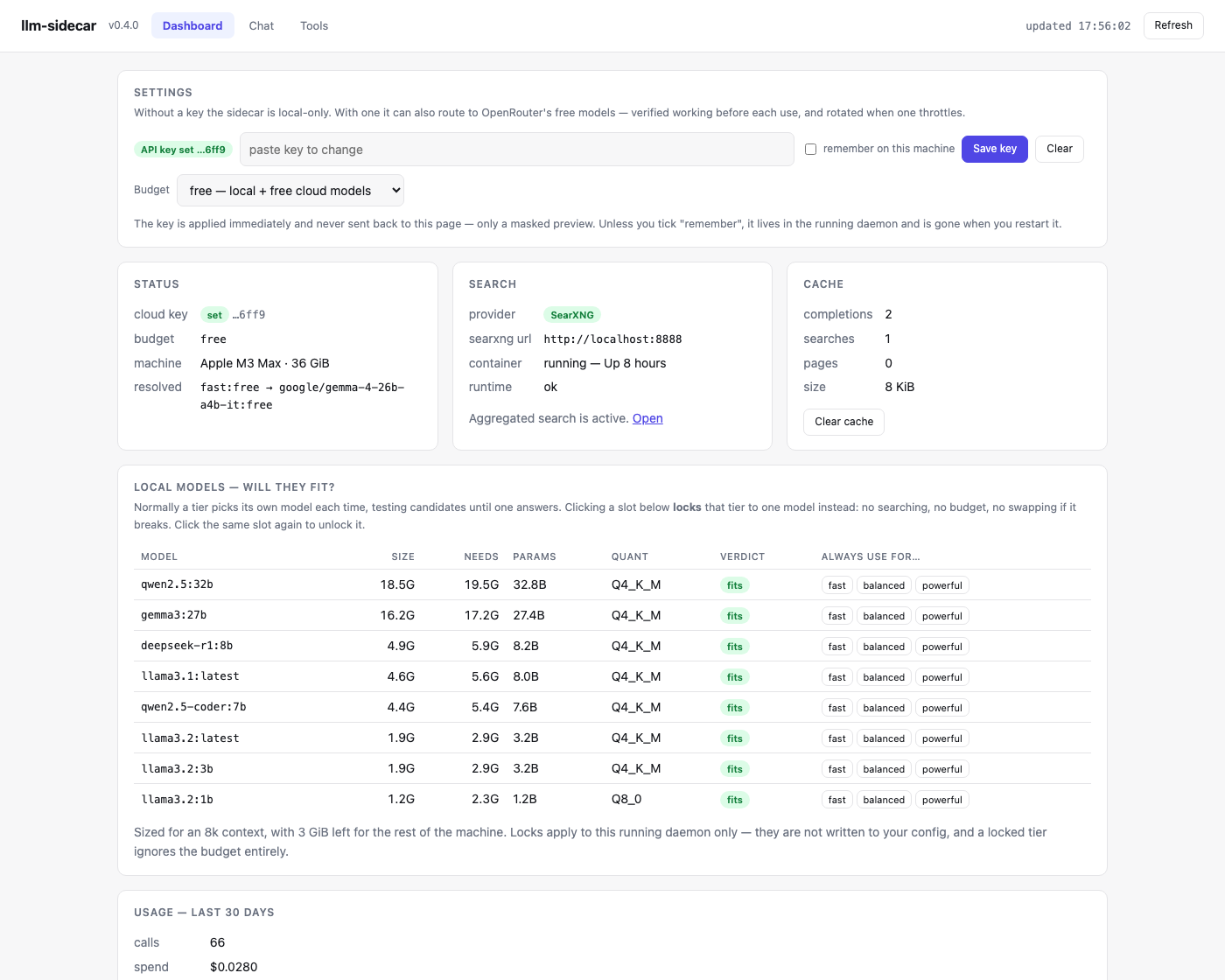
Dashboard — API key and budget, status, which local models fit, spend over 30 days, cache size, whether SearXNG is really being used. Chat — multi-turn, streaming, with the model and cost under every reply. Tools — every capability, in one place, to try before you wire it in.
One HTML file. No build step, no dependencies, no external requests — no CDN, no fonts, no analytics; there's a test asserting it. Settings apply to the running daemon and are not written to disk unless you tick "remember".
Opt out entirely with llm-sidecar serve --no-ui (or LLM_SIDECAR_NO_UI);
/ then 404s and the API is untouched. That controls serving, not
installing — the page is a ~40 KB file in the package either way.
Browser clients
The daemon sends no CORS headers by default, so a page cannot call it. That is
deliberate: it is unauthenticated on loopback, so a permissive
Access-Control-Allow-Origin would let any site you happen to visit spend your
OpenRouter credit and read whatever the daemon can reach.
Name the origins you actually want:
export LLM_SIDECAR_CORS_ORIGINS="chrome-extension://your-id,http://localhost:3000"
* is accepted and logs a warning. If you use it, set LLM_SIDECAR_TOKEN too.
On your phone
Everything the sidecar can reach — its own Ollama models, the Claude subscription signed in on this machine, OpenRouter — from your phone, at home or away, with nothing exposed to your Wi-Fi or the internet.
llm-sidecar service install   # keep the daemon running
llm-sidecar phone             # put it on your tailnet; prints the address
That uses Tailscale: install it on this machine and
on the phone, signed in to the same account. llm-sidecar phone runs
tailscale serve — never funnel, which would make it public — on its own
HTTPS port (8443), so it cannot replace anything you already serve on 443.
Only devices in your tailnet can open the address. llm-sidecar phone off
stops it.
Open the address on the phone and you get a phone-first app at /app/:
- Chat with any engine, picked by where it runs rather than by model id:
on your Mac (private, free), Claude (your subscription, via
claude -p), or Cloud (OpenRouter, by tier and budget). Every reply says which one answered and what it cost. - Web — a question answered from live pages, with the sources as cards.
- Image — generated on the Mac's GPU, kept on the Mac, shown on the phone, saved to your gallery on request. Appears only where images are available.
- Share a link or text from any app → summarise it, ask about it, fact-check it, or explain it simply.
- Voice in and replies read aloud, for using it while you walk around.
In Chrome, ⋮ → Install app makes it an app with a Share entry.
mobile/ is an Android app around the same page that adds the
system speech recogniser, saving straight to the gallery, links opening in
their own apps, and a proper offline screen. Conversations stay on the phone;
the sidecar keeps nothing of them.
Like the dashboard it is one file with no external requests, and a test asserts that.
Why the daemon now checks the Host header
Tailscale delivers the phone's requests to 127.0.0.1, so they look exactly
like requests from this machine. That is the intended boundary — your tailnet
is your devices — but it means the only thing distinguishing a request is the
name it was sent to.
So the daemon answers only to localhost, 127.0.0.1, ::1, *.ts.net
(which resolve only inside your own tailnet) and the Docker and Podman host
aliases. That check was overdue regardless of phones. Without it, any web
page you visit could reach a loopback daemon through DNS rebinding —
re-pointing its own domain at 127.0.0.1 so its scripts become same-origin
with a process that holds an API key and spends money on request.
If you call the daemon by another name, add it:
export LLM_SIDECAR_HOSTS="mac.lan,studio.local"
Binding to 0.0.0.0 turns the check off, because you have then decided it is
reachable by whatever names your network uses. Anyone in your tailnet can use
the phone app; if you share devices in your tailnet with other people, set
LLM_SIDECAR_TOKEN and the app will ask for it.
Configuration
Precedence: defaults < ~/.config/llm-sidecar/config.json < environment <
keyword arguments to Sidecar(...).
| Env var | Default | Meaning |
|---|---|---|
OPENROUTER_API_KEY | — | Unset means local-only. Settable from the dashboard. |
OLLAMA_HOST | http://localhost:11434 | Local inference endpoint |
LLM_SIDECAR_BUDGET | free | free | cheap | best |
LLM_SIDECAR_MODEL_{FAST,BALANCED,POWERFUL} | — | Lock a tier |
LLM_SIDECAR_SEARCH_PROVIDER | auto | auto | ddg | searxng |
SEARXNG_URL | http://localhost:8888 | Where to find SearXNG |
LLM_SIDECAR_HOST / _PORT | 127.0.0.1 / 4001 | Daemon bind |
LLM_SIDECAR_TOKEN | — | Require Authorization: Bearer … |
LLM_SIDECAR_HOSTS | — | Extra Host names to answer to, beyond loopback, *.ts.net and the Docker aliases |
LLM_SIDECAR_NO_UI | — | API only, no dashboard |
LLM_SIDECAR_NO_CACHE / _NO_LEDGER | — | Turn those off |
The daemon binds loopback deliberately: it holds an API key and spends real
money on request. config.save() does not write the API key unless asked.
Caching and cost
Deterministic requests (temperature=0) and searches are cached to disk,
which is why re-checking a document doesn't re-pay for the claims that didn't
change. Creative requests are deliberately not cached — a byte-identical
"random" answer is a surprise, not an optimisation. The cache is trimmed
oldest-first to 256 MiB; the ledger rotates at 8 MiB.
Performance
Measured on an M3 Max, not estimated.
| before | after | |
|---|---|---|
| Evidence gathering, 8 claims | 11.3s sequential | 2.3s parallel |
| Model probing, 4 dead candidates ahead | ~10s | 4.0s |
| Batch of 5 completions | 2.6s | 0.3s |
| Repeat deterministic completion | 8.4s | cached |
Images
Local image generation on Apple Silicon, through mflux. One install, one warm model, one queue — so every project on the machine stops carrying its own copy.
pip install "llm-sidecar[images]"
llm-sidecar image gen "a red apple on a wooden table" --out ./pics --profile draft
Profiles, not models
A caller asks for a profile. Each one fixes the model, steps, quantisation, licence, memory peak and reference limit together, so upgrading a profile upgrades every caller at once.
| profile | for | refs | commercial |
|---|---|---|---|
standard | the default — klein-4b q8, measured 22-26s at 1024x1024 | 0 | yes |
fast | FLUX.1-schnell (gated: needs an HF token) | 0 | yes |
cinematic | best-looking FLUX.1-dev | 0 | no |
zimage-negprompt | the only profile whose negative prompt works; ~31 GiB | 0 | yes |
characters-consistent | the same character across frames | 3 | yes |
kontext-edit | continuity edits to an existing frame | 1 | no |
lineart | colouring pages | 3 | yes |
upscale | SeedVR2 | 1 | yes |
llm-sidecar image profiles prints the full table with memory peaks.
What it fixes
Five projects on one machine each drove mflux themselves: three mflux versions, two repos importing another repo's virtualenv, the model reloaded on every image in the subprocess callers, per-directory locks that stopped a repo racing itself but not two repos racing each other, and five provenance formats.
-
One process owns the model. If the daemon is running, every caller — the CLI, the MCP server, the Python library, another repo — posts the job to it and never loads a model itself. This is the arrangement the rest of the sidecar already used and images did not: chat and embeddings go to Ollama, which owns those weights. mflux is a library rather than a server, so for a while whichever process called it paid the ~12 GiB, and four MCP servers answering four image requests could hold four copies.
Without a daemon it still works in-process, serialised by the machine-wide lock below. That is the fallback, not the design — and
GET /v1/images/statusreportsdelegating_to_daemonso you can tell which one you are on.A refusal from the daemon — a non-commercial profile, a missing reference — is not retried locally. It would be just as wrong here, and falling back would mean the licence check only applies when the service happens to be down.
-
One model resident at a time, swapped on demand, dropped after 10 idle minutes (1 minute for a model that takes most of the machine).
draftpeaks near 31 GiB; holding two is how a 36 GiB machine starts swapping. -
No job starts without room for it. When a job is next, the engine checks the memory free right then, not just the machine's size. If it is short, it asks Ollama to unload, then refuses with HTTP 503 and
Retry-Afterrather than load 28 GiB into a machine that is already full. That is what crashed a 36 GiB Mac twice before this check existed. Retry on 503. -
Big models can be prepared once.
llm-sidecar image prepare --profile zimage-negpromptsaves the quantised weights, so loads skip mflux's full-precision copy. Run it once with the Mac otherwise quiet. -
A watchdog during every job. If macOS memory pressure goes critical or swap climbs fast, the daemon exits to release the model at once and launchd restarts it. The job fails; the Mac does not.
-
A GPU fault restarts the engine. After a Metal timeout MLX is not usable in that process, so image work pauses for 60 seconds and the service exits for launchd to restart it.
-
A machine-wide lock, taken through a file so it holds across processes. It is what makes the no-daemon path safe, and it covers the case where a library-mode caller starts before the service does.
-
Never overwrite. The service owns naming:
<stem>_<seed>.png, with a collision becoming-2rather than a clobber or a refusal. -
One manifest beside each image, carrying the request, the model, the mflux version, the licence and a digest. Beside the image rather than in an index, so provenance survives a copy.
-
Licences are enforced, not remembered.
commercialdefaults to true, socinematicandkontext-editare refused unless a caller says the output is non-commercial. That check runs before 10 GiB loads.
Speed, and the bug that was costing it
llm-sidecar image bench times four images on your machine and prints every
one, because the interesting number is the slowest, not the average.
The first version of this module had a real bug, found by benchmarking
rather than by reading the code. Driving mflux's Python classes directly
leaves MLX's buffer cache uncapped — the CLI caps it through
CallbackManager, the classes on their own do not. It grew to 16.2 GiB
beside 3.2 GiB of live weights, and generation times became unpredictable.
There are two ways to drive mflux and each has its own cost, which is why a shared service helps either way:
| how a caller drives mflux | what it costs |
|---|---|
| Python classes in-process | uncapped cache; unpredictable times |
| the CLI, one process per image | MemorySaver evicts the text encoder, so every prompt rebuilds the model |
The sidecar takes neither: it keeps one model resident and caps the cache.
M3 Max, FLUX.2 klein-4b q8 at 1024x1024, four runs per setting, on a machine that started 92% free. Peak allocation during a generation: 11.9 GiB.
| MLX cache cap | times | spread |
|---|---|---|
| uncapped (grew to 16.2 GiB) | 22.5 – 77.6s | 3.4x |
| 4 GiB | 35.8 – 48.7s | 1.4x |
| 8 GiB | 31.8 – 40.3s | 1.3x |
| 12 GiB | 23.1 – 23.9s | 1.03x |
The pattern is not "smaller is safer". A cap below the working set makes MLX release and re-acquire memory mid-generation, and that churn is what costs the time — 4 GiB was the slowest setting tested. A cap just above the working set holds it without churning and still refuses to balloon.
So the cap is sized to the profile's peak plus 15%, not to a fraction of
RAM, and retune_mlx_cache raises it if a generation actually peaks higher
than the profile estimated — ask for 2048x2048 and it will.
Two things that looked right and were not:
- Clearing the cache after each image. That is a zero cap, and the table above shows where zero caps land. Removed.
- mflux's own
MemorySaver, which the CLI always installs and which does cap the cache. It also evicts the text encoder after encoding, and FLUX.2 keeps no prompt cache, so the model is rebuilt per prompt: 43.1 – 65.9s, about 20s of tax on every image. It trades unpredictability for a permanent cost.
What each profile actually costs
Measured on an M3 Max through the daemon, with the peak reset per
generation (mlx_peak_gib in /v1/images/status):
| profile | size | time | peak |
|---|---|---|---|
standard | 1024x1024 | 22-26s | 11.9 GiB |
characters-consistent, 2 refs | 1024x640 | 60s | 13.0 GiB |
characters-consistent, 3 refs | 1024x640 | 93s | 13.9 GiB |
zimage-negprompt | 1024x768 | ~100s | 27.8 GiB |
Two things follow for anyone planning a batch:
- Reference-guided editing is the expensive operation, not generation — 93s against 23s, and a book is mostly edits. Budget from the edit figure.
- Switching profiles unloads and reloads, so order a batch by profile: generate everything, then upscale the keepers, rather than interleaving two models and paying the swap each time.
Quality is why this runs at q8
Your choice of quantisation decides this far more than any tuning:
| 1024x1024 | output | |
|---|---|---|
| bf16 | 125.6s | swaps on 36 GiB |
| q8 | ~32s | clean |
| q4 | 30.2s | paints a fake signature |
| pre-quantised 4-bit | 25.7s | paints a fake signature |
4-bit is genuinely faster and genuinely worse, so every profile pins q8 or
better and profiles.py refuses anything below it.
Keeping a model resident is not about speed
The original premise here was that reloading costs real time, so a warm model is faster. It is not: mflux loads weights lazily, construction is under a second, and a warm model measured no faster than a cold one. What holding one model buys is a bound on how much sits in memory at once — which on a 36 GiB laptop with a 31 GiB profile is reason enough, just not the reason originally claimed.
Skipping work that is already done
The manifest digest covers everything that changes the pixels — prompt, negative, model, steps, size, seed, and the contents of the reference images rather than their paths. Renaming a reference does not invalidate an image; editing one does. Regenerating a folder skips what has not changed.
Content policy stays in your project
The Quran imagery gate, the modesty rules, the anachronism lists — those are editorial judgements belonging to the repo that holds them. This service never weakens a project's gate and does not try to own one.
Not installed by default
[images] is deliberately outside [all]. mflux is built on MLX and runs on
Apple Silicon only, and it pulls several GB of toolchain, so install.sh
would otherwise impose it on every developer on every platform. Everything
under llm_sidecar/images imports mflux lazily: the package installs,
imports and tests cleanly without it, and the HTTP routes answer 501 with
an explanation rather than a stack trace.
Writeups
- My image generation got slower the longer it ran, and a smaller cache made it worse — benchmarking an MLX image service: why a cache cap below the working set was the slowest setting tested, why a warm model was not faster, and the process-lifetime peak reading that made one model size another's cache.
Honest limitations
- Verification is only as good as retrieval. The verifier can only grade
what came back; ambiguous evidence produces a wrong verdict. Unverified
claims are re-checked against full page text, and SearXNG covers more
engines — neither is a fix. When retrieval finds nothing useful you get
unverified, and that is the correct answer. read_urlstrips<nav>/<header>/<footer>and finds the content region, but it's regex-based, not a readability port. Unusual markup degrades to the whole page.- Streaming bypasses the completion cache. Replaying stored tokens is a different feature.
- The daemon has no request queue or admission control. Fine for one user, wrong for anything shared.
- Parallel verification helps against cloud models, not against a single local Ollama model — those queue server-side anyway.
- Embeddings are local-only. OpenRouter proxies chat completions and
lists no embedding models at all, so
embed/rankneedollama pull nomic-embed-text. They refuse rather than falling back to a chat model, because chat-model vectors rank wrongly — measured: asked to rank for "python backend developer", one put "C++ embedded engineer" above "5 years Django and FastAPI". Passallow_chat_model=Trueto override. - No vector store or cross-session memory. Storing and retrieving embeddings is a different product; producing them is not.
searxng installruns SearXNG natively on macOS (launchd) and Linux (systemd user unit), and needs git and Python 3.10+. Anywhere else, run SearXNG yourself and setSEARXNG_URL.claude/ignoresmax_tokensandtemperature, because the CLI has no flag for either. They are dropped rather than approximated — amax_tokensthat silently does nothing is worse than one that is documented as absent. Multi-turn conversations are flattened to a transcript for the same reason: the CLI takes one prompt, and pretending turn boundaries survived would be the dishonest version.
Layout
| Module | Responsibility |
|---|---|
config.py | Config dataclass, file + env loading |
catalogue.py | OpenRouter list (disk-cached), local Ollama models |
picker.py | Candidate ranking, live probing, pick / pick_pool |
client.py | complete / stream, provider routing, backoff, web plugin |
answer.py | Grounded question answering |
verify.py | Claim extraction, evidence, grading, escalation |
ops.py | summarise / classify / extract with pinned schemas |
search/ | Provider dispatch, DDG, SearXNG, read_url, search health |
searxng_native.py | SearXNG as a login service (launchd/systemd) |
cache.py · ledger.py · hardware.py | Cache, spend record, memory fit |
daemon.py · mcp_server.py · cli.py · ui/ | The four doors |
phone.py · ui/app.html | The phone app, the Host check, llm-sidecar phone |
mobile/ | The Android app (Flutter); not part of the Python package |
The core imports nothing but httpx. FastAPI and mcp are optional extras,
pulled in only by the doors that need them:
pip install -e ".[search]"    # web search
pip install -e ".[daemon]"    # HTTP server + dashboard
pip install -e ".[mcp]"       # MCP server
pip install -e ".[all]"
Tests
pytest
152 tests, fully offline — every network path is stubbed. Live-provider behaviour is verified by hand.
Licence
MIT.