groundcheck — decision-grade fact verification
Verify claims, resolve FIGI identity, extract claims, and sign x402 delivery receipts over MCP.
One address for any MCP client. No sign-in needed on this server.
What it does
3 read2 other
Grouped by tool name. At most: only reads or looks up information.
What it costs
FreeOdel charges nothing per call. The publisher may charge for its own service.
Tools
5 · grouped by tool name · checked 8 Oct 2026Read · 3Look things up
- verify_claim
- check_citations
- resolve_instrument
Other · 2Neither hinted nor named
- extract_claims
- attest_delivery
Groundcheck
Exact dated SOFR, EFFR and OBFR percentage claims use the NY Fed's official
benchmark API before general retrieval. For example, SOFR was 3.88% on 2026-09-29. is compared with that effective date's published percentRate.
The evidence retains the date, retrieval time and response digest. Missing or
ambiguous prints remain unverified; the route does not infer a date, certify an
original historical vintage, or transfer the language-model calibration.

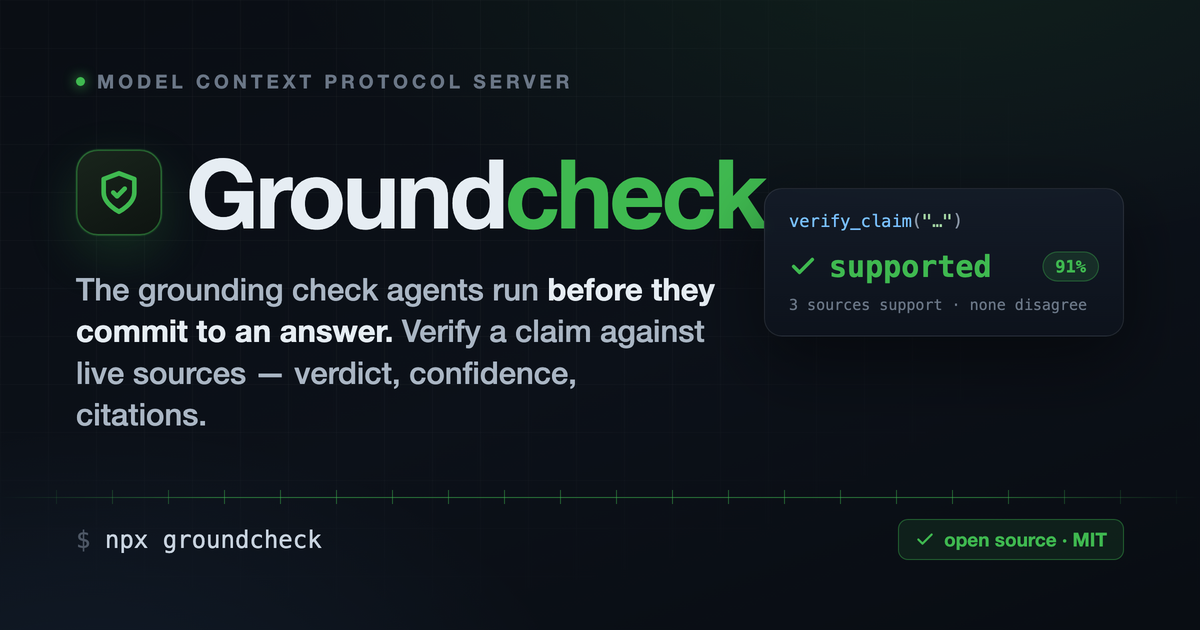
The grounding check agents run before they commit to an answer.
Groundcheck verifies a factual claim against live sources and returns a verdict, a confidence score, and citations. Any agent — Claude Code, Cursor, your own — can call it mid-task, before it states a fact it isn't sure of.
It is also a verification layer for agentic commerce: when an agent pays another
service over x402, attest_delivery verifies what was delivered against what was
advertised and issues a signed, offline-verifiable delivery receipt binding payment →
delivery → grounded content — the neutral accountability trail the a2a-payments
literature calls the missing layer (docs/delivery-attestation.md).
Architecture
Two parts, each in the language that fits it:
server/   TypeScript MCP server   — thin protocol layer (stdio). Holds no logic.
engine/   Python FastAPI service  — retrieval + stance classification + the verdict brain.
The MCP server is spawned by your client over stdio and talks to the engine over HTTP
(GROUNDCHECK_ENGINE_URL, default http://127.0.0.1:8723). The engine is the single source
of truth for how a verdict is reached, and it classifies source stance through the canonical
Python free-llm-router (free-tier providers).
verify_claim ─▶ TS MCP server ─HTTP▶ Python engine
                                        ├─ retrieval  (Wikipedia, keyless; or your own search)
                                        ├─ stance     (free-llm-router → supports/refutes/neutral)
                                        └─ verdict    (refuses on conflict, saturating confidence)
Tools
| Tool | Use it when | Returns |
|---|---|---|
verify_claim(claim, maxSources?) | About to assert a fact you're unsure of | { verdict, confidence, rationale, sources } |
check_citations(text, maxClaims?) | Before publishing an AI-generated draft | per-claim verdict report |
attribution_badge() | Want to mark content as checked | a Markdown badge |
resolve_instrument(query, idType?, maxResults?) | Text names a security and you need to know exactly which one | canonical FIGI records + provenance (Bloomberg open symbology) |
extract_claims(text, maxClaims?) | Want to see which claims a document makes before paying to ground them | atomic checkable claims + a signed receipt bound to the input hash |
attest_delivery(service, response_text, …) | You paid another service over x402 and will act on (or account for) its output | a signed delivery receipt binding payment → delivery → grounded content (docs) |
verdict is one of supported · refuted · unverified. Each verdict also
carries a sufficiency tag (sufficient · insufficient · no_sources ·
no_stance · conflict) so an agent can tell "I found nothing" from "sources
exist but don't establish it" from "sources disagree" — the three ways an
abstention happens carry different meaning and are no longer collapsed
(SURE-RAG).
Compound claims are decomposed. A claim like "Marie Curie won two Nobel
Prizes and was born in Paris" is split into atoms
(Fact in Fragments), each verified on its
own evidence and recombined weakest-link: one false part refutes the whole, one
unproven part blocks a supported. The true half can no longer carry the false
half past the check. The atom breakdown is returned in atoms. (Decomposition
is rule-based and high-precision — it splits only on clean conjunction
boundaries and otherwise leaves the claim whole; disable with
GROUNDCHECK_DECOMPOSE=0.)
Remote MCP (no install): add https://groundcheck.seiche.info/mcp as a remote MCP server (Claude/ChatGPT/Cursor connectors, or a gateway like Smithery/Glama). Speaks streamable-HTTP JSON-RPC; verify_claim is free, the paid tools answer HTTP 402 with an x402 offer.
Quickstart
The MCP server auto-starts the Python engine if one isn't already running, so a single registration is enough — no separate process to babysit.
make install                      # deps for both halves (pip + npm)
npm --prefix server run build     # compile the server
export GROQ_API_KEY="gsk_..."     # one free key for stance classification (Groq: ~2 min, 14,400/day)

# register with your MCP client — the engine spawns on first use and stops with the server
claude mcp add groundcheck -- node "$PWD/server/dist/server.js"
Already running the engine yourself (make engine or docker compose up -d)? The server
detects and reuses it — and won't touch an engine it didn't start. Set
GROUNDCHECK_NO_SPAWN=1 to stop it from ever spawning one.
Once published to npm, registration becomes
claude mcp add groundcheck -- npx -y groundcheck-mcp. Auto-spawn needs a localengine/+ Python deps; for an npx-only install, run the engine viadocker compose up -dand the server connects to it overGROUNDCHECK_ENGINE_URL.
With no provider key the engine still runs — retrieval works, but every verdict is
unverified. It degrades honestly: a disabled backend, a missing key, or conflicting sources
all flow toward unverified. An unconfigured Groundcheck cannot return supported.
Note: OpenRouter's
:freemodels are quota-throttled (HTTP 429) and make a poor sole provider. Prefer Groq or Cerebras for the fast classification tier.
Why grounded verdicts, not LLM-judgment
Asking an LLM to judge whether a claim is true is unreliable in a way that's easy to miss. In TraderBench (Yuan et al., 2026), the same candidate responses re-scored by three frontier LLM judges swung by ~29 points on the knowledge-retrieval section — while the performance-grounded section, whose scoring is anchored to verifiable computation, swung 0.3. The lesson: the more you constrain a judgment with external evidence, the less it varies.
Groundcheck is built on that principle. It never asks a model "is this true?" from parametric memory. Instead it:
- retrieves sources first, then asks only the narrow, evidence-anchored question — does this cited passage support, refute, or stay neutral on the claim (stance classification);
- refuses on conflict and saturates confidence, so disagreement flows to
unverifiedrather than a confident guess; - returns citations, so the verdict is checkable, not taken on the model's word.
That's the difference between an LLM judge and a grounding check: the judge's discretion is the product; here it's deliberately fenced in by retrieved evidence.
Calibrated verdicts: the "error ≤ α" guarantee
A confidence number without a promise attached is just vibes with decimals. When a
calibration artifact is deployed, Groundcheck attaches a guarantee object to
directional verdicts, built with split conformal prediction (adapted from
Multi-LLM Adaptive Conformal Inference, arXiv:2602.01285):
- Stance classification runs as a panel: up to
GROUNDCHECK_ENSEMBLE_MAXfree providers judge the claim independently (different model families disagree on which claims they get wrong, so the ensemble beats any one of them). Per-source stances are majority-voted; each panelist also emits a probability the claim is true given only the snippets, combined into a weightedensemble_score. scripts/calibrate.pyruns the real pipeline over a labeled claim set and stores finite-sample thresholds per claim group (instrument/general,globalfallback) incalibration/calibration.json.- A verdict is certified (
guarantee.certified: true) only when its score clears the threshold. The math guarantees that, for claims exchangeable with the calibration set, a false claim is certifiedsupportedwith probability ≤ α (default 0.1), and symmetrically forrefuted. No distributional assumptions, exact in finite samples.
Honest degradation, as everywhere else: no artifact → no guarantee is ever claimed; too little calibration data for a given α → the threshold is refused rather than extrapolated. The guarantee is only as good as the exchangeability assumption — recalibrate with domain claims before leaning on it in a new domain.
Configuration (engine)
| Var | Default | Purpose |
|---|---|---|
GROUNDCHECK_SEARCH_BACKEND | (unset) | stub to disable real retrieval |
GROUNDCHECK_SEARCH_URL | Wikipedia | custom JSON search endpoint ({results:[{title,url,snippet,stance?}]}) |
GROUNDCHECK_SEARCH_KEY | — | bearer token for the custom endpoint |
GROUNDCHECK_ROUTER_PATH | sibling checkout | path to the free-llm-router Python package |
GROUNDCHECK_ENGINE_HOST / _PORT | 127.0.0.1 / 8723 | engine bind address |
GROQ_API_KEY (or any router provider key) | — | enables stance classification |
GROUNDCHECK_ENSEMBLE | 1 | multi-provider stance panel (0 = single-router) |
GROUNDCHECK_ENSEMBLE_MAX | 3 | max concurrent panelists per claim |
GROUNDCHECK_CALIBRATION | calibration/calibration.json | conformal artifact path |
Machine-payable hosting (x402)
A hosted engine can charge AI agents per call in USDC over the
x402 protocol — HTTP 402 + signed transfer authorization,
no accounts or API keys. Dormant unless GROUNDCHECK_X402_PAY_TO is set;
/verify stays free forever and is the way to evaluate output before paying;
the paid surface prices as a granular verification loop: extract $0.005 → ground
$0.02 → delivery-attestation bundle $0.05 (plus /resolve at $0.005).
Both protocol generations (v1 and v2) are accepted, and agents can read the
offer at GET /.well-known/x402. Full operator guide: docs/x402.md.
Server side:
| Var | Default | Purpose |
|---|---|---|
GROUNDCHECK_ENGINE_URL | http://127.0.0.1:8723 | where the server finds the engine |
GROUNDCHECK_NO_SPAWN | (unset) | set to disable auto-spawning the engine |
GROUNDCHECK_ENGINE_DIR | repo engine/ | engine location for auto-spawn |
GROUNDCHECK_PYTHON | python3 | interpreter used to spawn the engine |
GROUNDCHECK_REPO_URL | repo URL | URL used in the attribution footer/badge |
Development
make test        # engine pytest (verdict rule + x402 gating) + server typecheck
make engine      # run the engine
make server      # run the MCP server in dev (tsx)
make build       # compile the server to server/dist
The interesting logic is in engine/groundcheck_engine/verdict.py: how much source
agreement counts as "supported," how conflict is handled, and how confidence saturates.
MIT.