
 ██████╗ █████╗ ██████╗ ████████╗ ██████╗  ██████╗ ██████╗  █████╗ ██████╗ ██╗  ██╗███████╗██████╗
██╔════╝██╔══██╗██╔══██╗╚══██╔══╝██╔═══██╗██╔════╝ ██╔══██╗██╔══██╗██╔══██╗██║  ██║██╔════╝██╔══██╗
██║     ███████║██████╔╝   ██║   ██║   ██║██║  ███╗██████╔╝███████║██████╔╝███████║█████╗  ██████╔╝
██║     ██╔══██║██╔══██╗   ██║   ██║   ██║██║   ██║██╔══██╗██╔══██║██╔═══╝ ██╔══██║██╔══╝  ██╔══██╗
╚██████╗██║  ██║██║  ██║   ██║   ╚██████╔╝╚██████╔╝██║  ██║██║  ██║██║     ██║  ██║███████╗██║  ██║
 ╚═════╝╚═╝  ╚═╝╚═╝  ╚═╝   ╚═╝    ╚═════╝  ╚═════╝ ╚═╝  ╚═╝╚═╝  ╚═╝╚═╝     ╚═╝  ╚═╝╚══════╝╚═╝  ╚═╝
MCP governance server in Go for the Agentic Wiki — knowledge that composes, not that you query.





[!WARNING] Beta software. Cartographer is pre-1.0: the MCP tool surface, CLI and configuration may change between minor releases without a deprecation period. Breaking changes bump the minor version (0.x semantics) and are called out in the changelog. Expect rough edges — bug reports are very welcome.
LLM agents forget everything between sessions, and stateless RAG only bolts retrieval onto that amnesia. The alternative is a knowledge base the agent itself builds and maintains over time — but letting an agent loose on a folder of files ends in broken links, lost history, and silent corruption. Cartographer is the governance layer that makes the pattern safe: the agent works the wiki exclusively through MCP tools, and the server enforces every invariant — validation, linking, immutability gates, one git commit per write.
What is it
Cartographer implements the Agentic Wiki: a persistent knowledge base of interlinked Markdown files that an LLM agent grows and curates by talking to the server over the MCP protocol. The agent never touches the files directly.
The wiki is grounded in Karpathy's "LLM Wiki" pattern (operating model: knowledge accretes
over time, it is not stateless RAG) on top of the OKF substrate (Open Knowledge Format v0.1 by
Google Cloud) — each KB is a folder of .md files with YAML frontmatter, self-contained and
version-controlled with git. Zero lock-in: the wiki is readable by any tool, including Obsidian and
any text editor.
Cartographer offers two complementary profiles:
- Local Core — single agent, stdio transport, local git. Captures the value of the pattern with minimal complexity.
- Server — multi-KB, HTTP + token auth. One server holds several knowledge bases, hands each client the artifacts its KBs define, and lets a team share some KBs while keeping others private.
Two consequences are worth stating on their own, because they are what most of the design is for: the KB configures the agents that read it across every client you use, and it does that for a whole team rather than a single laptop.
One KB, every agent
A knowledge base is not only what an agent reads — it is also how that agent is set up to work. Cartographer treats skills, subagents, hooks and standing instructions as content of the KB, and materializes them into each client's native format.
The manual alternative is what most setups do today: the same skill hand-copied into
.claude/skills/, .opencode/skills/ and .codex/skills/, each drifting on its own, each config
file edited by hand for every MCP endpoint. Change one thing and you change it in five places, on
every machine, forever.
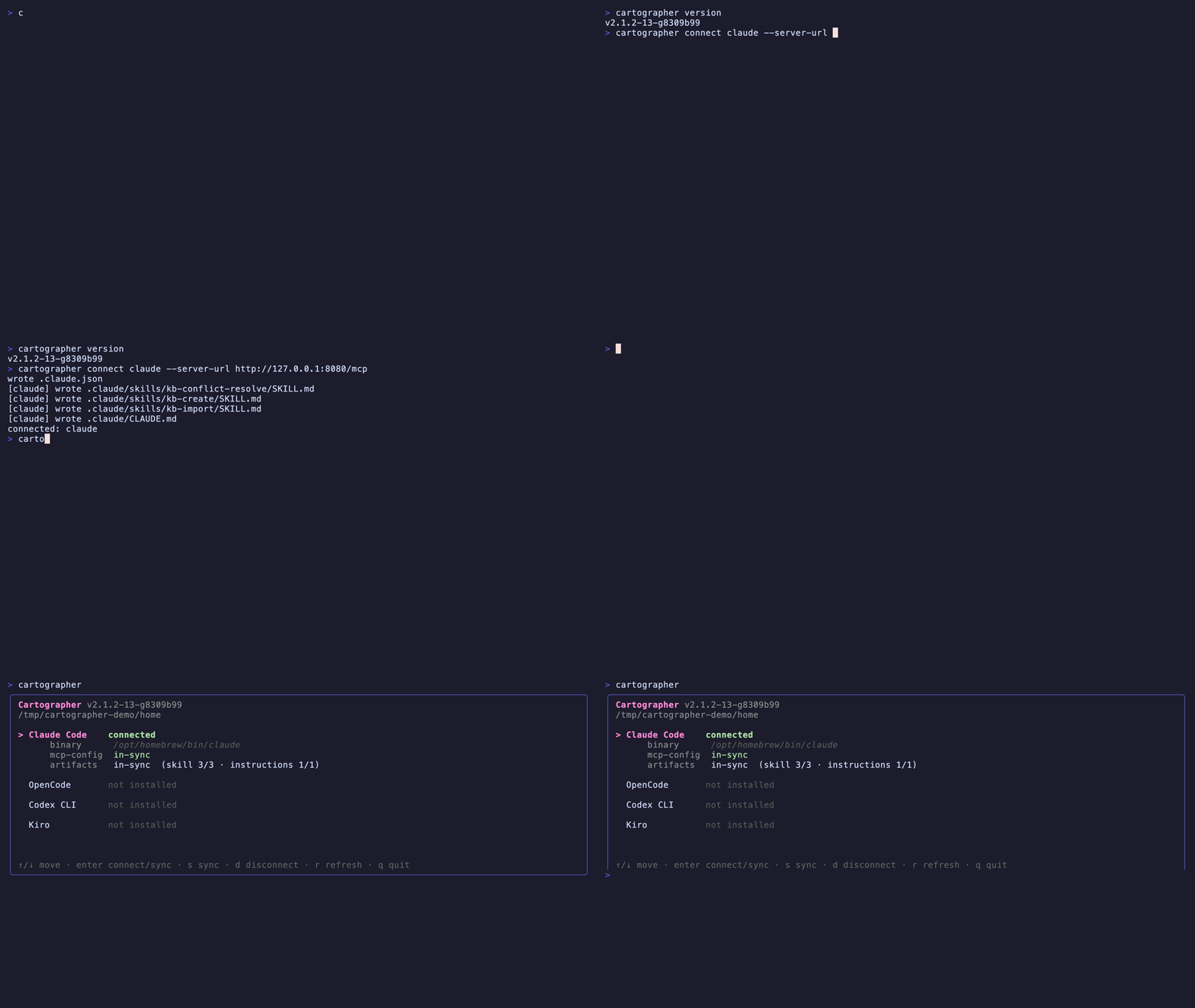
cartographer connect # detects installed clients and configures all of them
That single command writes, per client and in the format that client expects:
| claude | opencode | codex | kiro | hermes | |
|---|---|---|---|---|---|
| MCP endpoint | .claude.json | opencode.json | config.toml block | .kiro/settings/mcp.json | rendered by its own deploy |
| Skills | .claude/skills/ | .opencode/skills/ | .codex/skills/ | .kiro/skills/ | delivered to its inbox |
| Subagents | .claude/agents/*.md | .opencode/agent/*.md | .codex/agents/*.toml | — | — |
| Hooks | settings.json | generated JS plugin | config.toml block | — | — |
| Instructions | block in CLAUDE.md | block in AGENTS.md | block in AGENTS.md | .kiro/steering/ | — |
Subagents and hooks are translated, not copied: the same KB artifact becomes a Markdown agent
for Claude Code, a TOML one for Codex, and a generated JavaScript plugin where a hook has no native
equivalent. Cells that cannot exist are unsupported by explicit declaration, never by silent
omission — and a cell missing from the table fails a test.
What keeps it true after the first run:
- it re-syncs by itself — a
SessionStarthook on every client that has one, a scheduled timer for those that don't; - it verifies the files on disk, not just its own bookkeeping: an artifact edited by hand or deleted is restored from the server;
- every materialized file carries a provenance stamp saying which KB it came from and where to edit it for real;
- it only ever touches what it created — pruning is limited to its own tracked paths, and
--dry-runshows the plan without writing; doctordiagnoses residues and drift read-only;reconnectrebuilds a client from scratch while preserving every setting.
Edit a skill once in the KB, and every client of every machine converges on it.
Teams
The same mechanism is what makes Cartographer work for more than one person. A server mounts
several KBs and routes by ?kb=<name>, so colleagues can each keep a private knowledge base while
sharing others.
- Per-KB authorization — bearer tokens carry
kb:<name>:rorkb:<name>:rwscopes. Roles (docs/transport-auth.md) narrow that further to specific maps, journals and concept types, so a teammate can be an editor of the runbooks and a reader of everything else. Rules are unioned: adding a role can only widen access, never silently revoke it. - Git is the sync layer — every write is a commit, with fetch/pull-rebase before and push after,
so teammates running their own server against separate clones of the same remote converge
without a coordination protocol. A conflict is then not an error page but a workflow: the affected
concepts are flagged
degraded,conflicts_listenumerates them, and a bundled skill walks an agent through resolving them. (One process is the sole writer of a given working copy; pointing two writers at one checkout is not a supported model — partition KBs across instances instead, seedocs/concurrency.md.) - Shared content stays portable — a skill that mentions a local repository uses a
{{repo:<name>}}placeholder resolved on each client from its own git remotes, so the same artifact works on every teammate's machine without machine-specific paths leaking into the KB. A server-side lint flags the ones that do. - Provenance you can verify — a KB can sign its provisioning artifacts with Ed25519; clients pin the public key out of band and refuse anything that fails verification. Distributing a skill to a team is then a checkable act, not a matter of trust.
- Per-KB identity — commit author and an optional tool-name prefix are configured per KB, so history attributes correctly and an agent mounting several KBs never confuses their tools.
Key features
- 🔧 Full MCP tool suite — complete list in
docs/control-plane.md - 📖 Read & navigation —
atlas_overview,index_get,concept_read,map_list,graph_neighbors(outbound links or backlinks) andconcept_list(scoped frontmatter facets) - 🔍 Search — keyword: a pure-Go inverted index, or SQLite FTS5 with a trigram tokenizer when the KB has a persisted index
- ✍️ Validated writes with optimistic concurrency (
if_match/ content-hash), includingconcept_newfrom KB-owned templates discovered throughtemplate_list,index_patchfor curating root/Map/Journalindex.mdentries with the same boundedconcept_patchsemantics, andconcept_batchfor atomic multi-concept writes/patches across a large refactor (one commit, full rollback on any failure) - 📎 Concept assets — read, write, list, and delete binary or text dossier files inside expanded concepts
- 🛡️ Governance — deterministic
lint(broken link, stale claim, orphan, map contracts),commit_gate,gate_check,supersede, contradiction tracking - 🧬 Transactional git — one commit per write operation; optional synchronization to a remote (fetch/pull-rebase before and push after every write), which is also what lets several instances serve one KB — see Teams
- 🔐 Audit log — append-only with hash-chain and Ed25519 signature
- 🧩 Domain skills (
SKILL.md/ agentskills.io format), including executable scripts and binary assets — see One KB, every agent for how they reach each client - 🔑 Secrets via SOPS — JSON Pointer references, scoped resolution and safe rotation; plaintext values never stored
- 📦 OKF-compliant — each KB is an OKF bundle and a standalone git repo, zero lock-in (just git + Markdown)
Architecture
Cartographer separates a data plane from a control plane:
- Data plane — the KB itself: OKF Markdown files under
data/, organized as atlas → map → concept (the KB, its thematic archives, the pages; journals are the chronological maps). Plain files + git: history, diff, backup, sharing for free. - Control plane — the MCP tools the agent calls. The server applies every invariant (validation, gates, immutability) so the agent operates safely without direct filesystem access.
The interaction rests on the MCP + Skill + Hook triad: MCP carries data and capabilities, Skills carry procedural know-how loaded on demand, Hooks carry deterministic 0-token automation.
flowchart LR
    A["🤖 Agent (LLM)<br/><i>only via MCP — never touches files</i>"]
    S["Cartographer<br/>Go MCP server<br/><i>invariants enforced server-side</i>"]
    KB[("KB<br/>Markdown + git")]
    R[("remote git")]
    A -- "MCP tools" --> S
    S -- "bounded reads" --> A
    S -- "one commit<br/>per write" --> KB
    KB -. "sync in/out" .-> R
Install
# macOS (Homebrew)
brew install beppetemp/tap/cartographer

# Linux / macOS without Homebrew
curl -fsSL https://raw.githubusercontent.com/BeppeTemp/cartographer/main/install.sh | sh

# From source (Go 1.26+)
go install github.com/BeppeTemp/cartographer/cmd/cartographer@latest
Agent-driven install
Give an agent this prompt to install Cartographer, mount its first KB, connect itself, and verify the setup:
Set up Cartographer on this machine by following
https://raw.githubusercontent.com/BeppeTemp/cartographer/main/docs/agent-install.md
My first knowledge base is at: `<git remote URL>`
Quick start
The primary path is four commands: install the binary, run it as a native service, create your first KB, and connect an agent client to it.
brew install beppetemp/tap/cartographer   # or curl install.sh, or `go install` (see Install above)
cartographer service install              # generates config, installs and starts the service
cartographer kb create <name> --remote <url>  # scaffolds a KB in the data dir, pushes it to <url>
cartographer connect                      # configures every detected client — see One KB, every agent
--remote <url> is an empty git repository that becomes the KB's origin: a KB is a git
repository, and that remote is what makes it durable and syncable (--no-remote creates a
local-only KB that is neither, D134). A repository that already holds a KB is mounted with
cartographer kb clone <remote> instead. kb create prints how to get the server to pick up the
new KB (cartographer service restart, or --restart to do it and wait for it automatically);
service install itself hints at kb create if it starts with no KB mounted yet.
Upgrades of a native local install (brew upgrade or install.sh update) repair themselves:
the new binary restarts the running service and re-synchronizes the configured providers in
place — repair in place is the default, and cartographer reconnect is the explicit rebuild for
what an incremental sync cannot see. Only already-open agent sessions need restarting. See docs/deployment.md §Upgrades, schema migration, and repo growth.
connect with no flags in a TTY opens an interactive form (server URL, server
name, token env var, auth) instead of the flag defaults; pass --no-input to
force the non-interactive behavior. Once connected:
cartographer status    # drift check and client/server version check after upgrades; exit 0 in-sync / 1 drift / 2 error
cartographer sync      # re-apply after drift
cartographer doctor    # read-only diagnosis of the client configuration: residues, drift, missing triggers
cartographer reconnect # rebuild a client configuration from scratch, preserving every setting
For local stdio use (a single KB, no service, typically for development) or a manually-configured
HTTP server, see serve --kb <path> --init in docs/deployment.md — the native-service path above
covers everyday use.
Configuration
| Environment variable | Default | Description |
|---|---|---|
CARTOGRAPHER_KB | — | KB path(s) (single, or multiple comma-separated) |
CARTOGRAPHER_DATA | — | Directory whose subfolders are auto-discovered KBs |
CARTOGRAPHER_HTTP | — | HTTP address (e.g. :39273). Absent = stdio only |
CARTOGRAPHER_AUTH | auto | true / false / unset (auto on HTTP) |
CARTOGRAPHER_TOKENS | — | Comma-separated bearer tokens |
CARTOGRAPHER_GIT_AUTOCOMMIT | true | One git commit per write operation |
CARTOGRAPHER_GIT_SYNC | true | fetch/pull-rebase + push on origin around each write |
CARTOGRAPHER_AUDIT_LOG | — | Audit log file path |
CARTOGRAPHER_AUDIT_KEY | — | Ed25519 key for audit signing |
Full list with CLI flags and defaults → docs/deployment.md.
Building and testing
make build         # → bin/cartographer
make test          # Unit tests (go test ./...)
make smoke         # stdio smoke test
make smoke-http    # operator-level HTTP smoke test (creates temp KBs via curl)
make e2e           # deterministic HTTP/CLI end-to-end scenarios
The E2E suite drives the compiled binary through HTTP, CLI, filesystem and real
temporary git remotes. It is deterministic, requires no model credentials and
runs in CI. Full strategy → docs/testing.md.
Project structure
cmd/cartographer/   # single binary: server (serve), client (connect/status/sync/kb/service), TUI
internal/           # okf, kb, mcpserver, search, sqlindex, lint, gitx, audit, auth, embed,
                    # skill, sops, configurator, provisioning, agents, clientconfig, client
docs/               # full documentation (docs/index.md is the map)
test/               # deterministic HTTP smoke and cross-component E2E tests
Package-by-package map, with what each one owns → AGENTS.md §Code map (kept next to
the contributor instructions so there is a single copy to keep true).
Documentation
Browsable at beppetemp.github.io/cartographer — same content as docs/, rendered.
The full index lives in docs/index.md. Main entry points:
docs/overview.md— vision, guiding principles, architecturedocs/data-plane.md— KB model, hierarchy, OKFdocs/control-plane.md— Go server, MCP tool APIdocs/concurrency.md— single-writer, git sync, conflictsdocs/deployment.md— topologies (local service / k8s / multi-server), backup, env vars
Contributing
Issues and PRs are welcome — see CONTRIBUTING.md for the build/test loop, the
PR flow (squash-merge, conventional titles, docs updated in the same PR), and how to find your way
around the codebase. Cartographer is a personal project maintained on a best-effort basis: no
response-time SLA. For security reports, see SECURITY.md.
License
Released under the Apache License 2.0. See LICENSE.