Listed from the MCP registry; nobody on Odel publishes it.

regressGuard
Deterministic API regression checks for AI agents: snapshot a baseline, catch broken contracts.
Runs on your machine from its package; the steps are below.
What it does
- Reads
- Writes
- High impact
At most: only reads or looks up information.
What it costs
FreeOdel charges nothing per call. The publisher may charge for its own service.
Runs locally over stdio
This server isn't hosted — your MCP client launches it from a package registry. Use one of the commands below, or drop the config into your client (e.g. Claude Desktop).
Distributed as an MCP bundle (`https://github.com/Bharath-code/regressGuard/releases/download/v0.2.4/regressguard.mcpb`) — download it and import the bundle in your MCP client.


Before you commit, know what broke.
When an AI coding agent edits your app it can silently break an API contract — a removed field, a changed status code, a test that now fails — and still report success. RegressGuard records a known-good baseline and tells you (or the agent) exactly what regressed.
It is built to live inside the agent's own loop. RegressGuard ships as an MCP server, so agents like Claude Code and Cursor can verify their own work and self-correct before a human ever sees the diff — zero extra steps. The same engine also runs as a plain CLI for humans and CI.
# Agent-native (primary): the agent calls these as MCP tools in its loop
check → status                  # see "Agent-native verification (MCP)" below
                                 # the baseline stays yours: agents cannot re-record it

# Human / CI (also works): two commands, no test-writing, under 15 seconds
regressguard snapshot   # record the known-good state
regressguard check      # compare after edits — see what broke
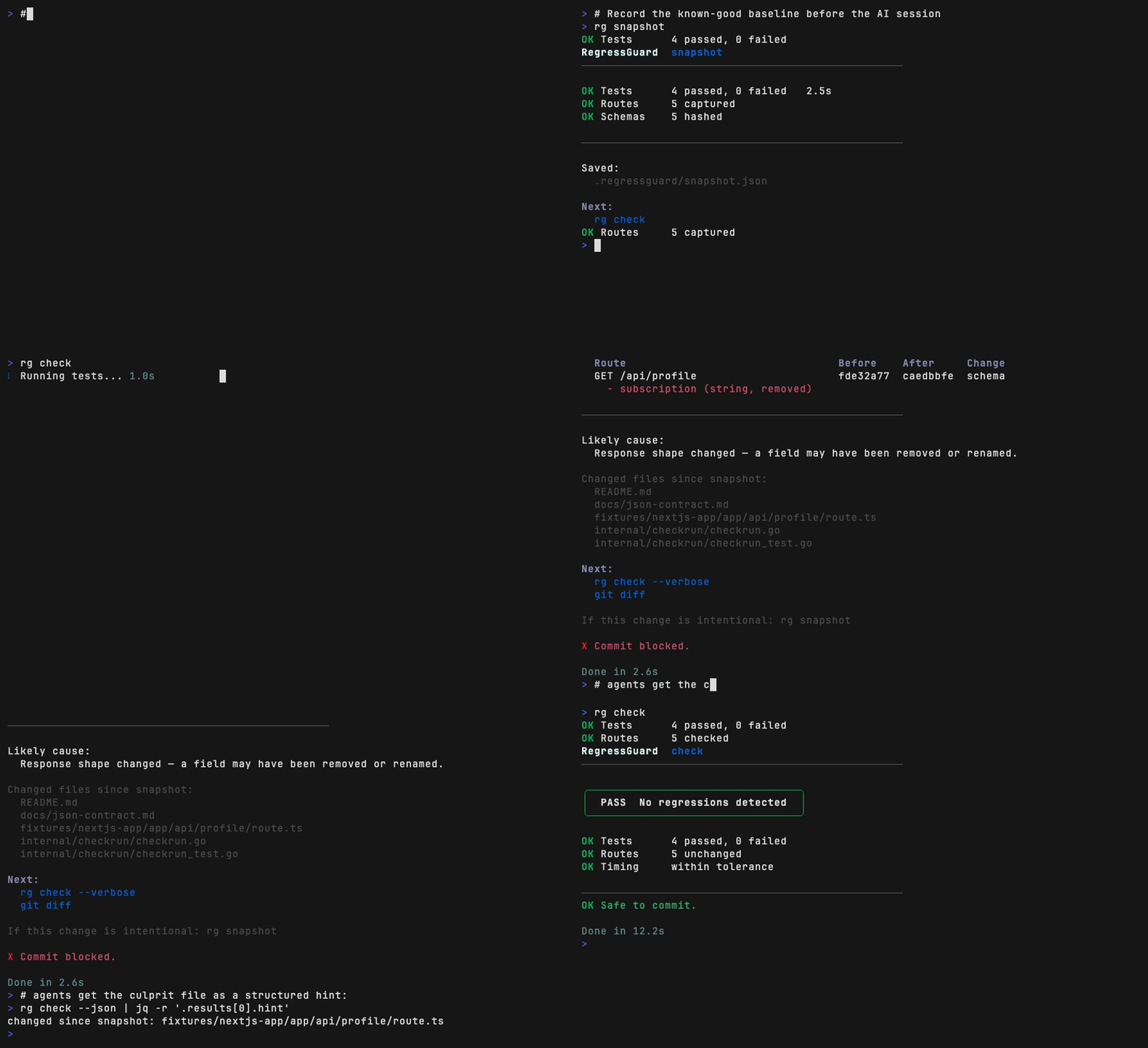
Break → detect → fix → green. Reproduce it yourself: ./demo/demo.sh.
Install
macOS / Linux (recommended)
curl -fsSL https://raw.githubusercontent.com/Bharath-code/regressguard/main/install.sh | sh
Verify
regressguard version # first line must say "RegressGuard"
Upgrading from v0.1.x? The binary was renamed from
rgtoregressguardbecausergcollides with ripgrep. There is norgshim and the oldrg upgradecan't fetch v0.2.0: re-run the installer, delete the oldrg, then runregressguard hook install(old hooks callrg;regressguard doctorflags them).
Quickstart (3 minutes)
1. Initialize your project
cd your-project
regressguard init
RegressGuard detects your test command, framework, and dev server URL automatically.
2. Record the baseline before your AI session
Make sure your dev server is running, then:
regressguard snapshot
Output:
Snapshot

OK Tests       42 passed, 0 failed       6.8s
OK Routes      6 captured, 2 skipped
OK Schemas     6 hashed

Saved:
  .regressguard/snapshot.json

Next:
  Ask your AI agent to make the code change, then run:
  regressguard check
3. Run your AI agent
Let Claude Code, Cursor, or Codex make its changes.
4. Check for regressions before committing
regressguard check
Clean — safe to commit:
Check

OK No regressions detected

  Tests       42 passed, 0 failed
  Routes      6 unchanged
  Timing      within tolerance

Safe to commit.
Regression found — commit blocked:
Check

X 2 regressions detected

  Route                                 Before    After     Change
  GET /api/users                        schema    schema    schema
    - role (string, removed)
    + age (number, added)
  POST /api/user/update                 200       500       status

Likely cause:
  Auth/session behavior or routing changed during the last code edit.

Changed files since snapshot:
  app/api/users/route.ts
  internal/auth/session.go

Next:
  regressguard check --verbose
  git diff

Commit blocked.
Exit code 1 on critical — works with git hooks and CI.
Git Hook (auto-protect every commit)
regressguard hook install
Now regressguard check runs automatically before every git commit. When a critical regression is detected, the commit is blocked with a compact output:
RegressGuard pre-commit

X 1 regression detected
  POST /api/user/update status changed from 200 to 500

Run:
  regressguard check --verbose

Commit blocked. Use --no-verify only if you accept the risk.
Bypass with git commit --no-verify only when you accept the risk.
Agent-native verification (MCP)
This is RegressGuard's primary mode. Instead of waiting for a human to run regressguard check, the AI agent calls it as a tool inside its own edit loop — so it catches and fixes regressions it just introduced, before handing the change back to you.
Start the server (stdio transport):
regressguard mcp serve
Register with Claude Code:
claude mcp add regressguard -- regressguard mcp serve
Register with Cursor (.cursor/mcp.json):
{
  "mcpServers": {
    "regressguard": { "command": "regressguard", "args": ["mcp", "serve"] }
  }
}
The agent then has two tools:
| Tool | Purpose |
|---|---|
check | Compare current state against the snapshot; returns structured findings with severity |
status | Sub-second health check (snapshot age, route/config/hook status) — no tests run |
The baseline is human-owned. Agents get no snapshot tool by default. If they
could re-record the baseline, an agent could accept its own regression
(check fails → snapshot → check passes). You record the baseline with
regressguard snapshot. To let agents re-baseline anyway, set this in
.regressguard/config.json and restart the MCP server:
{ "mcp": { "allowSnapshot": true } }
Tool responses are the same machine-readable payload as regressguard check --json — see docs/json-contract.md. Every tool call is recorded to an append-only audit log under .regressguard/ (tool, status, duration, timestamp).
A typical loop: the agent edits code → calls check → reads the structured findings → fixes the regression → calls check again → only then reports done.
Commands
| Command | Purpose |
|---|---|
regressguard init | Configure RegressGuard for this project |
regressguard quickstart | Auto-configure and snapshot in one command |
regressguard snapshot | Record the current passing state |
regressguard check | Compare current state against the snapshot |
regressguard status | Sub-second health check (snapshot age, routes, hook) — no tests run |
regressguard explain <route> | Show before/after diff for a specific route |
regressguard watch | Watch files and auto-run check on changes |
regressguard mcp serve | Run the MCP server so AI agents can self-verify (see above) |
regressguard hook install | Install the pre-commit git hook |
regressguard hook uninstall | Remove the git hook |
regressguard config get <key> | Read a config value |
regressguard config set <key> <value> | Write a config value |
regressguard doctor | Diagnose setup issues |
regressguard upgrade | Update regressguard to the latest version |
regressguard completion <shell> | Generate shell autocompletions (bash, zsh, fish) |
regressguard version | Print version and build metadata |
Run regressguard <command> --help for flags, examples, and exit codes.
Configuration
Config lives in .regressguard/config.json (human-readable, git-ignoreable).
{
  "version": 1,
  "testCommand": "npm test",
  "serverUrl": "http://localhost:3000",
  "auth": {
    "mode": "bearer",
    "testToken": "your-test-token",
    "headerName": "Authorization",
    "prefix": "Bearer"
  },
  "ignoreFields": ["requestId", "traceId"],
  "routes": [
    { "method": "GET", "path": "/api/health" },
    { "method": "GET", "path": "/api/users" },
    { "method": "GET", "path": "/api/admin", "skip": true }
  ]
}
Auth modes: bearer (Authorization header), cookie (Cookie header), or omit for public routes only.
ignoreFields: Fields to exclude from schema comparison — useful for volatile app-specific values like requestId or traceId.
How it works
-
regressguard snapshotruns your test suite and hits each configured route. It records pass/fail counts, HTTP status codes, and a normalized schema hash for each response. -
regressguard checkreruns the same tests and routes, then diffs against the snapshot:- CRITICAL: test suite newly failing, status code changed, response schema changed (e.g. field removed/added/changed)
- WARNING: response time increased >200ms and >50% of baseline
- PASS: everything within acceptable variance
-
Schema comparison automatically normalizes JSON payloads:
- Default Dynamic Keys: Strips 16 common dynamic keys (
id,uuid,token,nonce,timestamp,createdAt,updatedAt,deletedAt,created_at,updated_at,deleted_at,sessionId,accessToken,refreshToken,expiresAt,expires_at) before hashing. - Pattern Detection: Automatically detects ISO-8601 date strings, UUIDs, and JWTs, replacing them with generic type representations (
"date","uuid","token"). - User Customization: Respects custom
ignoreFieldsdefined in config.
This ensures the shape integrity of endpoints remains stable across runs even when database IDs and timestamps change.
- Default Dynamic Keys: Strips 16 common dynamic keys (
-
A route whose only change is a non-blocking WARNING (e.g. a timing regression) is reported on its own line and is not counted in the "Routes: N unchanged" summary or in
summary.passedof--jsonoutput.
Known limitations
These are deliberate trade-offs in v1 — favoring zero false positives over exhaustive detection. They are on the roadmap, not accidental:
- Test identity comparison is best-effort.
regressguard checkrecords failing test names (jest, vitest, bun, go test output) and flags a CRITICAL when a test that passed at baseline starts failing — even if the net failure count is unchanged. When names cannot be parsed from your runner's output (or the baseline predates name recording), it falls back to count comparison: a CRITICAL only when the number of failing tests increases. Pairregressguard checkwith your normal test runner in CI for exhaustive per-test assertions. - Array schemas are inferred from the first element. The schema normalizer represents a JSON array's shape using its first element. If later elements have a different shape (heterogeneous arrays), that divergence is not reflected in the schema hash and will not be flagged.
Exit codes
| Code | Meaning |
|---|---|
0 | Pass or warnings only — safe to commit |
1 | Critical regression detected — commit blocked |
2 | Usage, config, or runtime error |
Scripting and CI
# JSON output for scripts and agents
regressguard check --json | jq .status

# Verbose diagnostics on stderr (stdout stays clean JSON)
regressguard check --json --verbose

# Disable color for CI
NO_COLOR=1 regressguard check
GitHub Action — runs regressguard check on every PR and comments the findings:
- uses: Bharath-code/regressguard@v0
  with:
    server-command: npm run dev
On pull requests the action compares against the snapshot committed on the base branch (regressguard check --base origin/main), so a PR that edits .regressguard/snapshot.json to hide a regression still fails. Require a human approval when the baseline changes with a CODEOWNERS rule:
/.regressguard/snapshot.json @your-handle
Commit .regressguard/snapshot.json (regressguard init adds .regressguard/* + !.regressguard/snapshot.json to .gitignore); everything else in .regressguard/ stays local.
See action.yml for all inputs (version pinning, working directory, server URL).
Supported stacks (v1)
- Frameworks: Next.js App Router, Express, Hono
- Test runners: Vitest, Jest, Bun test, npm test
- Package managers: npm, pnpm, yarn, bun
- Auth: Bearer token, Cookie header, public routes
Python, FastAPI, and Django support is planned for v2.
Demo fixture
A minimal Next.js API fixture is included in fixtures/nextjs-app for demos and testing. See fixtures/README.md.
Open core
This repo — the CLI and MCP server — is free and MIT, forever. A hosted team layer
(cross-repo dashboard, history retention, compliance export) is scoped in
docs/paid-layer-spec.md. Anything that runs on one machine for
one repo stays free; the paid layer is strictly additive.
Changelog
See CHANGELOG.md for release history.
License
MIT — see LICENSE.
From the same developer as git-scope.







