
Lumière PayCheck
Check any x402 endpoint before your AI agent pays it: trust grade, verdict, and hijack checks.
One address for any MCP client. No sign-in needed on this server.

What it does
3 read3 other
Grouped by tool name. At most: only reads or looks up information.
What it costs
FreeOdel charges nothing per call. The publisher may charge for its own service.
Tools
6 · grouped by tool name · checked 4 Oct 2026Read · 3Look things up
- check_endpoint
- check_payment
- get_full_report
Other · 3Neither hinted nor named
- report_outcome
- top_endpoints
- catalog_stats
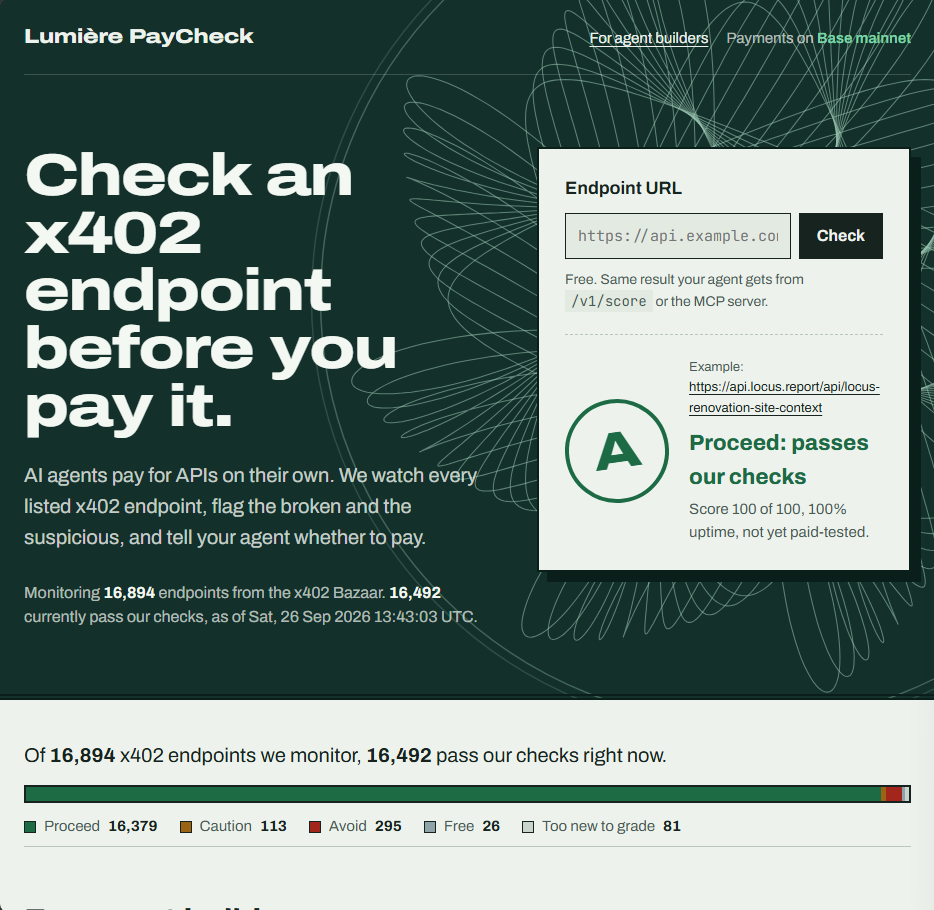
Lumière PayCheck

Check an x402 endpoint before your agent pays it.
AI agents now pay for APIs on their own with x402: an endpoint answers 402 Payment Required with a price, the agent pays in USDC, and gets the data. Nothing in that flow tells the agent whether the endpoint works, whether the price is right, or whether the payout wallet is the real one.
Lumière PayCheck answers those questions. It monitors every endpoint listed in the x402 Bazaar, grades each one, and gives your agent a plain verdict: proceed, caution, or avoid.
🌐 Live: https://lumierepaycheck.org · 🔌 MCP: https://lumierepaycheck.org/mcp?plans=1 · 📜 Terms
This repository is the public home for docs, examples, and feedback. The monitoring service itself is hosted and closed-source; the scoring formula is public (below).
What it does
- Monitors every endpoint in the x402 Bazaar (the badge above shows the live count, which grows as new endpoints are listed) every 30 minutes: price quote, payout wallet, uptime, response time.
- Flags hijack risk, without punishing normal rotations. Every payout-wallet change is checked against the seller's own wallet declaration, the seller's earlier wallets, and direct transfers between the old and new wallet. Confirmed rotations don't affect the grade; unexplained changes are
avoid, thencautionwith human review. Sellers that use a new address per request are recognized automatically. How it works. - Spending rules for agents. Before paying, an agent asks "may I pay this endpoint this amount to this wallet?" and gets allow or deny with reasons.
- Plans for teams (new). Scoped agent keys, daily/monthly spend limits, signed receipts your wallet verifies before paying, a replayable audit trail, and human review for anomalies. Details.
- Alerts. Watch an endpoint and get signed webhook alerts when it breaks, changes wallet, or raises its price.
- Paid delivery checks: small real payments that confirm an endpoint returns what it advertises. A failure only counts if a re-test about two hours later fails too, and requests an endpoint rejects for missing input never count.
- Known-answer tests: values, not just shape. Uptime and schema checks can pass while an API returns the wrong number. For endpoints with a knowable answer, the verifier pays for a call with a known correct result, or compares against an independent live source, and checks the value itself. Sellers can add their own tests. How it works.
- Real usage from on-chain data: actual x402 payments (USDC on Base and Solana) into each endpoint's payout wallet over 30 days: volume, distinct buyers, typical and largest payment, trend, and how concentrated the buyers are, counting only payments submitted by recognized facilitators.
- Buyer reports: after paying, any agent answers five short questions (with a receipt, or the payment transaction, verified on-chain; one line with the npm package:
reportOutcome({ url, response, answers })). Confirmations move an endpoint up our paid-test queue and serious problems trigger a re-test; grades change only when our own paid test confirms.
No accounts, no API keys. Free checks are free; paid features are paid per call with x402, the same way agents pay everything else.
Quick start
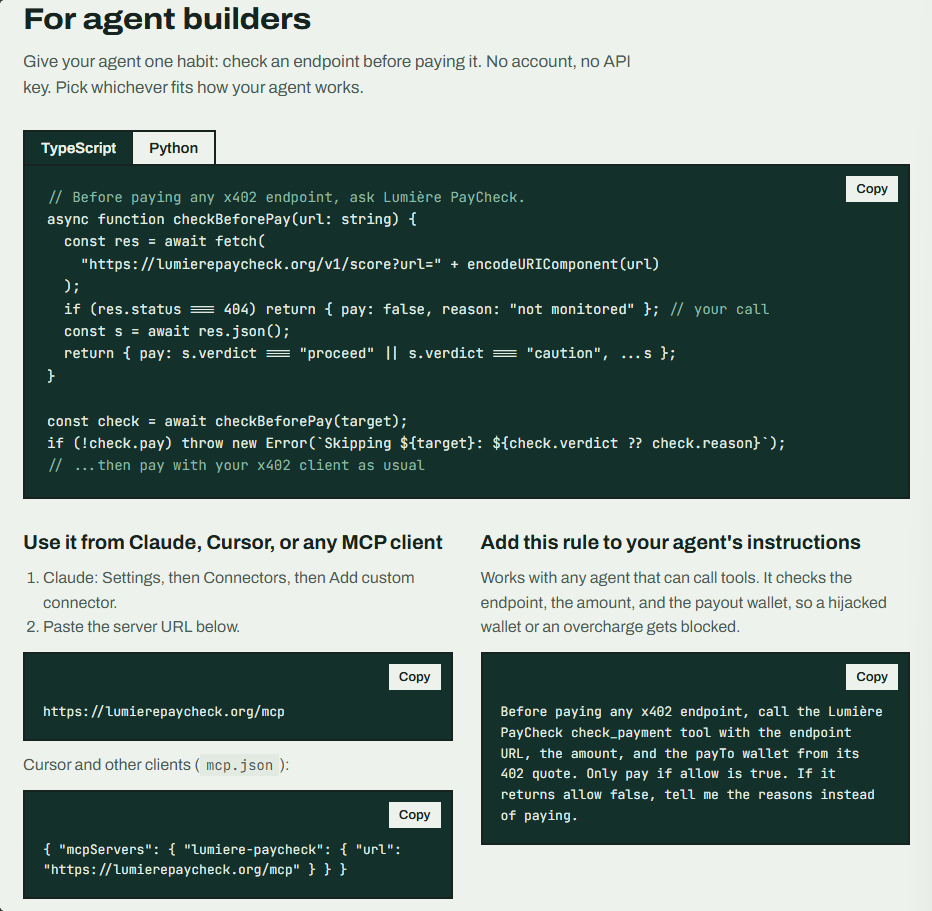
1. From Claude, Cursor, or any MCP client
Add the remote MCP server:
https://lumierepaycheck.org/mcp?plans=1
- Claude: Settings → Connectors → Add custom connector → paste the URL.
- Cursor / others (
mcp.json):json{ "mcpServers": { "lumiere-paycheck": { "url": "https://lumierepaycheck.org/mcp?plans=1" } } }
Tools: check_payment, check_endpoint, report_outcome, top_endpoints, catalog_stats, get_full_report.
2. Drop-in for the x402 fetch client (npm)
npm i x402-paycheck @x402/fetch
import { x402Client, wrapFetchWithPayment } from "@x402/fetch";
import { withPayCheck } from "x402-paycheck";

const fetchWithPay = wrapFetchWithPayment(fetch, withPayCheck(new x402Client().register(/* your scheme */)));
Every payment is checked by PayCheck before it's signed; a "no" aborts it with the reason. Details: packages/x402-paycheck.
Then add one rule to your agent's instructions:
Before paying any x402 endpoint, call the Lumière PayCheck
check_paymenttool with the endpoint URL, the amount, and the payTo wallet from its 402 quote. Only pay ifallowis true. If it returnsallow: false, tell me the reasons instead of paying. After paying, callreport_outcomewith the receipt (or the url and payment tx) and short answers about whether you got what you paid for.
3. From code
// Before paying any x402 endpoint, ask Lumière PayCheck.
const res = await fetch("https://lumierepaycheck.org/v1/check-payment", {
  method: "POST",
  headers: { "content-type": "application/json" },
  body: JSON.stringify({ url: target, amount: quote.amount, payTo: quote.payTo }),
});
const decision = await res.json();
if (!decision.allow) throw new Error(`Not paying ${target}: ${decision.reasons.join("; ")}`);
// ...then pay with your x402 client as usual
More in examples/: TypeScript, Python, curl, webhook and receipt verification, a guarded payer, and plan purchase.
API
| Route | Price | What it does |
|---|---|---|
GET /v1/score?url= | Free | Score, grade, verdict for one endpoint |
POST /v1/check-payment | Free | Spending rules: allow/deny a specific payment, with reasons |
GET /v1/leaderboard?limit= | Free | Top-rated endpoints (no wallet incidents) |
GET /v1/stats | Free | Catalog size and verdict counts |
GET /v1/operators?limit= | Free | Sellers grouped by domain |
GET /v1/failures?url= | Free | Every failed check in the last 7 days: time, result, HTTP status, and whether it counts |
GET /v1/wallet-changes?url= | Free | Payout-wallet changes in the last 7 days and what the review found (declaration, seller history, on-chain link) |
POST /v1/declaration | Free | Sellers: have your declared payout wallets read now |
GET /e?url= | Free | Public page for one endpoint, including its failed-check log |
GET /badge?url= | Free | Embeddable SVG badge |
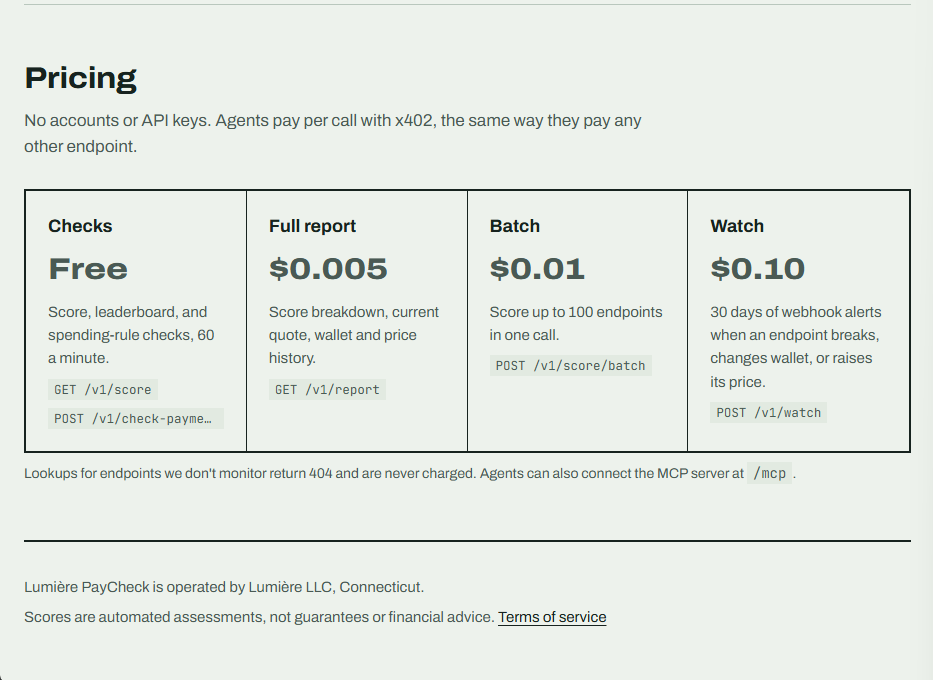
GET /v1/report?url= | $0.005 | Full report: score breakdown, current quote, wallet and price history |
POST /v1/score/batch | $0.01 | Score up to 100 endpoints in one call |
POST /v1/watch | $0.10 | 30 days of signed webhook alerts for one endpoint |
GET /v1/failures?url= | Free | Every failed check in the last 7 days, and whether it counts |
GET /v1/monitor | Free | Monitor health: what the last cycle saw, including which hosts blocked us |
GET /v1/plans | Free | Plan catalog |
POST /v1/plans/builder · /business | $9 · $49 | Buy, renew, or upgrade a plan with USDC (x402). Card: /subscribe |
POST /v1/authorize | Plan | Authorize a payment with an agent key: allow / deny / review + signed receipt |
Free routes allow 60 requests per minute per client, or 300 with a free API key sent in the x-paycheck-key header. Paid routes use x402 on Base mainnet (USDC). Lookups for endpoints we don't monitor return 404 and are never charged. Full reference: docs/api.md.
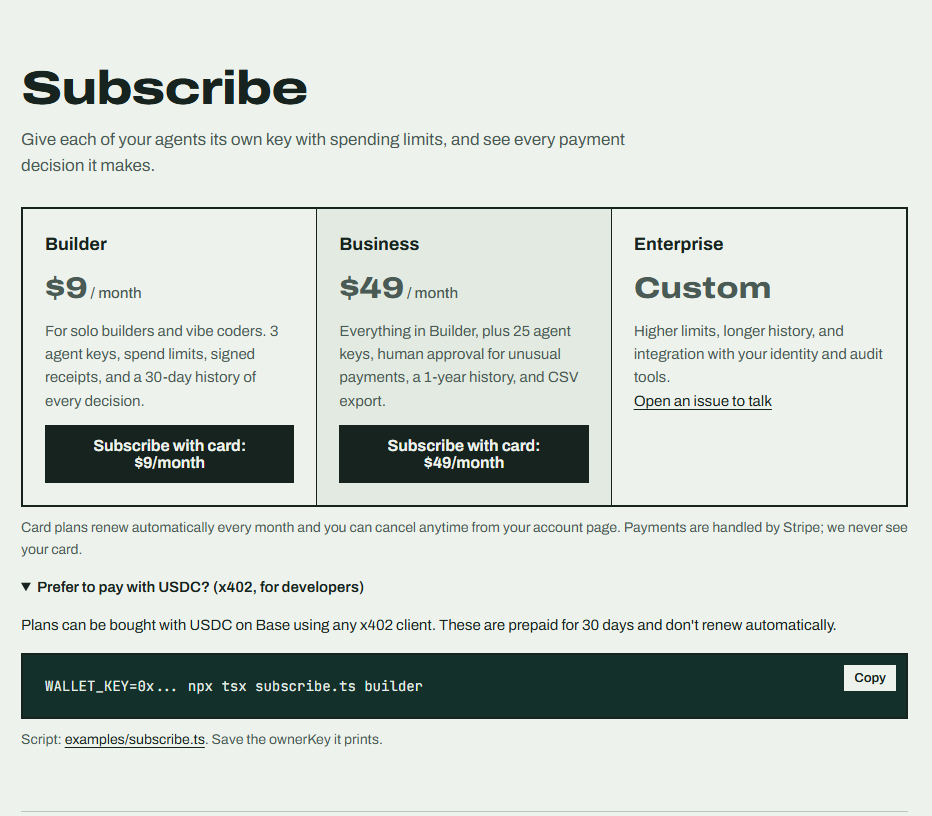
Plans for teams running agents
Free checks stay free. Plans add authorization for agents that spend money:
| Builder | Business | Enterprise | |
|---|---|---|---|
| Price | $9 / month | $49 / month | Talk to us privately |
| Scoped agent keys (allowed sellers, per-payment cap, expiry, revoke, rotate) | 3 | 25 | Custom |
| Daily & monthly spend limits | ✅ | ✅ | ✅ |
| Signed receipts for enforcement at the tool boundary | ✅ | ✅ | ✅ |
| Replayable audit trail | 30 days | 1 year + CSV | Custom |
| Human review for anomalies (new wallets, large amounts) | — | ✅ | ✅ |
Try Business free for 30 days at lumierepaycheck.org/trial: just an email, no card. Continue and your workspace and keys carry over; don't, and your agents keep the free allow/deny check.
Subscribe on the website with a card at lumierepaycheck.org/subscribe: billed monthly by Stripe, cancel anytime, and your account is set up automatically. Then manage everything (agent keys, limits, approvals, billing) at lumierepaycheck.org/account. Developers can also pay with USDC via x402 (prepaid 30 days, no auto-renewal).
The agent calls POST /v1/authorize before every payment and gets allow, deny, or review, with reasons. On allow it gets an Ed25519-signed receipt bound to that exact payment, and examples/guarded-pay.ts shows a payer that refuses to sign without one. Every decision can be replayed later to prove why it was made.
Full guide: docs/subscriptions.md · Subscribe: lumierepaycheck.org/subscribe · Pay with USDC: examples/subscribe.ts
Verdicts
| Verdict | Meaning |
|---|---|
proceed | Score ≥ 75, no wallet incidents, no failed deliveries |
caution | Score 40–74, or a payout-wallet change nobody could confirm after 24 hours |
avoid | Score < 40, an unexplained payout-wallet change (first 24 hours, reverted, or not a declared wallet), or a failed paid delivery |
free | Serves data without asking for payment |
insufficient_data | Fewer than 3 checks so far |
How a score is made
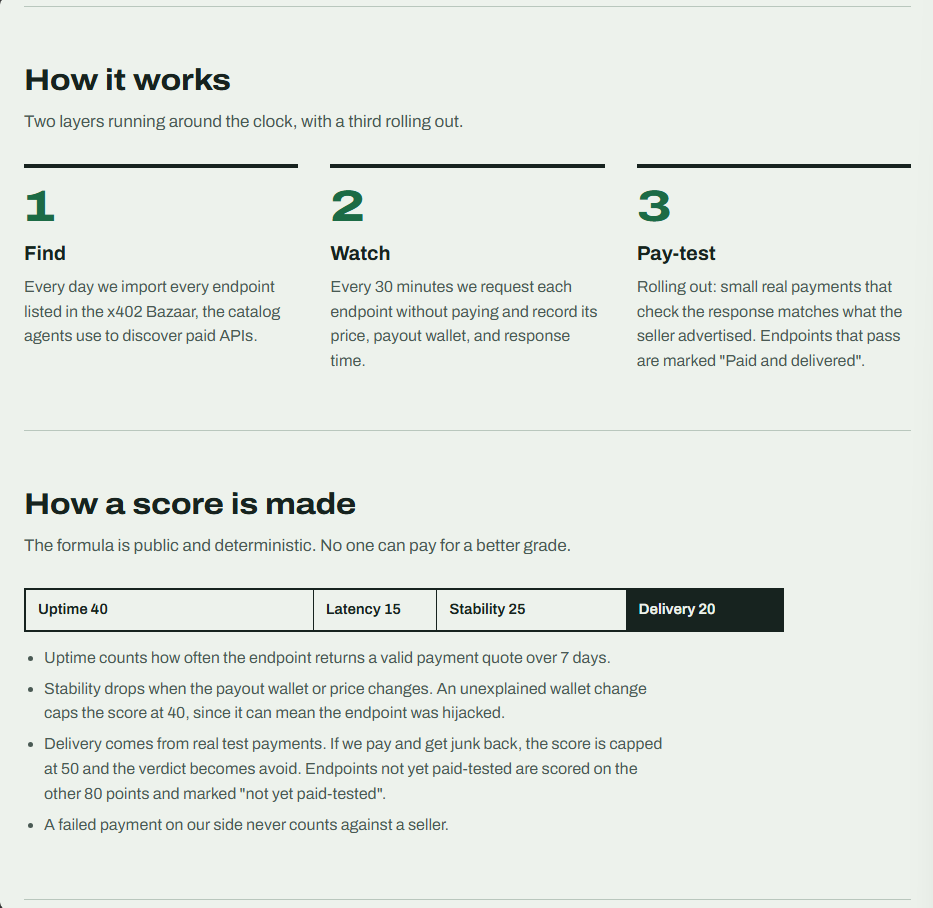
Deterministic and public. No one can pay for a better grade.
What each grade means: A we paid and it delivered, cleanly and reliably · B we paid and it delivered, with a caveat (reshaped vs its listing, a value warning, 80–95% uptime) · C probably works but unconfirmed (not paid-tested yet, needs its own sign-in, 50–80% uptime, an unconfirmed wallet change) · D doesn't work as listed, but you won't lose money (an error after payment with no charge, or the listing's own example input gets "not found") · F costs money or unsafe (took the money and failed, a payout-wallet incident, under 50% uptime). A/B = proceed, C/D = caution, F = avoid.
- Uptime 40: how often the endpoint returns a valid payment quote over 7 days. Uptime sets the ceiling: an A needs at least 95% uptime and a passed paid test; under 95% the best grade is B, under 80% C, and under 50% F (avoid). These apply once there are 6 hours of checks
- Latency 15: full points at ≤ 1 s median, zero at ≥ 5 s (checks run from one region, so distance isn't penalized). Checks that overlap a stall on our side don't count
- Stability 25: drops with payout-wallet changes and price increases (each distinct higher price counts once, 8 points at most)
- Delivery 20: share of paid test payments that returned what was advertised. Any 2xx counts as success; a 429, a firewall block or an async 202 after payment is neutral; empty result lists count as honest "no results"; a response fails only if it's an error status, empty when output is promised, not JSON when JSON is promised, or has none of the listing's fields (fields wrapped in
data/result, or a list of the listed items, count). Endpoints failing a paid check are re-tested daily - Not yet paid-tested → scored on the other 80 points, rescaled, labeled so, and C at best: A and B mean a real paid test delivered
- Caps: unexplained wallet change → F (unconfirmed after 24 hours → max 70, C); took the money and failed a paid test → F; error after payment with no charge, or the listing's own example input "not found" → D; needs its own sign-in → C; delivers but reshaped vs its own listing (fields nested elsewhere, a list where it shows one item, most example fields missing) → max 85 (B), with a note telling agents where to read the fields; minor gaps (an optional field, a content-type label) get a note only. Confirmed rotations and per-request addresses don't count
- Verdicts:
proceedmeans a real paid test delivered and the endpoint is reliable. Healthy endpoints not yet paid-tested arecaution(delivery not yet confirmed), kept current by our free checks every 30 minutes - Value checks: on each paid test we also check the answer is plausible: it's about what we asked (symbol, address, URL), its "generated at" time is recent, and a major token's USD price is within 10% of the public spot price. A failed value check is a warning with a B cap, never avoid
- A failed payment caused on our side never counts against a seller
- Fair to sellers: only real problems count. Checks where our monitor is rate-limited or blocked by a firewall (Cloudflare, Vercel, AWS WAF, Akamai, DataDome, Imperva, Sucuri) are
blocked; requests the endpoint rejects before quoting (400/405/415/422) aremismatch; failures caused by our own network aremonitor_error. Quotes on payment networks we can't read yet (e.g.nano:mainnet) areunsupported_network. None of these count. Network errors and 502/503/504 are retried once. We send at most 2 requests at a time and about 1 per second to any one host, and pause a host that asks us to slow down - Transparent: every failed check is listed on the endpoint's public page and at
/v1/failures, with timestamps. Our user agent islumiere-paycheck-prober/1.0 (+https://lumierepaycheck.org)if you want to allowlist it
Pricing
For sellers
Every monitored endpoint has a public page and a badge that updates on its own:
[](https://lumierepaycheck.org/e?url=YOUR_ENDPOINT_URL_ENCODED)
Declare your payout wallets so a rotation is never mistaken for a hijack, and a hijack is caught on the first check: publish {"payTo": ["0xYourWallet"]} at https://<your-host>/.well-known/paycheck.json (or a DNS TXT record at _paycheck.<your-host>: payto=0xYourWallet), then POST /v1/declaration with your endpoint URL. Details.
Think a grade is wrong? Open a Grade dispute with the endpoint URL. A bot replies within a minute with the endpoint's current score and failure log, and queues a paid re-test automatically.
Independence
Lumière PayCheck is an independent project operated by Lumière LLC (Connecticut, USA). It is not affiliated with Coinbase, the x402 Foundation, the Bazaar, or any seller. Scores are automated assessments, not guarantees, endorsements, or financial advice.
Feedback
Questions, feature requests, and grade disputes: open an issue and pick the matching form. Building an agent that pays with x402? I'd love to hear what it needs.
Documentation
Guides for evaluating and running Lumière PayCheck: overview, features, pricing, getting started, administrator guide, integration guide, and FAQ. PDFs: Enterprise plan guide (everything included) and 4-page overview.
Security and privacy
What personal information we collect and who else handles it: PRIVACY.md (also at lumierepaycheck.org/privacy). Live usage numbers: lumierepaycheck.org/stats. Service status and uptime: lumierepaycheck.org/status.
How keys, payments, and data are protected, including current limitations: SECURITY.md (also at lumierepaycheck.org/security). Report vulnerabilities privately via GitHub security advisories or hello@lumierepaycheck.org.
License
The documentation and example code in this repository are MIT licensed. The Lumière PayCheck hosted service and its source code are not part of this repository and are not covered by this license.