Listed from the MCP registry; nobody on Odel publishes it.

Adrian Capraru: profile and hiring
Ask about Adrian Capraru, Head of AI & Automation: case studies, services, availability, hiring.
Runs on your machine from its package; the steps are below.
What it does
- Reads
- Writes
- High impact
At most: only reads or looks up information.
What it costs
FreeOdel charges nothing per call. The publisher may charge for its own service.
Runs locally over stdio
This server isn't hosted — your MCP client launches it from a package registry. Use one of the commands below, or drop the config into your client (e.g. Claude Desktop).
Distributed as an MCP bundle (`https://github.com/cadi27tech/adrian-capraru-mcp/releases/download/v1.1.1/adrian-capraru-mcp-1.1.1.mcpb`) — download it and import the bundle in your MCP client.
adrian-capraru-mcp

An agent-readable profile. A small Model Context Protocol server that lets Claude, ChatGPT, Cursor or any MCP client answer questions about Adrian Capraru, Head of AI & Automation, and hand a user the routes to hire him: who he is, what he has built and measured, what his published offers cost, whether he is taking work, and where to make contact.
Every answer comes from the data behind adriancapraru.com. A build script generates data/profile.json from the site's own content file, its JSON Resume and the published Upwork offers, so the server says what the site says and nothing else.
- Registry: official MCP Registry,
io.github.cadi27tech/adrian-capraru(registry entry), active since 27 Oct 2026 - Transport: stdio. Runs with
npx github:cadi27tech/adrian-capraru-mcp, or as the MCPB bundle attached to each release - Auth and network: none. No key, no account, no outbound call at runtime, nothing written
- Side effects: none.
how_to_hirereturns contact routes; it never sends a message or books a call

Tools
All six are read-only (readOnlyHint: true, openWorldHint: false).
| Tool | Returns |
|---|---|
get_profile | Positioning, summary, all 8 roles with highlights and key figures, location (Romania, EET) and remote terms, what he is open to, languages, education, skills, links |
list_case_studies | The 7 case studies on the site: slug, title, summary, headline figure, status, URL |
get_case_study | One case in full: client type, role, timeline, status, problem, what was built, measured results, stack, links. slug is an enum, so an unknown slug is refused rather than guessed |
list_services | 12 fixed-price projects (3 tiers each, delivery days, what is included) and 3 consultations, as published on Upwork; prices are quoted on Upwork |
check_availability | The status in availability.json, its update date, what he is open to and his time zone. A status note, not a calendar |
how_to_hire | Contact page, Upwork profile, LinkedIn and CV PDF, what each route is for, and what to put in a first message |
Then ask, for example: "Has Adrian Capraru shipped anything with Xero in production, and what would a HubSpot to Xero build cost?"
Connect
Node 20 or later. The first run installs the package from GitHub.
Claude Code
claude mcp add adrian-capraru -- npx -y github:cadi27tech/adrian-capraru-mcp
Claude Desktop (claude_desktop_config.json)
{
  "mcpServers": {
    "adrian-capraru": {
      "command": "npx",
      "args": ["-y", "github:cadi27tech/adrian-capraru-mcp"]
    }
  }
}
Or download adrian-capraru-mcp-1.1.1.mcpb from the latest release and open it: Claude Desktop installs bundles in one click.
Cursor (~/.cursor/mcp.json, or .cursor/mcp.json in a project)
{
  "mcpServers": {
    "adrian-capraru": {
      "command": "npx",
      "args": ["-y", "github:cadi27tech/adrian-capraru-mcp"]
    }
  }
}
On Windows, if the client cannot find npx, use "command": "cmd" with "args": ["/c", "npx", "-y", "github:cadi27tech/adrian-capraru-mcp"].
Any client, from a clone: npm ci, then node examples/call.mjs <tool> '<json arguments>' starts the server over stdio, calls one tool and prints what the agent reads back.
Verification
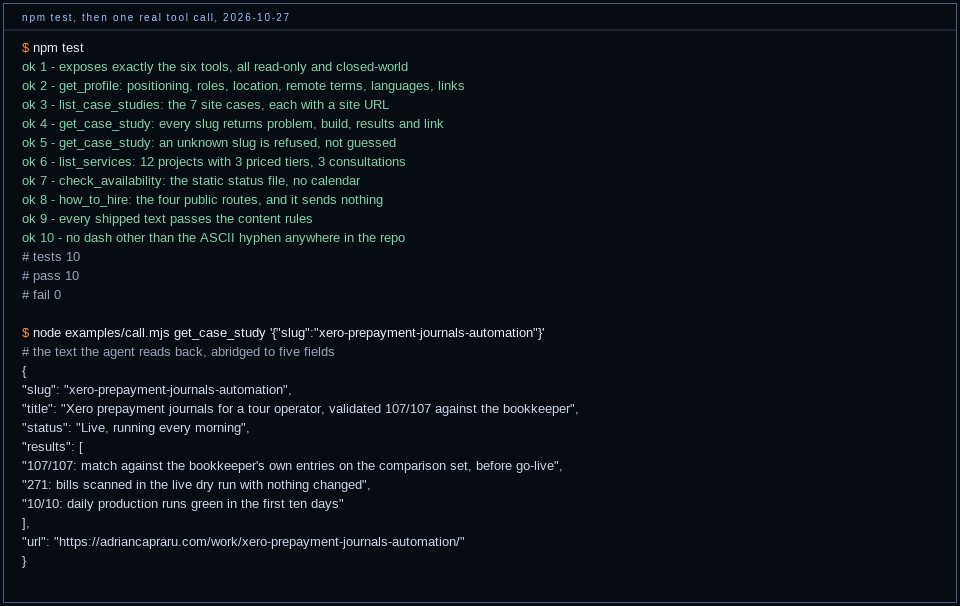
npm test starts the real server over stdio and calls every tool the way an MCP client does: exactly six tools and all read-only, the profile fields, all 7 case slugs, an unknown slug refused, 12 projects with three rising price tiers and 3 consultations, the availability file, the four contact routes, and two repository checks. CI runs it on Node 20 and 22 on every push, then calls how_to_hire from a clean install.
Design decisions
Generated, never typed. scripts/build-data.mjs imports the site's content.mjs, reads resume.json, lifts the "Open to" and "Where" copy from the contact page source and parses the published Upwork catalog and consultations. A wording change on the site reaches the server on the next build. If the contact page loses a section the script depends on, the build throws instead of shipping a gap.
Content rules that fail the build. scripts/rules.mjs lists what may never be published: partner names, superlatives, figures withheld on purpose, email addresses, first-person copy, hype words and any dash other than the ASCII hyphen. The build rewrites the few site sentences that carry such a fact, drops any list item still failing, then checks the whole output and refuses to write it if one rule still fails. The tests run the same rules over the data, the README and the changelog.
Availability is a file, not a calendar. availability.json holds a status, a sentence and a date, edited by hand and read on every call, so an edit applies without a restart. The server never claims a free slot it cannot see.
Contact stays human. The server hands back routes and a suggested brief. A person, or an agent acting for one, makes contact. Nothing here can send a message in Adrian's name or on a user's behalf.
Update the data
node scripts/build-data.mjs "<folder holding website/ and deliverables/upwork-v3/>"
npm test
To change availability, edit availability.json (status, summary, updated) and push. Clients running through npx pick it up on the next install; the registry bundle changes only with a release.
A new release: bump version in package.json, manifest.json and server.json, run npx @anthropic-ai/mcpb pack, attach the .mcpb to a GitHub release, put its SHA-256 and URL in server.json, then run the publish to MCP Registry workflow. It checks the hash and signs in with GitHub OIDC, so no secret is stored.
Licence
MIT. Adrian Capraru, adriancapraru.com. The drawing is generated with blueprint-svg.