Listed from the MCP registry; nobody on Odel publishes it.
Is this yours? Claim it
Voicedex
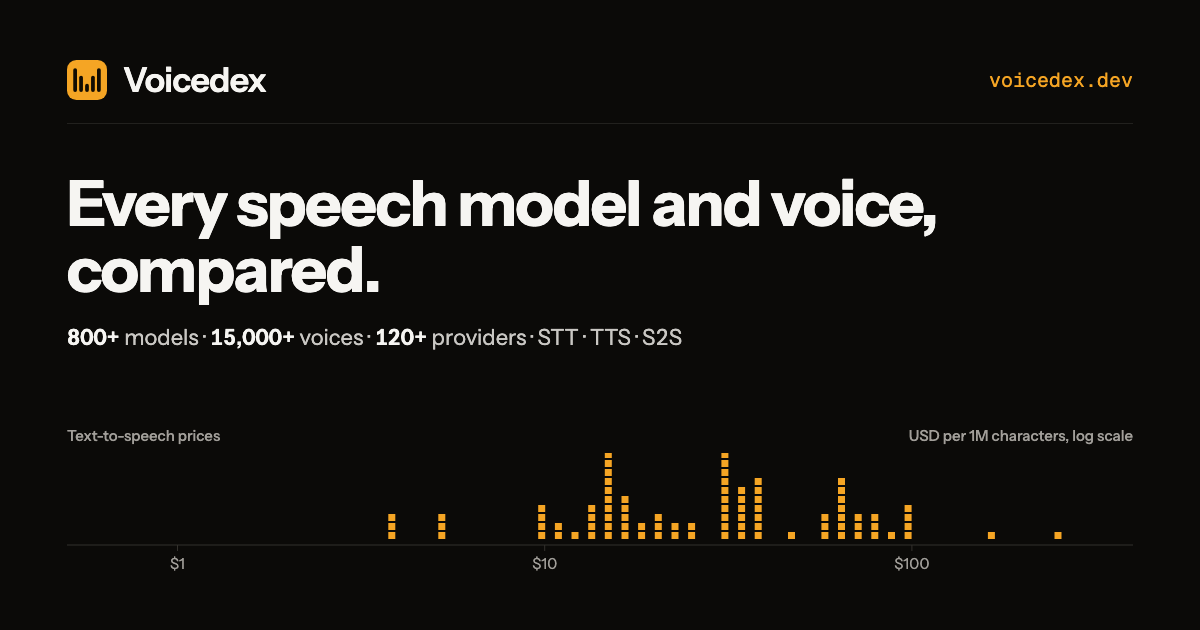
Search, compare and price 800+ speech-to-text, text-to-speech and voice models from 120+ providers
One address for any MCP client. No sign-in needed on this server.
What it does
7 read1 other
Grouped by tool name. At most: only reads or looks up information.
What it costs
FreeOdel charges nothing per call. The publisher may charge for its own service.
Tools
8 · grouped by tool name · checked 19 Nov 2026Read · 7Look things up
- search_models
- get_model
- compare_models
- estimate_cost
- find_alternatives
- search_voices
- list_providers
Other · 1Neither hinted nor named
- recent_changes
voicedex.dev is an open catalog of speech AI: speech-to-text, text-to-speech and speech-to-speech models and voices from 120+ providers, normalized so you can compare them. For every model it records the supported languages, features, price, regions, streaming interfaces and shutdown dates. You can browse it on the site, query it with a free REST API, or download it as one JSON file.
800+ models · 15,000+ voices · 120+ providers · synced from provider APIs and docs · versioned in git
What you can do with it
- Compare prices across providers. Text-to-speech is normalized to USD per 1M characters and speech-to-text to USD per hour of audio, so one table sorts them all: text-to-speech · speech-to-text · speech-to-speech.
- Find models for a language, for example Hindi text-to-speech or Swahili speech-to-text.
- Filter by feature, for example speech-to-text with speaker diarization or open-source text-to-speech.
- Listen to voices across providers, with samples in the language you choose, filtered by use case, age, accent and gender: voices.
- See what's shutting down before it breaks your app: scheduled shutdowns.
- Compare models side by side on languages, features, price, limits and audio formats (compare), or two providers head to head (Deepgram vs ElevenLabs).
- See published latency and independent benchmarks: each vendor's own latency figure, labelled as their claim, and links to public leaderboards (Open ASR Leaderboard, Artificial Analysis, TTS Arena) that test it.
- See what works with your framework: providers with a built-in LiveKit, Pipecat, Vapi or Retell integration, from each framework's own docs (text-to-speech for Pipecat, speech-to-text for LiveKit).
- Find alternatives to a provider or a model that's shutting down (ElevenLabs alternatives).
- Estimate monthly cost at your usage on any model list or model page.
- Browse every provider (providers) and which languages each covers.
- Follow what changes: new models, price changes and shutdowns (changes, Atom feed), and what speech AI costs overall (pricing report).
Why trust the data
- Auditable. The whole catalog is plain JSON in
data/. Every change is a reviewable diff, and every model records its source URLs and when it was checked. Price history isgit log -p data/*/models.json. - One schema for every provider. Languages are BCP-47, capabilities and regions use a controlled
vocabulary, and voices are linked to the models they work with. See
schema/. - Nothing invented. Prices come only from vendor pages and are never converted between currencies. Unknown values stay empty instead of guessed. Shutdown dates are taken from the vendor's own announcement.
- History is kept. Models that disappear upstream are marked deprecated, not deleted, and providers that shut down stay listed with the date and the evidence.
API
Free, read-only, no key needed. Base URL: https://voicedex.dev. Interactive reference:
voicedex.dev/docs.
# British English female voices
curl "https://voicedex.dev/v1/voices?language=en-GB&gender=female&limit=5"
# Speech-to-text models with speaker diarization, hosted in the EU
curl "https://voicedex.dev/v1/models?type=stt&capabilities=speaker_diarization®ion=eu"
# Everything, in one response
curl -O "https://voicedex.dev/v1/catalog.json"
| Path | |
|---|---|
GET /v1/providers · /v1/providers/{id} | Providers, with model and voice counts and framework integrations. Filters: type, compliance, access, headquarters, framework |
GET /v1/providers/{id}/models · /models/{model_id} | Filters: type, language, capabilities, lifecycle, region, realtime, open_weights, recommended, shutting_down, max_price_usd, framework, search; sort = name, price or newest |
GET /v1/providers/{id}/voices · /voices/{voice_id} | Filters: gender, category, language, model, accent, use_case, age, has_sample, multilingual, capabilities, search |
GET /v1/models · /v1/voices | The same filters across all providers, plus provider |
GET /v1/catalog.json | Everything in one response, deprecated records included |
Responses carry an ETag, so you can poll cheaply with If-None-Match. List endpoints also support
updated_since and limit/offset. Public ids are stable across deploys.
For LLMs and AI agents there is /llms.txt, a plain-Markdown map
of the site and the data.
MCP server
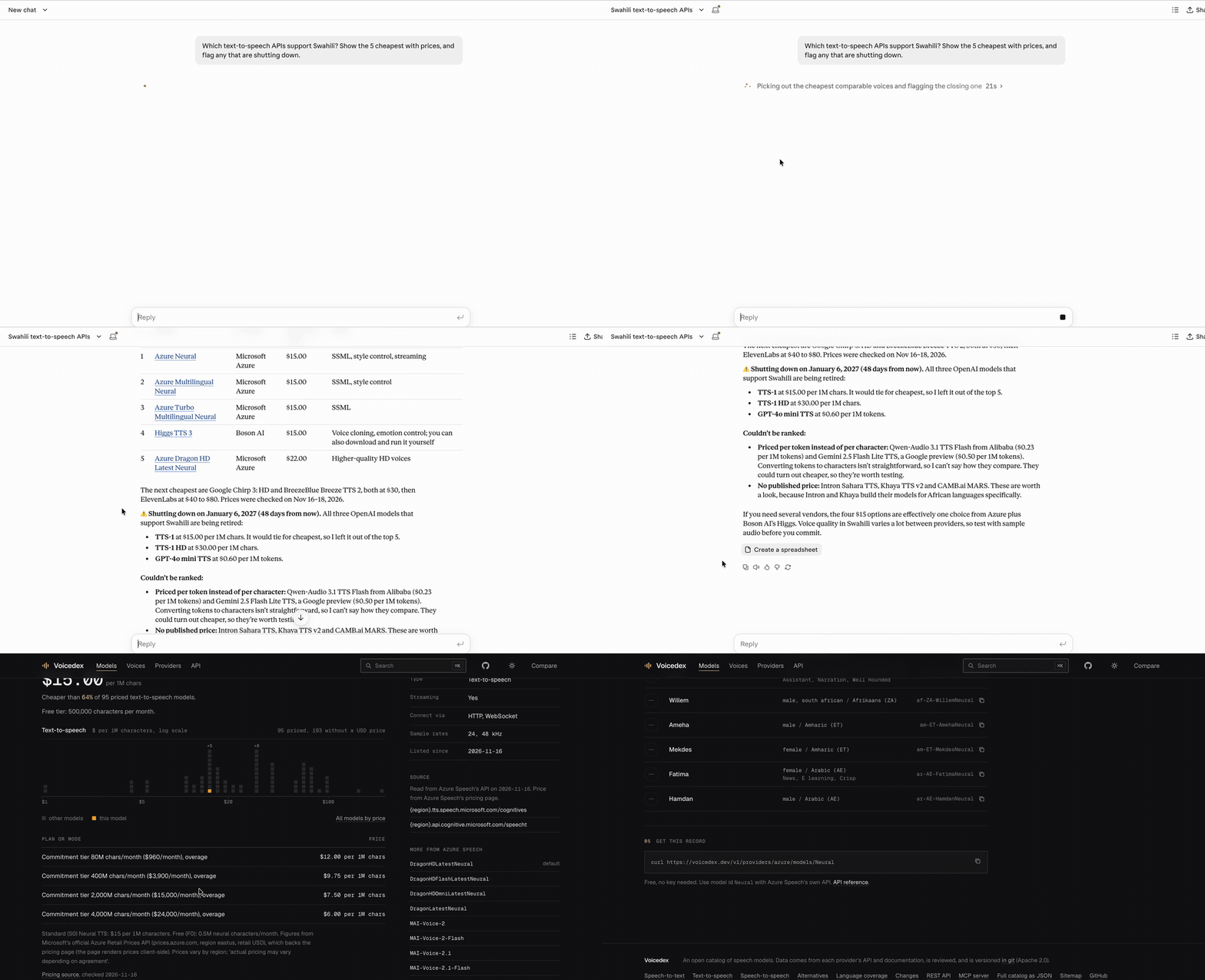
Give AI assistants the whole catalog over the Model Context Protocol:
https://voicedex.dev/mcp (Streamable HTTP, free, no key, read-only). Setup for each client is at
voicedex.dev/mcp.
claude mcp add --transport http voicedex https://voicedex.dev/mcp # Claude Code
Tools: search_models, get_model, compare_models (accepts loose names like "deepgram nova-3"),
estimate_cost (workload or voice-agent pipeline, maths done server-side), find_alternatives (replacements
for a model, e.g. one shutting down), search_voices, list_providers, recent_changes. Every result carries
its price source, check dates and a voicedex.dev link; missing prices come with the reason.
Ask things like "Which text-to-speech APIs support Swahili, cheapest first?" or "Which speech models shut
down in the next 90 days?".
How the data is kept fresh
Each provider has a syncer in voicedex/sync/. It calls the provider's API where
one exists, and otherwise extracts the data from the provider's documentation. Open-weights models are
synced from the Hugging Face Hub. scripts/sync.py then merges the result into data/:
- New records are added; unchanged records keep their dates.
- Records that disappeared upstream are marked deprecated, never deleted.
- A guard refuses to write if a fetch looks partial.
The diff is reviewed in a pull request, and merging to main deploys it.
uv sync --extra dev --extra sync
uv run python scripts/sync.py deepgram            # dry-run, prints a per-field diff
uv run python scripts/sync.py deepgram --write    # updates data/deepgram/
uv run python scripts/validate.py                 # schema and consistency checks (CI runs this too)
uv run python scripts/catalog_health.py           # what's stale, broken or due for a re-sync
Run locally
uv sync --extra dev
uv run uvicorn voicedex.main:app --reload --port 8001
uv run pytest
Contributing
Spotted a wrong price, a missing model or a provider we don't cover? Open an issue with a link to the vendor's page, or send a pull request.
- To add a provider, follow the checklist in
CLAUDE.md. - Which providers qualify:
docs/design/provider-expansion.md. - Architecture:
docs/design/v2-architecture.md.
License
Code and data: Apache 2.0. If you use the data, a link back to voicedex.dev is appreciated.