Listed from the MCP registry; nobody on Odel publishes it.
Is this yours? Claim it
RankFence
Replay supplied ranked lists and check when shard-local reciprocal rank fusion has an exact top k.
One address for any MCP client. No sign-in needed on this server.
What it does
1 read
Grouped by tool name.
What it costs
FreeOdel charges nothing per call. The publisher may charge for its own service.
Tools
1 · grouped by tool name · checked 23 Nov 2026Read · 1Look things up
- rankfence_analyze

StreamSieve
Find which telemetry channels changed, then read the samples behind the alert.
Put StreamSieve between a metrics collector and an alerting service or monitoring agent. Feed it one row of numeric measurements per tick. It returns a ranked brief with flagged channels, estimated change points and handles for reading back exact samples held in memory.
Try the Python example · Use the CLI or MCP server · Benchmark results · Agent reference · Find a tool by task
Try it
Install the v0.1.0 wheel from GitHub Releases with CPython 3.9–3.13 on Linux x86-64 (glibc 2.17+, AVX2/FMA) or macOS on Apple Silicon (11+).
python -m pip install --no-index --only-binary=:all: --find-links https://github.com/pgg898200-ship-it/streamsieve/releases/expanded_assets/v0.1.0 streamsieve==0.1.0
Run this example in Python. It works with the release wheel and with the current source.
from streamsieve import EStream

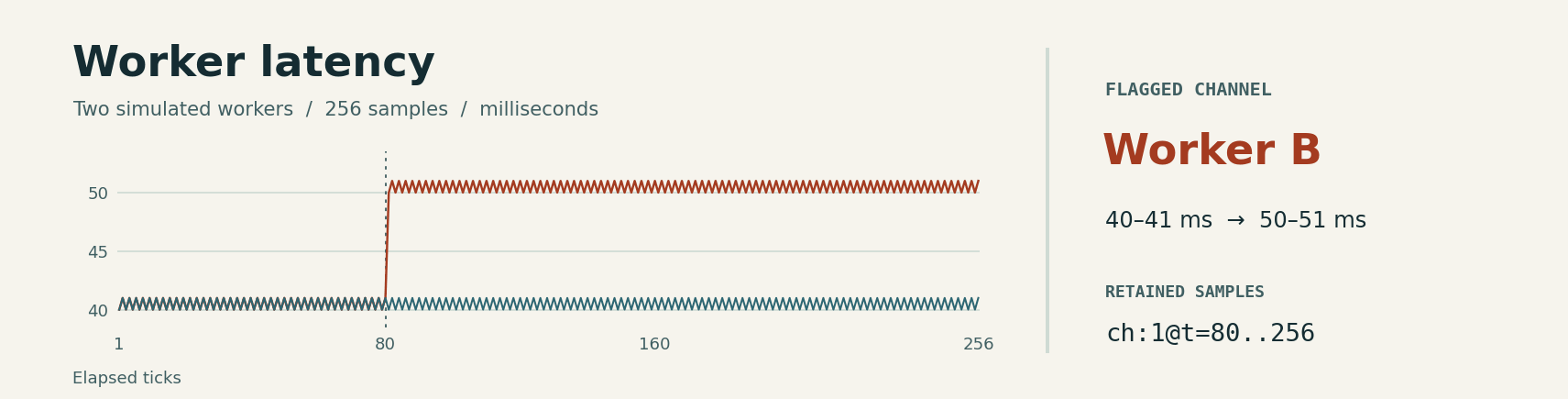
# Two workers alternate between 40 and 41 ms. After 80 samples, B gains 10 ms.
rows = [[40 + t % 2, 40 + t % 2 + 10 * (t >= 80)] for t in range(256)]
with EStream(2, warmup=32, ring_capacity=256) as monitor:
    monitor.update_batch(rows)
    brief = monitor.brief(names=["worker_a_ms", "worker_b_ms"])
    for item in brief["top"]:
        if item["rejected_ebh"]:
            print(item["name"], item["handle"], monitor.fetch_raw(item["handle"])[-1])
worker_b_ms ch:1@t=80..256 (256, 51.0)
Only worker B crosses the alert threshold. Its last retained sample is 51 ms at tick 256. Keep the monitor alive to resolve its handles. The ring retains the most recent ring_capacity samples per channel.
For continuous monitoring, keep an EStream per group of channels and update it as new rows arrive. A CLI call analyzes one input window. The stdio MCP server lets an agent call sift_stream, then fetch_raw_ticks against the same session. Current source adds JSONL input, seasonal adjustment, detrending and a scikit-learn adapter. Build the current source · Statistical assumptions and limits
Catch up a slow reader
Afterkey is the standalone C++17 change feed for dashboards and agents that poll at different rates. It returns the latest value or deletion for each changed key since a reader’s cursor. Try the interactive demo or compile the StreamSieve channel-score example.
Route moving agents by zone
EdgeChime emits the rectangular zones that each moving agent entered or left. It includes a dependency-free JavaScript API, an NDJSON CLI, and examples for Eclipse SUMO and Tiled. Compare it with a packed R-tree and a perimeter grid on two CPUs, including random jumps where the R-tree wins. Live demo · Labeled replay · Benchmark data.
Verified Benchmarks (StreamSwarmBench)
Measured live on an Intel Xeon 2.30 GHz Linux VM (2 vCPUs, AVX2+FMA, Python 3.12.16) against river 0.27.0, scipy 1.18.1, and numpy 2.5.5. Full structured output: benchmarks/results.json | Detailed report: docs/benchmarks.md.
1. Throughput, Incumbent Speedups & Startup Latency
| Workload | streamsieve 0.2.0 | Incumbent Baseline | Verified Speedup |
|---|---|---|---|
Native 8-wide AVX2 CLI (256 ch × 16,000 ticks) | 255.67 M ch-ticks/s (16.02 ms) | — | Native C++20 SIMD |
Native 8-wide AVX2 CLI (1,024 ch × 4,000 ticks) | 191.20 M ch-ticks/s (21.42 ms) | — | Native C++20 SIMD |
Native 8-wide AVX2 CLI (4,096 ch × 2,000 ticks) | 146.69 M ch-ticks/s (55.85 ms) | — | Native C++20 SIMD |
Python batch vs river.drift.ADWIN (64×2k) | 1.21 ms (105.75 M/s) | 32.62 ms (3.92 M/s) | 26.9× faster |
Python batch vs river.drift.PageHinkley (64×2k) | 1.21 ms (105.75 M/s) | 111.67 ms (1.15 M/s) | 92.3× faster |
Python batch + online e-BH vs NumPy/SciPy z+BH (256×4k) | 7.58 ms (135.18 M/s) | 79.92 ms (12.81 M/s) | 10.55× faster |
Cold startup (CLI vs import streamsieve) | 3.87 ms (CLI) / 25.30 ms (import) | 1,791.01 ms (numpy+scipy+river) | 70.8× faster (import) / 463× (CLI) |
2. Continuous-Peeking Calibration, Zero-Mean Bursts & Non-Stationary Streams
| Benchmark (nominal $\alpha = 0.05$) | streamsieve 0.2.0 | Naive |z| > 3 | Peeking Welch+BH | river.ADWIN(0.002) | river.PageHinkley |
|---|---|---|---|---|---|
| Stationary Null FAR (Gaussian / Student-$t(3)$ / LogNormal / $10^{10}$ DC+1000×) | 0.004 – 0.010 | 0.196 – 0.834 | 0.476 – 0.542 | 0.000 – 0.004 | 0.108 – 1.000 |
Non-Stationary Null FAR (Diurnal P=24 / LinearTrend / RandomWalk / Both) | 0.010 – 0.050 (--season / --detrend) | 0.000 – 0.645 | 0.835 – 1.000 | 0.000 – 1.000 | 1.000 |
| 256-Ch Mixed Firehose (4 shifts + 4 bursts + 32 loud 5×): Emp. FDR / F1 | 0.000 / 0.883 (2.8 ms); peeking 0.040 / 0.909 (40.8 ms) | 0.966 / 0.059 | 0.321 / 0.799 (183.0 ms) | 0.054 / 0.862 (49.3 ms) | — |
Zero-Mean ±3.5σ Bursts (256-ch): Burst Recall / F1 | 0.65–0.70 / 0.897–0.900 | 0.30 / 0.102 | 0.00 / 0.578 | 0.00 / 0.667 | — |
64-Ch Diurnal (P=24, 6σ wave) Firehose: Emp. FDR / F1 / Wall | 0.000 / 0.799 / 1.7 ms | — | 0.000 / 0.667 / 125.5 ms | 0.000 / 0.618 / 11.6 ms | — |
| Sequential Stopping ($H_0$ FAR / $H_1$ Power / Samples Saved) | 0.015 / 1.00 / 70.0% | — | 0.440 / 1.00 / 74.7% | — | — |
3. Multi-Agent Coordination, Token Compression & Real NOAA Weather
| Mechanism | streamsieve Engine | Verified Result vs Baseline |
|---|---|---|
Token Compression (1024 ch × 2000 ticks, 15.4 MB CSV) | EStream | 3,844,353 → 325 tokens (99.99% / 11,829× reduction) in 53.4 ms, 1.00/1.00 Prec/Rec, 0 loud FPs, 0.0 exact raw drill-down error |
| Anti-Echo Gossip ($W = 8$ agents, 40 msgs/trial, 200 trials) | EvidenceLattice | 0.0% overwrite churn, 1.00× inflation (Brier skill +0.686) vs 96.5% LWW churn / 10.39× naive log-odds inflation |
| Wire Budget (256 unique findings across 8 hypotheses) | EvidenceLattice (SSLT v1) | 10,428 B binary (13,035 Base85 chars) vs 111,143 B JSON debate (10.7× smaller) |
| Firehose Attention (2,048 ch, 256 sites, $W = 4$, 10 seeds) | VOISifter | +0.702 Brier skill, 78.3% Recall@Top, 0.11% inter-agent overlap vs -0.010 round-robin / -32.42 raw-mean |
| Byzantine + Trust Flip (4-epoch delay, flip @ 60, 20 seeds) | TrustCalibrator | 100.0% Byzantine quarantine, post-flip Brier 0.1840 vs 0.2179 ExpWeights / 0.2539 mean vote |
Real NOAA Seattle temp_max (1,461 days, 4:1 cost, 1-day delay) | TrustCalibrator | 30.39% asymmetric cost reduction (3.889 vs 5.587) and 90.01% empirical coverage on 90% AgACI intervals |
Quickstart
Build the current source
The examples below use the v0.2.0 code on main. Install the Python SDK and its streamsieve command with Python 3.9+ and a C++20 compiler.
git clone https://github.com/pgg898200-ship-it/streamsieve.git
cd streamsieve
python -m pip install .
streamsieve version
On Unix, set CXX=c++ if Python selects a compiler that is missing. For an x86-64 CPU without AVX2/FMA, set STREAMSIEVE_NO_AVX2=1 before building. To build the separate native executable in the checkout, run make all and then ./build/streamsieve version.
Read CSV, TSV or JSON Lines from the terminal
# Each line is a flat JSON object with numeric metric fields
tail -n 2000 metrics.jsonl | streamsieve sift --season 24 --alpha 0.05 --json -

# Detrend linear ramps or random walks (1.0 = causal first difference)
cat cpu_trend.csv | streamsieve sift --detrend 1.0 --alpha 0.05 -

# Compact agent-ready brief on real NOAA telemetry (numeric columns 3-6)
cut -d, -f3-6 examples/noaa_weather.csv | streamsieve sift -

# Native AVX2 throughput self-benchmark & causality self-verification
streamsieve bench --channels 1024 --ticks 4000
streamsieve verify --json
Python SDK and adapters
import streamsieve as ss

# 1. Anytime-valid firehose sift (with optional causal deseasonalizing/detrending) + lossless drill-down
est, brief = ss.sift_matrix(
    matrix, names=col_names, alpha=0.05, season_period=24, detrend_alpha=0.0, ring_capacity=256
)
print(brief.to_compact_text())                        # ~320 tokens regardless of channel count
raw_ticks = est.fetch_raw(brief["top"][0]["handle"])  # bit-exact raw (tick, float) tuples

# 2. Drop-in 1-line replacement for river.drift.ADWIN / PageHinkley (zero river dep!)
from streamsieve import EStreamDrift as ADWIN
det = ADWIN(alpha=0.05, season_period=24)             # catches shifts + zero-mean +-3.5 sigma bursts
for x in stream:
    if det.update(x).drift_detected:
        print(f"Drift ({det.mode}) e={det.e_value:.1f}")

# 3. Drop-in zero-dependency scikit-learn OutlierMixin-compatible multivariate streaming detector
det_sk = ss.SklearnSieveDetector(alpha=0.05, warmup=32, season_period=24)
labels = det_sk.fit_predict(X_stream)                 # +1 calm, -1 anytime-valid e-BH anomaly
print(det_sk.rejected_channels_, det_sk.brief().to_compact_text())

# 4. Zero-echo CRDT multi-agent belief & Vovk-Wang e-value fusion
lat_a, lat_b = ss.EvidenceLattice(), ss.EvidenceLattice()
lat_a.observe("outage", "ch:3@t=180..600", llr=2.4, log_e=3.2, agent_id=0, timestamp_ns=100)
lat_b.observe("outage", "ch:3@t=180..600", llr=2.4, log_e=3.2, agent_id=1, timestamp_ns=200)  # echo!
lat_a.merge(lat_b)                                    # commutative, associative, idempotent
print(lat_a.query("outage"))                          # unique_evidence=1, echoes_suppressed=1

# 5. Zero-overlap hierarchical VOI attention + delayed-label Byzantine-safe TrustCalibrator
sifter = ss.VOISifter(n_channels=2048, n_sites=256, ticks_per_epoch=8)
sifter.set_noise_scales(channel_stds)                 # loud-channel immune
plan = sifter.allocate(budget_per_agent=4, n_agents=4)

tc = ss.TrustCalibrator(n_agents=4, conformal_alpha=0.10)
dec = tc.predict_scalar("day_42", [18.1, 17.8, 18.4, 999.0], underage_cost=4.0, overage_cost=1.0)
tc.resolve("day_42", outcome=18.2)                    # strictly causal delayed resolution
See runnable cookbooks in examples/jsonl_diurnal_sre.py and examples/multi_agent_pipeline.py.
MCP server and agent configuration
Run the zero-dependency JSON-RPC 2.0 stdio MCP server exposing 7 stateful tools (sift_stream with jsonl_text / csv_text / rows / json_data, fetch_raw_ticks, lattice_observe, lattice_merge, lattice_query, voi_allocate, trust_step):
streamsieve mcp
# or: python3 -m streamsieve.mcp_server
Add to .mcp.json / Claude Desktop / Cursor MCP config:
{
  "mcpServers": {
    "streamsieve": {
      "command": "streamsieve",
      "args": ["mcp"]
    }
  }
}
Plugin manifests and agent skill instructions are pre-packaged at SKILL.md, .claude-plugin/plugin.json, and .cursor-plugin/plugin.json.
Score revised scalar forecasts
RecastCRPS scores an ensemble after a member revises or withdraws its point forecast. It also identifies the best and worst single-member withdrawals for an equal-weight panel in logarithmic time. A worked example uses the same forecasts with TrustCalibrator and RecastCRPS and resolves both against an observed outcome. Try the Hurricane Lee replay.
Architecture: Four Co-Designed Strictly Causal Engines
flowchart LR
    RAW["High-Frequency Stream\n(CSV / JSONL / Matrix\nN ch × T ticks)"] --> E1["1. EStreamEngine\nCausal Detrend & Season Pre-Filter\n8-wide Cache-Tiled AVX2 SoA\nDual-Res E-Process + Online e-BH\nLossless Raw Ring"]
    E1 -->|"Compact Brief (~320 tok)\n+ Raw Drill-Down Handles"| E3["3. VOISifter\nSite × Channel × Tick\nSparse-Burst LLR\nZero-Overlap Multi-Agent VOI"]
    E1 -->|"Provenance-Tagged\nChannel E-Values"| E2["2. EvidenceLattice\nJoin-Semilattice CRDT\nBayes Log-Odds + Vovk-Wang E\nSSLT v1 Binary / Base85 Wire"]
    E3 -->|"Non-Overlapping\nAgent Inspections"| E2
    E2 -->|"Echo-Free Beliefs"| E4["4. TrustCalibrator\nCausal Delayed-Label Buffer\nNon-Negative Platt + Fixed-Share BOA\nVille Quarantine + Delayed AgACI"]
    E4 -->|"Agent Trust Weights\n& Quarantine Masks"| E2
Every engine obeys bit-exact zero-lookahead causality verified by assert_causal() (poisoning all future ticks $s > t$ with +1e12, -1e12, NaN, and +Inf produces 0.0 bit diff on outputs at $\le t$).
Verification, Adversarial Testing & Honest Scope
- Multi-Compiler + Sanitizer Verification:
make all test-cpp test-sanbuilds GCC-O3 -march=native -ffp-contract=off -Wall -Wextra -Wpedantic(AVX2), strictclang++ -Werror, MSVC C++20 on Windows CI, and-fsanitize=address,undefined,float-cast-overflow(scalar) with 0 compiler warnings, 0 sanitizer errors, and 0-ULP bit-exact parity across 8-wide/4-wide/scalar AVX2update_batch,update_row, andupdate_one. - 79/79 Zero-Dependency Python Tests + Adversarial Breaker Suite: Runs unit tests, drop-in
river/sklearnadapter tests, 27 adversarial torture tests (tests/test_breaker_adversarial.py), and 23 v0.2.0 parity/causality/breaker-regression tests (tests/test_v020_features.py) covering alternating±1e308warmup inputs, seasonal subtraction overflow, simultaneous1e15warmup spikes, strict RFC-8259 JSONL fuzzing, deeply nested JSON/bigint inputs, atomic MCP session swaps, and batch-size invariance. - Reproduce all benchmarks:
bash
PYTHONPATH=python .bench-venv/bin/python benchmarks/run_all.py
Honest Limitations (Where NOT to Use streamsieve)
- Detrender choice (
detrend_alpha=1.0vs< 1.0): Usedetrend_alpha=1.0(causal first difference) for arbitrarily steep linear trends and random walks (0-tick transient; detects slope breaks & bursts cleanly). Values0 < detrend_alpha < 1run a robust 5-sample-median-initialized EWMA high-pass filter suitable for slow drift (converging in~3/alphaticks), not steep ramps. - Seasonal period & warmup budget: Causal deseasonalization (
season_period=P) freezes per-phase medians over at least3 * Pwarmup ticks (eff_warmup = max(warmup, 3*P)) and applies an analytical OOS variance scale correction; streams with time-varying periods or non-integer periods should be residualized externally before feedingEStream. - Short baselines on ultra-wide panels for rare bursts: Online e-BH at $M = 1{,}000$ with 1 active channel requires $E \ge 20{,}000$; rare bursts ($p_b \le 0.05$) need enough pre-onset baseline ticks ($n_0$) for the universal-inference Beta-Binomial denominator to separate the rate, or hierarchical triage via
VOISifter. - Single-tick Python loops: Calling
EStream.update_row()one row at a time from Python incursctypesper-call overhead (4.97 M ch-ticks/s, still1.27×faster thanriver.ADWIN). Batch rows withupdate_batch()(70–135 M/s) or use the native CLI/C ABI (147–256 M/s). - Sybil provenance forgery:
EvidenceLatticeprevents accidental or gossip-induced double counting when identical observations carry identical content-hashedprovenance_ids; deliberate Sybil adversaries forging fresh IDs are mitigated byTrustCalibratorVille quarantine.
Documentation & Comparisons
- Technical Specification & Math:
docs/architecture.md - Full Benchmark Report (
StreamSwarmBench):docs/benchmarks.md|benchmarks/results.json - Runnable Cookbooks:
examples/README.md - Honest Head-to-Head Comparisons:
- Agent / LLM Machine Index:
llms.txt|llms-full.txt|SKILL.md
License
Apache License 2.0 — see LICENSE.
