
Run Coach
Garmin data with interactive charts: daily briefing, training trends, workout planning. Unofficial.
Runs on your machine from its package; the steps are below.
What it does
- Reads
- Writes
- High impact
At most: creates or changes data: records, files, settings.
What it costs
FreeOdel charges nothing per call. The publisher may charge for its own service.
Runs locally over stdio
This server isn't hosted — your MCP client launches it from a package registry. Use one of the commands below, or drop the config into your client (e.g. Claude Desktop).
Run
npx -y garmin-mcp-app
MCP client config
{
  "mcpServers": {
    "run-coach": {
      "command": "npx",
      "args": [
        "-y",
        "garmin-mcp-app"
      ]
    }
  }
}Run Coach — Garmin MCP App
Connect your Garmin watch to Claude Desktop or ChatGPT. Explore interactive charts.
Unofficial. Not affiliated with or endorsed by Garmin. Garmin is a trademark of Garmin Ltd.
Install
Claude Desktop
- Download the latest
.mcpbfile from Releases - Drag it into Claude Desktop to install
- Ask Claude anything about your Garmin data — it will prompt you to sign in on first use
ChatGPT (desktop app)
Requires Node.js 20+.
- In the ChatGPT desktop app, open Settings → Plugins → Add marketplace
- Source:
chenhunghan/garmin-mcp-app(leave Git ref and sparse paths empty) → Add marketplace - Restart the app, open the Plugins Directory, choose the Run Coach marketplace and install Coach
Or with the Codex CLI: codex plugin marketplace add chenhunghan/garmin-mcp-app then codex plugin add garmin@garmin-mcp.
Coach then appears in the sidebar (daily briefing and performance dashboard) and as a Training Week tab in conversations; or just ask "@Coach how am I today?". It runs on your computer, so it works in the desktop app only.
Other MCP clients (Cursor, VS Code, Claude Code, Codex CLI, …)
Requires Node.js 20+. Add the server to your client's MCP config:
{
  "mcpServers": {
    "garmin": { "command": "npx", "args": ["-y", "garmin-mcp-app"] }
  }
}
Or from the command line: claude mcp add garmin -- npx -y garmin-mcp-app (Claude Code), codex mcp add garmin -- npx -y garmin-mcp-app (Codex CLI).
Clients that support MCP Apps (e.g. VS Code) show the interactive charts and the sign-in form. Other clients still get every Garmin tool as data, but can't show the sign-in form: sign in once from an MCP Apps client — the tokens are saved in ~/.garminconnect and shared by every client on your computer.
What you can do
Ask Claude about your health, training, and fitness — it reads your Garmin data and shows interactive charts right in the conversation.
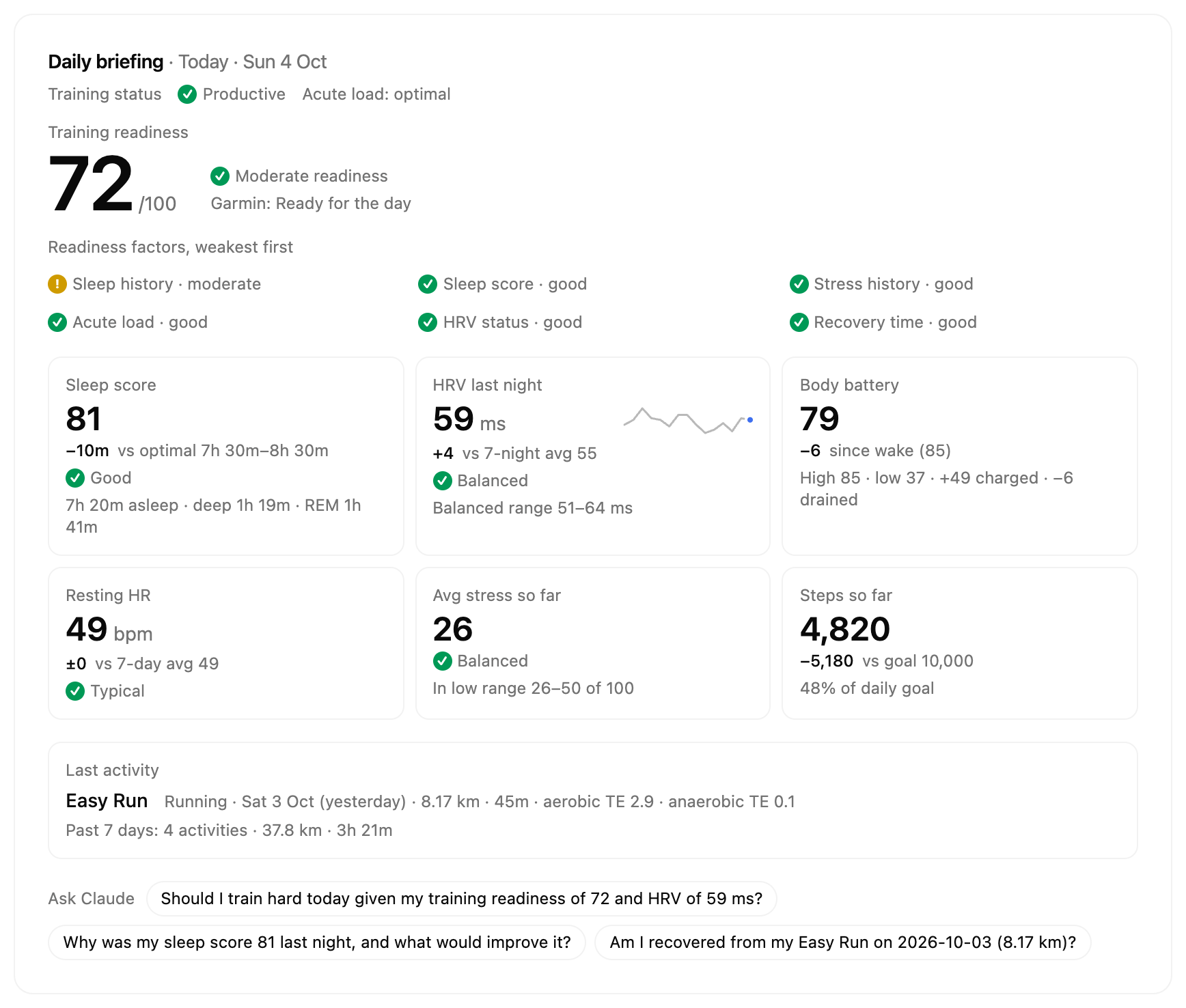
- Start your day — a morning briefing: readiness, sleep, HRV, body battery and resting HR against your own baselines, with Claude's suggestions
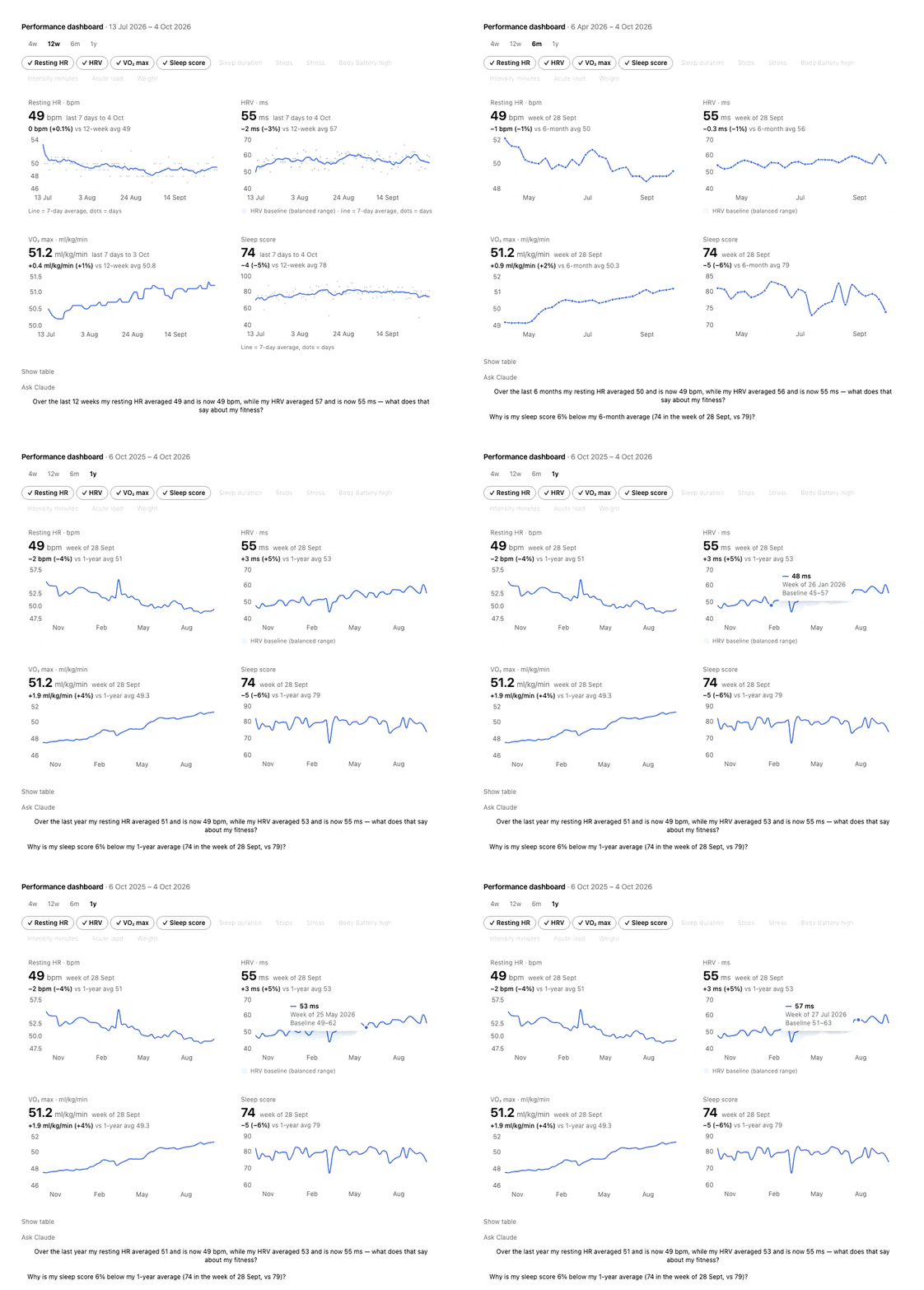
- See your trends — compare up to 4 metrics over 4 weeks to a year, and ask Claude what changed
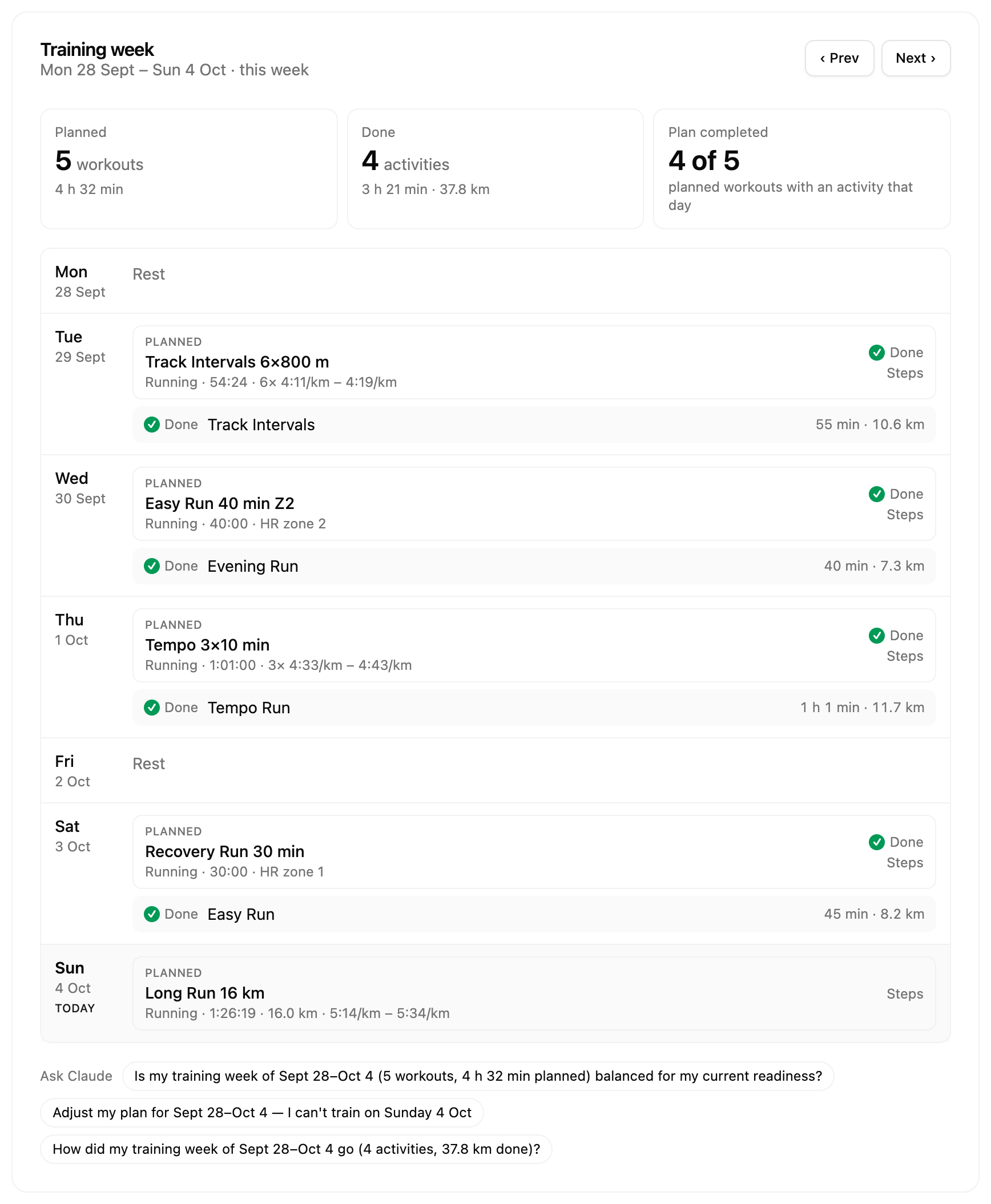
- Plan your week — Claude designs a week of training from your data, then creates and schedules the workouts on your Garmin calendar
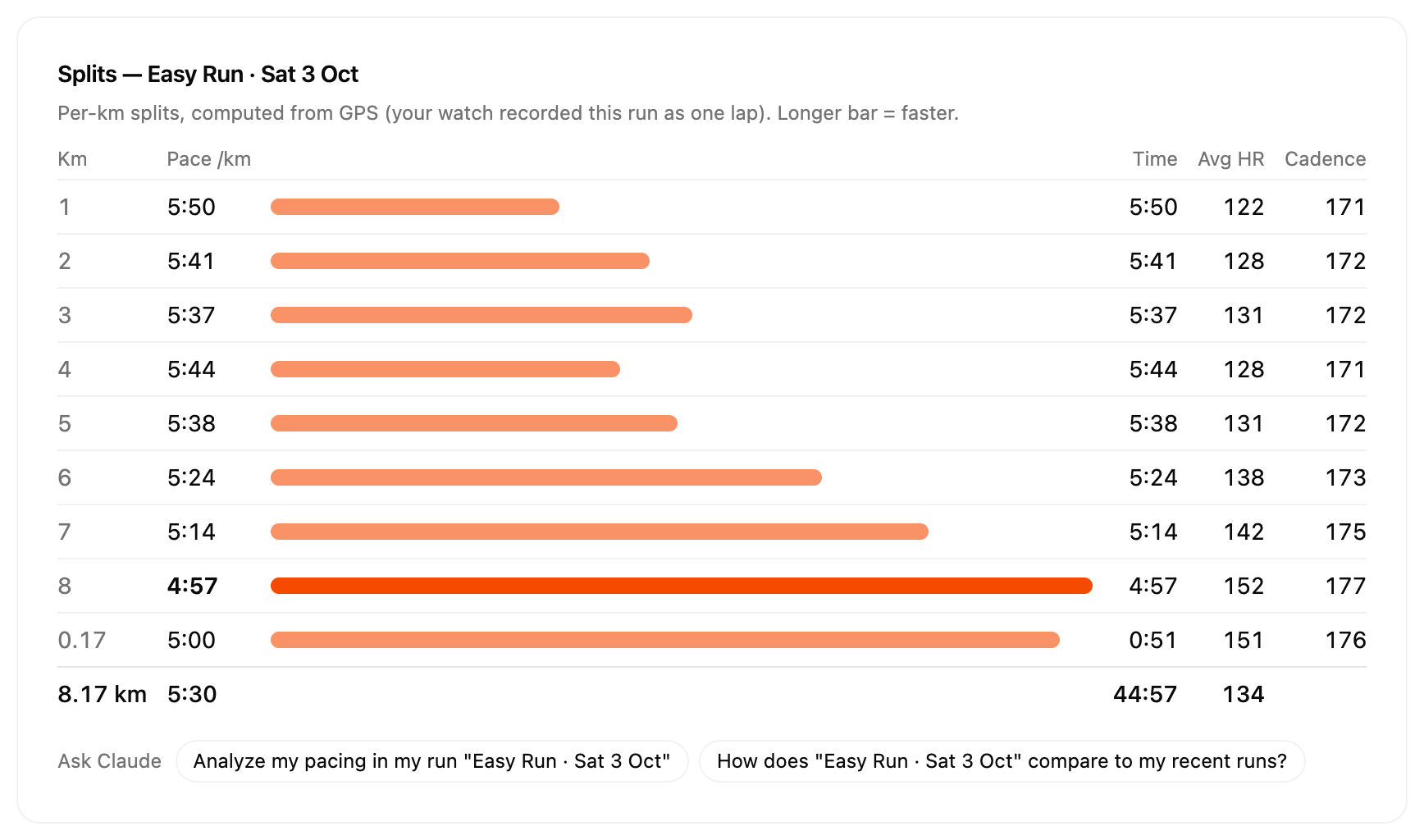
- Analyze your workouts — per-km splits (even for single-lap runs), HR zones, and training effect
- Track your fitness — training readiness, training load, VO2 Max, race predictions, and 30+ more Garmin metrics
Your Garmin, coached by Claude
The app frames your data against your own baselines; Claude reads it and suggests what to do. Every view has Ask Claude questions built from your numbers, and Claude knows what you're looking at.
Daily briefing — "How am I today?"
Performance dashboard — "How has my fitness trended this year?"
Weekly training plan — "Plan my training week" (or the plan-training-week prompt)
Per-km splits — "Show the splits of my last run"
Screenshots use the built-in demo mode (npm run dev:ui:demo): a fictional runner, no real person's data. Light and dark themes follow Claude Desktop.
What you can visualize
Plot your activities
Visualize training readiness
Full list of supported Garmin Connect data
| Category | Data |
|---|---|
| Daily health | Steps, heart rate, sleep stages, stress, body battery (+ events), HRV, respiration, SpO2, floors, hydration |
| Trends | Resting heart rate, weekly steps, weekly stress, weekly intensity minutes, weigh-ins |
| Activities | List / by date, details, splits, typed splits, HR time-in-zones, chart data, weather, exercise sets, gear |
| Training | Training readiness, training status & load, VO2 Max, race predictions, endurance score, hill score |
| Performance | Lactate threshold, cycling FTP, HR zones, fitness age, personal records, running tolerance, progress |
| Devices & gear | Devices, primary training device, last used device, gear, goals, training plans, calendar |
| Workouts | List, create, update, delete, and schedule workouts |
Privacy & Security
No data is stored or collected by this app. Your data flows directly between your machine and the Garmin Connect API — there is no intermediate server.
Learn more
- Your credentials stay private. You sign in through a secure login form rendered inside Claude Desktop. The login and MFA tools are marked as app-only (
visibility: ["app"]), meaning Claude (the LLM) cannot call them and never sees your email, password, or MFA code. - Claude doesn't know who you are. The LLM only receives the health/fitness data you ask for (steps, sleep, etc.) — it has no access to your Garmin account credentials, OAuth tokens, or profile (name, email, location).
- Your password is never sent in plain text. The login form encrypts it with a single-use key before it passes through Claude Desktop, so it can't leak into host logs.
- Tokens are stored locally. OAuth tokens are saved on your machine at
~/.garminconnect/with restrictive file permissions (0600). They are never sent anywhere other than the Garmin Connect API. - You can log out anytime. Logging out clears all saved tokens from your machine.
Developer / Contributor Guide
Getting Started
git clone https://github.com/chenhunghan/garmin-mcp-app.git
cd garmin-mcp-app
npm install
npm install automatically sets up git hooks via prek:
- commit-msg — enforces Conventional Commits via commitlint
- pre-push — runs lint, format check, typecheck, and tests (same as CI)
Troubleshooting: core.hooksPath
If npm install warns about core.hooksPath, prek cannot install git hooks. Fix it by unsetting the local config:
git config --unset-all --local core.hooksPath
npm run prepare
Development
npm run dev        # watch-build server + UI
npm run dev:ui     # standalone UI dev at localhost:5173
npm run test:lib   # run garmin-connect tests
npm run pack       # build + package .mcpb bundle
npm run dev:ui opens http://localhost:5173 with the React UI wired to the real MCP server in-process. You can test login, MFA, and logout against the actual Garmin API without deploying to Claude Desktop.
Testing in Claude Desktop
Run npm run build (one-off) or npm run dev (watch mode for live rebuilds), then add to ~/Library/Application Support/Claude/claude_desktop_config.json:
{
  "mcpServers": {
    "garmin-mcp": {
      "command": "node",
      "args": ["/absolute/path/to/garmin-mcp-app/dist/index.js"]
    }
  }
}
Restart Claude Desktop. Ask Claude to check your Garmin auth — it will render the app UI in an iframe and run the real login/MFA flow.
Architecture
- MCP Server (
src/server.ts) — Node.js server over stdio, registers tools + UI resource - React UI (
src/app.tsx) — Rendered in host's sandboxed iframe, communicates viapostMessage - garmin-connect (
packages/garmin-connect/) — TypeScript client library for Garmin Connect OAuth + API
Commit Convention
Commits must follow the Conventional Commits format:
type(optional-scope): description
Allowed types: feat, fix, chore, docs, ci, refactor, test
Disclaimer
Run Coach is an independent, open-source project. It is not affiliated with, endorsed by, or sponsored by Garmin Ltd. or its subsidiaries. Garmin and Garmin Connect are trademarks of Garmin Ltd. or its subsidiaries; they are used here only to describe compatibility. The app uses the unofficial Garmin Connect API with your own account.


