
Runs on your machine from its package; the steps are below.
What it does
- Reads
- Writes
- High impact
At most: only reads or looks up information.
What it costs
FreeOdel charges nothing per call. The publisher may charge for its own service.
Runs locally over stdio
This server isn't hosted — your MCP client launches it from a package registry. Use one of the commands below, or drop the config into your client (e.g. Claude Desktop).
Distributed via cargo as `craftbag-mcp`.
Discover, list, load, and explain Agent Skills (SKILL.md) for CLI and MCP hosts.







What it does
craftbag walks project and home skill trees (.agents, plus optional vendor trees for Claude, Cursor, Grok, and Bline). It then:
- catalogs skills (
list) - prints one skill body (
load), or heading keys / one heading (load --outline,load --section KEY) - explains why a skill would activate (
why) - checks a package (
validate)
The same operations exist over MCP stdio (skills_list, skills_load, skills_why, skills_validate). Hosts can filter, rank, and load skills without taking a dependency on any one agent product.
Install
macOS and Linux (Homebrew):
brew install craftbag/tap/craftbag
Windows (Scoop):
scoop bucket add craftbag https://github.com/craftbag/scoop-bucket
scoop install craftbag/craftbag
Both commands install craftbag and craftbag-mcp. The MCP host then runs craftbag-mcp (on macOS GUI apps, use the full path if PATH is empty: /opt/homebrew/bin/craftbag-mcp).
From a Rust toolchain (crates.io):
cargo install --locked craftbag-cli
cargo install --locked craftbag-mcp
Library dependency:
craftbag = "0.2"
From git (unreleased tip):
cargo install --locked --git https://github.com/craftbag/craftbag craftbag-cli
cargo install --locked --git https://github.com/craftbag/craftbag craftbag-mcp
MSRV is 1.85.
Getting started
Default list walks cwd-to-git .agents / vendor trees and $HOME/.agents / vendor trees. This clone has no project .agents. When those directories are absent, craftbag list exits 0 and says no skills were found. Point --path at the demo tree (same catalog as the demo GIF):
git clone https://github.com/craftbag/craftbag
cd craftbag
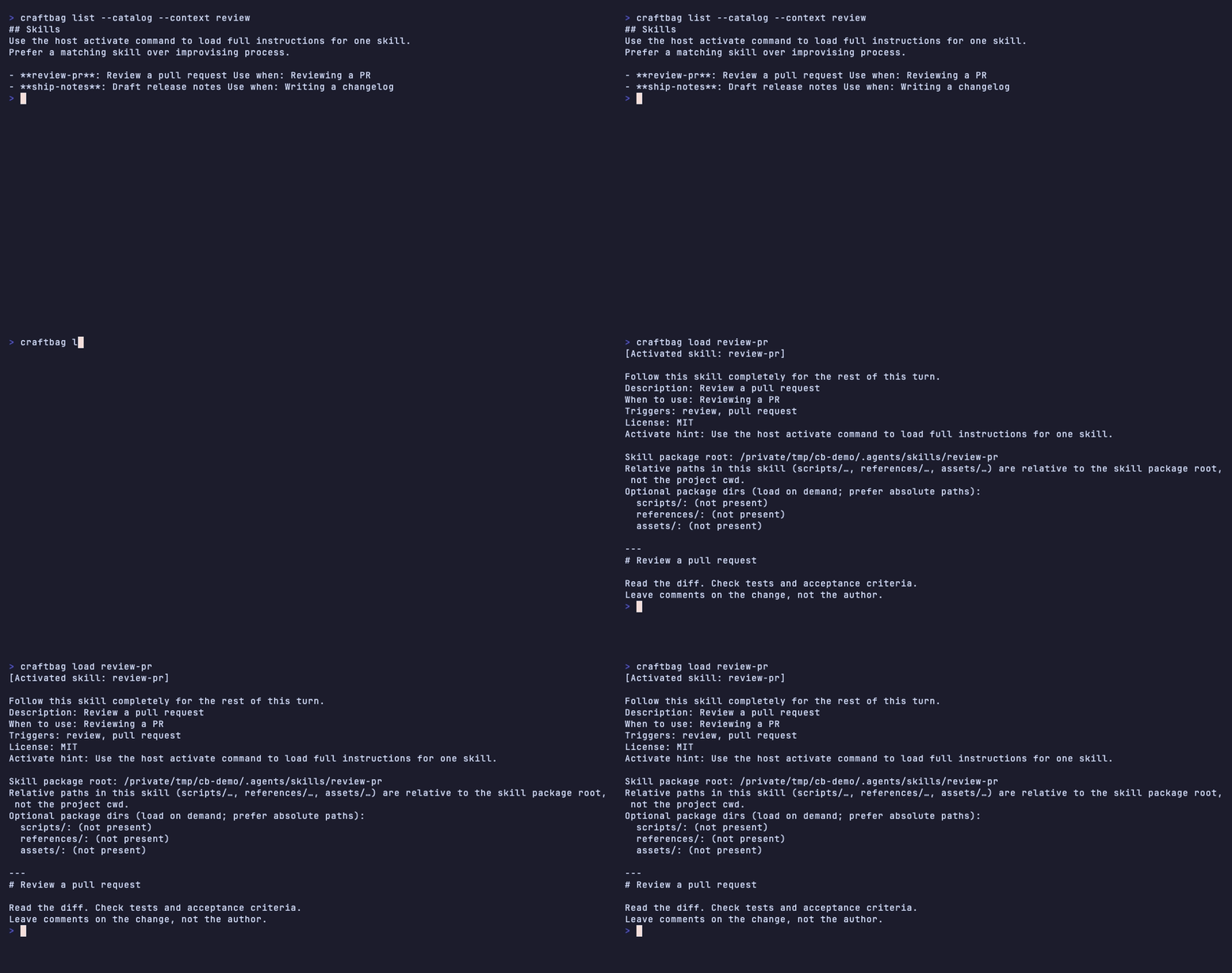
craftbag list --no-implicit-roots --path demo/workspace/.agents/skills --catalog
craftbag load review-pr --no-implicit-roots --path demo/workspace/.agents/skills
craftbag load review-pr --no-implicit-roots --path demo/workspace/.agents/skills --outline
craftbag load review-pr --no-implicit-roots --path demo/workspace/.agents/skills --section review-a-pull-request
craftbag why review-pr --no-implicit-roots --path demo/workspace/.agents/skills --context review
craftbag validate demo/workspace/.agents/skills/review-pr
If craftbag is not on PATH yet, cargo build -p craftbag-cli --locked and use ./target/debug/craftbag in those commands.
In a project that already has skills under .agents/skills:
craftbag list --catalog
craftbag load NAME
craftbag why NAME --context review
craftbag validate ./path/to/my-skill
Claude, Cursor, Grok, or Bline trees are opt-in:
craftbag list --vendor claude --catalog
Demo
MCP
craftbag-mcp speaks JSON-RPC on stdio. Tools: skills_list, skills_load, skills_why, skills_validate. After brew install or scoop install, craftbag-mcp --help names them.
Claude Desktop (claude_desktop_config.json) and other hosts that take a stdio command:
{
  "mcpServers": {
    "craftbag": {
      "command": "craftbag-mcp",
      "args": ["--vendor", "claude"]
    }
  }
}
Launch --path, --vendor, --user-dir, and --no-implicit-roots are the walk when a tool call omits that field. The host cwd is still the implicit walk root unless you pass --no-implicit-roots. skills_load accepts outline and section (same as load --outline / --section KEY).
Library
use craftbag::{discover, DiscoveryOptions};

fn main() -> std::io::Result<()> {
    let cwd = std::env::current_dir()?;
    let report = discover(&cwd, &DiscoveryOptions::default());
    for skill in &report.skills {
        println!("{} {}", skill.name, skill.description);
    }
    Ok(())
}
implicit_roots is on by default (cwd-to-git .agents and $HOME/.agents). Set it to false and put collection roots in paths for leftover-only hosts. format_load_view can print an outline or one heading instead of the whole body.
Contributing
See CONTRIBUTING.md. Security reports go to SECURITY.md. Roadmap and governance are in ROADMAP.md and GOVERNANCE.md.
License
Apache-2.0 or MIT. You may choose either. See LICENSE and LICENSE-APACHE.




