Listed from the MCP registry; nobody on Odel publishes it.

Asomiya (অসমীয়া)
Write, check and run code in Asomiya, the programming language in Assamese.
Runs on your machine from its package; the steps are below.
What it does
- Reads
- Writes
- High impact
At most: moves money, runs code or commands, deletes data, or sends messages for you.
What it costs
FreeOdel charges nothing per call. The publisher may charge for its own service.
Runs locally over stdio
This server isn't hosted — your MCP client launches it from a package registry. Use one of the commands below, or drop the config into your client (e.g. Claude Desktop).
Run
npx -y asomiya-mcp
MCP client config
{
  "mcpServers": {
    "asomiya": {
      "command": "npx",
      "args": [
        "-y",
        "asomiya-mcp"
      ]
    }
  }
}অসমীয়া · Asomiya
A programming language in Assamese.
Write real programs in অসমীয়া script, or in English letters the way you type Assamese in chats.






Website & Playground · Documentation · Examples · Report a bug · অসমীয়াত পঢ়ক
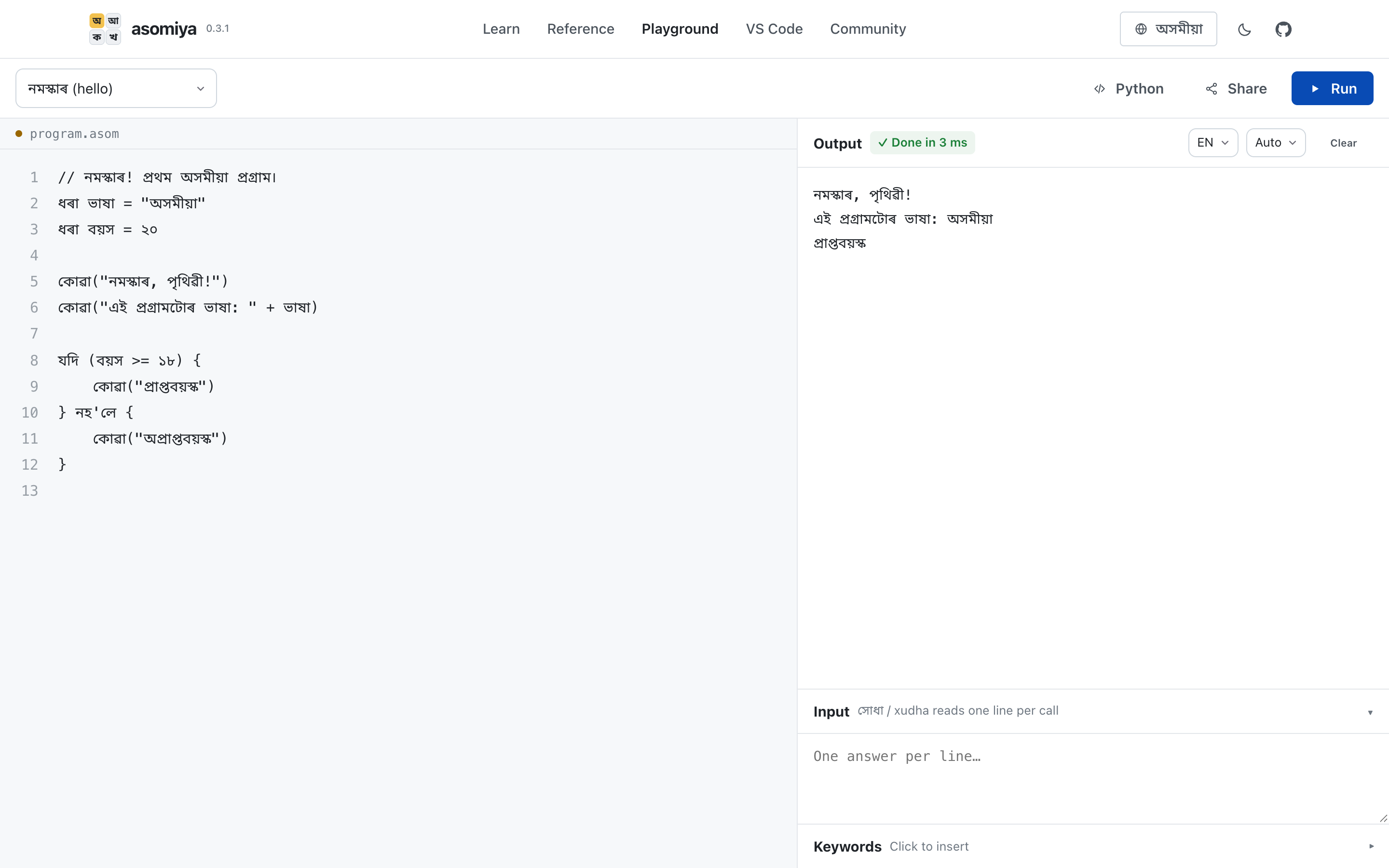
Assamese script
ধৰা ভাষা = "অসমীয়া"
ধৰা বয়স = ২০

কোৱা("নমস্কাৰ, পৃথিৱী!")
কোৱা("এই প্ৰগ্ৰামটোৰ ভাষা: " + ভাষা)

যদি (বয়স >= ১৮) {
    কোৱা("প্ৰাপ্তবয়স্ক")
} নহ'লে {
    কোৱা("অপ্ৰাপ্তবয়স্ক")
}
English letters
dhora bhaxa = "Oxomiya"
dhora boyox = 20

kowa("Nomoskar, prithibi!")
kowa("ei programor bhaxa: " + bhaxa)

jodi (boyox >= 18) {
    kowa("praptoboyosko")
} nohole {
    kowa("oprapto-boyosko")
}
Both are the same program. Output:
নমস্কাৰ, পৃথিৱী!
এই প্ৰগ্ৰামটোৰ ভাষা: অসমীয়া
প্ৰাপ্তবয়স্ক
You can run it without installing anything in the playground:
Try it now
No install needed: open the playground at asomiya.codes and press ▶.
Or install the command-line tool:
npm install -g asomiya
asomiya            # start the interactive REPL
Features
- Assamese everywhere. Keywords, built-ins, error messages, and numbers (
১০ + ২০prints৩০). - Or type in English letters.
dhora,kowa,jodi,nohole… with several common spellings for each word, because romanised Assamese has no single standard spelling. - Helpful errors. Every error has a code, a message in Assamese or English, and points at the
exact spot. Typos get a hint:
kowaa→ did you meankowa(কোৱা)? - A real language. Variables, conditions, loops, functions, recursion, closures, lists and input. A real lexer, parser and interpreter, written in TypeScript.
- Runs anywhere. A CLI and REPL for Node.js 20+, a browser playground, and a library API.
- Safe to run other people's code. Programs can't touch files or the network, and loops, recursion and memory are limited. See SECURITY.md.
- Well tested. Over 400 tests, run on Linux, macOS and Windows.
Installation
Requires Node.js 20 or newer.
npm install -g asomiya
This installs the asomiya command. To use Asomiya as a library in a project instead:
npm install asomiya
asomiya: command not found? You probably rannpm install asomiyawithout-g. Usenpm install -g asomiya, or run it once withnpx asomiya.
Quick start
Save this as hello.asom:
কোৱা("নমস্কাৰ, অসম!")
Run it:
asomiya run hello.asom
Start the REPL and type code line by line:
asomiya
Source files use the .asom extension.
The language in five minutes
| Concept | Assamese script | English letters |
|---|---|---|
| variable | ধৰা ক = ৫ | dhora k = 5 |
কোৱা("মান:", ক) | kowa("man:", k) | |
| if / else | যদি (ক > ১) { … } নহ'লে { … } | jodi (k > 1) { … } nohole { … } |
| while loop | যেতিয়ালৈকে (ক < ১০) { … } | jetialoike (k < 10) { … } |
| for-each loop | প্ৰতিটো ফল ফলবোৰ মাজত { … } | protito fol folbor majot { … } |
| break | ৰখা | rokha |
| continue | আগবাঢ়া | aagbara |
| function | ফাংচন যোগ(ক, খ) { ঘূৰাইদিয়া ক + খ } | fangchon jog(k, kh) { ghuraidiya k + kh } |
| true/false/null | সঁচা মিছা খালী | xosa misa khali |
| and / or / not | আৰু / বা / নহয় (or !) | aru / ba / nohoy |
| list | ধৰা ল = [১, ২, ৩], ল[০] | dhora l = [1, 2, 3], l[0] |
| comment | // line and /* block */ | same |
- Numbers can be written with Assamese (
২৪) or ASCII (24) digits. Programs in Assamese script print২৪; programs in English letters print24. - Text uses double quotes.
+joins text with any value. Length and indexing count whole characters, soদৈৰ্ঘ্য("নাম")is২. - Conditions must be true or false (
সঁচা/মিছা). There is no "truthiness". - Statements end at a newline,
;, or the danda।.
Built-in functions
| Assamese | English letters | What it does |
|---|---|---|
দৈৰ্ঘ্য(x) | doirghyo(x) | length of text or a list |
প্ৰকাৰ(x) | prokar(x) | the type of a value, as text |
সংখ্যা(x) | xonkhya(x) | text → number (খালী if it isn't a number) |
পাঠ(x) | path(x) | any value → text |
পূৰ্ণাংক(x) | purnanko(x) | drop the decimal part |
সংযোজন(l, x) | xonjojon(l, x) | add x to the end of list l |
সোধা(q) | xudha(q) | ask a question and read one line of input |
English letters: how spelling works
Everyone types Assamese differently, so Asomiya accepts several spellings for each word:
kowa, kuwa, kua and koa all mean কোৱা; xosa, hosa and sosa all mean সঁচা.
Roman keywords are lower-case only, so Jodi or Misha can still be names. The full list is in
the Roman spelling guide.
Examples
A leap-year checker, in English letters:
fangchon adhibarxa(boxor) {
    jodi (boxor % 400 == 0) { ghuraidiya xosa }
    nohole jodi (boxor % 100 == 0) { ghuraidiya misa }
    ghuraidiya boxor % 4 == 0
}

dhora boxor = xonkhya(xudha("Boxor likhok: "))
jodi (adhibarxa(boxor)) { kowa(boxor, "adhibarxa") } nohole { kowa(boxor, "adhibarxa nohoy") }
More in the examples/ folder (also
built into the playground):
| File | Shows |
|---|---|
hello.asom | variables, joining text, if/else |
variables.asom | types, reassignment, scope, separators |
arithmetic.asom | precedence, decimals, conversions |
conditionals.asom | else-if chains, logic words, nesting |
loops.asom | while, for-each, break, nested loops |
functions.asom | functions, recursion, higher-order, closures |
lists.asom | lists, Assamese-aware text indexing |
greet.asom | reading input with সোধা |
roman.asom | the same language in English letters |
Command-line usage
asomiya run <file> [options]      run a program
asomiya python <file> [options]   print the same program in Python
asomiya [repl] [options]          start the REPL (default)
asomiya --version | --help

Options:
  -l, --lang <as|en>   language for error messages (default: as)
  --ascii-digits       always print numbers with 0-9
  --assamese-digits    always print numbers with ০-৯
  --max-steps <n>      execution step budget, 0 = unlimited (default: 10000000)
  --max-depth <n>      maximum function call depth (default: 500)
Exit codes: 0 success, 1 the program had an error, 2 usage error or unreadable file.
Errors show a code, a message, the location and the line:
চলোৱাৰ সময়ৰ ভুল [R001]: "খ" নামৰ কোনো চলক ঘোষণা কৰা হোৱা নাই (প্ৰথমে "ধৰা খ = …" লিখক)
  --> program.asom:2:10
  |
2 | কোৱা(ক + খ)
  |        ^
REPL
A complete statement runs when you press Enter. An open { or ( waits for more lines, and
সোধা reads the next line you type.
| Command | Effect |
|---|---|
.সহায় / .help | show help |
.বাতিল / .cancel | discard an unfinished multi-line input |
.প্ৰস্থান / .exit, Ctrl+D | quit |
| Ctrl+C | quit immediately, even mid-program |
The REPL has no arrow-key history on purpose: line editors redraw the line with column arithmetic that doesn't match how terminals draw Assamese, which garbled the screen.
Playground
asomiya.codes runs the real interpreter in your browser. Nothing is
sent to a server. It has the examples built in, an input box for সোধা, Assamese or English
errors, a digit-style switch, and share links that carry your program in the URL.
The Python button shows your program in Python, side by side, updating as you type. It is a
real translation, not an approximation: the Python program prints exactly what the Asomiya program
prints, byte for byte, and stops with an error where Asomiya would. Where Python behaves
differently (Python prints 3.0 where Asomiya prints ৩, -7 % 3 is 2 in Python but -১ in
Asomiya, Python counts ক্ষ as three characters …) the code calls a small helper function, so
learners see plain Python everywhere else. asomiya python file.asom does the same in the
terminal. The test suite checks this by running thousands of programs in both languages and
comparing the output.
VS Code extension
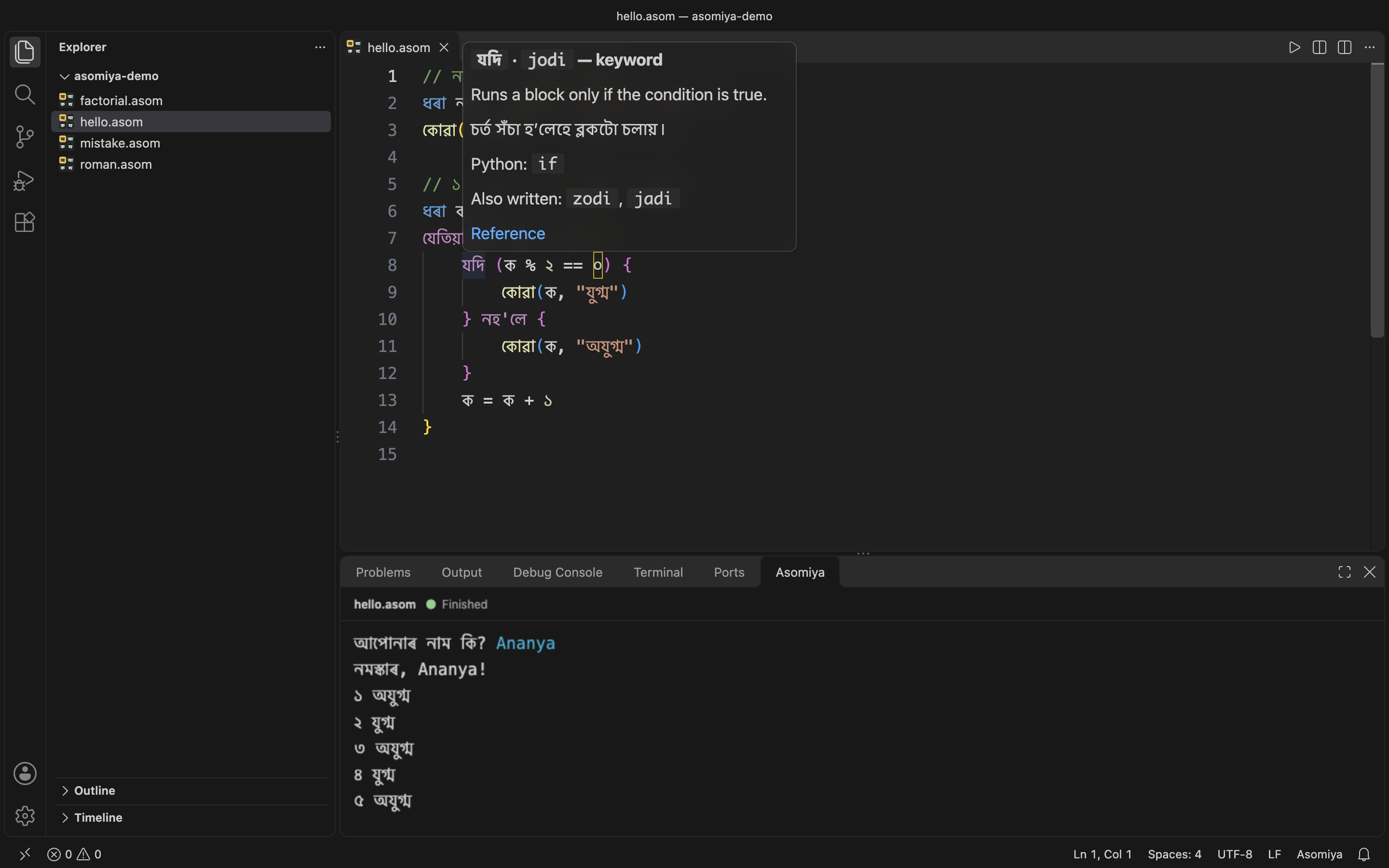
Asomiya for VS Code (also Cursor, Windsurf and VSCodium): syntax colours in both scripts, errors as you type, hover help, a ▶ Run button whose output (with proper Assamese text) appears in an Asomiya panel, and a live Show in Python view.
- VS Code: Visual Studio Marketplace, or search “Asomiya” in the Extensions view.
- Cursor, Windsurf, VSCodium: Open VSX, or search “Asomiya” in Extensions.
More on the extension page; the source is in
editors/vscode.
Use with AI
asomiya-mcp is an MCP server that lets Claude, ChatGPT, VS Code Copilot, Cursor and other AI apps write, check, run and explain Asomiya, with a playground right in the chat. Add it to your AI app:
claude mcp add asomiya -- npx -y asomiya-mcp
Other apps, and the one-click Claude Desktop extension: asomiya.codes/ai.
Use as a library
import { runSource } from 'asomiya';

const { output, error } = runSource('কোৱা(১০ + ২০)');
console.log(output); // ৩০

runSource('kowa(10 + 20)').output; // "30\n"

import { parse, toPython } from 'asomiya';

toPython(parse('কোৱা(১০ + ২০)')); // a Python program that prints ৩০
Documentation
| Guide | What's in it |
|---|---|
| Language specification | types, operators, scoping, semantics |
| Grammar | EBNF, precedence table, lexical rules |
| Keyword glossary | what every word means and why it was chosen |
| Roman spelling guide | writing Asomiya in English letters |
| Error reference | every error code, in Assamese and English |
| Architecture | how the interpreter is built |
| Changelog | what changed in each version |
Why Asomiya?
Programming languages almost always borrow English for their keywords. Asomiya shows that nothing
about lexing, parsing or running code depends on that. Variables can be called বয়স, loops can be
written with যেতিয়ালৈকে, and ১০ + ২০ prints ৩০. It's made for teaching programming to
Assamese speakers in their own language, and for showing how a programming language works inside.
It's a small, educational language: readable and well tested, not fast or feature-complete.
Contributing
Contributions are welcome, especially from native Assamese speakers: if a keyword, spelling or error message sounds unnatural, please open an issue. Several keywords are still marked provisional in the glossary. See CONTRIBUTING.md.
Running tests
git clone https://github.com/d43ash1sh/asomiya.git
cd asomiya
npm install
npm test            # unit + integration tests
npm run check       # typecheck, lint, format and tests
Security
To report a security problem, please use GitHub's private vulnerability reporting instead of a public issue. See SECURITY.md.
People
| Debashish Bordoloi (@d43ash1sh, ORCID 0009-0006-0473-0774) | Creator |
| Arnab Sharmah (@arnabsmh) | Contributor |
| Siddhartha Borah (@siddharthaborah) | Contributor |
| Bigratom Saikia (@saikiabigratom-design) | Contributor |
| Nitish (@Nitishsarma45678) | Contributor |
See all contributors on GitHub.
Acknowledgements
The idea of a playful language with native-language keywords was inspired by BhaiLang. Asomiya has its own grammar, semantics and implementation.
License
MIT © Debashish Bordoloi and contributors