
DomainScout
Domain research for AI agents: checks hundreds of names in one call, with prices and where to buy.
Runs on your machine from its package; the steps are below.
What it does
- Reads
- Writes
- High impact
At most: only reads or looks up information.
What it costs
FreeOdel charges nothing per call. The publisher may charge for its own service.
Runs locally over stdio
This server isn't hosted — your MCP client launches it from a package registry. Use one of the commands below, or drop the config into your client (e.g. Claude Desktop).
Run
npx -y @dakaio/domainscout-mcp
MCP client config
{
  "mcpServers": {
    "domainscout": {
      "command": "npx",
      "args": [
        "-y",
        "@dakaio/domainscout-mcp"
      ]
    }
  }
}Domain research for AI agents. Every good .com is taken. Find the ones that aren't.





DomainScout is an MCP server for bulk domain search. Your AI assistant brainstorms hundreds of names, and DomainScout checks all of them in one call: which are free, what they cost and where to buy them. It runs on your own machine. You need no account and no server of ours, and API keys are optional.
Website · npm · MCP Registry · Examples
What it does
- Finds the free names in a long list. Hundreds of names in one call; 500 .com names take about 20 seconds.
- Checks for real. DNS first, then the registry itself over RDAP, or WHOIS where a TLD has no RDAP. A bought but unused domain is still reported as taken.
- Compares prices at nine registrars: Cloudflare, Porkbun, Namecheap, Spaceship, GoDaddy, Name.com, Dynadot, NameSilo and Hover. The first year, the renewal and any minimum term, cheapest to own first.
- Spots the traps. Premium and reserved names (with a registrar API key), and taken names that are being deleted and may become available soon.
- Any TLD.
.com,.netand.aiby default; ask for any other.
DomainScout does not invent names: your assistant does that, and DomainScout tells it which of them are really free.
Install
Node 20 or newer.
Claude Desktop: one click: download the extension and open it. Claude Desktop asks to install it, and lets you set the options below.
Claude Code: the plugin adds the server and a skill that runs the whole name search (brainstorm, check, present the free names with prices):
/plugin marketplace add JohnDaka/domainscout-mcp
/plugin install domainscout@domainscout
Or the server alone:
claude mcp add domainscout -- npx -y @dakaio/domainscout-mcp
Cursor and VS Code: use the buttons at the top, or add the server to the MCP config.
Any MCP client: add to the MCP config:
{
  "mcpServers": {
    "domainscout": {
      "command": "npx",
      "args": ["-y", "@dakaio/domainscout-mcp"],
      "env": { "DOMAINSCOUT_TLDS": "com,net,ai,io" }
    }
  }
}
On Windows, if npx is not found, use "command": "cmd" with
"args": ["/c", "npx", "-y", "@dakaio/domainscout-mcp"].
Then just ask: "Brainstorm 200 names for my coffee subscription app and tell me which .com domains are free."
From source: npm install && npm run build, then run node /path/to/domainscout-mcp/dist/index.js
in place of npx -y @dakaio/domainscout-mcp.
Tools
check_domains
Checks whether domain names are free to register, and shows prices and where to buy the free ones. Read-only: it never registers or changes anything.
| Parameter | Type | Default | What it is |
|---|---|---|---|
domains | string[] (1 to 1,000 entries) | required | Names or domains: acme, acme.io, https://acme.dev. A name without a TLD is tried in every TLD from tlds |
tlds | string[] | DOMAINSCOUT_TLDS (com,net,ai) | TLDs for names given without one, e.g. ["com"] for a long list |
confirm | boolean | true | Confirm free-looking names with registrar APIs, when you set keys |
details | boolean | false | Include the evidence from every source (DNS, RDAP, WHOIS, registrar API) |
saved | string[] | none | Domains the user saved in the results panel: checked again with the rest and marked saved, so they stay through a regenerate |
It returns a short text report for the model and the same data as structured content: a summary with counts per status, one result per domain (status, note, registration dates, buy links with prices), skipped entries and warnings.
| Status | Meaning |
|---|---|
available | A registrar API confirmed it can be registered; premium says whether it costs extra |
likely_available | Not in the registry or DNS, not confirmed by a registrar |
taken | Registered |
reserved | Blocked by the registry, or the registrar cannot sell it |
unknown | Could not verify right now (timeout, rate limit); try again |
Example
You ask your assistant "I'm naming a note-taking app. Brainstorm 500 names and tell me which .com
domains are free." The assistant calls check_domains once with all 500 names and gets back:
Checked 500 domain(s) in 23.0s: 27 available, 473 taken.

AVAILABLE (cheapest known offer for each):
- quillloom.com: $10.46/yr at Cloudflare https://www.cloudflare.com/domains/search/?q=quillloom.com
- scribeloom.com: $10.46/yr at Cloudflare https://www.cloudflare.com/domains/search/?q=scribeloom.com
- scribebloom.com: $10.46/yr at Cloudflare https://www.cloudflare.com/domains/search/?q=scribebloom.com
...
TAKEN: quillwise.com, quillnest.com, quillflow.com, quillhub.com, quillpad.com, quillbox.com,
  quillbase.com, quillkit.com, ...
Ask about a few favourites afterwards and each one gets every registrar's link and price. More real output, including the command line and JSON: examples.
Results card
In clients that support MCP Apps (Claude on
the web and desktop, VS Code, ChatGPT and others), each check_domains call shows an interactive
panel, the same as on the website:
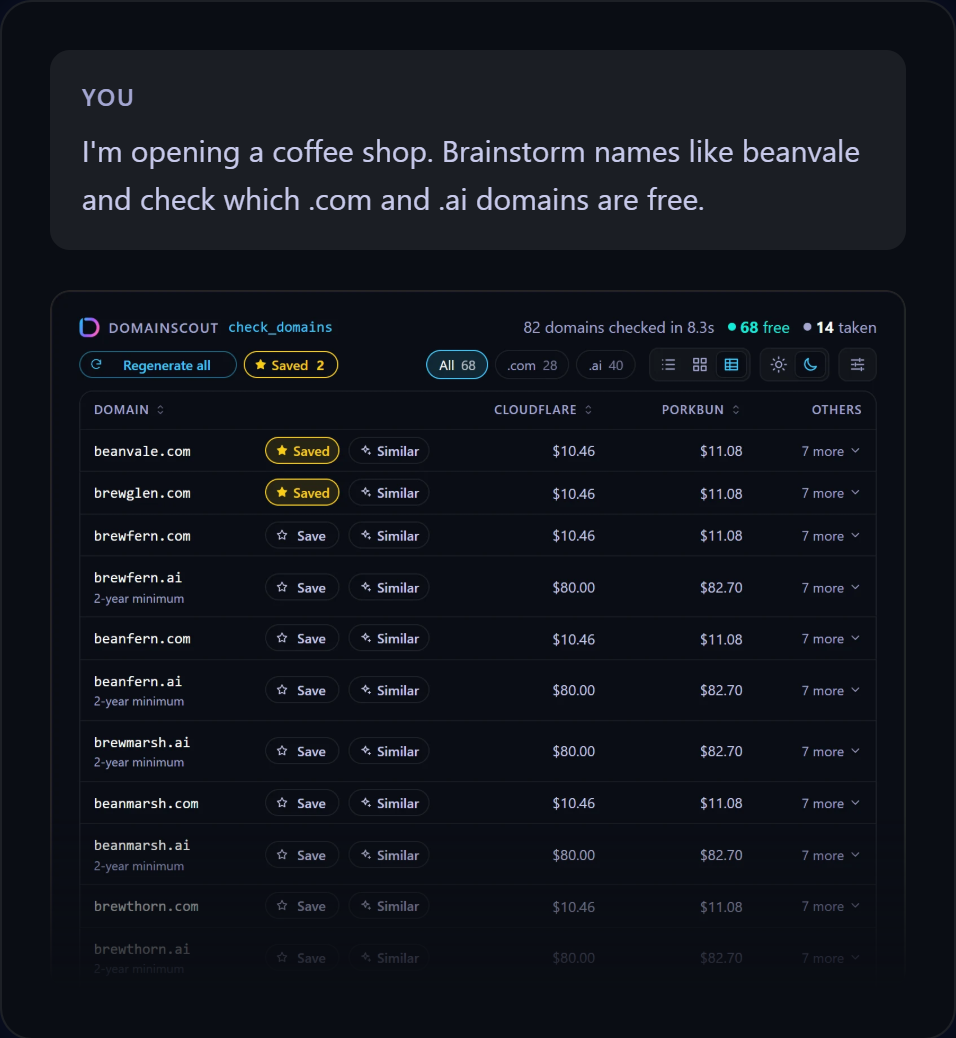
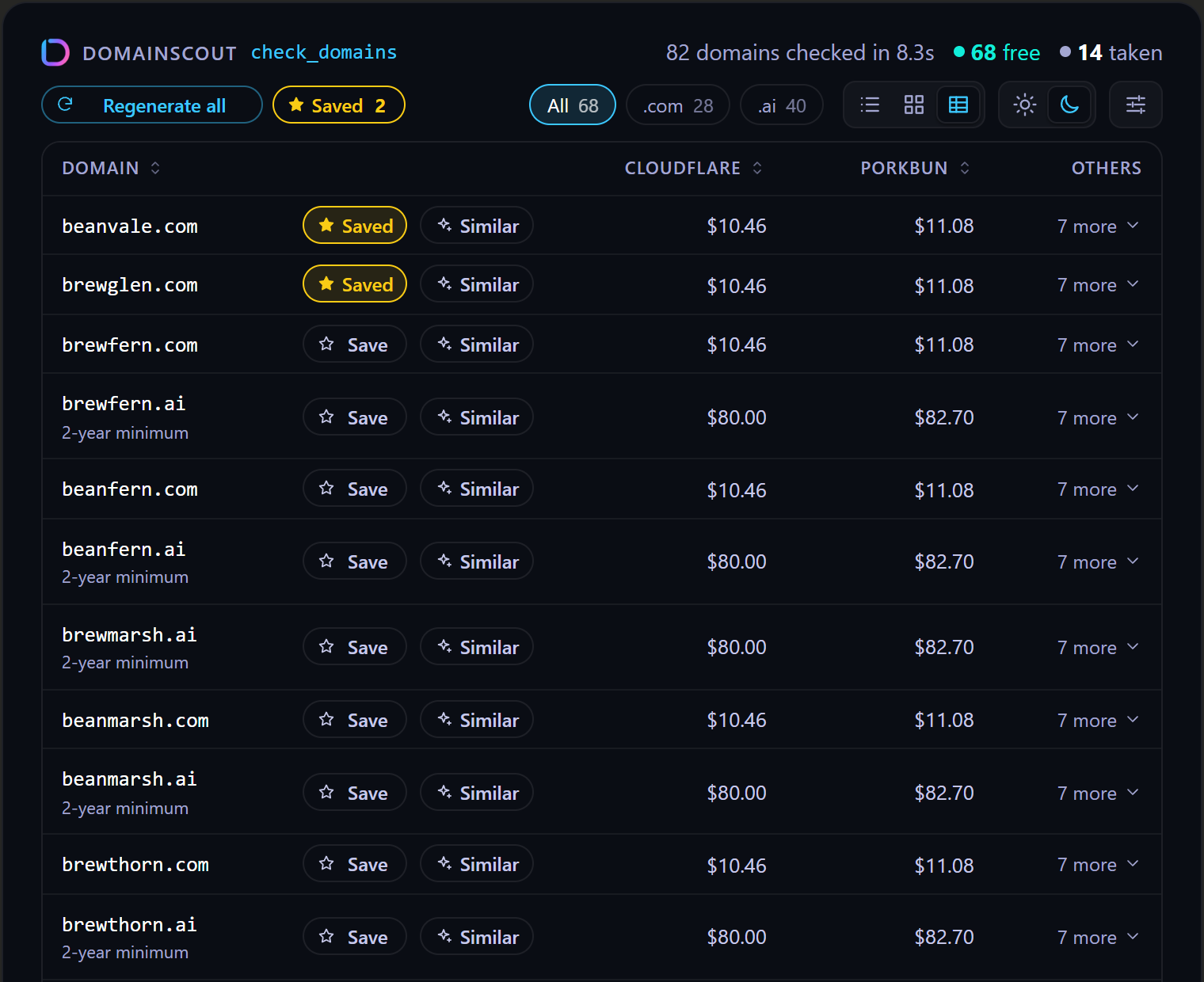
- The free domains as a price table (domains down the side, registrars across the top, every price a link), a list or cards, in a dark or light theme, switched beside the TLD filter. The table sorts by any column; a TLD filter narrows every view to one TLD.
- Prices as a range across registrars, with what renewing costs when it differs from the first year and what a minimum term costs upfront. Registrars are always in price order, cheapest first, the same as in the text report.
- Every registrar for a name under "All registrars" or the table's "N more", each a link.
- Save the names you like and mark the ones to take after as Similar, then Regenerate:
the chat brainstorms a new batch like the marked names (or in the same style, when none are
marked) that leaves out every name checked so far, and the saved domains come along in the
new check (the
savedparameter), still marked as saved and listed first. "Saved 3" beside Regenerate asks the chat to compare the saved domains; both buttons explain themselves on hover. "Try other TLDs" re-checks the taken names elsewhere, and "Compare in chat" asks the chat to pick one of the saved names; it sees what you saved. "Download CSV" saves the free domains with prices and links.
The panel ships in the package (ui/), loads nothing from elsewhere, and uses only what the client
offers: a client that can't send messages or save files simply doesn't show those buttons. Other
clients show the text report.
How it checks
For each domain, in parallel and within polite rate limits:
- DNS. If the TLD zone delegates the name, it is taken. This step is free and saves the registries' rate limits.
- The registry over RDAP, the authoritative source. If the domain is found, it is taken; the result includes expiry, and a note when the domain is being deleted and may become available soon. A 404 means it is likely available.
- WHOIS, only for TLDs without RDAP (for example
.ioand.de) or when RDAP fails. - Your registrar API, optional. If you set an API key, the registrar confirms that each free-looking name can really be bought, flags premium names and gives the exact price.
Having no DNS never proves a domain is free: a bought but unused domain has no DNS either.
Without a registrar API key, "not in the registry" is reported as likely_available. Premium
and registry-reserved names look the same there, so the registrar's page has the final price.
Authentication
None. DomainScout works without an account or API keys. Registrar API keys are optional: with one, free-looking names are confirmed by the registrar, premium names are flagged and the exact price is shown. One key is enough. With several, the APIs are asked in this order, each name only until one answers.
| Registrar | Variables | Where to get it |
|---|---|---|
| Name.com | DOMAINSCOUT_NAMECOM_USERNAME, DOMAINSCOUT_NAMECOM_TOKEN | Account Settings → Security → API Tokens |
| Cloudflare | DOMAINSCOUT_CLOUDFLARE_ACCOUNT_ID, DOMAINSCOUT_CLOUDFLARE_API_TOKEN | API token with Registrar permission. The Registrar API is in beta |
| Spaceship | DOMAINSCOUT_SPACESHIP_API_KEY, DOMAINSCOUT_SPACESHIP_API_SECRET | API Manager; the key needs the domains:read scope |
| Porkbun | DOMAINSCOUT_PORKBUN_API_KEY, DOMAINSCOUT_PORKBUN_SECRET_KEY | porkbun.com/account/api |
Each key is sent only to its own registrar's API, and it never appears in output, logs or error messages. If a registrar rejects a key, the result says so in its notes, and the check still works without that registrar.
Settings
Set these as environment variables in the MCP config. All are optional.
| Variable | Default | What it does |
|---|---|---|
DOMAINSCOUT_TLDS | com,net,ai | TLDs tried for names given without one |
DOMAINSCOUT_REGISTRARS | all | Registrars to show buy links for, e.g. cloudflare,porkbun,namecheap |
DOMAINSCOUT_MAX_CONCURRENCY | 10 | Network requests in flight at once |
DOMAINSCOUT_PER_HOST_CONCURRENCY | 2 | Requests in flight to one RDAP server |
DOMAINSCOUT_TIMEOUT_MS | 10000 | Timeout of one request |
DOMAINSCOUT_MAX_DOMAINS | 500 | Domains per call, after adding TLDs |
DOMAINSCOUT_CONFIRM_MAX | 50 | Free domains per call confirmed through your registrar API |
DOMAINSCOUT_DNS | on | DNS pre-check |
DOMAINSCOUT_DNS_SERVERS | system | DNS servers to use, comma-separated |
DOMAINSCOUT_PRICES | on | Public price lists |
DOMAINSCOUT_AFFILIATE | on | Affiliate buy links (off gives plain links) |
Rate limits
- Per call: up to 500 domains after adding TLDs (
DOMAINSCOUT_MAX_DOMAINS, at most 10,000) and 1,000 input entries. - Registries: each RDAP server gets at most 2 requests in flight and 5 per second; each WHOIS server one query at a time, at most one per second. A server that answers "too many requests" is left alone for as long as it asks, and the request is retried.
- Registrar APIs: every API gets its documented limit (Name.com 10 requests per second,
Cloudflare 4, Spaceship 30 per 30 seconds, Porkbun 8 batches per minute), and at most
DOMAINSCOUT_CONFIRM_MAXnames per call are confirmed. Porkbun throttles an account to 50 names per 5 minutes for a day once it has checked about 1,800 names in 3 hours while registering few of them; the limit keeps every call well below that. A tool call can passconfirm: falseto skip confirmation for a large list.
Pricing
DomainScout is free and open source under the MIT license. There is no account, subscription or usage fee. The prices it shows are the registrars' own standard prices, from public price lists, or the exact price from your registrar API.
Privacy Policy
The full policy: domainscout.dakaio.com/privacy.html.
- Data collection: none. No account, no telemetry, no analytics, and no server of this project. We never receive the names you check, your conversations or your API keys.
- Usage: to answer a check, your machine sends the domain names, and nothing else, to your
DNS resolver, the registries (RDAP/WHOIS) and the APIs of the registrars whose keys you set.
It also downloads IANA's list of registries and two public price lists, the Porkbun price API
and cfdomainpricing.com (a community mirror of Cloudflare's prices); these get no domain names.
DOMAINSCOUT_PRICES=offturns the price lists off. - Storage: recent answers are cached in memory while the server runs. Nothing is written to disk. API keys stay in your MCP client's settings and go only to their own registrar.
- Third-party sharing: none by us. The services above see the requests your machine sends them. Buy links open the registrar's site, and some are affiliate links (see below).
- Retention: nothing is kept after the server stops.
- Contact: GitHub issues, or the Security tab for anything private.
Affiliate links
Some buy links may be affiliate links. When they are, the result says so, and buying through
them earns the project a commission at no extra cost to you. Links are always ordered by price
and never by commission. DOMAINSCOUT_AFFILIATE=off turns them off.
Security
The tool is read-only, runs on your machine, and sends each API key only to its own registrar. To report a vulnerability, see SECURITY.md.
Support
- Questions, bugs and ideas: GitHub issues
- Website: domainscout.dakaio.com
Command line
npx @dakaio/domainscout-mcp check acme getacme.io --tlds com,dev
npx @dakaio/domainscout-mcp check acme --json --no-confirm
npx @dakaio/domainscout-mcp check $(cat names.txt) --tlds com
Development
npm run verify     # typecheck + lint (Biome) + tests with coverage thresholds
npm run build
| Path | What it is |
|---|---|
src/core/ | The checking funnel, input parsing, shared types, network limits and retries |
src/checkers/ | DNS, RDAP and WHOIS lookups |
src/confirm/ | Confirmation through registrar APIs, one class per registrar |
src/pricing/, src/registrars/ | Public price lists, buy links and affiliate templates |
src/report/, src/messages/ | The text report and every text shown to people or to the model |
src/scout/, src/server/, src/cli/ | The check as a whole, the MCP server and the command line |
test/ | Vitest tests; the network is faked, except for a local WHOIS server |
examples/ | Real output of the tool |
site/ | The landing page at domainscout.dakaio.com: static HTML, put out on every change merged into main |
server.json, manifest.json, glama.json | Listings: the MCP Registry, the Claude Desktop extension, Glama |
Releases happen on merge. A pull request's title says what it is (feat: …, fix: …,
docs: …, feat!: …; .github/workflows/pr-title.yml checks it), and once it is merged into
main, .github/workflows/publish.yml decides: feat raises the minor version, fix and
perf the patch version, a ! or a line starting BREAKING CHANGE: the major one, and anything else, or a
change to nothing the package ships, releases nothing. A release raises the version in
package.json, manifest.json and server.json, adds the merged pull requests to
CHANGELOG.md, tags it, publishes to npm (trusted
publishing), creates a GitHub Release with the Claude Desktop extension, publishes to the MCP
Registry and points the Claude plugin at the new version with a lockfile, committing to main
as it goes. The landing page goes out on every change to site/ (.github/workflows/landing.yml).
License
MIT © dakaio.com