Listed from the MCP registry; nobody on Odel publishes it.

Toolsmith
MCP gateway: APIs become tools, and repeated multi-call workflows become one approved tool.
Runs on your machine from its package; the steps are below.
What it does
- Reads
- Writes
- High impact
At most: moves money, runs code or commands, deletes data, or sends messages for you.
What it costs
FreeOdel charges nothing per call. The publisher may charge for its own service.
Runs locally over stdio
This server isn't hosted — your MCP client launches it from a package registry. Use one of the commands below, or drop the config into your client (e.g. Claude Desktop).
Run
npx -y toolsmith-mcp
MCP client config
{
  "mcpServers": {
    "toolsmith": {
      "command": "npx",
      "args": [
        "-y",
        "toolsmith-mcp"
      ]
    }
  }
}

toolsmith-mcp
Give any AI agent the tools it needs, and make the ones it uses faster.
An MCP gateway that turns your APIs into tools, learns the workflows agents repeat,
and offers each one back as a single verified tool, always behind human approval.
Website · Install · Wiki · Configure · Benchmarks · Changelog




Try it in one minute
npm install -g toolsmith-mcp
toolsmith-mcp demo
The demo runs the whole lifecycle against a bundled shop API: import, verify, approve, record agent traffic, discover a workflow, evaluate it, and serve it. It then leaves the gateway and the dashboard running for you to explore.
Why it helps
| Without Toolsmith | With Toolsmith | |
|---|---|---|
| Getting tools | Write an MCP server per API | Point it at an OpenAPI, GraphQL or gRPC API and review the generated tools |
| Many servers | Configure each one in every client | One endpoint for all of them, with one allow-list per client |
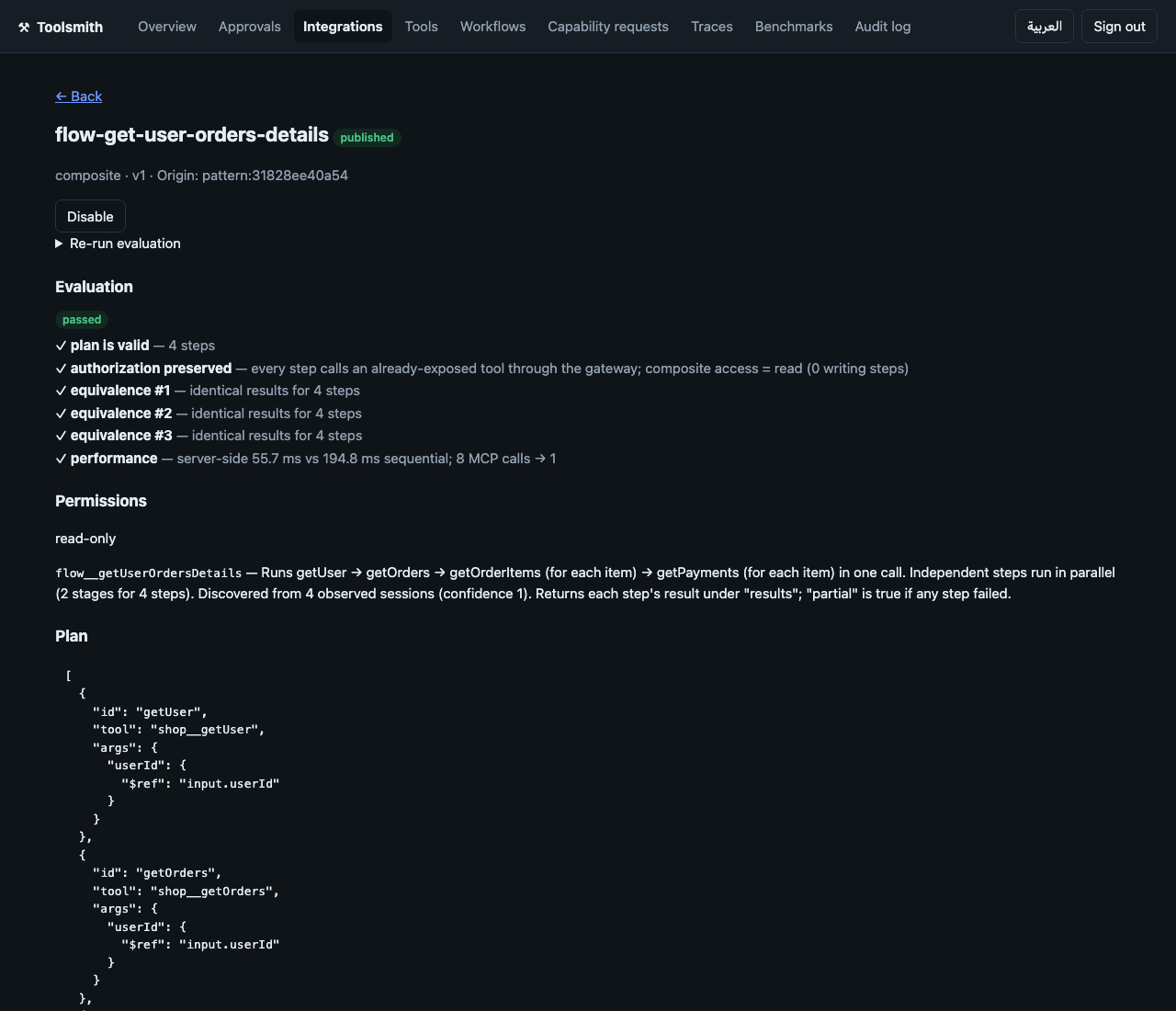
| Repeated work | The agent makes 8 calls, one model turn each | One composite tool does it in 1 call, with independent steps in parallel |
| Safety | Whatever a server exposes, the agent can call | Nothing generated is exposed until a human approves it, and every destructive call needs its own approval |
Measured on the 8-call workflow below: about 4× faster than a sequential agent, and at 50–100 concurrent agents 1.9× the throughput with 3–5× less MCP traffic, with results identical to the original calls. Details ↓
How it works
flowchart LR
  A["AI agents<br/>(any MCP client)"] -->|MCP| G
  subgraph G["toolsmith-mcp"]
    direction TB
    T["Tools from your APIs<br/>and other MCP servers"] --> O["Observe calls<br/>(no payloads stored)"]
    O --> M["Find repeated workflows"]
    M --> E["Build a composite tool<br/>and check it gives identical results"]
    E --> H{{"Human approves"}}
    H --> T
  end
  G --> API[("REST · GraphQL · gRPC APIs")]
  G --> UP[("Other MCP servers")]
- Import an API. Every operation becomes a typed tool, and read operations are called once to verify them.
- Approve it. Read tools go live; write and destructive tools stay hidden until you grant them.
- Let agents work. Toolsmith records which tools they call and how values flow between calls.
- Discover. A workflow agents repeat becomes a proposed composite tool. It is checked against the original calls, then waits for your approval.
What's inside
|
🔌 Connect anything
|
🧠 Learn from usage
|
|
🛡️ Safe by default
|
🏢 Ready for teams
|
New in 0.2.0: OAuth 2.1 resource server, per-client rate limits, gRPC sources, workflows with gaps, and PostgreSQL storage. See the changelog.
Quick start with your own API
mkdir my-tools && cd my-tools
toolsmith-mcp init                                       # config + .env with fresh tokens
toolsmith-mcp import ./openapi.yaml --name shop --token-env SHOP_TOKEN
toolsmith-mcp show shop                                  # review tools, findings, verification
toolsmith-mcp approve shop                               # read-only; --allow-writes to expose writes
toolsmith-mcp start                                      # MCP endpoint + dashboard
toolsmith-mcp client-config                              # snippets for your MCP client
After agents have used the tools for a while:
toolsmith-mcp patterns                                   # repeated workflows
toolsmith-mcp discover                                   # propose and evaluate composites
toolsmith-mcp approve flow-get-user-orders-details
toolsmith-mcp usage                                      # are they used, and what do they save?
More: connecting MCP clients · turning APIs into tools · workflows and composites
Benefits, measured
The workflow measured throughout: a customer, their orders, and the items and payments of each order. By hand that is 8 MCP calls; as an approved composite it is 1, and every composite run returned exactly what the individual calls returned.
All numbers come from npm run benchmark on an Apple M1 Pro with Node 22.13,
with clients, gateway and demo API in one process. No LLM is involved, so
the model turns a composite saves are not counted, and nothing is claimed
about tokens. Full report and methodology.
One agent, local
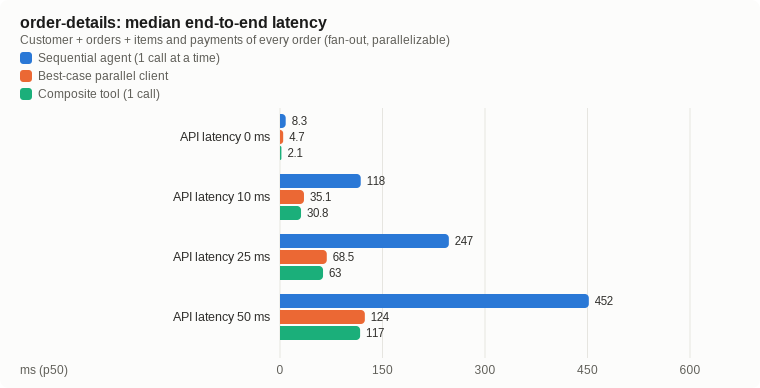
- About 4× faster than a sequential agent, the way most agents call tools.
- As fast as a client that already parallelizes perfectly (5–12% faster, within noise), while making 7 fewer round-trips. In a real agent each of those is a model turn.
- Little gain for strictly sequential chains: 3–7% for 3 dependent steps.
Table: median latency per workflow run
| Demo API latency | Sequential agent | Best-case parallel client | Composite |
|---|---|---|---|
| 0 ms | 8.3 ms | 4.7 ms | 2.1 ms |
| 10 ms | 118.1 ms | 35.1 ms | 30.8 ms |
| 25 ms | 247.1 ms | 68.5 ms | 63.0 ms |
| 50 ms | 451.9 ms | 124.2 ms | 117.2 ms |
Many agents at once
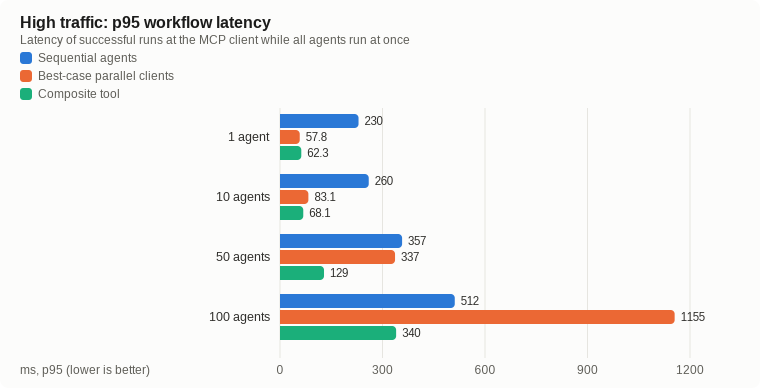
Each agent runs the workflow 10 times; the demo API takes 20 ms per request.
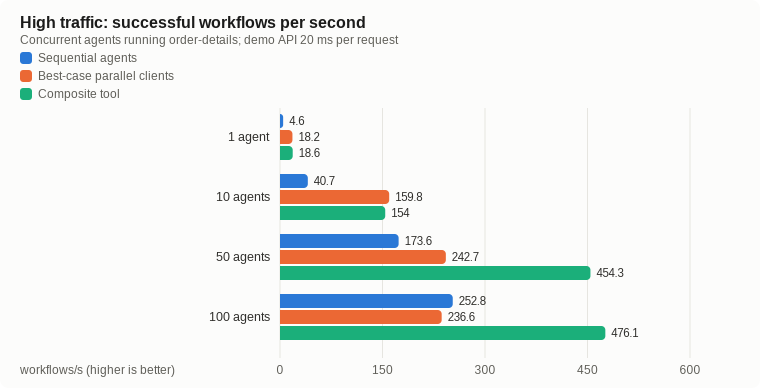
- About 1.9× the throughput of the best alternative at 50 and 100 agents.
- 1.5–3.4× lower p95 latency at 50 and 100 agents.
- 3–5× less MCP traffic at 50 and 100 agents, because each task is one request.
- At 10 agents, a perfectly parallel client keeps up, with a slightly worse p95.
Table: throughput, latency and failures by concurrency
| Agents | Variant | Workflows/s | p95 | MCP requests/s | Failed runs |
|---|---|---|---|---|---|
| 10 | Sequential | 40.7 | 259.7 ms | 325 | 0 / 100 |
| 10 | Parallel client | 159.8 | 83.1 ms | 1,278 | 0 / 100 |
| 10 | Composite | 154.0 | 68.1 ms | 154 | 0 / 100 |
| 50 | Sequential | 173.6 | 357.4 ms | 1,389 | 0 / 500 |
| 50 | Parallel client | 242.7 | 336.7 ms | 1,992 | 17 / 500 |
| 50 | Composite | 454.3 | 128.8 ms | 454 | 0 / 500 |
| 100 | Sequential | 252.8 | 511.5 ms | 2,022 | 0 / 1,000 |
| 100 | Parallel client | 236.6 | 1,155.1 ms | 2,358 | 275 / 1,000 |
| 100 | Composite | 476.1 | 339.9 ms | 476 | 0 / 1,000 |
The parallel client's failed runs are client-side connection resets, not tool errors: macOS caps the TCP accept queue at 128, and parallel clients open many connections at once. Linux usually allows 4,096.
Workflow discovery accuracy
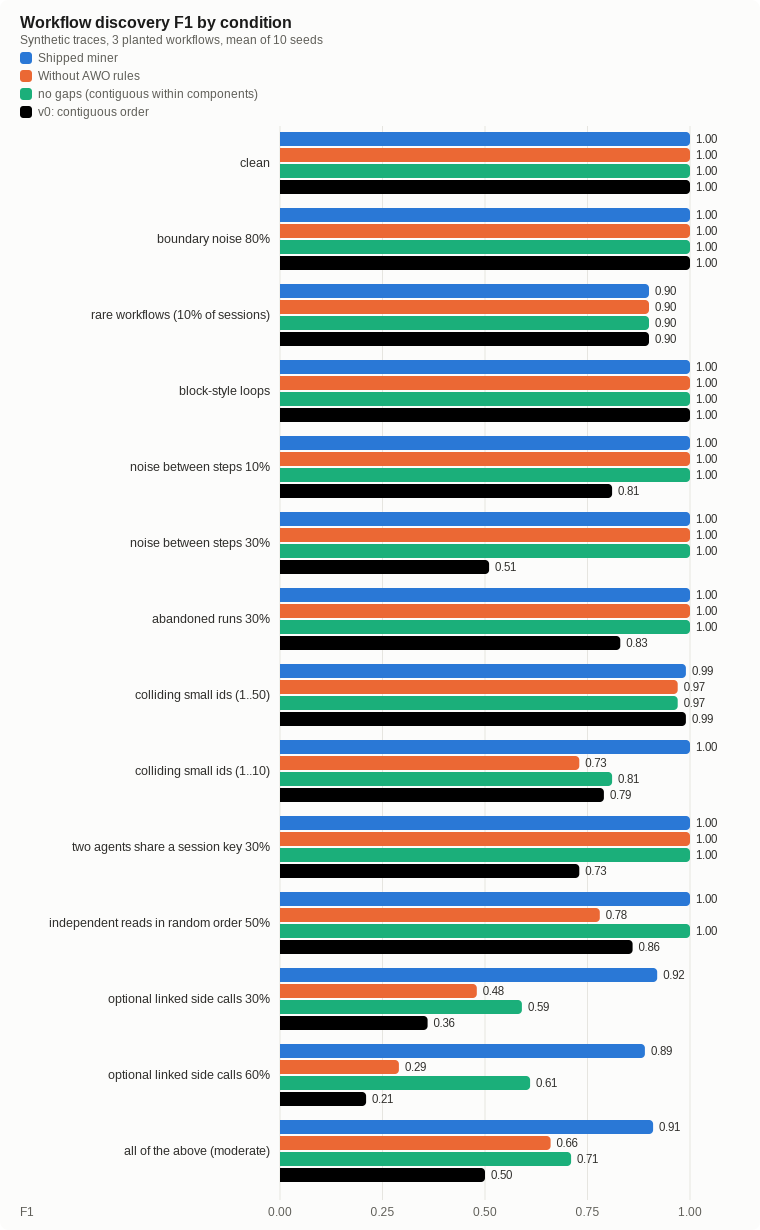
On synthetic traces with 3 planted workflows, 14 noise conditions and 10 seeds each:
- Mean F1 0.97, against 0.75 for the first version of the miner.
- Perfect on clean data, noise between steps, abandoned runs, agents sharing a session, reordered reads, and colliding ids 1..10 (ids 1..50: F1 0.99).
- Optional side calls no longer hide a workflow: F1 0.92 with them in 30% of runs, against 0.59 when only adjacent steps count.
- Weakest on rare workflows (10% of sessions: recall 0.83).
Documentation
Prior art, and what is new here
Mining agent traces into composite tools is not new: AWO (2026) builds meta-tools by hand, and ToolFactory (2025) generates and validates tools from API docs (how we build on both). Toolsmith puts the pieces together behind one standard MCP endpoint: arguments wired automatically from value fingerprints, parallel execution, equivalence-checked evaluation, and a human-approval lifecycle.
Status
Version 0.2.1
- Tested: unit, integration, end-to-end over MCP and security suites, on SQLite and on PostgreSQL (including multi-node tests).
- Validated: fifteen rounds by an independent agent (reports).
- Not yet hardened by production use. Runs on one host with SQLite, or as several nodes sharing PostgreSQL.
Contributing · Security policy · Code of conduct · MIT licensed