Listed from the MCP registry; nobody on Odel publishes it.

Inferrail
Local, payload-free AI cost visibility for agents. Query spend by model, route, or tagged work.
Runs on your machine from its package; the steps are below.
What it does
- Reads
- Writes
- High impact
At most: only reads or looks up information.
What it costs
FreeOdel charges nothing per call. The publisher may charge for its own service.
Runs locally over stdio
This server isn't hosted — your MCP client launches it from a package registry. Use one of the commands below, or drop the config into your client (e.g. Claude Desktop).
Run
uvx inferrail
MCP client config
{
  "mcpServers": {
    "inferrail": {
      "command": "uvx",
      "args": [
        "inferrail"
      ]
    }
  }
}

Inferrail
Spending limits, receipts and paid execution for AI agents.
Give each AI job a dollar budget that's enforced before the provider is called,
and a cost receipt that never stores what the model said.



Quickstart · For agents · How it works · Docs · tryinferrail.com
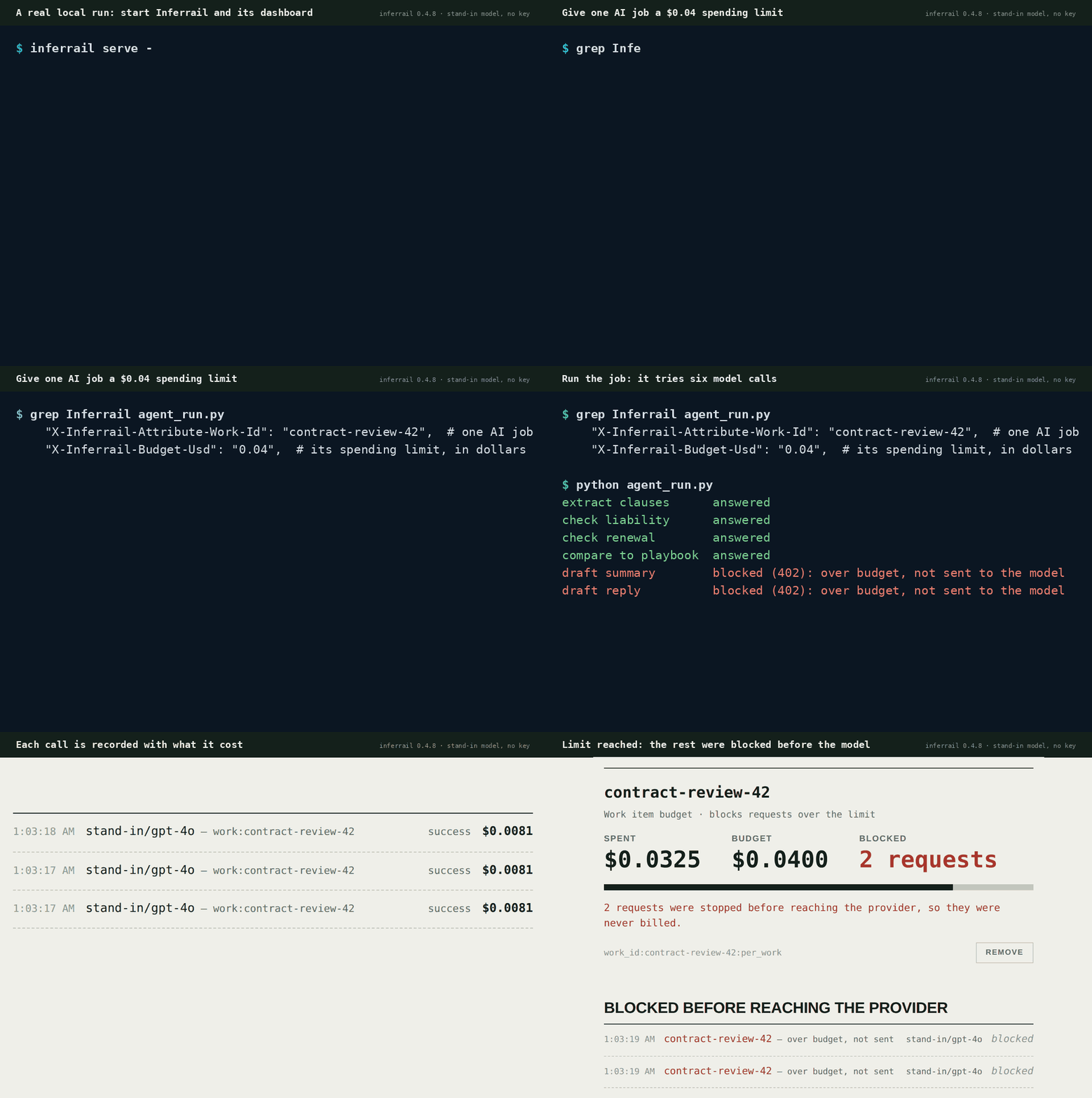
A real run of the gateway and dashboard with a local stand-in model: one job with a $0.04 limit, four calls answered, two refused with HTTP 402 before reaching the model. How it was recorded
What works today
Developer preview: interfaces may change before 1.0.
| Capability | What it does | Where | Status |
|---|---|---|---|
| Gateway | OpenAI- and Anthropic-compatible proxy you run yourself. A dollar budget per job, shared by parallel calls; a call that would exceed it gets HTTP 402 before the provider. | pip install inferrail | Available |
| Cost receipts | One record per call: tokens, price, cost, status, your tags. Never prompts or responses. Totals by job, customer or any tag. | local SQLite or JSONL | Available |
| MCP server | Read-only get_spend and get_health tools over your local receipts. | inferrail mcp | Preview |
| Inferrail Hosted | The same per-run budgets run for you, shared across agents and machines. 250 runs a month free, then USDC credits over x402. Bring your own provider key. | hosted guide | Preview |
| Web Read | One public web page as clean markdown with a receipt, paid per call by the agent over x402 or MPP. | below | Preview |
| Agent purchases under a job budget | One budget covering model calls and x402 purchases; a purchase that doesn't fit is refused before it's signed. Local proof, no mainnet. | example | Experimental |
Also experimental: AP invoice-exception recovery, a hosted trial gateway, and Work Economics / Economic Authority (example; Base Sepolia testnet only).
Quickstart
Requires Python 3.11+.
Try it offline. No API key, no network calls, no provider charges:
pip install inferrail
inferrail demo
inferrail report --by customer --receipts ./inferrail-demo-receipts.jsonl
The demo sends scripted requests through the real engine to a fake provider with made-up
prices labelled DEMO, and prints what they cost by customer.
Give one run a budget, inside your Python app. No config file, no second process:
import inferrail
from openai import OpenAI

base_url = inferrail.start()   # the gateway, on a background thread in this process
client = OpenAI(base_url=base_url, api_key="unused")   # your key stays in OPENAI_API_KEY
client.chat.completions.create(
    model="gpt-4o-mini",   # any model your account can use; `inferrail models` lists priced ones
    max_tokens=200,
    messages=[{"role": "user", "content": "Summarize this contract."}],
    extra_headers={
        "X-Inferrail-Attribute-Work-Id": "contract-review-42",   # the run
        "X-Inferrail-Budget-Usd": "0.50",                        # its dollar ceiling
    },
)
Every call with the same work id shares that budget, including parallel calls; one that would
push the run past it gets HTTP 402 before it reaches OpenAI. inferrail work contract-review-42
shows what the run cost.
More: run it as a shared gateway with the local dashboard, framework snippets (LangChain, LangGraph, OpenAI Agents SDK, CrewAI, Haystack, LlamaIndex, Microsoft Agent Framework), and other clients, including the Anthropic SDK.
For agents
Start at tryinferrail.com/llms.txt: what's live, with links to each service's guide and the OpenAPI contract.
Web Read sells one public web page as clean markdown, with its word count, a SHA-256 of the
content and a receipt. $0.002 per delivered page, paid over x402 (USDC
on Base) or MPP (Tempo); no account or API key. The payment is checked first
and settled only after the page is delivered, so refusals (robots.txt, non-public addresses,
non-text, over 2 MB, target-site errors) are never charged. Retrying the same url and
request_id from the same wallet within 10 minutes returns the page already paid for.
curl -i -X POST https://inferrail-cost-gateway.onrender.com/read/v1/page \
  -H 'content-type: application/json' -d '{"url": "https://example.com/"}'
# HTTP 402 with the price; an x402 or MPP client pays and repeats the request
Install as agent skills. Three skills teach your coding or research agent when and how to use these tools: reading web pages (one, or up to 10 per call), checking dependencies for known vulnerabilities, and looking up a domain's DNS, SPF/DMARC and registration. Each is $0.002 per delivered result from the agent's own wallet, and the agent asks you before creating or funding one.
npx skills add domondi1/inferrail                         # Claude Code, Cursor, Codex, Copilot and more
/plugin install inferrail --marketplace domondi1/inferrail  # Claude Code plugin (2.1.275+)
To get later versions: npx skills update, or in Claude Code
/plugin marketplace update inferrail then /plugin update inferrail@inferrail.
In a Vercel AI SDK agent. @inferrail/ai-sdk-tools gives
your agent readPage, readPages, checkPackages, lookupDomain and findPaidApi, at $0.002
per delivered result. They're paid by the x402 fetch you pass in, from a wallet you fund and
control. Installing the package doesn't give your agent a wallet or funds.
npm i @inferrail/ai-sdk-tools ai zod
tools: inferrailTools({ fetch: wrapFetchWithPayment(fetch, client) }) // see the package README
Working agents with a per-run spending cap: examples/ai_sdk/.
Skills: skills/. In CI: check lockfiles for known vulnerabilities on every push
with actions/package-check (a capped wallet you set).
Guides: Web Read · Hosted · service source.
MCP. Ask your agent what a job cost, from your local receipts:
claude mcp add inferrail \
  -e INFERRAIL_RECEIPTS_PATH=/absolute/path/to/inferrail-receipts.jsonl \
  -- uvx --with "mcp>=2.0" inferrail mcp
Two read-only tools, get_spend (known cost and tokens by provider, model, route or any tag
such as work_id) and get_health. They don't run inference, write files or pay for anything.
Other clients: docs/integrations.md.
How it works

The gateway routes each request by model to a configured provider, checks any budget in
scope, forwards the call, and writes one receipt per request, including requests a budget
refused. A cost is recorded only when the provider reports usage and a price is on file;
otherwise it's unknown, never a guessed $0.
| Where | What it sees or keeps |
|---|---|
| Your provider | The full request, exactly as it would without Inferrail, under the provider's own policies. |
| The gateway, in memory | Your provider key (from its own environment) and the prompts and responses it forwards. |
| Receipts, on your disk | Provider, model, token usage, the price used and the cost, status, timing, and the attribution tags you send. |
| Not in receipts | Prompt and response bodies. |
Attribution tags are stored as sent, so keep secrets and message content out of them.
inferrail verify-payload-free prints the live receipt schema, and canary tests check that
message bodies never reach receipts; neither is a security audit. The optional usage beacon
sends nothing unless an endpoint is configured (details).
Architecture: docs/ARCHITECTURE.md.
Current support
- Endpoints:
POST /v1/chat/completions(OpenAI-compatible) andPOST /v1/messages(Anthropic-compatible), with streaming and tool calls, plusGET /v1/models. - Providers: OpenAI, Anthropic, and endpoints compatible with either. Built-in prices cover OpenAI and Anthropic models; others need a price in your config, or their cost stays unknown.
- Not supported: the OpenAI Responses API, embeddings, image generation, audio and Realtime, batch, and native Gemini or Bedrock APIs. Fields the gateway can't account for are rejected with a clear error, never silently dropped.
- Scope: only calls through a running gateway are counted.
Exact contract and non-goals: docs/PRODUCT.md. Running agent jobs that spend real money? Open a production setup request.
Documentation
- Give one AI agent run a dollar budget
- Integrations: SDKs, frameworks, attribution, MCP, voice
- Self-hosting: install, configuration, storage, budgets, dashboard
- Product scope and architecture
- Machine-readable: llms.txt, openapi.json (the gateway), config.schema.json
Contributing, security, license
Questions and bugs: GitHub issues.
Security or privacy vulnerabilities: report privately, as described in
SECURITY.md. Contributing: CONTRIBUTING.md
(pytest needs no API key or network). License: Apache-2.0.