SaC — Software as Content
Give your AI agent the ability to respond with live, interactive apps that evolve.
Runs on your machine from its package; the steps are below.
What it does
- Reads
- Writes
- High impact
At most: moves money, runs code or commands, deletes data, or sends messages for you.
What it costs
FreeOdel charges nothing per call. The publisher may charge for its own service.
Runs locally over stdio
This server isn't hosted — your MCP client launches it from a package registry. Use one of the commands below, or drop the config into your client (e.g. Claude Desktop).
Run
uvx sac-sdk
MCP client config
{
  "mcpServers": {
    "sac-software-as-content": {
      "command": "uvx",
      "args": [
        "sac-sdk"
      ]
    }
  }
}


AI agents can reason, code, and call APIs — but when they need to communicate back to you, all they have is text. SaC (Software as Content) is the missing interaction layer: your agent responds with a live, persistent, interactive app that evolves as the conversation continues. Not a screenshot, not a markdown wall — a real UI you click, explore, and shape together with your agent.
Quickstart
1. Install
pip install sac-sdk
2. Run
sac serve
First time? It'll ask for your API key and save it. Then open http://localhost:18420, type "3-day Tokyo trip planner with budget", and watch a live React app stream in. Click buttons. Ask it to evolve. This is SaC running a built-in agent loop — no external agent needed.
Connect to your agent
SaC plugs into the agent you already use — through MCP, Skill, or code.
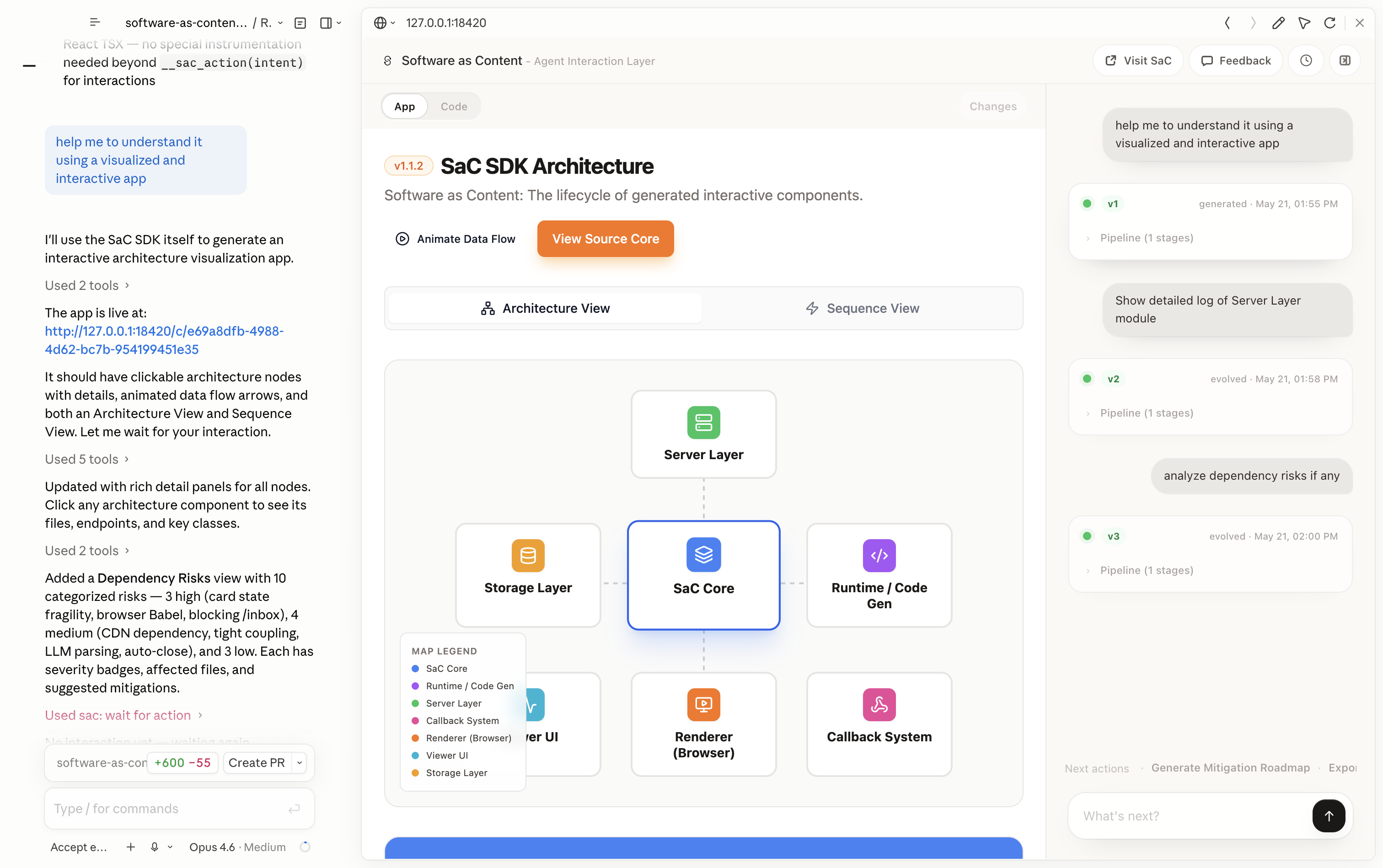
Claude Code (MCP)
pip install sac-sdk
sac setup claude-code        # registers SaC as an MCP server
Restart Claude Code. Then try:
"Help me understand this codebase using a visualized and interactive app using SaC MCP."
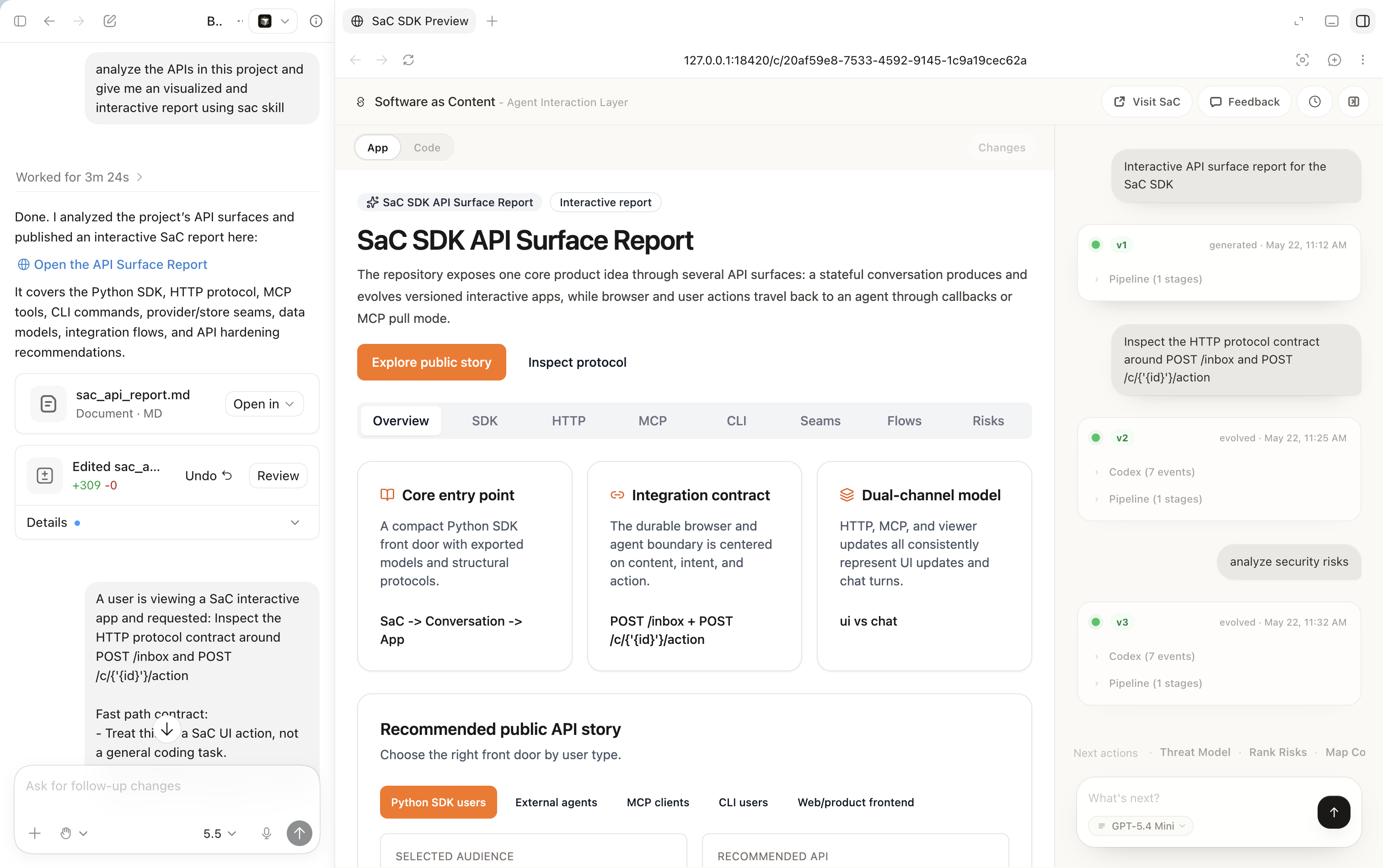
Codex (Skill)
pip install sac-sdk
sac setup codex              # installs the SaC skill
sac serve                    # keep running in a terminal
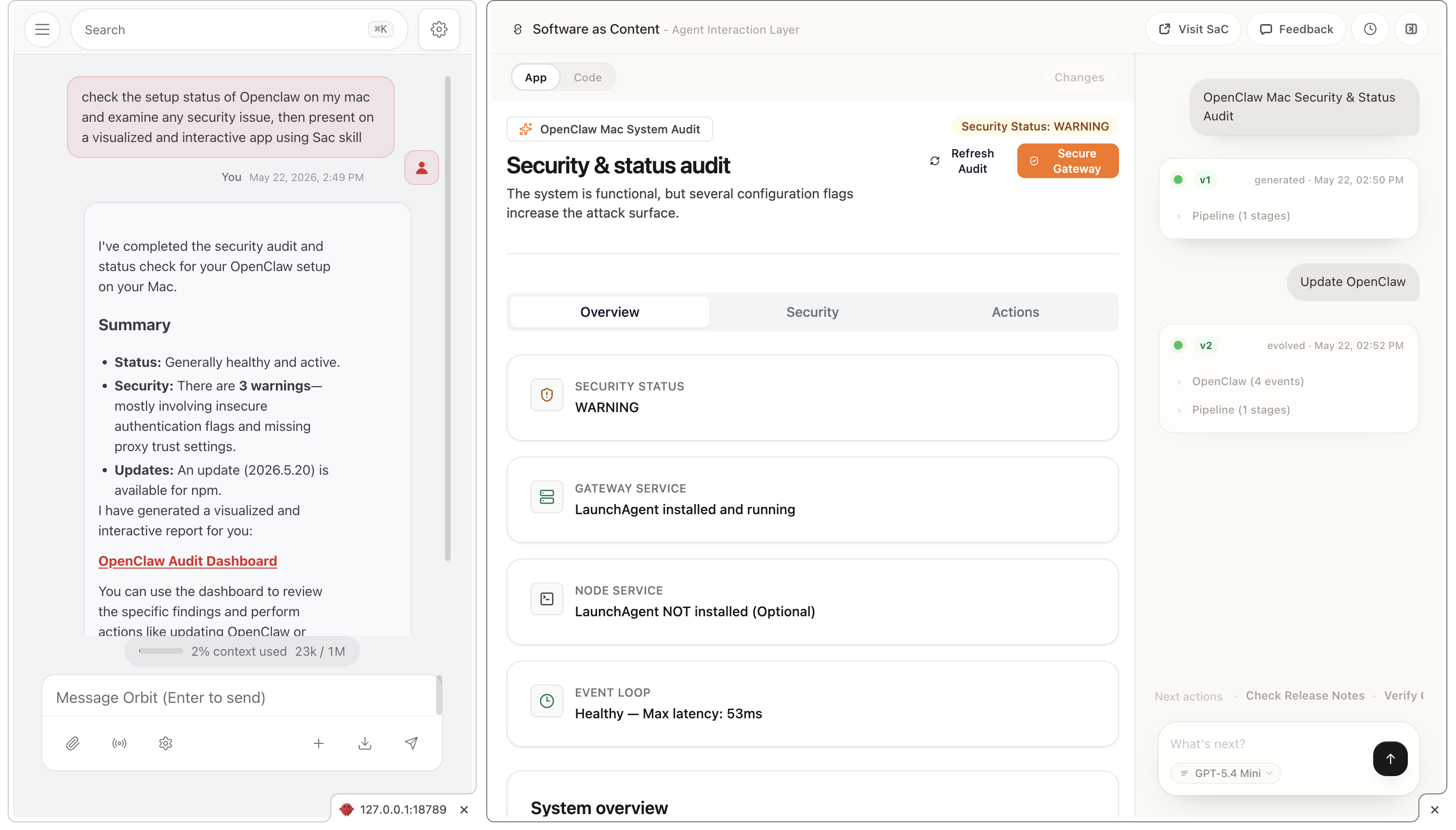
OpenClaw (Skill)
pip install sac-sdk
sac setup openclaw           # installs the SaC skill
sac serve                    # keep running in a terminal
Python (build your own agent)
from sac import SaC

sac = SaC()
conv = sac.conversation()
app = await conv.generate("3-day Tokyo itinerary")
print(app.url)   # user opens this
# app.code contains the generated TSX
How it works
Your agent ──▶ SaC ──▶ User sees a live app at a URL
                   ◀── User clicks a button / types a message
Your agent ──▶ SaC ──▶ Same URL, app evolves in place
                   ◀── ...
One URL, one conversation. The agent doesn't generate a new page every turn — it evolves the existing app. Users keep their context; the agent keeps its state.
Two channels, one loop: every response is either a UI update (the app evolves) or a chat reply (a text bubble). Users can click buttons in the app OR type in the chat — both go back to the agent through the same callback.
When to use SaC
SaC is for tasks where exploration and interaction matter more than a final answer.
Good fit: trip planning, data analysis dashboards, comparison shopping, project planning, research, financial reviews, decision aids, internal tools
Not the right tool for: simple Q&A, one-shot automations ("set an alarm"), conversations that are purely text
Customize
Every layer is pluggable:
from sac import SaC, FileStore

sac = SaC(
    llm=YourLLMProvider(...),       # any class implementing LLMProvider
    search=YourSearchProvider(...), # any class implementing SearchProvider
    store=FileStore(".sac"),
)
Prompts live in src/sac/runtime/prompts/ and
the default design system is in src/sac/renderer/design-systems/default/.
Architecture
src/sac/
├── sac.py / conversation.py    Entry + Conversation primitive
├── runtime/                    Generate + Evolve pipeline, prompts, providers
├── server/
│   ├── http/                   FastAPI + SSE streaming + viewer
│   └── mcp/                    MCP stdio server (Claude Code integration)
└── renderer/                   iframe sandbox + design system
Project status
v0.1.2 — alpha. The core protocol (generate → evolve → callback loop) is stable and runs in production at sac.dynsoft.ai. The SDK surface is being polished toward v1.0.
Contributing
Issues and PRs welcome. Highest-leverage contributions right now:
- Prompt improvements in
src/sac/runtime/prompts/ - Design system contributions in
src/sac/renderer/design-systems/
For local dev: pip install -e .