
Tkach Security
Fail-closed MCP adapter for untrusted model output over a local Tkach runtime.
Runs on your machine from its package; the steps are below.

What it does
- Reads
- Writes
- High impact
At most: moves money, runs code or commands, deletes data, or sends messages for you.
What it costs
FreeOdel charges nothing per call. The publisher may charge for its own service.
Runs locally over stdio
This server isn't hosted — your MCP client launches it from a package registry. Use one of the commands below, or drop the config into your client (e.g. Claude Desktop).
Distributed via cargo as `tkach-mcp`.
A fail-closed security boundary for AI agents and compromised model output.





The model proposes. Tkach authorizes.
Put Tkach between model proposals and protected actions. Its Rust Core checks authority and information flow before allowing an action or releasing output. Model output remains untrusted data, even when the model is compromised.
Why Tkach
- Explicit authority: protected actions need an exact-scope, Core-issued
Propusk; model text cannot create one. - Controlled data flow: permission to read is not permission to export. Provenance and release checks remain inside the boundary.
- Fail-closed decisions: invalid, denied, replayed, cancelled, or uncertain states do not silently become permission.
- Isolated secrets and bounded evidence: broker-held secrets stay outside
ordinary model context;
Sledreceipts do not include payloads.
These guarantees apply to paths routed through Tkach. It does not make the model trustworthy, detect every prompt injection, or protect a compromised host.
Start in minutes
Install from crates.io with Rust 1.85 or newer:
cargo install tkach-cli --version 0.1.2 --locked
tkach init my-agent
tkach check my-agent/.tkach/request.json
tkach run --demo
init creates a starter request without overwriting files; check validates
its schema, not permission to execute; run --demo exercises the offline
boundary without a model connection. Use tkach ui for the interactive panel.
Prefer no Rust toolchain? Download a binary below and start with tkach init.
Packages and downloads · v0.1.2
| Channel | What you get | Install / next step |
|---|---|---|
| GitHub Releases | tkach + tkach-mcp; Linux x86_64, macOS x86_64/arm64, Windows x86_64 | Verify downloads |
| crates.io | Seven Rust crates at 0.1.2: Core, Gateway, HTTP, client, MCP, CLI, provider adapter | Package list |
| npm | Thin JavaScript / TypeScript HTTP client | npm install tkach-security-client@0.1.2 |
| PyPI | Thin Python HTTP client | python -m pip install tkach-security-client==0.1.2 |
| Official MCP Registry | io.github.ECD5A/tkach-security@0.1.2, local stdio | Configure MCP |
| GHCR | OCI image for Linux amd64 / arm64 | Digest and deployment |
Binary archives include SHA-256 manifests, keyless Sigstore bundles, and GitHub build attestations. Pin the OCI digest for deployment; verification details live in the distribution guide.
Integrate without moving policy out of Rust
Use the HTTP contract from
your application, the Rust client,
a Python/JS/TS/Go client,
or the stdio adapter from an MCP client.
Clients and MCP require a separately started local tkach serve runtime and
its bearer token; installing a package does not enable background protection.
tkach-core stays provider-, protocol-, and language-independent. Adapters
transport requests; policy and authority stay in Rust. Follow the
integration guide or copy a working examples/
scenario. The Go client is a source module, not a separate registry package.
The supported runtime is loopback-only by default. Public internet serving, TLS termination, Streamable HTTP, a cloud control plane, and a generic executor are not included; see the deployment contract.
Show the cross-platform CLI window
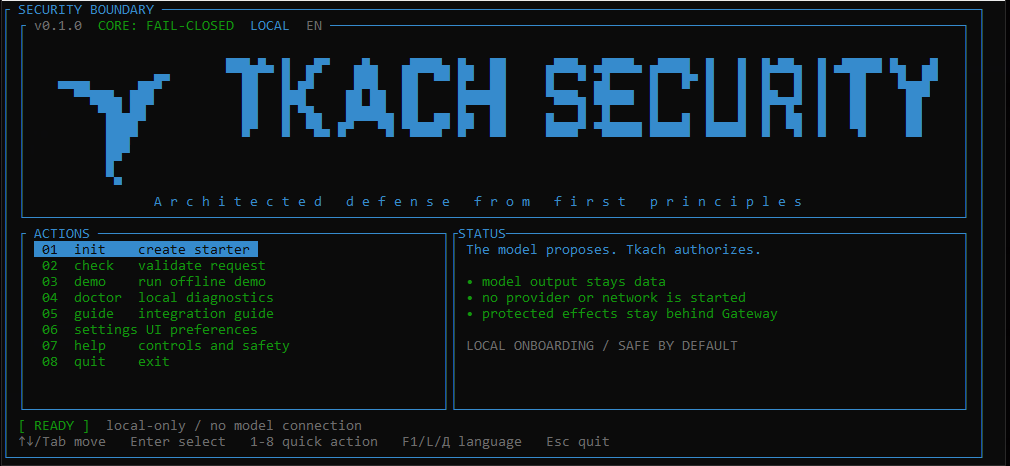
See the boundary in action
From a repository checkout, run the offline Golden Case. It needs no model service or credentials. It performs one create-only write inside a temporary sandbox, then proves that a sibling path and a compromised provider proposal are denied:
cargo run -p tkach-gateway --example golden_case --locked
Expected result:
GOLDEN_CASE|safe_output=released|allowed_write=committed|out_of_scope=denied|compromised_action=denied|compromised_executor_calls=0
The positive path uses trusted host configuration for the exact policy, destination, and executor binding; the provider supplies only an untrusted proposal. Read the architecture for the enforcement path and the release notes for the release checks and remaining limitations.
Documentation
- Use: integration guide, examples, distribution.
- Review: product contract, architecture, security model, threat model.
- Follow: changelog, roadmap. Report vulnerabilities through SECURITY.md.
Contributing
Keep changes small and explicit about the security boundary. Core changes need a demonstrated security or product defect; adapters must remain thin and must not duplicate Core logic. See CONTRIBUTING.md for required checks, public-claim rules, and files that must remain local.
Support
If Tkach Security is useful to your work, support its continued maintenance:
- TON:
pointoncurve.ton - Bitcoin (BTC):
1ECDSA1b4d5TcZHtqNpcxmY8pBH1GgHntN - USDT (TRC20):
TUF4vPdB6QkjCvZq18rBL4Qj4dK5ihCN75
Contact
For inquiries about Tkach Security, integrations, security research, or collaboration:






