Listed from the MCP registry; nobody on Odel publishes it.
Is this yours? Claim it
Echo UI
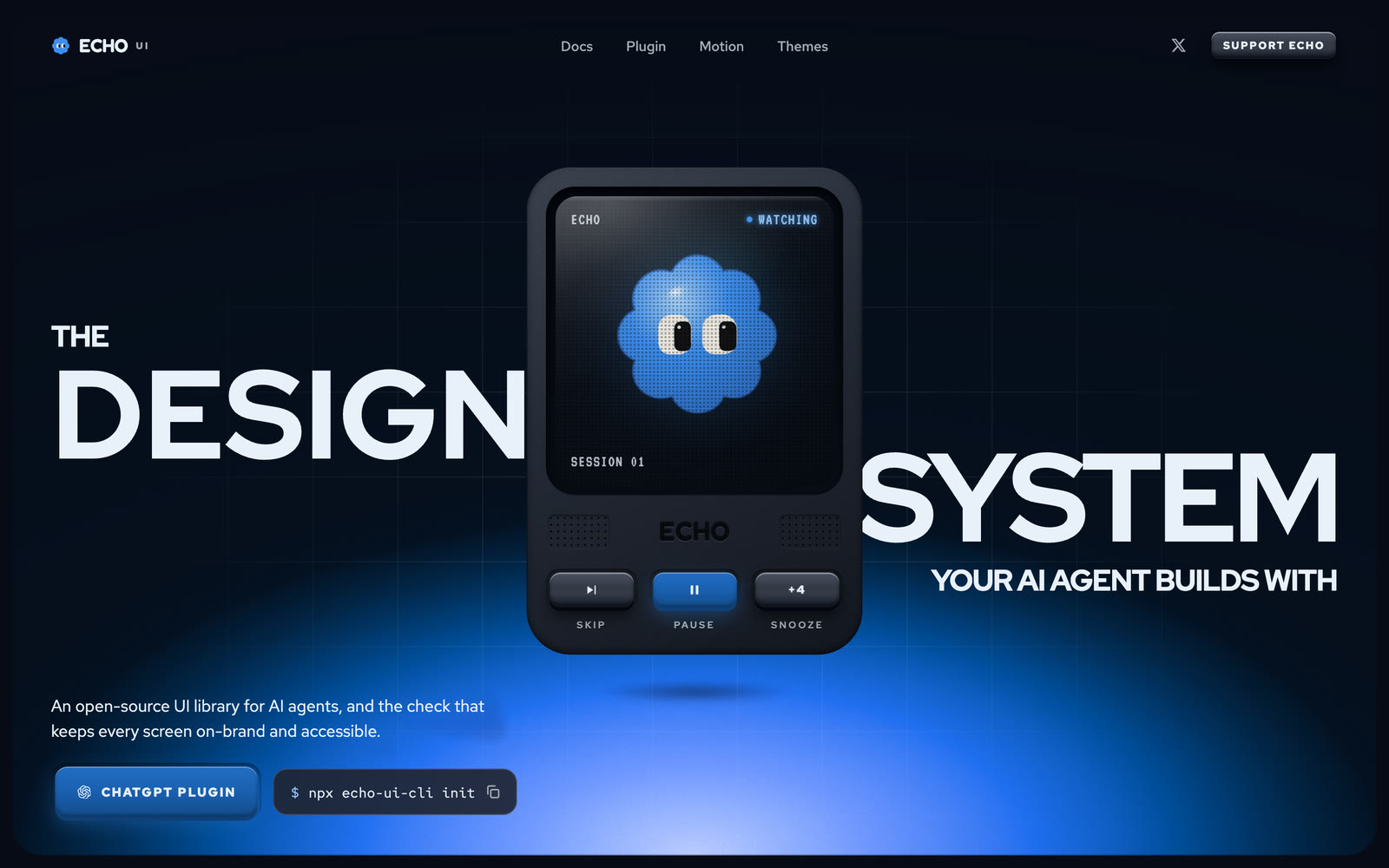
A tactile React component library, and the design system that keeps your AI agent on-brand.
One address for any MCP client. No sign-in needed on this server.
What it does
8 read2 other
Grouped by tool name. At most: only reads or looks up information.
What it costs
FreeOdel charges nothing per call. The publisher may charge for its own service.
Tools
10 · grouped by tool name · checked 7 Nov 2026Read · 8Look things up
- search_components
- get_component
- get_tokens
- get_examples
- get_accessibility
- check_code
- list_styles
- check_style
Other · 2Neither hinted nor named
- fit_styles
- wear_style
Echo UI is a tactile React component library, and the design system that keeps your AI agent on-brand.
Echo is one design system, not a bundle of components. Every part is molded from the same material and follows the same rules: caps in recessed wells, emissive LCD readouts, real press travel. One colour themes all of them, and they press, sound and move the same way, so your product feels like one thing. Motion and sound are first-class token families alongside colour and type, so a button does not just look pressed, it moves and it clicks.
Your style goes on top. Echo keeps the feel (the press, the sound, the motion, the AA floor), and the look is yours:
- Your mood boards become styles. Echo's Design Eye reads them, asks you what a board can't settle, and saves each style to your own private library. A board drawn in line becomes a drawn device.
- A new app picks its style.
initsets the project up, and Style Fit picks the style that fits. - Your agent builds the screen, asking Echo which component does each job. Changing one
setting later, like "rounder", is one line:
style set. - When it slips, Echo hands it back. A check runs on every file your agent saves, and when it says it's done, Echo's tests (design and axe) run on the pages it changed until they pass.
- Next product, next style. The same components and the same feel, in another look.
The workflow follows one builder through all five.
Echo's components are copied, not installed: its CLI puts their source in your repo and you
own it from there. The one npm package is echo-ui-core, the small shared grammar they import
(the theme engine, sound, motion and tactile feedback).
npx echo-ui-cli init
npx echo-ui-cli add hardware-button
115 items: 113 components (two of them hooks) and 2 whole-screen templates. Every one has a docs page that is axe-clean, works from the keyboard, runs on Chromium and WebKit in the test suite, and relights from a single colour seed.
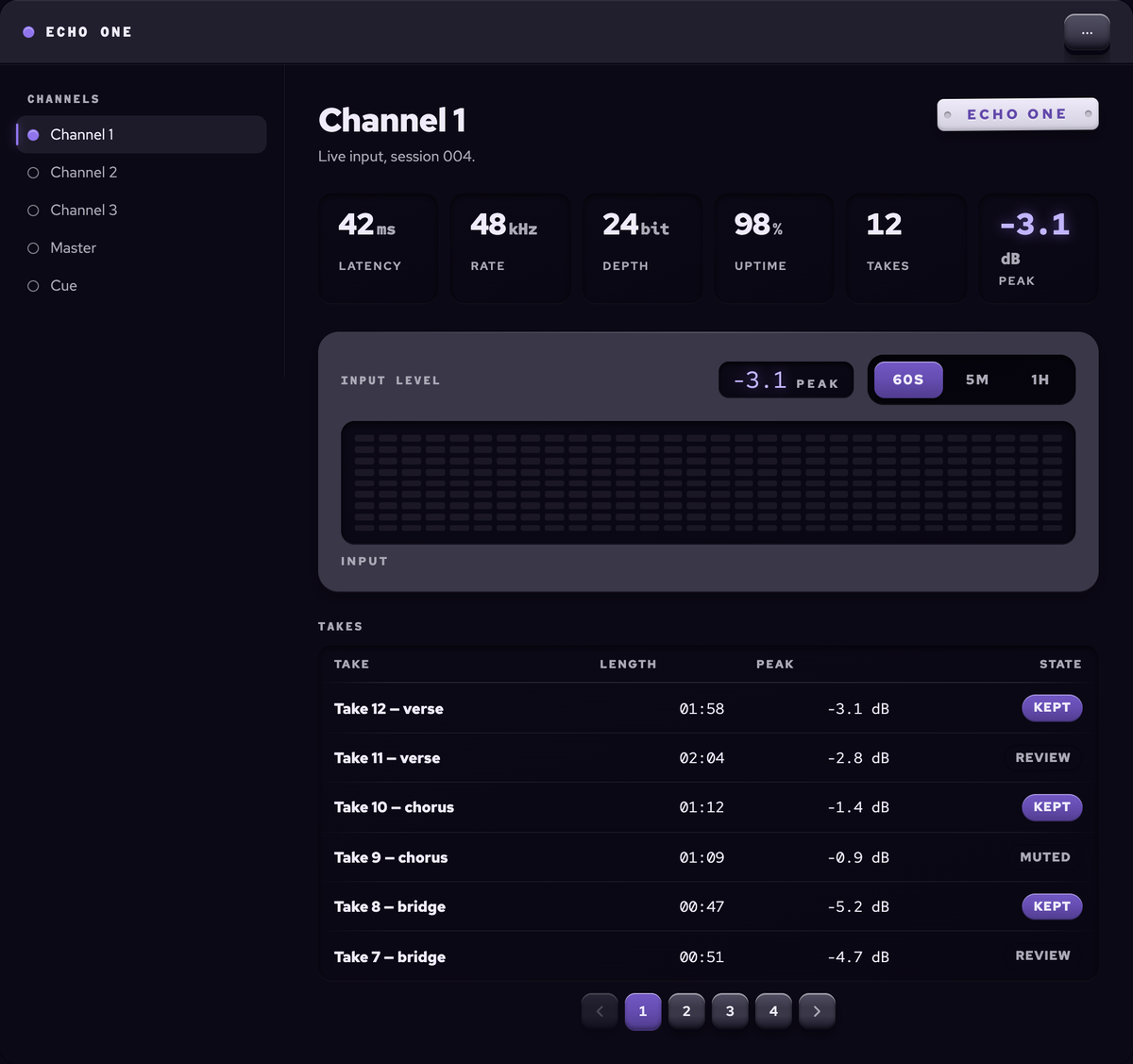
The Console template, one command: npx echo-ui-cli add console. A rail, six readouts, a level matrix and a table on one screen.
Browser support
Chrome/Edge 111+, Safari 16.2+, Firefox 113+. Declared as a browserslist key so a build tool
can read it, and checked on two engines — the test suite runs against Chromium and WebKit.
The floor is oklch() and color-mix(). Echo's whole colour system derives every surface, every
border and every state from one seed colour, and that derivation happens in CSS at paint time
rather than being precomputed — which is what lets a theme relight from a single value. Those two
functions are how.
Below the floor the failure is silent: an unsupported color-mix() makes the whole declaration
invalid rather than falling back, so a surface loses its colour instead of degrading. createEchoTheme
therefore emits one @supports not (color: color-mix(…)) guard that paints plain seed colours on
the page root. An out-of-baseline visitor gets something legible and obviously unstyled rather than
invisible text on an invisible background. There are no per-property fallbacks beyond that, and
there will not be: a flat-colour twin for every color-mix() in the library is a second, worse
design system running in parallel forever.
Install
Before you start: a Next.js 16 (App Router) or Vite app on React 18 or later, with TypeScript
(components ship as .tsx), and Node 20 or later for the CLI. Nothing else: no CSS framework, no
config file, no path alias. Installation says why each one.
1. Set the project up once. This installs echo-ui-core, writes echo.json, echo-lock.json
and echo-theme.css, adds what an agent reads (a marked Echo block in CLAUDE.md or AGENTS.md, a
check hook, the Stop gate and three skills), and prints the lines it wants you to paste yourself:
npx echo-ui-cli init
It never edits your source code, and add refuses to run before it. npx echo-ui-cli agent off
takes the block, DESIGN.md, the hook and the skills back out. The registry it reads defaults to
https://echo-ui.com/e; --registry points it somewhere else.
2. Add anything:
npx echo-ui-cli add hardware-button   # one component
npx echo-ui-cli add console           # a whole screen
A template pulls in every component it uses. Everything lands under a single Echo folder and the
items import each other by relative path, so they resolve identically in this repo and in yours —
no alias to configure. echo-lock.json records what was installed, so a file you have edited stops
the next install instead of being overwritten.
What you can count on
- Updates keep your edits. Echo records a hash of every file it installs.
npx echo-ui-cli diffsays what changed since, andnpx echo-ui-cli updatemerges Echo's change into files you've edited; where the two meet in the same lines, it shows them and changes nothing. initdoesn't touch your CSS. It writes the theme into its own file in the Echo folder and prints the one import line for you to paste. Your global CSS and your layout stay yours.- Few dependencies.
echo-ui-corehas none of its own: it asks for React and GSAP, which your app installs once. Components add Base UI where they need it, and nothing else. - First-party code only. Every file you install is Echo's own source, in your repository, where you can read it. Once the repository is public, the release workflow publishes each package with npm provenance, so a version can be traced to the commit it was built from; until then, releases are published by hand.
- Accessible, and kept that way. Every component is tested against WCAG 2.2 AA: axe, keyboard,
focus-visible, forced-colors, target-size, reflow.
npx echo-ui-cli checkkeeps an agent from undoing it in the screens it builds: unnamed controls, clicks with no keyboard, images without alt text, removed focus rings. What a check can't judge still needs a person: the reading order, and whether a name makes sense. Still open: screen-reader, not yet verified by a person.
What's in it
echo-ui-core — the theme engine, the sound engine, motion tokens, useTactile,
useGsapPresence. Foundations — SizeProvider, and Scope (a colour of its own for one part of
the page).
Buttons (4) — HardwareButton, LedKey, Toggle, Toolbar.
Forms (21) — Field, Textarea, Select, Combobox, TagsInput, Checkbox, CheckboxGroup, RadioGroup, ChoiceCards, Switch, Slider, RangeSlider, NumberField, OTP field, DateField, Calendar, DatePicker, FileUpload, Segmented, Fieldset, Form.
Overlays (7) — Modal, AlertDialog, Sheet, Menu + ContextMenu, Popover, Tooltip, Command (a dot-matrix command palette).
Navigation (7) — SideNav, TabBar, Tabs, Breadcrumb, Pagination, Steps, Link.
Layout (11) — AppShell, Stack & Grid, Panel, Card, Item, Divider, Accordion, Collapsible, ScrollArea, WidgetGrid, PullToRefresh.
Data display (11) — Table, DescriptionList, StatTile, LcdChip, Chart (a readout, not a charting library), Badge, CountBadge, Tag, Avatar, Kbd, ShortcutMap.
Feedback (10) — Toast, Banner, Progress, Meter, Loader, Skeleton, StatusDot, EmptyState, NotificationCenter, StatusIsland.
Objects (18) — the hardware only Echo has: Knob, Tuner, JogWheel, Keypad, FillSlider, QuickTile, SwitchBank, PatchBay, FilterTray, WeekStrip, LevelMeter, SegmentDisplay, DateTile, Annunciator, EngravedPlate, Receipt, Ticket, NowPlaying.
Motion (18) — HoldButton, Morph, DoneButton, ConfirmButton, SaveButton, ActionFan, Timer,
Stopwatch, VoiceNote, AddToBag, PullCord, SplitFlap, LightSource, Magnetic, ThrowStack, Ripple, and
the hooks useBudOff and useRoll.
Creature (2) — Creature, the companion that reports what's happening, and Perch. Texture (2) — dither, noise, halftone, scanlines and grain overlays, and ShaderField.
Templates — whole screens, installable as one block:
| Block | Proves |
|---|---|
echo-console | Density and data at scale. Whether the material language holds when nothing has room. |
echo-chat | That the material survives running text: incoming messages get no container, and the only raised object is Send. |
Theming
One seed in, the whole device relights:
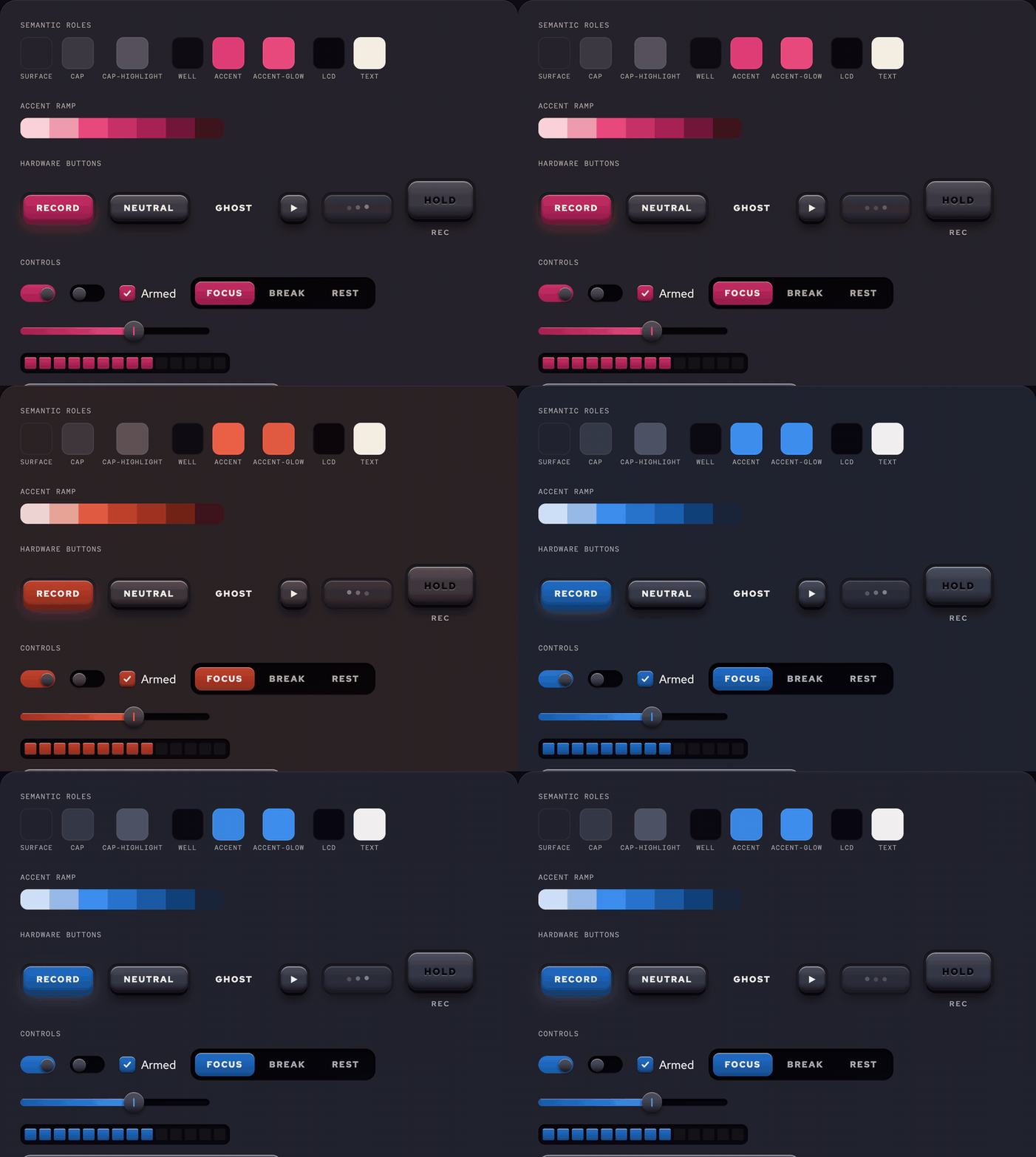
Four seeds from the theme generator: Nawwara, Raspberry, Coral and Sky.
import { createEchoTheme } from "echo-ui-core/theme";

const { css, values } = createEchoTheme({ accent: "#3D8EF0" });
Every Layer-3 --echo-* role is derived in OKLCH from a ~3-value seed, with a 7-stop accent ramp
and a JS mirror for GSAP and canvas. Text roles are contrast-guarded to WCAG AA against every
ground they are used on; a seed whose constraints cannot all be met is reported rather than silently
shipped.
Echo is dark or light, and the chassis decides. A dark chassis makes a device with lit screens: recessed glass whose readouts glow. A pale one makes a light device, like a white calculator: screens of paper glass printed in ink, because a glow on a pale body is a smudge; the accent lit on it, with lit text printed a step deeper; the same primary cap, with a light label; shadows of the body's own colour; and a lit rim that stops short of white, so a cap keeps its bevel. It isn't a mode to switch: one seed makes one device, and both are held to the same contrast guarantee.
Sound
Sound tokens are serializable synth recipes rendered by a zero-dependency WebAudio backend — no
audio assets. SoundProvider handles the parts that are easy to get wrong: no AudioContext until a
user gesture, persisted mute, a blur guard, and coupling to prefers-reduced-motion.
For agents
Echo is built to be used through a coding agent, and init makes the project say so. It writes a
short Echo block into CLAUDE.md or AGENTS.md, which Claude Code, Codex and Cursor read at the
start of every session; a hook that runs npx echo-ui-cli check on every file the agent edits and
hands what it finds straight back; the Stop gate, which runs Echo's tests (the design tests and
axe) on the pages the agent changed before it can call the work done; an Echo skill with the steps for building a screen from Echo's
reference screens; Echo's Design Eye, which reads a moodboard into a style the project can wear,
saved to the builder's own private library; and Echo's Style Fit, which picks the style a product
wears from that library and Echo's. What Echo puts in your project
lists each one, and npx echo-ui-cli agent off takes them out.
The agent asks before it writes, several questions at once, answered offline from a copy of the catalog in the project:
npx echo-ui-cli which "a settings toggle" "confirm a delete"
npx echo-ui-cli docs switch alert-dialog
For tools without a terminal, the same records are published: every component's props, examples and anti-patterns as data, so a model is told that a screen readout does not ease smoothly and that severity is not red/amber/green.
/llms.txt·/llms-full.txt·/r/catalog.json- An MCP server over the same catalog, run with
npx -y echo-ui-mcpor hosted athttps://mcp.echo-ui.com/mcpfor the tools without a terminal:search_components,get_component,get_tokens,get_examples,get_accessibility,check_code, and four for styles,list_styles,fit_styles,check_styleandwear_style. Seemcp/README.md. - The docs site has a guide for each: For AI agents, Installation, MCP server and more.
Contributing
See CONTRIBUTING.md for the development workflow and the rules a change has to meet. The short version: Echo's architecture is locked — the stack, the three-layer token model, and the copy-into-your-tree distribution were each decided with the tradeoffs weighed. CONTRIBUTING lists them. A change that needs one of them re-decided is an issue, not a pull request.
Support Echo
Echo is free, and it stays free. If it saves you time, one-time or monthly support pays for new components, bug fixes and releases: echo-ui.com/support. Starring the repository and reporting bugs help too.
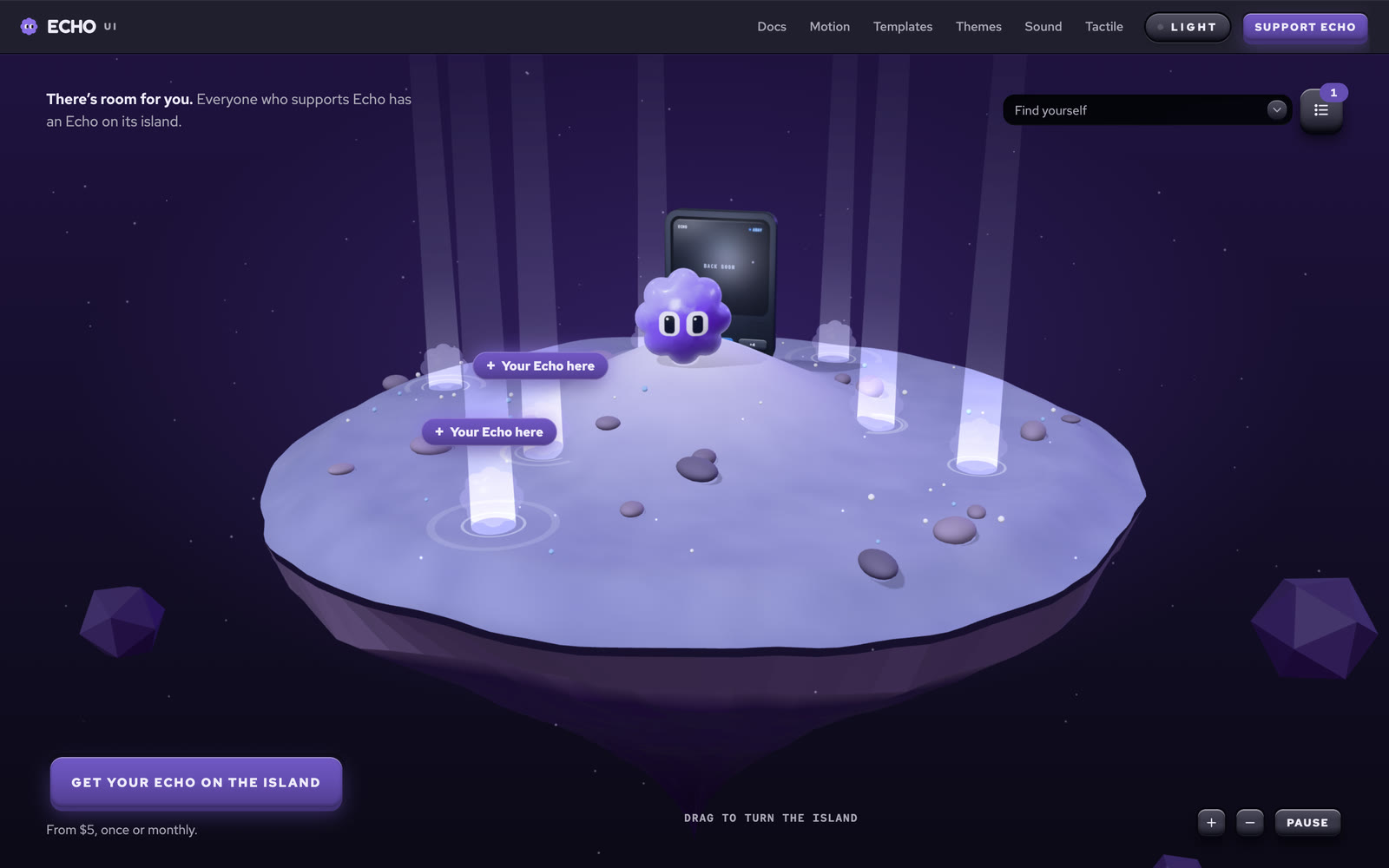
Everyone who supports Echo gets an Echo of their own on its island, with their name and their links.
License
MIT — see LICENSE. Components, blocks and the agent layer are all MIT; nothing here is a paid tier. Installed components are copied into your repo and are yours to change.