Listed from the MCP registry; nobody on Odel publishes it.

Mesh2cad
Mesh (STL/OBJ/PLY) to editable STEP, CadQuery, OpenSCAD or FreeCAD, with a fidelity report
Runs on your machine from its package; the steps are below.
What it does
- Reads
- Writes
- High impact
At most: moves money, runs code or commands, deletes data, or sends messages for you.
What it costs
FreeOdel charges nothing per call. The publisher may charge for its own service.
Runs locally over stdio
This server isn't hosted — your MCP client launches it from a package registry. Use one of the commands below, or drop the config into your client (e.g. Claude Desktop).
Run
uvx mesh2cad
MCP client config
{
  "mcpServers": {
    "mesh2cad": {
      "command": "uvx",
      "args": [
        "mesh2cad"
      ]
    }
  }
}mesh2cad converts an STL mesh of a simple mechanical part into editable parametric CAD: STEP, CadQuery, OpenSCAD, and FreeCAD scripts. It is also an MCP server.



If you find this useful, you can support me by getting a SkinToScan pack, my other project. It's a one-time purchase that directly funds my open-source work.



OBJ and PLY meshes work the same way. The fit runs on your machine. Nothing is uploaded.
A STEP file is the solid. When the fit is exact, a hole is one cylindrical face, not a ring of triangles. A script is for changing a dimension and rebuilding. CadQuery is Python. OpenSCAD is the text the Customizer on Thingiverse and Printables edits. The FreeCAD file is a macro. All three use the same names, so hole_1_d is the same hole in each of them.
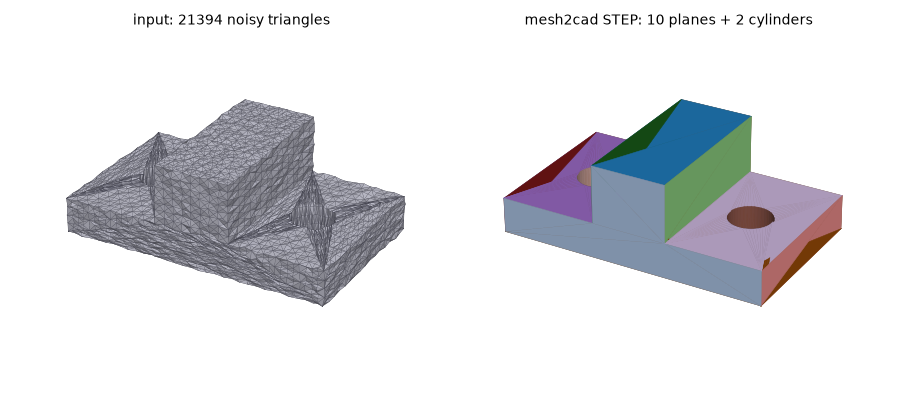
Left: a 21k-triangle mesh with 0.1 mm noise. Right: the STEP file mesh2cad writes, 10 planes and 2 cylinders, max deviation 0.05 mm from the true part.
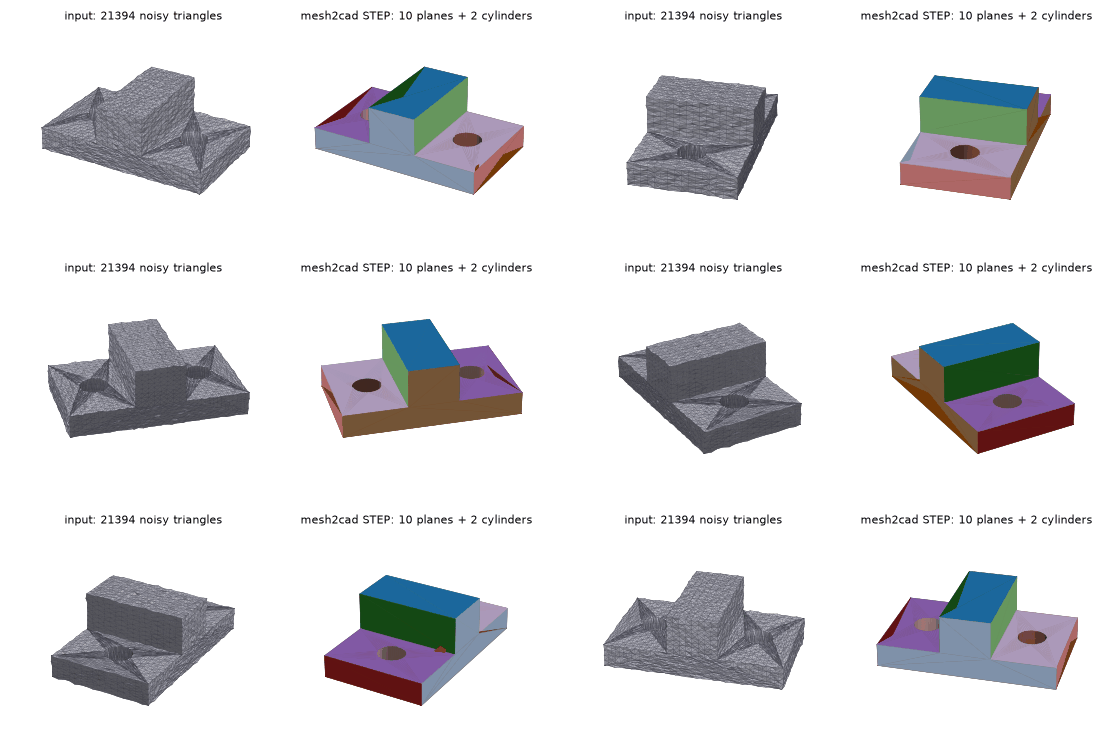
Four printer parts, with the STEP files and the generated scripts, are in the example gallery.
Hackaday wrote about it: Mesh2Cad Automates Re-Modelling.
Install
pip install mesh2cad
Python 3.10 or newer. That install is the command line tool and STEP export. OpenCascade comes in with the package (cadquery-ocp).
pip install "mesh2cad[mcp]" adds the server. pip install "mesh2cad[cadquery]" lets mesh2cad run a generated .py and check it before the file is written. OpenSCAD and FreeCAD are separate programs, not pip packages. Without openscad on PATH, a .scad file is still written and the command says it was not verified. A .FCMacro is written only when a check passes. What happens when freecadcmd is missing is in Install.
Quick start
mesh2cad convert plate.stl --cadquery plate.py
mesh2cad edit plate.py --set hole_grid_1_d=8 --in-place -o plate.step
The first command writes plate.py. Diameters, thicknesses, and positions are names at the top of the file. A four-hole grid is hole_grid_1_d. The second sets that diameter to 8 mm, rewrites the script, and writes plate.step. Every other byte of the file stays as it was.
mesh2cad edit bracket.py --set base_x=+2 adds 2 mm to the current length. A leading + or - is a change from the current number, not how you set a negative value. mesh2cad params bracket.py prints each name, its value, and the unit when there is one.
A STEP file on its own is mesh2cad convert part.stl -o part.step. Add --report report.md for the numbers: Hausdorff and RMS deviation, volume error, face types, and the method (exact, faceted-hybrid, or faceted). Open that STEP file in FreeCAD, Fusion, Onshape, or another CAD tool and select a face.
If the part is outside what a script can express, or the rebuilt solid misses the check, the script is not written and the command exits with code 2. The reason is printed. The same convert can write .scad and .FCMacro. Flags are in the CLI reference. What the scripts contain is in CadQuery, OpenSCAD, and FreeCAD. The edit rules are in Parameters.
What it handles
It is meant for simple mechanical parts: plates, brackets, and boxes with holes, bolt circles, slots, bosses (including on an extruded outline), countersunk and counterbored holes on that outline, and fillets. A Z extrusion can also carry one radius on every vertical corner of the outline. It fits planes, cylinders, spheres, cones, and constant-radius rounds, and writes those as faces you can select.
It does not recover organic or sculpted shapes, scans, or free-form surfaces. When a fit is poor it does not invent a surface. STEP output falls back to a faceted solid that is still valid, and the report names that fallback. A script is held to a tighter check: deviation at most max(4 times the tolerance, 0.1 mm), and volume error at most 1%. Miss that, and the script is refused.
Six Original Prusa i3 MK3S printed parts in the test set come back as exact STEP, and all six also as a script. The measurements, including the small belt-profile patches that stay faceted, are in Real parts. Synthetic noise tests are in Benchmarks. The fitted-surface list, the parameter names, and the refusals are in Limits (v0.31.0). The pipeline is in How it works.
MCP
pip install "mesh2cad[mcp]"
mesh2cad mcp
That starts the server on stdio. Point a client at it like this:
{ "mcpServers": { "mesh2cad": { "command": "mesh2cad", "args": ["mcp"] } } }
The tools are convert, analyze, report, to_cadquery, to_openscad, to_freecad, list_params, and edit_params. Arguments, return values, and the directory listings are in MCP.
Docs
- Install: extras, OpenSCAD and FreeCAD
- CLI reference: every command and flag
- CadQuery scripts: parameters and the check
- OpenSCAD scripts
- FreeCAD macros
- Editing a parameter:
paramsandedit - MCP server: tools and arguments
- How it works: the fitting pipeline
- Limits: what is fitted and what is refused
- Benchmarks: synthetic noise tests
- Real parts: Prusa printer parts
- Development: tests and demo images
- Changelog
- Project site with an overview and FAQ
A mesh that converts badly can go in a GitHub issue. There is a template for an STL that fails.
License
MIT. See LICENSE.