Open Design
Design skills, design systems and artifact tools: landing pages, decks, prototypes, posters, more.
Runs on your machine from its package; the steps are below.
What it does
- Reads
- Writes
- High impact
Not assessed yet.
What it costs
FreeOdel charges nothing per call. The publisher may charge for its own service.
Runs locally over stdio
This server isn't hosted — your MCP client launches it from a package registry. Use one of the commands below, or drop the config into your client (e.g. Claude Desktop).
Run
npx -y @feimacode/open-design-agent-kit-mcp
MCP client config
{
  "mcpServers": {
    "open-design": {
      "command": "npx",
      "args": [
        "-y",
        "@feimacode/open-design-agent-kit-mcp"
      ]
    }
  }
}Open Design Agent Kit
Pro-grade design, built right into the coding agent you already use.
Open Design Agent Kit brings Open Design's design skills, brand design systems, and remixable examples into GitHub Copilot Chat, Claude Code, Codex, Cursor, and any other MCP-capable agent. Ask for a pitch deck, landing page, dashboard, or mobile prototype in the chat you already have open. Your agent's own model builds it with its own file tools, guided by a library that keeps the result from looking AI-generated.
No desktop app. No daemon. No extra account, API key, or model settings. Install it, ask, and the files show up in your repo.
Why built-in beats another app
Open Design itself is a full local-first desktop app with its own daemon, project database, and model setup. It's excellent, but it's one more thing to install, keep running, configure, and switch into. Most of what makes it valuable day to day isn't the app. It's the content: 163 skills, 114 design templates, 152 brand design systems, 167 remixable example artifacts, and 11 craft docs (typography, color, accessibility, anti-"AI slop"). Agent Kit takes that content and the generation workflow around it and builds them directly into your agent:
| Open Design desktop app | Open Design Agent Kit | |
|---|---|---|
| Install | Desktop app plus a background daemon | One VS Code extension, Claude Code plugin, or npx command |
| Where you work | A separate app window | The agent chat you already have open |
| Model | Chosen and configured in the app | Whatever model your agent already uses, with no second key or bill |
| Setup | Providers, keys, and projects set up in the app | Nothing to configure. Your active design system is remembered per workspace. |
| Output | Stored in the app's project database | Plain files in your repo: diff, review, and commit them like any other code |
| Getting to production | Export and hand off | Promote the prototype into your real app's components, in the same session |
What makes it different
- Native to each agent. It isn't a wrapper or a separate UI; each integration uses the agent's own mechanism. In Copilot, that's VS Code
languageModelTools, chat instructions, and slash commands. In Claude Code, it's a plugin with skills and a bundled MCP server. In Codex, it's.agents/skillsplus MCP. The agent finds the tools on its own, so you just describe what you want. - A curated library, not a prompt. Task-specific recipes, brand-accurate design tokens, and hard-won craft rules. That's the difference between "a generic gradient card layout" and something that looks designed.
- Remix, don't start blank. Start from any of 167 real rendered examples, plus a growing community catalog, and let the model adapt one instead of inventing from scratch.
- Brand-consistent by default. Pick a design system once (bundled, invented from a brief, or imported from your own) and every generation after that uses it.
- Grounded in your codebase, and headed there. Generation looks at your real components first. When the prototype is right, one tool call ports it into your app as idiomatic production code.
- Everything is a file. Artifacts, manifests, comments, and custom design systems are plain files in your workspace. There's no database, no lock-in, and nothing to export.
Ways in:
- VS Code extension: native tools for GitHub Copilot Chat, plus a gallery, a live artifact preview with comments, WYSIWYG editing and a Tweaks panel, multi-screen collections and explorations, and an Integrations view.
- Claude Code plugin:
/plugin install open-designgives you skills that trigger on design requests (including social posts, posters, campaigns, explorations and decks from documents), 27 curated/open-design:*commands, and the MCP server, registered automatically. - Codex CLI: the same skills in Codex's own
.agents/skillsformat, plus the MCP server. - One-command project setup:
npx @feimacode/open-design-agent-kit initwires Claude Code and/or Codex into your project. - MCP server:
npx @feimacode/open-design-agent-kit-mcpfor Cursor or any other MCP-capable agent. - Any agent via
npx skills add:npx skills add https://github.com/feimacode/open-design-agent-kit/tree/main/packages/claude-plugin/skills/open-designdrops the same skill into any of the 75+ agentsskillssupports (Cursor, OpenCode, Cline, and more). It registers the MCP server itself the first time you ask it to design something — nothing else to run first.
Published under the feimacode entity; the VS Code extension's publisher id is feima.
See what it builds
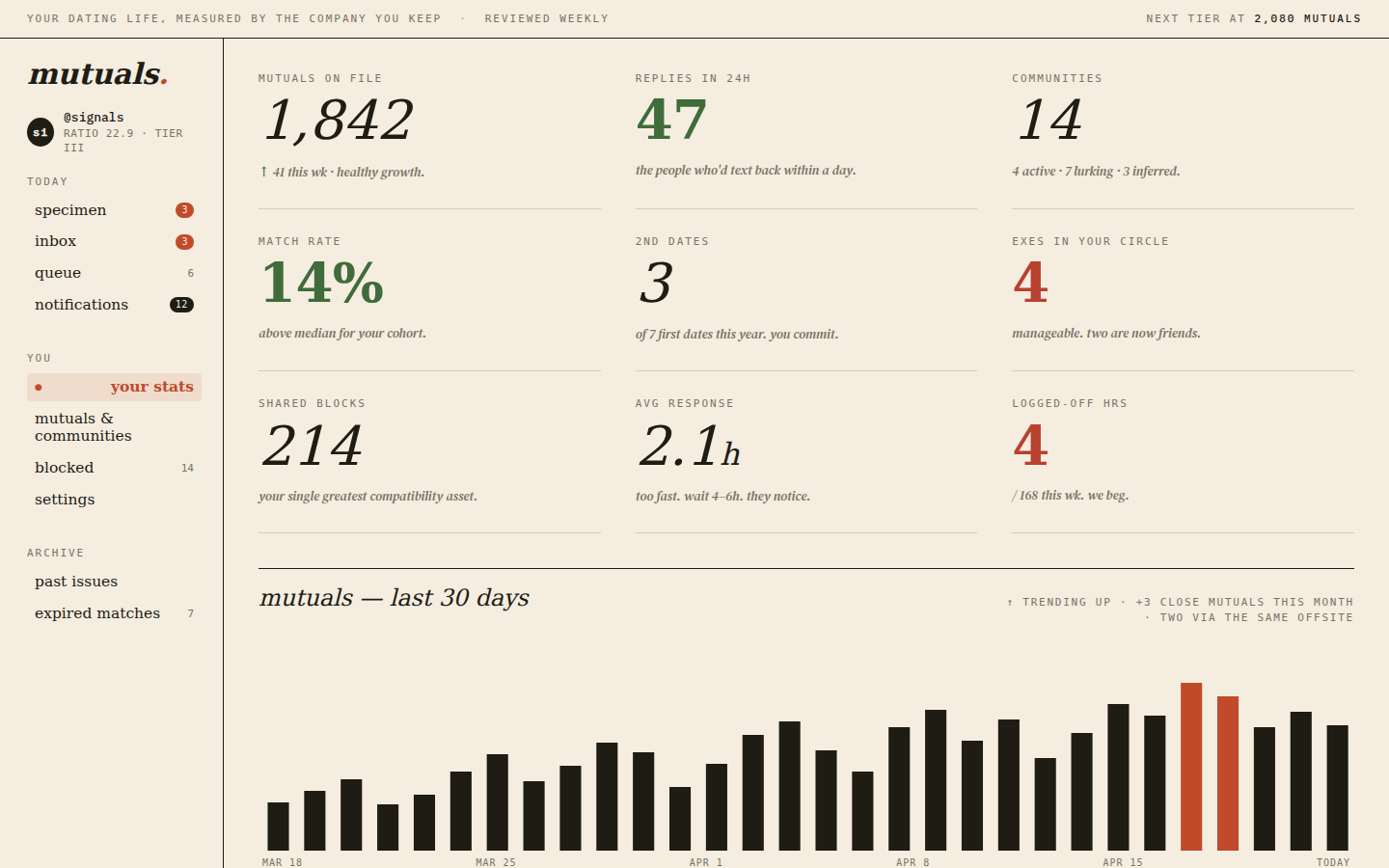
Six of the ~280 vendored skills and templates, rendered exactly as-is — no retouching, no cherry-picked crops:
|
"Design a dating-site dashboard — mutuals, match rate, a 30-day trend." Editorial dashboard, left-rail nav, one restrained accent color. |
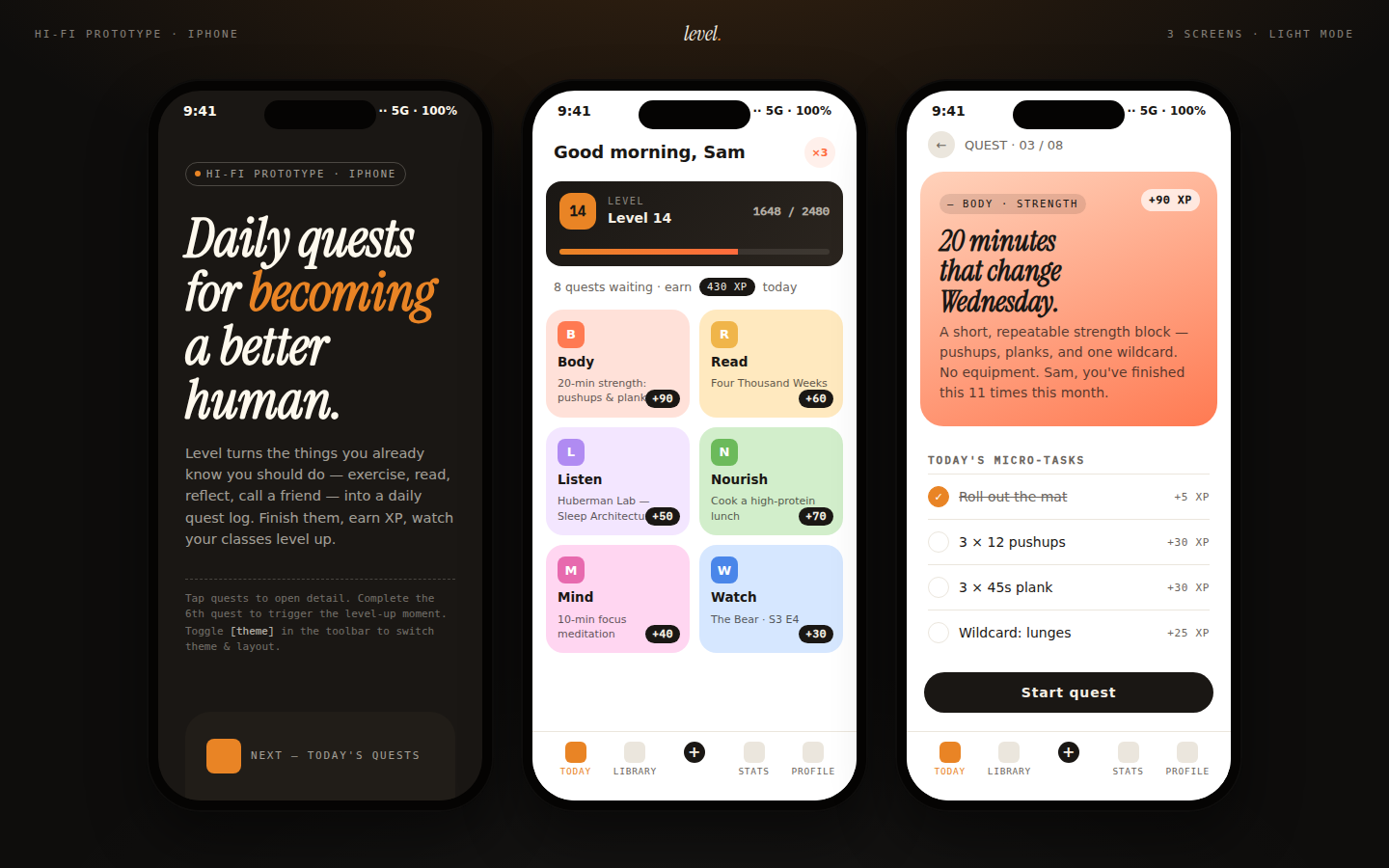 "A habit-tracking app with daily quests and XP." Three-screen mobile prototype, vivid quest tiles, level bar. |
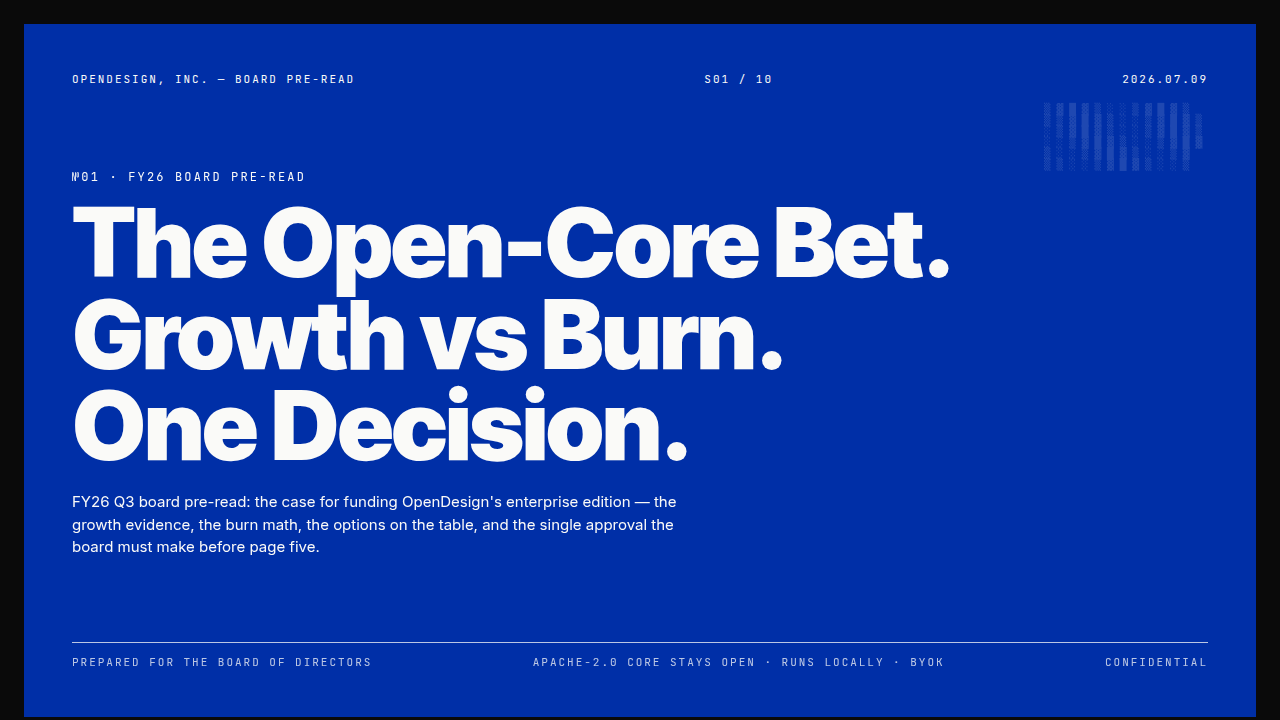 "A board-ready strategy deck, Swiss International style." Decision-grade corporate deck — this is slide one of ten. |
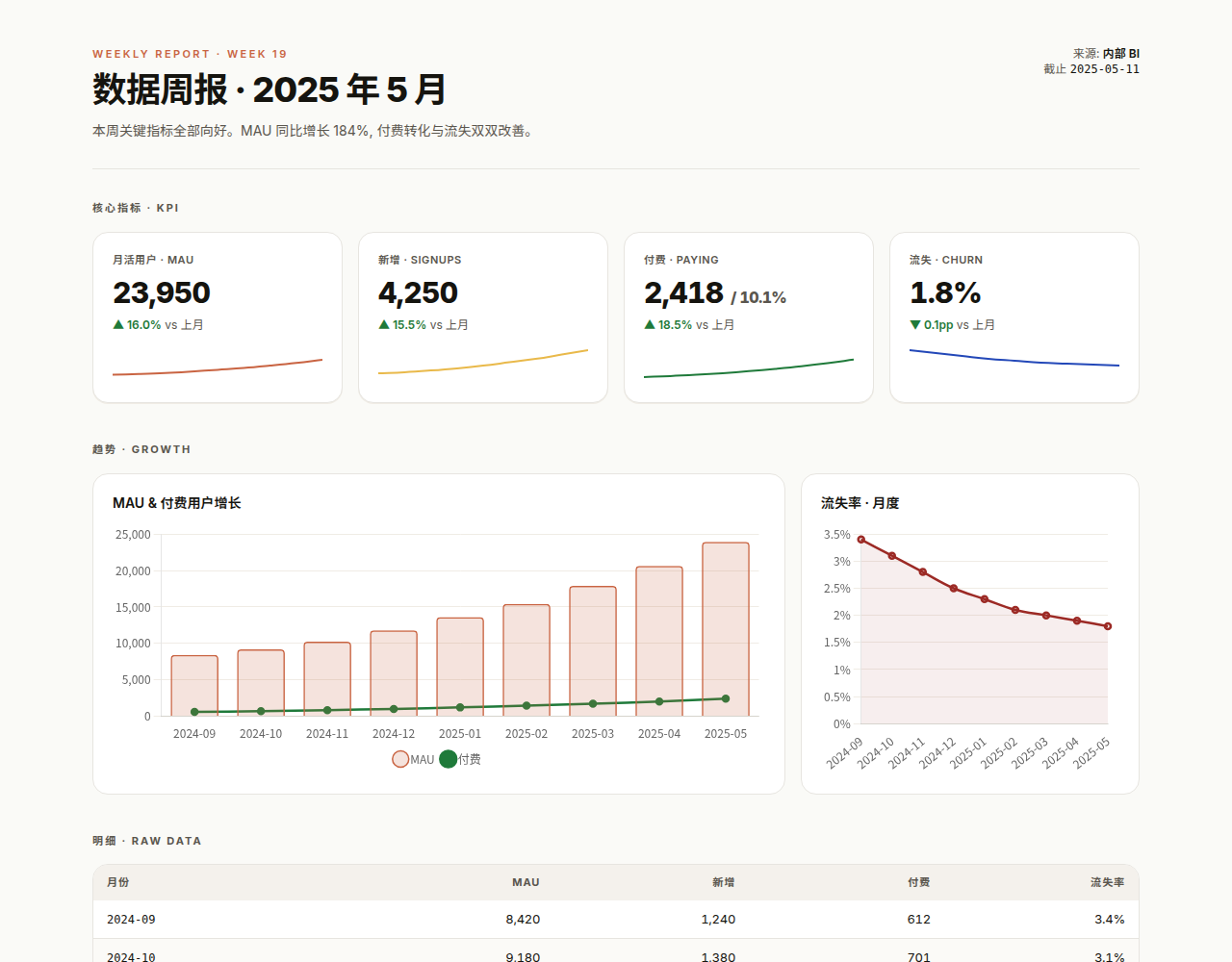 "Turn this CSV into a weekly metrics report." KPI cards, trend charts, and a raw-data table. |
 "5 tips, as a Xiaohongshu-style swipeable card carousel." Social-native knowledge cards, ready to export as images. |
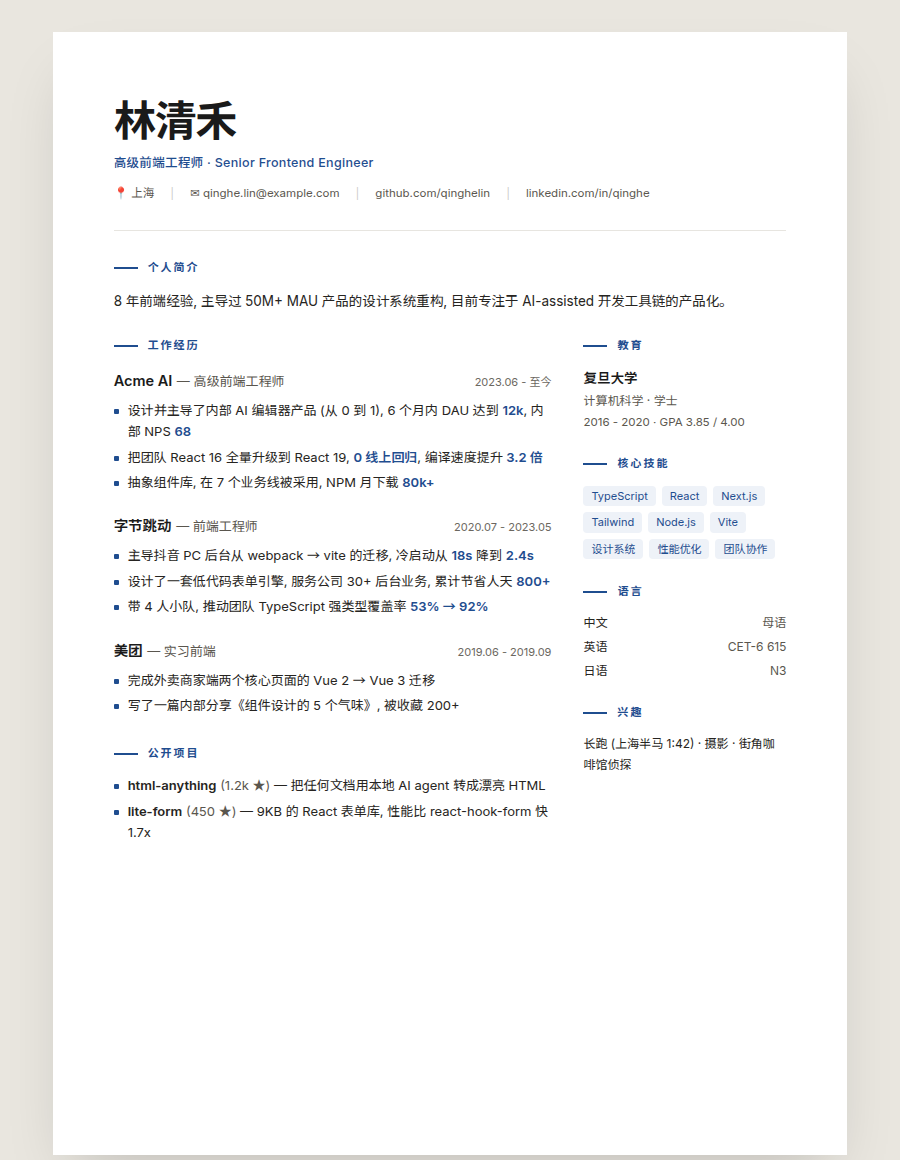 "A modern, print-ready resume." Single A4 page, ready for PDF export. |
Every one of these started from remix_open_design_example (copy a real example, then modify it) or prepare_open_design_brief (compose instructions and generate from scratch) — the same two tools regardless of which surface below you use.
Get started
- VS Code (GitHub Copilot Chat): install "Open Design Agent Kit" from the Marketplace. See the getting-started guide.
- Claude Code:
/plugin marketplace add feimacode/open-design-agent-kit, then/plugin install open-design. Or runnpx @feimacode/open-design-agent-kit init --tools claudein your project. See the getting-started guide. - Codex CLI:
npx @feimacode/open-design-agent-kit init --tools codex. See the getting-started guide. - Any MCP agent (Cursor and others): register
npx -y @feimacode/open-design-agent-kit-mcpas a stdio MCP server. See the MCP server README. - Any of the 75+ agents
skillssupports:npx skills add https://github.com/feimacode/open-design-agent-kit/tree/main/packages/claude-plugin/skills/open-design(add--agent <name>to target one directly). The skill wires up the MCP server on its own the first time it runs. - Scripts and CI:
npx @feimacode/open-design-agent-kit export …,check …andrender-video …. See the CLI guide.
Works with the tools you already use
When your agent is connected to one of these services' official MCP servers, Open Design's workflows use it directly instead of handing you a file to upload: importing into Canva, pushing designs into Figma, saving to Drive, posting through a scheduler. Nothing is installed without your yes. See Connect other services.
| Integration | What your agent can do with it |
|---|---|
| Canva | Import a design, upload assets, export, read brand kits |
| Figma | Read frames into code, push designs in as editable layers, export and upload assets |
| Notion | Read pages, create pages, upload files |
| Google Drive | Search, read and save files |
| Slack | Share a message or image in a channel |
| Buffer | Draft and schedule posts on X, LinkedIn, Instagram, Facebook, Threads, Bluesky, Mastodon, TikTok, Pinterest, YouTube |
| Metricool | Schedule posts on Instagram, Facebook, LinkedIn, TikTok, YouTube |
| X | Post through X's own server |
Documentation
Everything lives in docs/:
- Guides:
- generate a design, explore design directions, turn a document into a deck, diagrams of your code, 3D objects, engineering documents;
- design systems, remix and the gallery, community designs;
- preview, comment and edit, Figma, promote to app code, connect other services;
- social media posts, HTML email, paste into WeChat, Notion and newsletters, posters and print, run a campaign, YouTube videos;
- export images, export decks and PDFs, export animations, share and publish.
- Reference: tools, prompts and commands, CLI, settings and environment variables, artifact manifest.
- Help: troubleshooting.
- Automation: social media pipeline.
- Contributing: architecture, content sync, adding a skill or prompt, upstream ports, releasing.
Provenance
Some code is adapted from open-design (Apache-2.0): the artifact manifest logic, parts of the preview editor, and deck export. See Upstream ports, and packages/core/src/vendored/SOURCE.md for the exact record.
License
MIT — see LICENSE. Skill/design-system/craft/example content is vendored from open-design, licensed Apache-2.0; see Provenance above for which files that applies to.