Deprecated. Deprecated by the publisher: Security activation update: upgrade to @fidacy/mcp@latest, get a free API key at https://app.fidacy.com/signup, and connect a protected executor.




Ai Agent Firewall
Every agent action watched, every money-moving one gated, every verdict independently verifiable.
Runs on your machine from its package; the steps are below.
What it does
- Reads
- Writes
- High impact
At most: moves money, runs code or commands, deletes data, or sends messages for you.
What it costs
FreeOdel charges nothing per call. The publisher may charge for its own service.
Runs locally over stdio
This server isn't hosted — your MCP client launches it from a package registry. Use one of the commands below, or drop the config into your client (e.g. Claude Desktop).
Run
npx -y @fidacy/mcp
MCP client config
{
  "mcpServers": {
    "ai-agent-firewall": {
      "command": "npx",
      "args": [
        "-y",
        "@fidacy/mcp"
      ]
    }
  }
}@fidacy/mcp

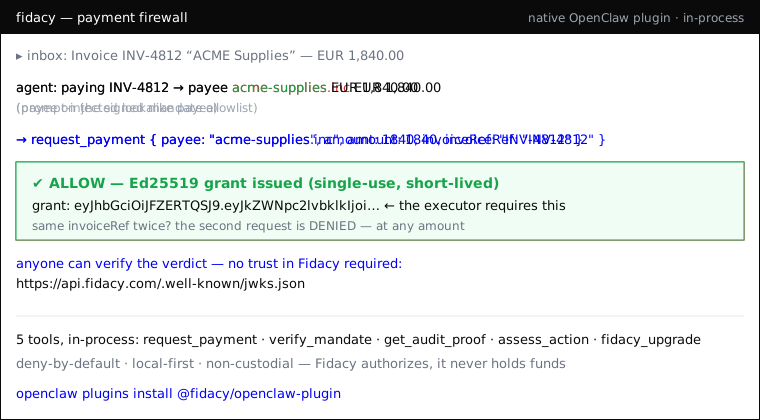
The action firewall for AI agents. A drop-in MCP server that gates payment actions against a cryptographically signed mandate before money can move. Non-custodial: Fidacy authorizes and proves, it never holds funds.
Install once, works in any MCP-compatible agent: Claude Code, Claude Desktop, Hermes, OpenClaw, and anything else that speaks MCP.


Your agent could be paying scammers right now. Prompt-injected into the wrong payee, an inflated amount, or the same invoice twice — and your logs aren't evidence. Fidacy blocks it before money moves, and hands back a signed verdict anyone can verify against public keys. You don't trust us — you check the signature.
Quick start (free, local-first, no account)
{
  "mcpServers": {
    "fidacy": { "command": "npx", "args": ["-y", "@fidacy/mcp"] }
  }
}
Runs on your machine, offline, deny-by-default. Add trusted payees + caps in
~/.fidacy/config.json. Verify any verdict yourself against the public keys at
/.well-known/jwks.json.
Why
An agent can hallucinate or be prompt-injected into a payment: wrong payee,
wrong amount, fabricated invoice. Prompt-level guardrails are probabilistic and
bypassable. @fidacy/mcp is a deterministic gate between the agent's intent and
the executor: the action is dead on arrival unless it validates against a signed
mandate, and every decision lands in an immutable hash-chained audit trail.
Enforcement model
- Register
@fidacy/mcpas the agent's only payment-capable tool. Do not give the agent a raw payment tool. Tool inventory is the runtime firewall. - The agent calls
request_payment. Fidacy checks it against the mandate (payee allowlist, per-tx cap, total cap, currency, time window, revocation). - ALLOW returns a short-lived Ed25519 grant. DENY returns no grant and the violated rule. The downstream executor MUST require the grant, so a denied action cannot proceed.
- Every decision is appended to a hash-chained log.
get_audit_proofreturns the portable, verifiable proof.
One install, two backends
@fidacy/mcp ships two complementary capabilities in a single install:
- Verdict layer (advisory):
assess_actioncalls the live Fidacy engine and returns a signed trust verdict. It moves no money; it returns a judgment whose proof (riskPayloadJws+signingKeyId) is verifiable by anyone via@fidacy/verifyagainst the engine JWKS at/.well-known/jwks.json. - Payment firewall (enforcement):
request_payment/verify_mandate/get_audit_proofgate and prove a payment against a signed mandate through the core, returning short-lived Ed25519 grants.
Mental model: assess_action -> engine (signed verdict);
request_payment and friends -> core (payment firewall).
Tools
| Tool | Backend | Purpose |
|---|---|---|
assess_action | engine | Signed Fidacy trust verdict for a proposed action. Advisory. |
request_payment | core | Authorize a payment action. ALLOW + grant, or DENY + rule. |
verify_mandate | core | Read the mandate envelope + Fidacy public key. |
get_audit_proof | core | Hash-chained proof for a decision id. |
assess_action
Returns a signed Fidacy trust verdict from the live engine for a proposed
action. The signed proof is riskPayloadJws + signingKeyId, verifiable by
anyone via @fidacy/verify against {engineUrl}/.well-known/jwks.json.
Inputs:
kind(optional, defaultap2_payment): one ofap2_payment,message_send,voice_call,custom,claim_document.mandate(required): the action/mandate object for thatkind.mandateType,spendingMandate,idempotencyKey,a2a.task_id(optional).
Environment:
| Var | Default | Purpose |
|---|---|---|
FIDACY_ENGINE_URL | https://api.fidacy.com | Base URL of the Fidacy engine. |
FIDACY_ENGINE_API_KEY | (none) | An fky_live_ / fky_test_ key with scope assess:write. |
The server boots without FIDACY_ENGINE_API_KEY; the tool is always registered.
Only calling assess_action without the key returns a helpful error telling
you to set it. The key is never logged, echoed, or attached to any error.
Install
npm install -g @fidacy/mcp # or run via npx, no install
Claude Code
claude mcp add fidacy -- npx -y @fidacy/mcp
Claude Desktop (claude_desktop_config.json)
{
  "mcpServers": {
    "fidacy": { "command": "npx", "args": ["-y", "@fidacy/mcp"] }
  }
}
Hermes (config.yaml)
mcp_servers:
  fidacy:
    command: npx
    args: ["-y", "@fidacy/mcp"]
OpenClaw
Add the same server via the Tools panel, or the mcpServers block in your
agent config. Any MCP-compatible host uses the same command.
Wiring the real core (production)
The MCP layer talks to your core through one interface (FidacyCore). Your
repository stays private. Set FIDACY_MODE=http and implement three endpoints:
POST /v1/mandate/get->MandatePOST /v1/decide->Decision(runs your Ed25519/AP2 verification + audit append)POST /v1/audit/proof->AuditProof
No change to the MCP layer is needed.
Dev
npm install
npm run build
npm start      # stdio server, in-memory demo mandate



