
Chrome Bridge




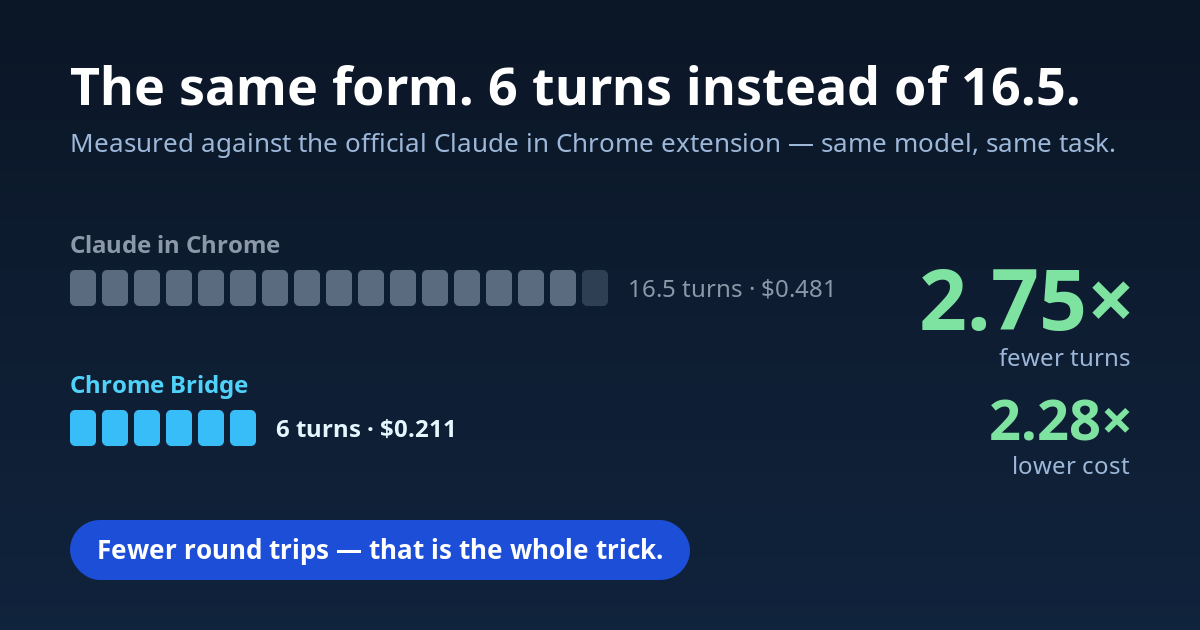
An MCP server that gives Claude Code your real, logged-in Chrome — measured 2.75× fewer turns and 2.28× lower cost than the official "Claude in Chrome" extension on a form-filling task, with ~3× the toolset and no paid plan.
59 web-development tools (navigation, DOM inspection, visual regression, audits, network mocking) over a local WebSocket bridge, plus a headless instance for CI. Self-hosted, local-only.
Quickstart
Requires Node.js 18+ and Chrome 135+.
git clone git@github.com:frsorrentino/chrome-bridge.git
cd chrome-bridge && ./install.sh
- Open
chrome://extensions, enable Developer mode, click Load unpacked, select theextension/folder. - Restart Claude Code.
Then ask for something like "open localhost:3000, run an accessibility audit
and find the Sign Up button": Claude Code calls navigate,
audit and find_text. Because navigate already returns
element refs, click(ref="n1") follows with no discovery turn in between.
On ChromeOS/Crostini install from the Chrome Web Store instead: an unpacked extension is dropped on every reboot, because the container isn't mounted when Chrome starts.
install.sh registers the MCP server with --scope user. To do it by hand:
claude mcp add --scope user chrome-bridge node /path/to/server/index.js.
For execute_js, enable Allow user scripts in chrome://extensions →
Chrome Bridge → Details (on Chrome 135-137, enable Developer Mode instead).
Why Chrome Bridge?
| Chrome Bridge | Claude in Chrome | Chrome DevTools MCP | Playwright MCP | |
|---|---|---|---|---|
| ChromeOS / Crostini | Yes (real host) | No | Container only | Container only |
| Tools | 59 (38 core) | ~20 | ~50 | 23 core (71 total) |
| Requires paid plan | No | Yes (Pro+) | No | No |
| Network mocking | Yes (stub/headers) | No | No | Yes |
| Visual regression | Yes (screenshot_diff) | No | No | No |
| Audits (a11y/SEO/sec) | Yes (one call, report on disk) | No | Partial | No |
| Headless / CI | Yes | No | Yes | Yes |
| GIF / video | No | Yes | Partial | No |
| Breakpoints / heap | No | No | Yes | No |
It wins on round trips, not payload size: short element refs instead of the
screenshot-and-click loop, fill_form filling N fields in one call, table
filtering done server-side. Per single turn it actually costs slightly more.
The full benchmark — method, every raw run including the unfavourable ones, and what the harness can't measure — is in docs/EFFICIENCY.md.
Using it
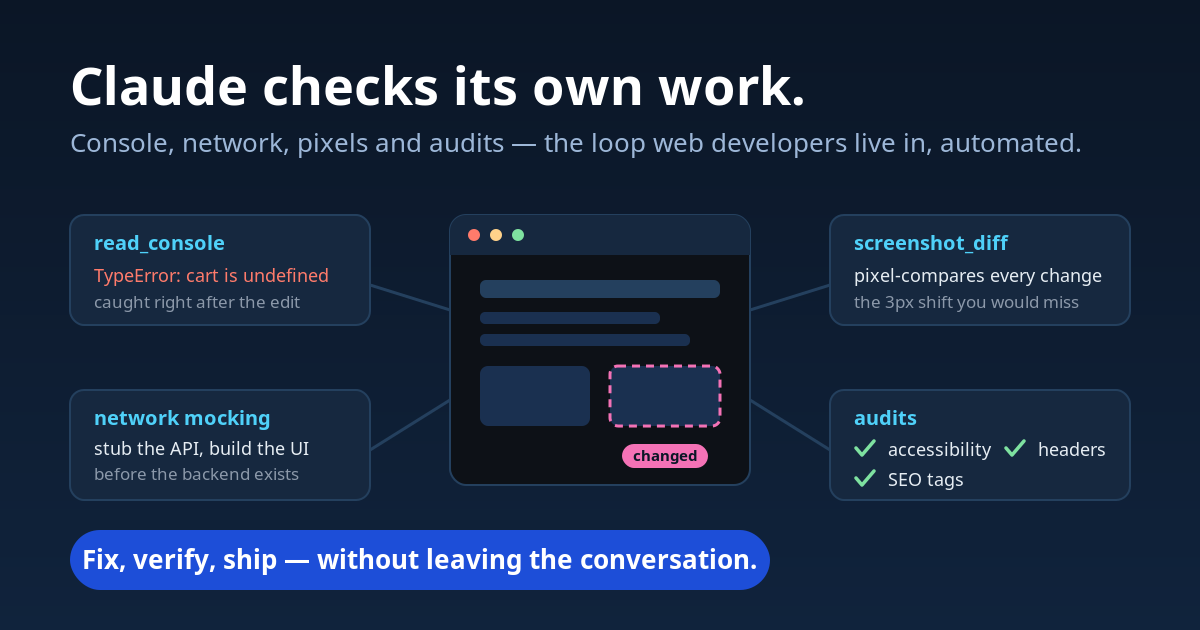
The skill in skills/chrome-bridge/SKILL.md
is what makes the tools discoverable: recipes with the phrase that triggers
each one ("verify the email arrives", "test the checkout with a test card",
"which plugin slows the page", "what fires before consent"), the tool sequence,
and the zero-token CLI commands the model would otherwise never see.
install.sh copies it to ~/.claude/skills/chrome-bridge; do the same by
hand for other clients.
Beyond the MCP tools, two lanes keep work away from the model entirely.
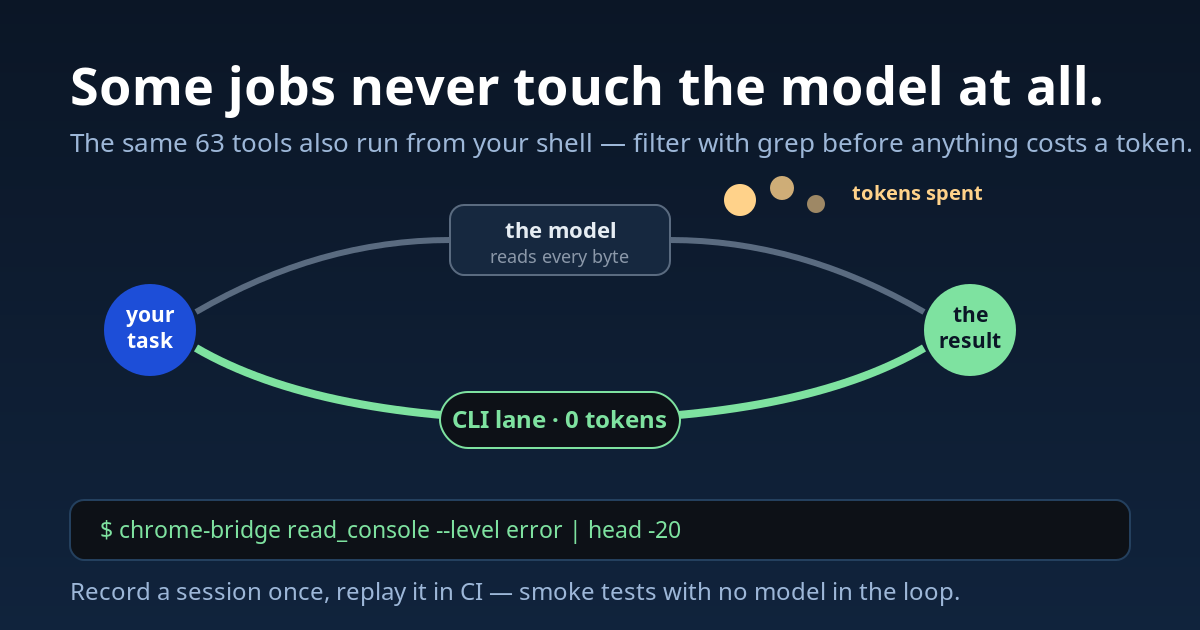
CLI — batch operations, piped through grep or jq before anything reaches
the context:
chrome-bridge navigate --url https://example.com
chrome-bridge read_console --level error | head -20
chrome-bridge assert --selector "#success" --text "Done"
chrome-bridge replay --file ./recordings/login.jsonl
Launch mode — a dedicated Chromium instance with an ephemeral profile, for isolated sessions or CI:
node server/index.js --launch --headless
Pair it with session_record + replay for smoke tests with no model in the
loop. In launch mode execute_js falls back to new Function when the
user-script toggle isn't available.
Tools
59 in total, in seven groups. Only core (38 tools) loads by default; the rest
are opt-in via --caps.
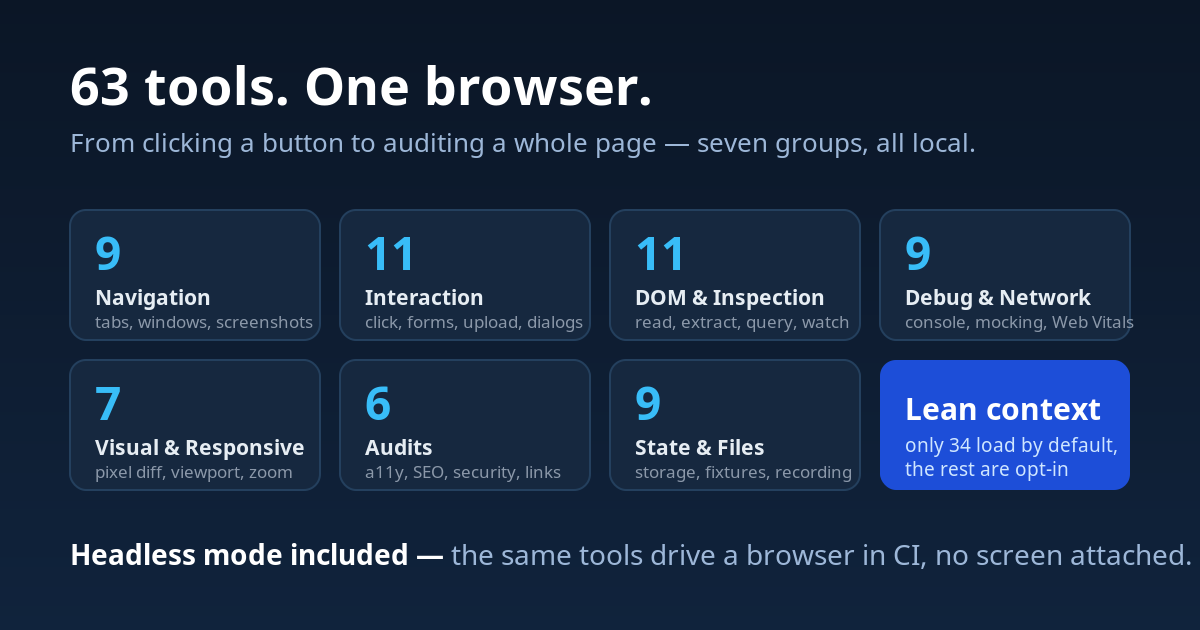
| Group | N | What's in it |
|---|---|---|
| Core & Navigation | 13 | tabs, windows, navigate, screenshot, tile_windows |
| Interaction | 11 | click, fill_form, upload_file, dialogs, clipboard |
| DOM & Inspection | 10 | read_page, extract, query_dom, watch_dom |
| Debugging & Network | 8 | execute_js, console, network log, mocking, track_events |
| Visual & Responsive | 5 | screenshot_diff, viewport and zoom, media emulation |
| Audits | 2 | audit (a11y, keyboard, SEO, security, links, vitals, css, resources, cache in one call), cookie_audit |
| State, Storage & Files | 9 | storage, fixtures, MHTML, recording, assert |
Every tool, with the notes that matter: docs/TOOLS.md.
How it works
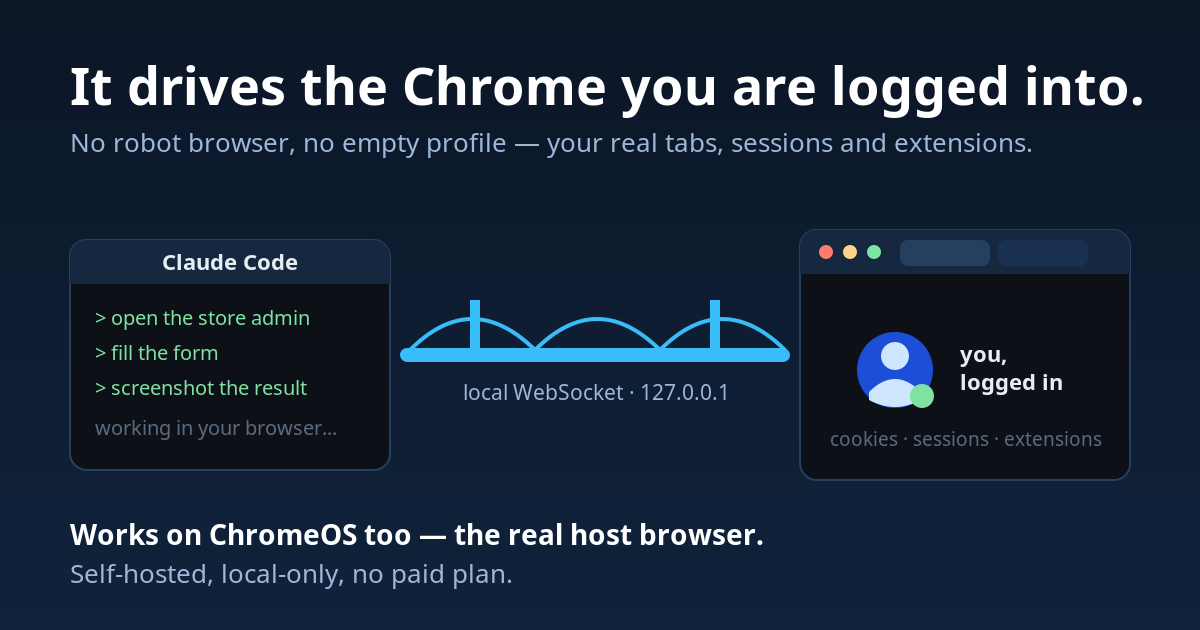
Claude Code  <--stdio-->  MCP Server  <--WebSocket :8765-->  Chrome Extension
                          (server/)                          (extension/, MV3)
The Node.js server handles the protocol and tool logic; the MV3 extension
executes commands through Chrome APIs. User scripts (execute_js) run via
chrome.userScripts.execute().
Configuration and security
Environment variables, each with a matching CLI flag:
| Variable | Default | Notes |
|---|---|---|
CHROME_BRIDGE_PORT | 8765 | |
CHROME_BRIDGE_HOST / --host | 127.0.0.1 | 0.0.0.0 only where the browser lives outside the container (ChromeOS/Crostini port-forward) — and only with a token |
CHROME_BRIDGE_TOKEN | unset | Required on both ext_init and relay_init. Strongly recommended whenever the bind isn't loopback |
CHROME_BRIDGE_CAPS / --caps | core | core, audits, visual, network, storage, dom, files, all. install.sh uses all |
The bridge binds loopback, accepts extension connections only from a
chrome-extension:// origin, and — when a token is set — requires it on both
handshakes. Without one, any local process could act as a relay and reach
execute_js inside your authenticated browser session. Secondary MCP instances
connect via loopback and are acknowledged with relay_init_ok, so a foreign
process holding the port fails fast instead of timing out per command.
What is not protected: page content reaches the model unfiltered, so a
hostile page's text is untrusted input. get_storage, session_fixture, HAR
exports and screenshots are not redacted and may carry cookies, tokens or
personal data. Don't point the automation at pages holding secrets you wouldn't
paste into a chat.
Troubleshooting
| Symptom | Cause / fix |
|---|---|
Chrome extension not connected | Extension disabled, or its port differs from the server's. The error names the actual host/port; check them in the popup (⚙). |
| Port 8765 already in use | Expected: a second MCP session becomes a relay and shares the one bridge. Set CHROME_BRIDGE_PORT for a separate one. |
Port N is held by a process that is not chrome-bridge | Something else owns the port. Free it or change CHROME_BRIDGE_PORT. |
execute_js fails | Enable Allow user scripts in chrome://extensions → Chrome Bridge → Details (Chrome 138+; on 135-137 enable Developer Mode). |
read_console returns note=Instrumentation not loaded | The page was opened before the extension, "Capture console & metrics" is off, or the page isn't injectable (chrome://). Reload it. |
| Screenshot times out | On ChromeOS a fully occluded window stops producing frames; captures fail after 10s. Bring the window forward. |
| Commands work, then stop | The MV3 service worker restarted and in-memory state (network log, diff baselines, HTTP auth) was reset. Re-run the monitoring call. |
| Extension dropped on every ChromeOS reboot | Install from the Web Store instead of Load unpacked. |
| Tool missing from the list | It's in an opt-in group. Check get_status → caps_available, then set CHROME_BRIDGE_CAPS=all. |
Documentation
- docs/TOOLS.md — all 59 tools, by group
- docs/EFFICIENCY.md — the benchmark and the design behind it
- bench/RESULTS.md — raw runs and inclusion rule
- CHANGELOG.md
Tests
npm test (Chrome-free, ~22s) · npm run test:e2e (needs Chrome and a
connected extension; with a bridge already on 8765:
CHROME_BRIDGE_PORT=8799 node test/test-devtools.js --launch, which opens
its own Chromium with extension/) · npm run measure (schema cost).
License
MIT