Listed from the MCP registry; nobody on Odel publishes it.
Is this yours? Claim it
Second Brain
Linked markdown notes as memory for AI apps: search, read, save and link notes over MCP.
One address for any MCP client. You sign in at app.getsecondbrain.io once, after adding it.
What it does
- Reads
- Writes
- High impact
At most: creates or changes data: records, files, settings.
What it costs
FreeOdel charges nothing per call. The publisher may charge for its own service.
What it asks for at sign-in
| Access to | Read | Change |
|---|---|---|
| Notes |
From the sign-in at app.getsecondbrain.io, as the endpoint publishes it. You approve it there.
Tools
None listed · checked 24 Nov 2026Odel could not list its tools without signing in.
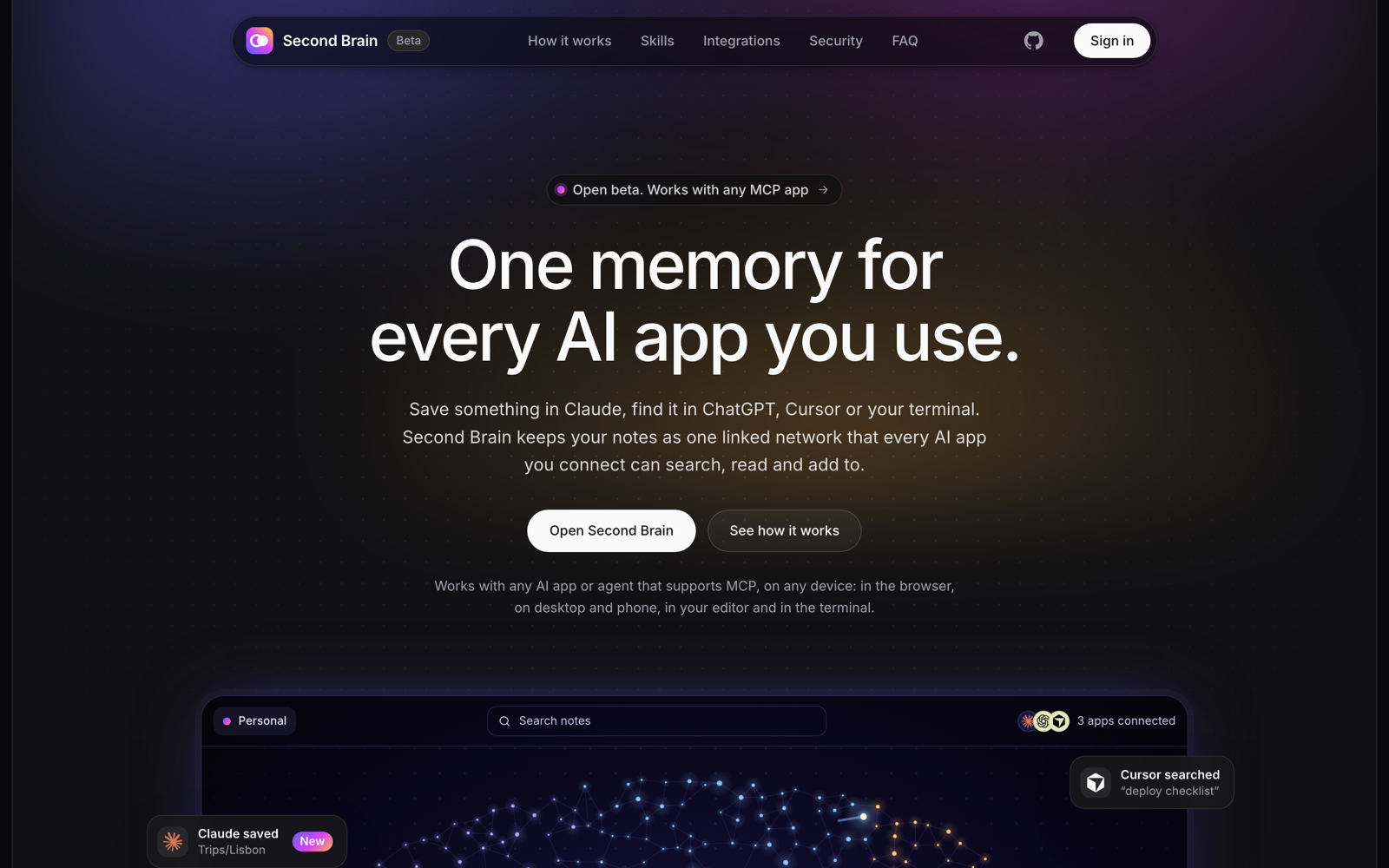
One memory for every AI app you use.

Website · Open the app · Security · License: AGPL-3.0
Linked markdown notes that every AI app can read and write. Connect Claude, ChatGPT, Cursor, Codex,
Gemini CLI or any MCP client to one remote MCP address, https://mcp.getsecondbrain.io/mcp, save
something in one app, and find it from another. Notes live in a workspace you can see as a network
and edit in the browser.
This repository is the full source of the hosted service at getsecondbrain.io.
What it does
- One memory for every AI app. A remote MCP server with OAuth. You pick a workspace and read or read-and-write access when you connect an app, and you can disconnect it at any time.
- Linked notes. Obsidian-style
[[wikilinks]], tags and frontmatter, with backlinks, renames that rewrite links, revisions, a trash and full-text search. - Network view. Every note and link drawn as a live graph in the browser.
- Skills. Notes under
Skills/in the SKILL.md shape become reusable instructions your apps can list and load (list_skills,use_skill, and MCP prompts). - Sources. Granola meeting notes sync in hourly.
- Safe by default for AI writes. Every write is attributed to the app and versioned. Apps can move a note to the trash but never delete it for good; only you can, in the web app.
MCP tools: search, get_note, list_recent, get_linked, list_tags, save_note,
update_note, append_to_note, link_notes, trash_note, list_skills, use_skill.
How it is built
One Cloudflare Worker serves four things by hostname: the landing site, the web app and its JSON API, the OAuth server, and the MCP endpoint.
| Part | Where |
|---|---|
| Router, security headers | src/worker/index.ts |
| Google sign-in, OAuth server, consent page | src/worker/auth/ |
| MCP server and tools | src/worker/mcp/ |
| Workspace store: one SQLite Durable Object per workspace (notes, revisions, links, tags, FTS5, audit) | src/worker/workspace/ |
| Accounts and memberships (D1) | src/worker/control/, migrations/ |
| Sources (Granola sync) | src/worker/sources/ |
| Landing site | src/worker/site/ |
| Web app (React, sigma.js, CodeMirror 6) | src/web/ |
A workspace id only ever comes from a verified session or OAuth token, never from a request parameter, and every route and tool has a test that one workspace cannot reach another.
Run it locally
Requires Node 24 and pnpm.
pnpm install
pnpm test        # all tests, in the Workers runtime
pnpm dev         # builds the web app and starts the Worker on port 8787
Locally the app is at http://localhost:8787, the MCP endpoint at http://127.0.0.1:8787/mcp and
the landing site at http://www.localhost:8787.
Sign-in needs a Google OAuth web client with the redirect URI
http://localhost:8787/auth/google/callback. Put the local secrets in .dev.vars (never commit it):
GOOGLE_CLIENT_ID=...
GOOGLE_CLIENT_SECRET=...
ALLOWED_EMAILS=you@example.com
SOURCES_KEY=...   # openssl rand -base64 32; only needed for Granola
SIGNUP in wrangler.jsonc controls who can join: "open" lets any verified Google account in;
any other value allows only ALLOWED_EMAILS.
Deploy your own
- Create a D1 database and a KV namespace, then put their ids, your
account_id, your hostnames and your origins in theproductionsection ofwrangler.jsonc. - Set the secrets:
wrangler secret put GOOGLE_CLIENT_ID --env production, and the same forGOOGLE_CLIENT_SECRET,ALLOWED_EMAILSandSOURCES_KEY. - Run
pnpm check(types, tests, build, deploy dry run), thenpnpm deploy:production, which builds the web app, applies D1 migrations and deploys.
Fair-use limits per workspace (notes, storage, saves a day) are in
src/worker/workspace/limits.ts.
Contributing
Issues and pull requests are welcome. See CONTRIBUTING.md and the Code of Conduct.
Security
Please report vulnerabilities privately; see SECURITY.md.
License
GNU Affero General Public License v3.0. If you run a modified version as a service, you must offer its source to your users.