Listed from the MCP registry; nobody on Odel publishes it.

RE-call MCP Memory Server
Agent memory on SQLite or Postgres that flags superseded facts and abstains below its threshold.
Runs on your machine from its package; the steps are below.
What it does
- Reads
- Writes
- High impact
At most: creates or changes data: records, files, settings.
What it costs
FreeOdel charges nothing per call. The publisher may charge for its own service.
Runs locally over stdio
This server isn't hosted — your MCP client launches it from a package registry. Use one of the commands below, or drop the config into your client (e.g. Claude Desktop).
Run
uvx recall-rag
MCP client config
{
  "mcpServers": {
    "re-call-mcp-memory-server": {
      "command": "uvx",
      "args": [
        "recall-rag"
      ]
    }
  }
}

 official site

RE-call is persistent memory for agents, built on hybrid retrieval with rank fusion. On SQLite or PostgreSQL, it combines dense vectors and full-text search using reciprocal rank fusion (RRF).
Atomic rescue recovers a passage when a single sentence matches the query. A semantic graph maps the links between your memos.
The trust layer abstains when no result clears a threshold calibrated on your own store.
It ranks superseded memos below their successors.
Set valid_from and valid_until to define when a memo is valid. Search flags memos
that are expired or not yet valid. Use recall forget to erase a memo's indexed data from the store.
Benchmarks and limits · Security policy · For agents
Memory that abstains when nothing clears its threshold.



Quickstart
python -m pip install "recall-rag[fastembed,mcp]>=0.16.1"
recall setup --lite --memory ./notes
Point it at a folder of Markdown notes. Setup indexes them into .recall/memory.db, tries to
calibrate on them, and registers Claude Code for this project. Restart Claude Code and ask about
something your notes answer.
No Docker, no database server, no API key. The default embedder runs on your machine after a one-time model download. A folder too small to calibrate refuses trusted answers until it grows.
Getting started covers Codex, other MCP clients, PostgreSQL, the Agent SDK and LangChain.
What changes for your agent
- Every search comes back trusted, degraded or abstained, with the reason.
- A memo that declares
supersedes:outranks the memo it replaces. - A memo past its validity date comes back flagged as expired.
- On Lite, forget zeroes the deleted bytes in the store.
- Storing a memory makes no LLM call.
- Claude Code and Codex read and write the same store.
Claude Code loads the first 200 lines of its own memory index. RE-call searches every memo.
What a search returns
Real recall_search responses from two certified corpora, returned on 2026-10-20: RE-call's own
source code, and the author's working memory. They are abridged: fields and text are cut, never
edited, and chunk ids are shortened.
An answer, with the chunks it may cite.
recall_search {"query": "where is reciprocal rank fusion implemented?", "k": 3}

{"decision_state": "supported", "abstained": false,
 "calibration_status": "certified", "trust_state": "trusted",
 "hits": [
  {"chunk_id": "b52539f1ef1f", "source": "recall/retriever.py", "score": 0.7776,
   "confidence": 0.9984, "verdict": "ok", "superseded_by": null,
   "text": "def _rrf(rankings: list[list[str]], k: int = 60) -> dict[str, float]: ..."},
  {"chunk_id": "69f9573b0bde", "source": "benchmarks/mtrag/multiquery.py", "score": 0.7712,
   "confidence": 0.9977, "verdict": "ok"},
  {"chunk_id": "68806c06538a", "source": "scripts/agent_ab_fusion_frontier.py", "score": 0.7665,
   "confidence": 0.997, "verdict": "ok"}],
 "evidence": {"decision": "answer",
  "citable": ["b52539f1ef1f", "69f9573b0bde", "68806c06538a"]}}
Every hit carries a calibrated confidence and a verdict. evidence.citable lists exactly what an
answer may cite.
An abstention, on a question the corpus cannot answer.
recall_search {"query": "how does the Kubernetes operator autoscale the GPU inference pods?", "k": 3}

{"decision_state": "corpus_gap", "abstained": true,
 "reason": "no hit above the calibrated confidence threshold (probable corpus gap)",
 "calibration_status": "certified",
 "hits": [
  {"source": "benchmarks/mtrag/rerank_offload.py", "score": 0.5628, "confidence": 0.0036,
   "verdict": "low_confidence"},
  {"source": "recall/index.py", "score": 0.4139, "confidence": 0.0, "verdict": "low_confidence"},
  {"source": "recall/ops/__init__.py", "score": 0.5553, "confidence": 0.0023,
   "verdict": "low_confidence"}],
 "evidence": {"decision": "abstain", "reason_code": "corpus_gap", "citable": []}}
Plain vector search would answer from the first file. RE-call shows the candidates, says why none qualifies, and offers nothing to cite.
A superseded note, kept out of the answer.
recall_search {"query": "does the 0.12.0 release candidate include the first class Codex integration from PR 583?", "k": 3}

{"decision_state": "supported", "abstained": false,
 "calibration_status": "certified", "trust_state": "trusted",
 "hits": [
  {"chunk_id": "5781fb607b3d", "source": "recall/2026-09-02-release-0.12.0-published.md",
   "score": 0.4695, "confidence": 0.8525, "verdict": "ok", "superseded_by": null,
   "text": "The release changelog covers ... and Codex integration from PR #583. ..."},
  {"chunk_id": "9f245a7a6959", "source": "recall/2026-09-02-release-preparation-0.12.0-pr583.md",
   "score": 0.5838, "confidence": 0.9941, "verdict": "superseded",
   "superseded_by": "recall/2026-09-02-release-0.12.0-published.md",
   "text": "RE-call PR #583 ... merged into master on 2026-09-02 ... the candidate now includes PR #583's merged changes as well."},
  {"chunk_id": "00f4a94bab54", "source": "recall/project_index.md",
   "score": 0.4081, "confidence": 0.486, "verdict": "low_confidence"}],
 "evidence": {"decision": "answer", "citable": ["5781fb607b3d"]},
 "historical": {"candidates": ["9f245a7a6959"], "scope": "historical_only",
  "requires_validity_check": true}}
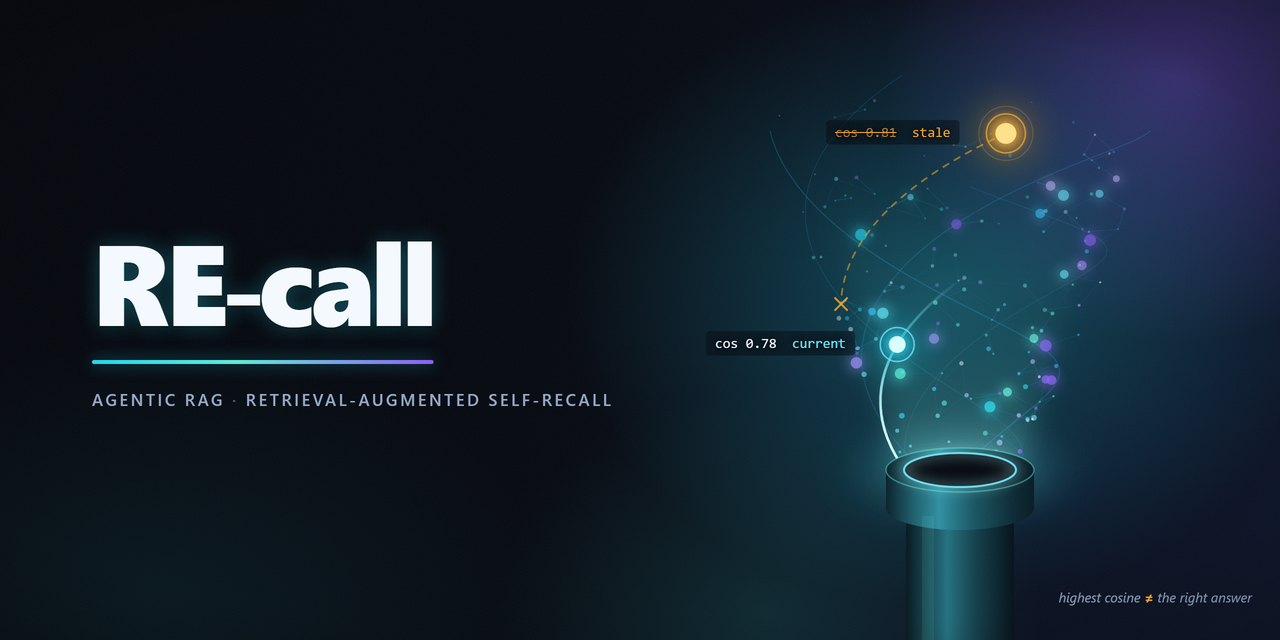
The later note declares that it supersedes the earlier one. The stale note is the closest match,
so similarity alone would answer from it. RE-call names its successor, keeps it out of
evidence.citable, and offers it only as history.
A bug fixed from its symptom.
recall_search {"query": "my long background job on the server died when I closed the SSH session, even though I started it with nohup and &", "k": 3}

{"decision_state": "supported", "abstained": false,
 "calibration_status": "certified", "trust_state": "trusted",
 "hits": [
  {"chunk_id": "00192d073e84", "source": "recall/detached-runs-need-setsid.md",
   "score": 0.6413, "confidence": 0.9989, "verdict": "ok",
   "text": "A long run ... launched as `nohup bash script.sh > log 2>&1 &` died silently at row 29 of 500 when the SSH session closed. ... Relaunched with `setsid nohup ... < /dev/null &` it ran to completion. ..."},
  {"chunk_id": "c73d42e81759", "source": "recall/detached-runs-need-setsid.md",
   "score": 0.5695, "confidence": 0.991, "verdict": "ok",
   "text": "A judge run launched with the Bash tool's `run_in_background` died at query 527 of 759 when the Claude session restarted ... **Fix that worked:** launch the long job as its own Windows process ..."},
  {"chunk_id": "cfcbb0b31d77", "source": "recall/systemd-user-scopes-need-linger.md",
   "score": 0.5393, "confidence": 0.9784, "verdict": "ok",
   "text": "... **`setsid` and `nohup` do not help.** They protect against terminal HANGUP. This is systemd stopping the whole user manager, a different failure ..."}],
 "evidence": {"decision": "answer",
  "citable": ["00192d073e84", "c73d42e81759", "cfcbb0b31d77"]}}
The question names only the symptom. Memory returns the fix that worked, a second case of the same failure, and the neighbouring failure where that fix does not apply. The agent reads what was learned the first time instead of repeating the diagnosis.
Lite or PostgreSQL
| Choose | Best fit |
|---|---|
| Lite | One project on one machine, in a local SQLite file. |
| PostgreSQL | Shared serving, immutable generations, several tenants, or authentication. |
Read next
| Need | Document |
|---|---|
| Install, integrations, the PostgreSQL demo | docs/GETTING_STARTED.md |
| Architecture and optional modules | docs/HOW_IT_WORKS.md |
| Lite in depth | docs/LITE.md |
| Python, CLI and MCP reference | docs/API.md |
| Measurements and limits | docs/EVIDENCE.md |
| Why an agent needs trusted memory | docs/FOR_AGENTS.md |
| Everything else | docs/README.md |
Published numbers are tied to committed artifacts, and the claim gate checks them in CI.
Citation
Cite the project and credit Giulio D'Erme. CITATION.cff is the canonical source.
License
Open source under the GNU Affero General Public License v3.0 (AGPL-3.0). For a closed source product or a proprietary hosted service, a commercial license is available: see COMMERCIAL_LICENSE.md. Preserve NOTICE when redistributing. Contributions are accepted under the Contributor License Agreement.







