Listed from the MCP registry; nobody on Odel publishes it.

Boundra — Payment Approval Gateway for AI Agents
Policy decision point for agent payments — allow, ask, or veto before signing
Runs on your machine from its package; the steps are below.
What it does
- Reads
- Writes
- High impact
At most: moves money, runs code or commands, deletes data, or sends messages for you.
What it costs
FreeOdel charges nothing per call. The publisher may charge for its own service.
Runs locally over stdio
This server isn't hosted — your MCP client launches it from a package registry. Use one of the commands below, or drop the config into your client (e.g. Claude Desktop).
Run
uvx boundra-mcp
MCP client config
{
  "mcpServers": {
    "boundra-payment-approval-gateway-for-ai-agents": {
      "command": "uvx",
      "args": [
        "boundra-mcp"
      ]
    }
  }
}
Boundra (boundra.io) — Boundaries for agent payments. The boundary layer for agent payments: before any money moves, answer "should this payment happen at all?"
Our thesis: the opportunity in agent payments is not "how to pay" (protocols solved that) but "whether to pay."
One natural-language rule → compiled into a policy → every payment the agent attempts is genuinely evaluated → allow / ask a human / veto, with a full audit trail.
Two run modes:
- Offline simulation (
demo.py): stdlib only, self-contained mock merchant and wallets, zero dependencies, zero network - Real protocol (
demo/demo_real.py): standard MCP server + real x402 SDK + Base Sepolia testnet
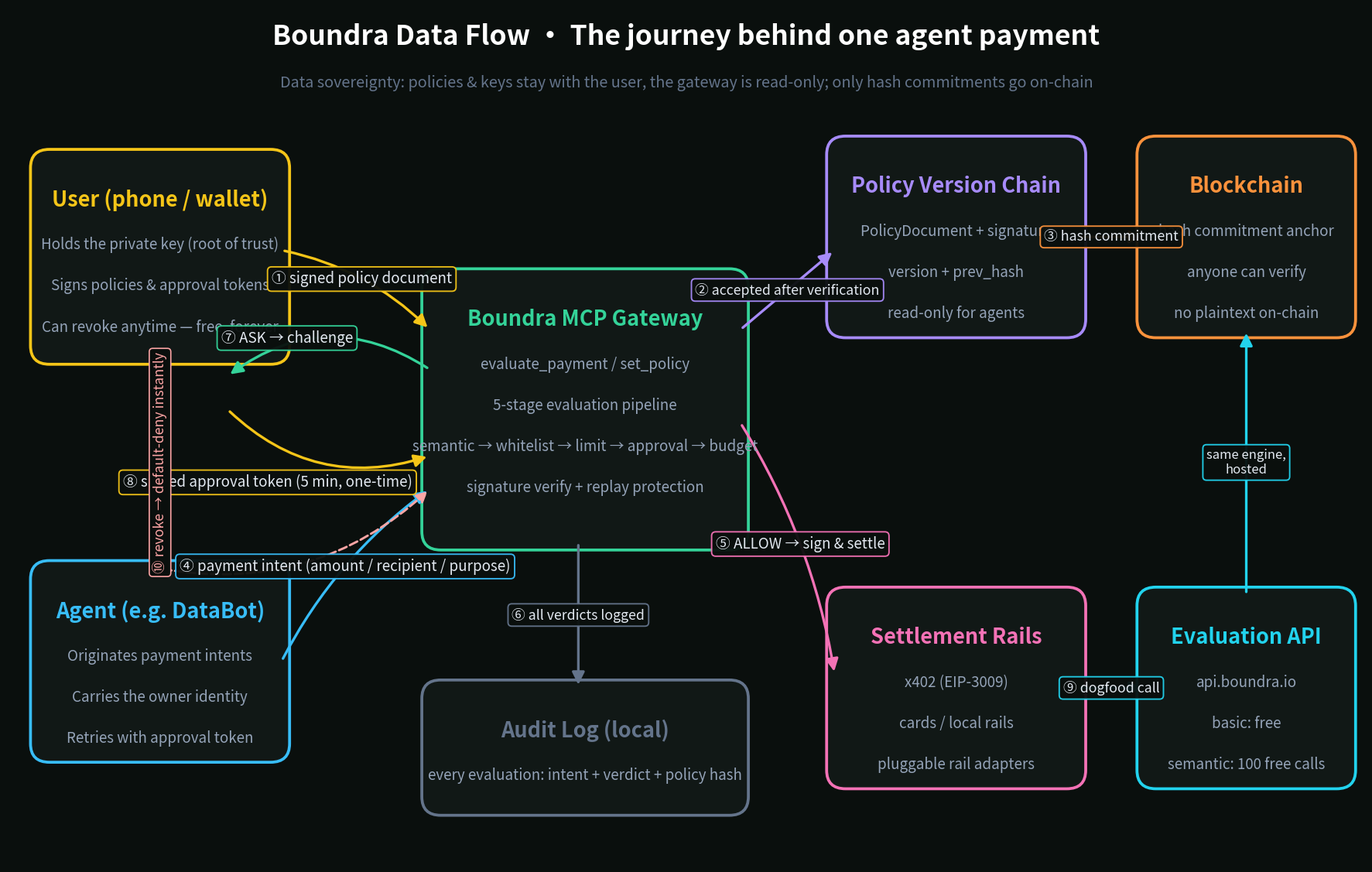
Data flow
Private keys stay with the user; the gateway is read-only; optional on-chain commits contain hashes, never policy plaintext. Hosted MCP stores the signed policy document you submit; self-hosted mode keeps it local. Revocation is free — forever, no exceptions.
Integrating Boundra into your agent? See docs/INTEGRATION.md — hosted API, fail-closed Python and TypeScript x402 SDKs, two-phase budget settlement, and MCP paths.
See it run in 60 seconds
# 1. Hit the hosted evaluation API — a real, public x402 merchant
curl -X POST https://api.boundra.io/evaluate/basic \
  -H 'Content-Type: application/json' \
  -d '{"intent":{"amount":0.01,"recipient":"api.weather.com","purpose":"weather data"}}'
# → {"decision":"ALLOW",...}  ·  semantic layer: 100 free calls per agent,
#   then $0.003 via x402 — settled for real on Base mainnet (USDC)

# 2. Local end-to-end simulation — a data-procurement agent's day
.venv/bin/python demo/simulate_agent.py
# signed policy publish → ALLOW / DENY (limit) / ASK → user-signed approval token
# → prompt-injection blocked → audit trail, plus a dogfood call to api.boundra.io

# 3. One-line MCP install + 2-minute policy wizard
uvx --from git+https://github.com/gobeyondfj-cmd/boundra boundra-mcp     # stdio server
uvx --from git+https://github.com/gobeyondfj-cmd/boundra boundra-init    # wallet → template → sign → anchor
uvx --from git+https://github.com/gobeyondfj-cmd/boundra boundra-approve # sign an ASK challenge
The complete flow, step by step
Zero to a signed, enforced policy in ~10 minutes. No accounts, no dashboards — your wallet key is your identity.
0 · Try the hosted API (30 seconds, nothing to install)
curl -X POST https://api.boundra.io/evaluate/basic \
  -H 'Content-Type: application/json' \
  -d '{"intent":{"amount":0.01,"recipient":"api.weather.com","purpose":"weather data"}}'
1 · Bind your identity — the wallet is the account
uvx --from git+https://github.com/gobeyondfj-cmd/boundra boundra-init
Creates or imports a Base wallet. No signup, no email — the private key never leaves your device, and your address is your identity everywhere in the system.
2 · Set your policy
The wizard offers templates (personal assistant / travel / dev API / procurement) or lets you write your own rule in plain English, then compiles it and shows you exactly what will be enforced — before anything is signed.
3 · Sign & publish
You sign the policy document with your wallet key (EIP-191). It is published as a versioned, hash-chained document. The default commitment is a local hash log; Base Sepolia anchoring is optional. From this moment the gateway is read-only for every agent — changing the policy without your key is impossible.
4 · Mount the MCP server into your agent
Hosted (zero install, multi-tenant, default-deny until you publish a signed policy):
{ "mcpServers": { "boundra": { "url": "https://api.boundra.io/mcp" } } }
Or self-hosted:
{ "mcpServers": { "boundra": { "command": "uvx",
  "args": ["--from", "git+https://github.com/gobeyondfj-cmd/boundra", "boundra-mcp"] } } }
5 · Every payment gets a verdict before signing
Your agent calls evaluate_payment; the 5-stage pipeline answers
ALLOW (sign & settle) / DENY (aborted pre-signature, zero on-chain
trace) / ASK (a challenge bound to this exact payment).
6 · When the agent asks, you decide
uvx --from git+https://github.com/gobeyondfj-cmd/boundra boundra-approve
Paste the ASK challenge, sign it on your device — the agent retries with the signed approval token. Forged, rebound, or replayed tokens are rejected.
7 · Watch, update, revoke
get_spend_report / get_audit_trail / get_policy_versions keep you in
control day to day. Every policy change is a new signed version
(set_policy); revoke_policy is instant default-deny and free forever.
Quick start (from source)
cd boundra

# Mode 1: offline simulation (run this first — the full flow in 30 seconds)
python demo/demo.py

# Mode 2: real x402 + MCP
python -m venv .venv && .venv/bin/pip install \
    "x402[evm,httpx]" mcp eth-account fastapi uvicorn
.venv/bin/python tests/test_mcp_client.py    # MCP protocol-level tests
.venv/bin/python demo/setup_wallets.py       # generate Base Sepolia test wallets + faucet guide
.venv/bin/python demo/demo_real.py           # real protocol end-to-end (settles on-chain after funding)
Architecture: where the gateway stands
Agent framework (Claude / custom)
   │  MCP protocol (stdio)
   ▼
mcp_server.py  ──→  policy.py 5-stage evaluation pipeline
(policy decision     semantic → whitelist → limit → approval → budget
 point)
   ▲
   │ on_before_payment_creation hook (x402 SDK v2 native interception point)
x402_buyer.py ──sign (EIP-3009)──→ x402 server ──→ facilitator ──→ Base Sepolia
Key finding: x402 SDK v2 natively provides the on_before_payment_creation
hook plus register_policy / set_spend_controls — the policy layer is not a
bolt-on; it is the slot the official protocol stack reserves. This validates
the wedge.
File map
boundra/
├── policy.py                 intent compilation (NL→Policy, bilingual CN/EN) + 5-stage pipeline + platform red lines
├── signed_policy.py          ★ signed policy documents + version chain + revocation (keccak)
├── approval.py               ★ signed approval tokens (challenge → user signs → gateway verifies)
├── mandate.py                ★ task Mandates: single-use authorization, burned after use (pipeline layer 4)
├── templates.py              ★ policy template library (personal assistant / travel / dev API / procurement)
├── chain_anchor.py           ★ anchor backends: local simulation + real Base Sepolia (web3)
├── gateway.py                gateway core v3: 4-layer stacking + token verification + Mandate + revocation
├── spend_ledger.py           ★ SQLite atomic reservations → settlement / release, with capability tokens
├── usage_metrics.py          persistent hosted evaluation, usage and revenue counters
├── rail_adapters.py          ★ rail adapter layer: evaluation core decoupled from settlement rails (x402 first)
├── boundra_x402.py           ★ async Python client + fail-closed x402 pre-sign hook
├── sdk/typescript/           ★ equivalent TypeScript client and x402 hook, with tests
├── mcp_server.py             ★ standard MCP server (11 tools, stdio)
├── boundra_cli.py            ★ boundra-init (policy wizard) + boundra-approve (challenge signer)
├── contracts/
│   └── PolicyAnchor.sol      ★ on-chain commitment contract (owner-write, anyone-read)
├── demo/
│   ├── simulate_agent.py     ★ end-to-end user journey simulation (MCP + hosted API dogfood)
│   ├── demo_policy.py        signed-policy demo (impersonation / unsigned / tampering attacks all blocked)
│   ├── demo_real.py          real-protocol end-to-end orchestration
│   ├── x402_resource_server.py  real x402 paywall server (FastAPI middleware)
│   ├── x402_buyer.py         real x402 buyer, evaluated by the MCP gateway before signing
│   ├── setup_wallets.py      Base Sepolia test wallet generation
│   └── demo.py / merchant.py / agent.py   offline simulation (zero dependencies)
├── tests/
│   ├── test_product.py       ★ product tests (28 assertions)
│   ├── test_mcp_client.py    MCP protocol-level tests
│   ├── test_reservation_sdk.py  atomic budget, metrics and Python SDK tests
│   ├── test_vectors.py       CC0 policy / ledger / approval consistency vectors
│   ├── vectors/              machine-readable CC0 conformance fixtures
│   └── run_semantic_eval.py  reproducible injection-corpus metrics (no LLM)
├── docs/
│   ├── dataflow.png          data-flow diagram (English)
│   └── render_*.py           diagram renderers (architecture / flow / use-case / data flow)
└── state/audit.jsonl         audit trail (generated at runtime, gitignored)
Signed policies: the root of trust is the user's key, not the gateway's database (v2)
A policy is a document signed by the user's wallet, not a row in the gateway's configuration:
user private key signature ──→ PolicyDocument (NL rule + compiled artifact + prev_hash + version)
                      │  three checks: signer == owner, versions sequential, prev_hash unbroken
                      ▼
              PolicyStore (version chain) ──→ LocalAnchor (simulated commitment; production writes to contract)
                      │
                      ▼  check_integrity before every evaluation (signature + anchor)
              5-stage pipeline; audit records cite policy version + hash
- Read-only for agents: without the user's private key,
set_policyalways fails — impersonation, unsigned, and tampered submissions are all blocked (seven scenarios indemo/demo_policy.py) - Two stacked scopes: user-level (rules for all agents) × agent-level (per-agent rules); the strictest verdict wins
- Every version bump is a signature: v2 must reference v1's hash; tampering with any historical version → signature invalid + chain broken
- Privacy shape: optional on-chain commitments contain only hashes. Hosted MCP stores the signed policy document submitted by the user; self-hosted mode keeps policy plaintext on the user's device
Run: .venv/bin/python demo/demo_policy.py
Verdict credentials: every decision comes with a signed receipt (v4)
Every evaluate_payment response carries a credential — a
boundra.verdict/v1 receipt signed by the platform key (EIP-191). It answers
"who can prove this ALLOW / DENY / ASK actually happened, under this policy,
for this exact payment intent?"
- Binds the intent and expectations:
intent_hashcovers the legacy {amount, recipient, purpose} plus any supplied quote / expectation fields (expected amount/payee, resource, method, network, asset). The credential also carries explicitquote,expectation, andexpectation_sourcefields - Binds the policy:
policy_refslists the policy version hashes used, comparable against local or optional on-chain anchors - Binds evaluation state:
audit_id,evaluation_id, andreservation_statuslink the decision to its audit and budget lifecycle; the secret reservation token is deliberately excluded - Verifiable offline, by anyone: strip
proof, canonicalize the payload (sorted keys, compact separators), recover the EIP-191 signer — it must equalissuerand the platform address0xF30955B6Be768370Da13fca237A5f252F6081d1C(the same address that receives x402 revenue — one identity for signing and settlement). Published atGET https://api.boundra.io/verdict-key.
from verdict_credential import verify_credential
ok, why = verify_credential(verdict["credential"])   # offline, no API call
Self-hosted gateways attach no credential unless BOUNDRA_VERDICT_KEY is set —
unsigned mode stays fully backward compatible.
Two-phase budget accounting
For hosted calls with an owner, ALLOW atomically reserves budget in SQLite and
returns evaluation_id plus a private reservation_token. After the real rail
settles, call POST /evaluations/{id}/settle with the transaction reference. If
payment fails or is abandoned, call /release to restore the allowance. Tokens
are SHA-256 hashed at rest and never enter audit logs or signed credentials.
Unconfirmed reservations expire after 15 minutes; duplicate settlement is
idempotent and cannot spend the same reservation twice.
For concurrent payment creation, pass a caller-generated top-level purchase_id
that identifies one logical purchase before fan-out. Within an owner, only its
first atomic reservation can receive ALLOW. A same-ID replay returns DENY at the
idempotency layer with the existing evaluation state and no reservation token;
reusing the ID for different intent fields sets purchase_id_conflict=true.
Different purchase IDs remain independent even when their quotes are identical.
Omitting purchase_id preserves the original budget-only behavior. This is a
shared pre-sign boundary, not post-sign chain reconciliation: after an ambiguous
payment outcome, reconcile before creating another purchase attempt.
MCP server tools
| Tool | Purpose | Caller |
|---|---|---|
evaluate_payment | Pre-payment evaluation. ALLOW proceeds / DENY aborts / ASK returns a challenge the user signs; retry with approval_token | Agent |
settle_evaluation / release_evaluation | Confirm actual settlement or restore an unused reservation | Agent with capability token |
get_evaluation | Inspect reservation / settlement state | Agent |
set_policy | Privileged: submit a new policy version; requires the owner's EIP-191 signature | User only |
revoke_policy | Privileged: revoke a policy chain (default-deny immediately, free forever) | User only |
get_policy_versions | Policy version history (chain + hashes, comparable with on-chain commitments) | Anyone |
get_policy | View the legacy fallback policy | Anyone |
get_spend_report | Today's spend / remaining budget | Agent |
get_audit_trail | Approval audit records | Agent |
request_policy_change | Agent asks the user for a policy change (queued, never self-applied) | Agent |
list_templates / render_template | Policy template helpers | Agent |
Mount into Claude Desktop
One line — uvx resolves dependencies and starts the server:
{
  "mcpServers": {
    "boundra": {
      "command": "uvx",
      "args": ["--from", "git+https://github.com/gobeyondfj-cmd/boundra", "boundra-mcp"]
    }
  }
}
On first run, use the boundra-init wizard (same package): create/import a
wallet → pick a policy template → sign → publish via MCP, about 2 minutes.
When your agent hits ASK, run boundra-approve and paste the challenge to
produce a signed approval token.
⚠️ Known trust-boundary simplifications (must fix for production)
human_approvedself-attested by the agentapprove(legacy-deprecated).- MCP-level interception is advisory — an agent framework can bypass the
gateway and talk to the wallet directly. Mitigation: pair with x402's
native hook (demonstrated in
demo/demo_real.py; the hook fires inside the SDK, before signing). Endgame: compile the deterministic parts of policy into a smart-contract wallet module, enforced at the settlement layer. - Semantic detection is deterministic regex, not an LLM — the included
30-case corpus currently reports 15 TP / 15 TN / 0 FP / 0 FN (baseline before
rule tuning: 9 TP / 14 TN / 1 FP / 6 FN). This small, self-authored corpus is
a regression benchmark, not evidence of real-world detection rates. Run
.venv/bin/python tests/run_semantic_eval.pyand inspectevaluations/. - Anchoring defaults to a local log — the real contract
(
contracts/PolicyAnchor.sol) and web3 client (chain_anchor.BaseSepoliaAnchor) are ready; setchain_config.jsonto switch to the real chain (deploy via Remix with test ETH).
Economic model: the evaluation API is itself an x402 merchant
Tiered pricing:
| Operation | Price |
|---|---|
Deterministic evaluation (/evaluate/basic) | Free |
Semantic evaluation (/evaluate/semantic) | 100 free calls per agent; then $0.003 USDC/call (real x402 charge) |
| Policy anchoring / revocation | Free (revocation is free forever — a safety red line) |
Open core: the client, evaluation engine, and demos in this repo are
Apache-2.0. The hosted evaluation service (tiered pricing, free-quota
accounting, revenue ledger) runs from the private boundra-ops repo.
Verified / not yet verified
Verified (test_product.py 28 assertions + MCP protocol tests + 11 CC0
vectors + Python/TypeScript SDK tests): 4-layer policy stacking (platform red
lines × user × agent × Mandate) with strictest-wins; signed approval tokens
(valid passes, forged rejected, intent-rebinding rejected, replay rejected);
Mandate single-use; revocation defaults to deny and a signed v2 restores;
template render+compile; atomic reservation / release / idempotent settlement;
fail-closed SDK hooks; all MCP tools over the wire; gateway blocks an injection
attack inside the real x402 402 round-trip before the SDK signs; the full
tiered-pricing loop — first
proven on Base Sepolia (2026-10-16), then on Base mainnet (2026-10-21):
free tier passes, paid tier settles $0.003 USDC for real (buyer 1.010 → 1.007,
platform address credited 0.003), dogfood hook self-evaluates, semantic layer
blocks the injection, /revenue ledger entry.
The mainnet settlement tx is publicly verifiable: 0xf04d3497…4eac7e5
— the live API now settles on Base mainnet via Coinbase's CDP facilitator.
Earlier testnet proof: 0x5ad8ef4b…c474bbe
(the hosted service code is closed by design — the chain is the receipt).
Not yet verified: real on-chain anchoring (contract ready, needs test ETH to deploy); real user demand; semantic layer false-positive rate under real LLM behavior distributions.







