Listed from the MCP registry; nobody on Odel publishes it.

Bastion
Reliability + security proxy for MCP: runtime tool-security and a compliance-mapped audit trail.
Runs on your machine from its package; the steps are below.
What it does
- Reads
- Writes
- High impact
At most: moves money, runs code or commands, deletes data, or sends messages for you.
What it costs
FreeOdel charges nothing per call. The publisher may charge for its own service.
Runs locally over stdio
This server isn't hosted — your MCP client launches it from a package registry. Use one of the commands below, or drop the config into your client (e.g. Claude Desktop).
Run
npx -y mcp-bastion
MCP client config
{
  "mcpServers": {
    "bastion": {
      "command": "npx",
      "args": [
        "-y",
        "mcp-bastion"
      ]
    }
  }
}🛡️ mcp-bastion
A reliability & security proxy for the Model Context Protocol (MCP).
Self-healing connections, runtime tool-security, and a compliance-mapped audit trail for your MCP servers.









mcp-bastion sits between your MCP client (Claude Code, Cursor, Cline, Windsurf, Zed, Claude
Desktop, or any MCP-compliant agent) and your MCP servers. It is client-agnostic — it works with
any compliant client through configuration alone, with zero client-specific code — and non-invasive:
your servers run unchanged, and removing Bastion is a one-line config revert.
📦 Package: mcp-bastion on npm · 🗂️ Official MCP Registry: io.github.Gowthaman90/mcp-bastion
🔒 Security, measured: on the open, vendor-neutral mcp-defense-bench v0.9.0, Bastion covers 66% of the MCP attack surface (24.6/37 vectors; 23 enforced) on development fixtures and 53% on the pre-registered held-out set, at zero false positives on matched controls — the broadest of the proxies measured.
📖 Launch story: Medium · dev.to
👤 Created & maintained by Gowthaman Arumugam — Independent Researcher. Companion benchmark: mcp-defense-bench.
Contents
- Why
- How it works
- Security model
- Features
- Quick start
- Demo
- Control tools
- Configuration
- Transports
- Per-user identity (gateway mode)
- Delegation checks
- Runtime authorization
- Runtime security
- Audit & compliance
- Client setup
- Architecture
- Development
- Roadmap
- Contributing
- Security
- License
Why
When an MCP server disconnects mid-session, the agent only sees a generic "No such tool available" error — indistinguishable from a tool that never existed — and it cannot reconnect; only a human can. Long agent sessions silently lose capabilities and fail in confusing ways.
Bastion closes that gap. It health-checks every server, auto-reconnects with backoff, and — crucially — exposes control tools so the agent itself can inspect connection health and recover a dropped server without human intervention.
Bastion now spans three layers: reliability (v0.1), runtime security (v0.2 — tool pinning / rug-pull & poisoning detection), and audit & compliance (v0.3 — pluggable sinks mapped to NIST AI RMF / OWASP LLM Top 10). See the roadmap.
How it works
Today your client connects directly to each server. With Bastion, your client connects to Bastion, which connects to those same servers on your behalf — so it sits in the tool-call path and can add reliability (and, later, security) transparently.
Before:   Client ─▶ server A / server B / server C

After:    Client ─▶ mcp-bastion ─▶ server A
                                  ─▶ server B
                                  ─▶ server C
Bastion is a standard MCP server to your client and a standard MCP client to each upstream. Because it speaks the protocol faithfully, it works with every compliant client automatically — the only per-client difference is where you put a few lines of config.
Security model
Bastion's security rests on three independent mechanisms. Heuristics feed all three and replace none of them: a heuristic finding is a risk signal, never a proof that a tool is safe.
| Mechanism | What it gives you | Checks |
|---|---|---|
| Definition integrity | The tool, server and configuration you approved are the ones being called | tool pinning (rug pull), server identity, config drift, argument schema |
| Runtime authorization | Each caller reaches only the tools and argument values its policy grants, decided before any upstream contact | authorization rules, delegation checks (who acts for whom), MRTR continuation custody |
| Trustworthy audit evidence | Every decision is recorded without leaking secrets, and a changed or shortened log can be detected | audit events, hash chain, signed checkpoints, sink health, redaction |
Every finding carries a kind: deterministic (an exact comparison against a pin, a schema, a policy
or a token's claims) or heuristic (pattern matching that can misfire on benign text and can be
evaded by a novel payload). What each enforcement profile does with them:
| Check | Kind | observe | balanced (default) | strict |
|---|---|---|---|---|
| Tool pinning (rug pull), server identity | deterministic | warn | block | block |
| Runtime authorization | deterministic | warn | block | block |
| Delegation token checks | deterministic | warn | block | block |
| Delegation chain depth / cycles | deterministic | warn | warn | block |
| Cross-server data flow | deterministic | warn | block | block |
| Argument inspection: schema, plus command-injection and injected-instruction patterns | mixed | warn | block | block |
MRTR (input_required) gate | mixed | warn | block | block |
| Description poisoning | heuristic | warn | warn | block |
| Response heuristics (injection, steering) | heuristic | warn | warn | block |
Argument inspection blocks under balanced even though part of it is heuristic: a false positive costs
the agent a retry, while a miss can run a command. Inline secret redaction in results
(redactResponseSecrets) is on in every profile. Under observe nothing is blocked and each audit event
records wouldBlock: what balanced would have done.
Known limits. Poisoning and response heuristics can be evaded by payloads they have not seen.
Redaction covers known secret shapes, not every secret. Bastion does not sandbox the upstream server
itself. Authorization trusts the identities it is given: bearer clients it authenticates itself, and
delegation claims it verifies only in signature mode (see trustStructuralClaims).
Features
- 🔌 Client-agnostic — one binary, config-only integration; no per-client plugins.
- ♻️ Self-healing — health checks + capped exponential-backoff auto-reconnect for stdio servers.
- 🧭 Agent-recoverable —
bastion__statusandbastion__reconnectlet the agent detect and fix drops itself, instead of hitting an opaque "no such tool" wall. - 🧩 Transparent aggregation — merges many servers into one, with per-server tool namespacing to prevent collisions and tool-shadowing.
- 💬 Legible failures — a dropped server yields an actionable message, not a crash.
- 🛡️ Runtime security (new in v0.2) — pins each tool's definition and blocks "rug pulls" (a server changing a tool after approval); heuristically inspects descriptions for poisoning; detects cross-server shadowing. See Runtime security.
- 🔐 Runtime authorization (new in v1.4, opt-in) — per-caller, per-tool policy decided before any upstream contact: which client, user and agent may call which tool with which argument values, deny-overrides, default-deny, and an observe mode to preview a policy. See Runtime authorization.
- 📝 Audit & compliance (opt-in) — structured, hash-chained audit events to pluggable sinks (console / file / webhook / OTLP), mapped to NIST AI RMF & OWASP LLM Top 10; since v1.4 with HTTPS-only remote sinks, retrying delivery, per-sink redaction and Ed25519-signed checkpoints that make a shortened log detectable. See Audit & compliance.
- 🪶 Non-invasive & reversible — your servers run unchanged; uninstall is a config revert.
- 🧱 Enterprise-grade codebase — strict TypeScript, layered architecture, ESLint + Prettier, and unit + end-to-end tests.
Quick start
Bastion is published on npm as mcp-bastion — the
npx command below fetches it automatically, so there's nothing to install first.
1. Add Bastion to your client, pointing it at a config file:
// your client's mcpServers config
{
  "mcpServers": {
    "bastion": {
      "command": "npx",
      "args": ["-y", "mcp-bastion", "--config", "bastion.config.json"],
    },
  },
}
2. List your real servers in bastion.config.json (moved verbatim from the client):
{
  "servers": {
    "github": { "command": "npx", "args": ["-y", "@modelcontextprotocol/server-github"] },
    "filesystem": {
      "command": "npx",
      "args": ["-y", "@modelcontextprotocol/server-filesystem", "/path/to/dir"],
    },
  },
  "reconnect": { "auto": true },
  "healthCheck": { "enabled": true },
}
3. Restart your client. Your tools now appear namespaced (e.g. github__create_issue) alongside
Bastion's control tools. See bastion.config.example.json for the
full set of options.
🔒 Security is on by default. Out of the box, Bastion runs the
balancedenforcement profile: it blocks high-confidence attacks (rug-pulls, argument/command injection, cross-server exfiltration) and warns on heuristic ones (description/response poisoning), while redacting leaked secrets from tool results. Setsecurity.enforcementProfiletoobserve(warn-only) orstrict(block-all), or tune any individual control — see Runtime security.
Demo
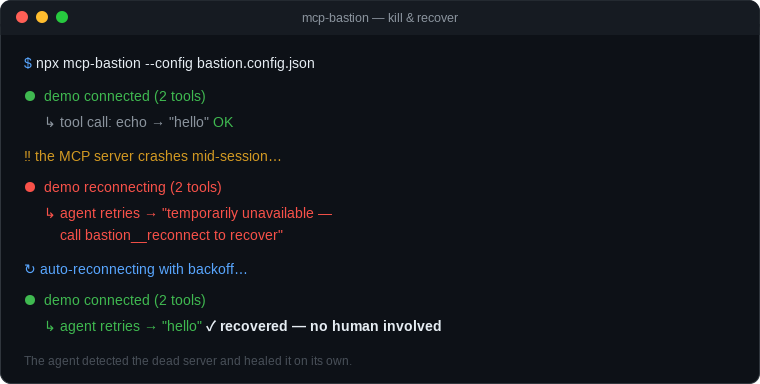
See the whole thing in action — a server crashing mid-session and healing itself:
npm run demo
It boots Bastion in front of a server that crashes on command, shows the agent getting an actionable
"reconnect" message instead of a cryptic error, and then the connection auto-recovering with no human
involved. To record it as a GIF: asciinema rec demo.cast -c "npm run demo" && agg demo.cast assets/demo.gif.
Control tools
Bastion injects control tools so the agent can manage connections and review security itself, using only standard MCP calls:
| Tool | Purpose |
|---|---|
bastion__status | Health of every proxied server: connected / disconnected / reconnecting / failed, tool counts, last error. |
bastion__reconnect | Reconnect a named server (argument: { "server": "<name>" }) without human intervention. |
bastion__security | Per-tool security report: pin status (approved vs changed), poisoning findings, and shadowing. |
bastion__compliance | Audit summary of recent activity mapped to NIST AI RMF / OWASP LLM Top 10 (requires audit.enabled). |
Re-approval is operator-only. Clearing a rug-pull block is a security authority, so it is not an agent-callable tool — a prompt-injected agent must not be able to re-approve the very tool it was blocked from. A changed tool stays blocked until an operator clears it out-of-band;
bastion__approveis not advertised and a client call to it is refused.
Configuration
| Key | Type | Default | Description |
|---|---|---|---|
servers | map | — | Upstream servers to proxy (required, at least one). |
servers.<name>.command | string | — | Executable to launch (e.g. npx, node). |
servers.<name>.args | string[] | [] | Arguments to command. |
servers.<name>.env | map | — | Env overrides merged over the process env. |
servers.<name>.cwd | string | — | Working directory for the spawned process. |
reconnect.auto | boolean | true | Auto-reconnect after an unexpected disconnect. |
reconnect.maxRetries | number | 10 | Max attempts before giving up (-1 = unlimited). |
reconnect.initialBackoffMs | number | 500 | Initial backoff, doubled each attempt. |
reconnect.maxBackoffMs | number | 30000 | Backoff ceiling. |
healthCheck.enabled | boolean | true | Enable periodic liveness probing. |
healthCheck.intervalMs | number | 30000 | Interval between probes. |
healthCheck.timeoutMs | number | 5000 | Per-probe timeout. |
namespace.strategy | prefix | passthrough | prefix | How upstream tool names are exposed. |
namespace.separator | string | __ | Separator used by the prefix strategy. |
security.pinTools | boolean | true | Pin tool definitions and detect later changes. |
security.onRugPull | block | warn | block | Action when a pinned tool's definition changed. |
security.inspectDescriptions | boolean | true | Run poisoning heuristics on tool descriptions. |
security.onPoisoning | block | warn | warn | Action on a high-severity poisoning finding. |
audit.enabled | boolean | false | Record an audit event for every tool call. |
audit.includeArgs | none|redacted|full | none | How tool arguments are recorded. |
audit.tamperEvident | boolean | false | Hash-chain events so tampering is detectable. |
audit.sinks | array | console | Destinations: console, file, webhook, otlp. |
servers.<name>.transport | stdio | http | stdio | Local subprocess or remote endpoint. |
servers.<name>.url | string | — | Remote MCP URL (required for http). |
servers.<name>.headers | map | — | Headers for http upstreams (e.g. Authorization). |
servers.<name>.forwardHeaders | map | — | http only. Upstream header ← incoming header, copied per request (gateway mode). Needs listen.mode: "http". |
servers.<name>.onMissingForwardedHeader | error | omit | error | When a request lacks a forwarded header: answer a tool error without calling the upstream, or call it without. |
servers.<name>.connect | startup | onDemand | startup | onDemand: connect on the first request that needs this upstream, with that request's forwarded headers. |
servers.<name>.authHeaders | string[] | — | Extra header names that count as authentication in bastion__status (forwardHeaders keys always count). |
servers.<name>.delegation | object | — | http only, needs forwardHeaders. Keyless checks on the delegate JWT in a forwarded header (below). |
servers.<name>.delegation.verify | structural | signature | structural | signature also verifies the JWT against public keys (jwksUrl or jwks), with issuer and an algorithms allow-list. |
delegation.gatewayAudiences | string[] | [] | Audiences that identify Bastion itself; a token for one of them (or with no aud) is passthrough. |
delegation.oneUserPerRequest | boolean | true | All delegate tokens in one request must name the same user (iss + sub). |
delegation.recordSubject | hash | plain | hash | Audit subject: HMAC pseudonym of iss|sub, or sub as is. |
delegation.subjectKey | string (≥16) | see below | Pseudonym key; or MCP_BASTION_SUBJECT_KEY, then the audit integrity key, then random per process (warned at start-up). |
security.onDelegation | block | warn | block | Action on a delegation finding other than the chain rules. |
security.onDelegationChain | block | warn | warn | Action on delegation-chain-depth / -chain-cycle (block under strict). |
listen.mode | stdio | http | stdio | Serve Bastion over stdio or Streamable HTTP. |
listen.host / listen.port | string / number | 127.0.0.1 / 3000 | Bind address for http mode. |
listen.validateRoutingHeaders | boolean | true | Reject Mcp-* routing headers that disagree with the body (-32020, MCP 2026-07-28). |
security.maxCacheTtlMs | number (ms) | 3600000 | Ceiling on upstream ttlMs cache hints forwarded downstream (MCP 2026-07-28). |
servers.<name>.protocol | auto|legacy|2026-07-28 | auto | Era negotiation per upstream (probe 2026-07-28, fall back; or pin). |
listen.legacy | stateless | reject | stateless | Serve pre-2026-07-28 clients statelessly, or refuse them (-32022). |
security.inspectInputRequests | boolean | true | Gate input_required rounds (credential phishing, model steering). |
security.onInputRequired | block | warn | block | Action on a high-severity MRTR finding (warn strips the request). |
security.requestStateKey | string (≥16) | random per process | HMAC key sealing requestState envelopes; or MCP_BASTION_REQUEST_STATE_KEY. |
security.requestStateTtlSeconds | number | 300 | Lifetime of a sealed requestState envelope. |
security.enforcementProfile | observe | balanced | strict | balanced | Sets every on* action as a group; see Security model. An explicit on* overrides it. |
security.onAuthorization | block | warn | block | Action when authorization refuses a call (warn under observe). |
security.redactResponseSecrets | boolean | true | Redact secret values from tool results before the agent sees them. |
authorization.enabled | boolean | false | Turn on runtime authorization; see Runtime authorization. |
authorization.default | deny | allow | deny | Decision for an identity no rule allows. |
authorization.rules | array | [] | { id, effect, principal, tools, args? } rules; deny overrides allow. |
authorization.trustStructuralClaims | boolean | false | Accept user/agent from structural-mode delegate tokens. |
listen.authToken | string | — | Bearer token for the client default. Required for a non-loopback bind unless listen.clients is set. |
listen.clients | map | — | Named clients: { "<name>": { "tokenEnv": "VAR" } }, one bearer token each. |
audit.integrityKey | string | — | HMAC key for the chain; or MCP_BASTION_AUDIT_KEY. |
audit.onSinkFailure | continue | block | continue | block refuses calls while no sink can deliver. |
audit.sinks[].includeArgs | none|redacted|full | audit.includeArgs | Per-sink argument recording. |
audit.sinks[].headersEnv | map | — | webhook/otlp: header name → environment variable. |
audit.sinks[].allowInsecureTransport | boolean | false | webhook/otlp: allow plain HTTP to a non-loopback host. |
audit.sinks[].maxQueue | number | 10000 | webhook/otlp: events held while the receiver is down. |
audit.sinks[].flushIntervalMs | number | 5000 | webhook/otlp: send a partial batch at least this often (ms); 0 sends only full batches. |
audit.checkpoint | object | — | Signed checkpoints: privateKeyFile, everyEvents (100), everySeconds (60), stateFile, sinks. |
Transports
Bastion runs on the MCP TypeScript SDK 2.0 and speaks both protocol eras — the stateless
2026-07-28 revision and the pre-2026 initialize handshake — on both faces, per upstream and per
client. When the protocol is stateless, the gateway is the only component that can still hold security
state, which is why v1.0 adds requestState custody and an input_required consent gate (see
CHANGELOG.md).
Bastion speaks two transports on both faces:
- stdio (default) — the client spawns Bastion, and Bastion spawns local servers.
- Streamable HTTP — connect to remote MCP servers (
servers.<name>withtransport: "http", aurl, and optional authheaders), and/or serve Bastion over HTTP to multiple/remote clients (listen.mode: "http", or--http <port>).
HTTP upstreams configured without an authentication header are flagged (authenticated: false) in
bastion__status and warned at connect time. A custom credential header counts once it is named in
authHeaders; a forwarded header always counts.
Running behind another MCP gateway
Tool pins live in memory, so Bastion has to keep running to compare a definition with the one it saw earlier. Some gateways start a new stdio process for every call (MCPJungle 0.4.7 does). Each of those Bastion processes starts with empty pins, so it can't detect a changed tool. The pattern scans still run.
Run Bastion as a long-running HTTP server and register its URL in the gateway:
{
  "listen": { "mode": "http", "host": "127.0.0.1", "port": 3312 },
  "servers": { "tickets": { "command": "node", "args": ["tickets-server.mjs"] } },
  "security": { "enforcementProfile": "observe" }
}
- Behind the gateway, Bastion sees every tool definition the upstream sends, including changes the
gateway's stored tool list misses. It records the caller as
anonymousunless the gateway sends alisten.clientstoken, and then it names only the gateway. - In front of the gateway, give each client its own
listen.clientstoken and Bastion names the caller on every event. It sees only the tool list the gateway serves, so it can miss an upstream change the gateway has not picked up. - To get both, run one Bastion in each position.
Per-user identity (gateway mode)
When Bastion sits between an agent and sub-agents that must act as the signed-in user, each
upstream call has to carry that user's identity, not one fixed token. forwardHeaders does this:
{
  "servers": {
    "files": {
      "transport": "http",
      "url": "http://localhost:8011/mcp",
      "protocol": "legacy",
      "connect": "onDemand",
      "forwardHeaders": { "x-user-identity": "x-delegate-files" },
    },
  },
  "listen": { "mode": "http" },
}
The map reads upstream header ← incoming header. For every upstream request made while serving a
downstream HTTP request (initialize, tools/list, tools/call, ping), Bastion copies the value of
the incoming x-delegate-files header onto the upstream request as x-user-identity.
Bastion holds no credential in this mode. It only passes on what each request carries.
- Bound to the request. The incoming headers live in an
AsyncLocalStoragefor exactly the lifetime of one downstream request. A customfetchon the upstream transport reads them at send time. Concurrent requests from different users share one upstream connection but never see each other's headers. - Only listed headers travel. No other incoming header is forwarded. Hop-by-hop and
transport-owned headers (
connection,mcp-session-id,content-type, …) are rejected as forward targets at config load. Whilelisten.authTokenis set, the incomingauthorizationheader (Bastion's own bearer token) cannot be forwarded. - A forwarded header overrides a static
headersentry of the same name. - Missing header. By default (
onMissingForwardedHeader: "error") the upstream is not called. The caller gets a tool error such asfiles: the request carried no x-delegate-files header, so the call was not forwarded.Use"omit"to call the upstream anyway and let it decide. - On-demand connection. With
connect: "onDemand", nothing is sent at start-up. The first request that needs the upstream (tools/list, or a directtools/calloffiles__…) connects it with that request's headers. The tool list is then cached as usual. Health checks skip on-demand upstreams, which show asidleuntil first used. A failed connect returns toidlewith no reconnect timer.connect: "startup"withforwardHeadersconnects at boot with the staticheadersonly, so useonDemandwhen the upstream authenticatesinitializetoo. - 401 is an authentication failure. It is reported as such in the tool result and in
bastion__status(lastError), never as a crash or an unknown tool. One user's 401 does not tear down the connection other users share. - Values are never recorded. Logs, audit sinks and
bastion__statusnever contain a forwarded value. Audit events record only which headers were forwarded ("forwardedHeaders": ["x-user-identity"]). - Pinning is shared. Tool definitions are pinned on first sight and a change is blocked, whichever user's request saw it. Only the identity is per request.
forwardHeaders, onMissingForwardedHeader, connect and authHeaders are valid only on
transport: "http" upstreams. forwardHeaders also needs listen.mode: "http". Other combinations
are rejected at config load. See
examples/identity-forwarding.config.json for three
sub-agents behind one Bastion.
Delegation checks
Since v1.2.0. In gateway mode a caller (say, a master agent working for a signed-in user) sends one short-lived delegate JWT per sub-agent, each in its own header. Each sub-agent sees only its own token. Bastion sees the whole request, so it can check what none of them can, without holding any secret or key:
"servers": {
  "files": {
    "transport": "http", "url": "http://localhost:8011/mcp", "protocol": "legacy", "connect": "onDemand",
    "forwardHeaders": { "x-user-identity": "x-delegate-files" },
    "delegation": {
      "audience": "files",                // required: what this upstream's tokens must carry in `aud`
      "header": "x-user-identity",        // forwardHeaders key carrying the JWT (default: the only one)
      "verify": "structural",             // or "signature" (below)
      "maxLifetimeSeconds": 120,          // default 3600
      "clockSkewSeconds": 30,             // default 30
      "allowedActors": ["orchestrator-agent"],
      "requireActor": false,
      "maxChainDepth": 2
    }
  }
},
"delegation": { "gatewayAudiences": ["mcp-bastion"], "oneUserPerRequest": true, "recordSubject": "hash" }
| Rule | Fires when | Default (balanced) |
|---|---|---|
delegation-malformed | not a strict JWS compact token (see below), or a wrongly typed claim | block |
delegation-audience-mismatch | no aud value equals this upstream's audience (a sibling's token) | block |
delegation-passthrough | aud is absent, or any aud value is in gatewayAudiences | block |
delegation-subject-mixing | the request's delegate tokens name more than one (iss, sub) | block |
delegation-expired / -not-yet-valid | now > exp + skew / nbf > now + skew | block |
delegation-lifetime-excess | exp − iat > maxLifetimeSeconds, or no exp | block |
delegation-actor-not-allowed / -actor-required | current actor (act.sub, else act.client_id) not in allowedActors / no act | block |
delegation-chain-depth / -chain-cycle | the act chain is longer than maxChainDepth / names an actor twice | warn |
delegation-alg-disallowed | signature mode: alg is not in algorithms (case-sensitive; none and HMAC never are) | block |
delegation-key-unknown | signature mode: no trusted key matches the kid, or the key set could not be fetched | block |
delegation-signature-invalid | signature mode: the signature does not verify under the trusted key | block |
delegation-issuer-mismatch | signature mode: iss is not the configured issuer | block |
Chain depth and cycles concern prior actors, which RFC 8693 §4.1 calls informational, so they are
medium severity and only warned on unless security.onDelegationChain (or the strict profile) says
block. Everything else follows security.onDelegation (warn under observe).
- Strict decoding. Exactly three base64url segments, no padding, canonical encoding, JSON objects
with unique member names (after escape decoding) and a string
alg; an optionalBearerprefix is allowed. Anything else fails closed asdelegation-malformed. - One verdict per request. On first need Bastion decodes every delegation-configured token the
request carries, runs the per-upstream checks and the cross-token subject check, and caches the
verdict for the rest of the request. The checkers are exported as
checkDelegation(policy, carriedHeaders, now)(structural, synchronous) andcheckDelegationAsync(policy, carriedHeaders, now)(adds signature verification). - Before any upstream contact. A blocked
tools/callis refused before Bastion connects (on-demand connects included), with a tool error naming the rule, never a token or claim value, and an audit event with decisionblocked_delegation.tools/listleaves out an upstream the request is blocked from. As a backstop, the upstream transport refuses to send a token whose verdict blocks (reconnects and other sends made inside the request). - Who acted for whom. Calls to a delegation-configured upstream carry an audit
delegationrecord:subject,issuer,audience,tokenId(jti),expiresAt,actors(current first),chainDepth,verified(structural,signaturewhen the signature verified, orfailed) and the findings. Never the token. Inhashmode the subject is"hmac:"+ the first 16 hex characters of HMAC-SHA256(key,iss|sub): an operator with the key can recompute it to find one user's records. The key isdelegation.subjectKey, elseMCP_BASTION_SUBJECT_KEY, else the audit integrity key, else a random key per process, whose pseudonyms do not link across restarts or across replicas. Set one shared key on every replica to link a user's records; Bastion logs a start-up warning while none is set. - Status.
bastion__statusshows, per upstream,delegation: { mode, audience, lastViolation }, where the last violation is a rule id and a time only. - Config checks.
delegationneedsforwardHeaders;headermust be one of its keys; two upstreams cannot share anaudience, and no upstream audience may be a gateway audience; unknown keys are rejected. Signature mode needsissuer, a non-emptyalgorithmslist and exactly one key source.
Signature mode
When the issuer signs delegate tokens with an asymmetric key (ES256, EdDSA, RS256, PS256, …), Bastion can verify them against the issuer's public keys:
"delegation": {
  "audience": "files",
  "verify": "signature",
  "issuer": "https://spire.example/identity",               // exact match on `iss`
  "algorithms": ["ES256", "EdDSA"],                          // allow-list; HS256/384/512 and none are rejected
  "jwksUrl": "https://spire.example/.well-known/jwks.json"   // or "jwks": { "keys": [ … public JWKs … ] }
}
- Keys come only from the configured source.
jku,x5u,x5cand embeddedjwkheaders are never followed. An inlinejwkswith private or secret members (d,p,q,dp,dq,qi,oth,k) is rejected at config load.jwksUrlmust be HTTPS, except to a loopback host. - The algorithm allow-list runs first, case-sensitively, before any key lookup:
alg: none(in any casing) and HS256 signed with the public key are refused without a fetch. A critical header extension (crit, e.g. an unencoded payload) is refused. - Remote key sets are fetched on first use and cached. A token with an unknown
kidtriggers at most one refetch per 30 s cooldown. A fetch failure or a 5 s timeout fails closed: the call is blocked asdelegation-key-unknown, the upstream'slastErrorsays the key set is unavailable, and further fetches wait for the cooldown. - The structural rules still run on a verified token, under the same names, and the audit record says
verified: "signature".
Honest limits.
- Structural mode authenticates nothing: a party that can forge tokens can forge consistent claims. It stops misrouting, passthrough, user mixing, stale relay and chain abuse by honest-but-wrong or prompt-injected callers. The upstream remains the verifier. Use signature mode (asymmetric tokens) for authentication at the gateway.
- Signature mode holds public keys only, so Bastion stays keyless: it can verify tokens but never mint
one. It needs the issuer to sign with an asymmetric algorithm; HS256 tokens can only be checked
structurally, because verifying them needs the shared secret. It trusts whatever the configured key set
says, so the security of
jwksUrl(HTTPS, the issuer's own host) is the security of the check. - The one-user-per-request check covers only tokens configured with
delegation. - Replay inside the token's lifetime is not stopped (no
jticache yet; possible later, opt-in, bounded).
See examples/delegation.config.json for three sub-agents.
Runtime authorization
New in v1.4, opt-in. Decide who may call which tool, with which arguments, on every call and
before any upstream server is contacted. Inactive unless authorization.enabled.
"listen": {
  "mode": "http",
  "clients": {                                   // one bearer token per client, read from the environment
    "docs-assistant":   { "tokenEnv": "BASTION_TOKEN_DOCS" },
    "release-pipeline": { "tokenEnv": "BASTION_TOKEN_RELEASE" },
    "ops-console":      { "tokenEnv": "BASTION_TOKEN_OPS" }
  }
},
"security": { "enforcementProfile": "observe" },   // preview first: log, never block
"authorization": {
  "enabled": true,
  "default": "deny",
  "rules": [
    { "id": "docs-read", "effect": "allow", "principal": { "client": "docs-assistant" },
      "tools": ["files__read_file", "files__list_dir"],
      "args": { "path": { "pathWithin": "/srv/docs" } } },
    { "id": "release-staging", "effect": "allow", "principal": { "client": "release-pipeline" },
      "tools": ["deploy__*"], "args": { "env": { "in": ["staging"] } } },
    { "id": "no-prod-rollback", "effect": "deny", "principal": "*",
      "tools": ["deploy__rollback"], "args": { "env": { "equals": "prod" } } },
    { "id": "ops-control", "effect": "allow", "principal": { "client": "ops-console" },
      "tools": ["bastion__*"] }
  ]
}
Who is calling. A call carries every identity Bastion has authenticated: the client (a named
listen.clients bearer token, default for listen.authToken, or stdio), plus the user and the
acting agent from the call's delegate token when there is one. Identities named
in arguments, headers, _meta or input responses are ignored: a request cannot promote itself by
claiming to be someone else.
How a call is decided.
- Every identity must be permitted. An agent acting for a user needs the user's grant and its own, so an agent's broad service grant is never used for a user who lacks the right (the confused deputy), and a user's right is never used by an agent that was not granted it. Earlier agents in a delegation chain grant nothing; only the current one counts.
- Deny overrides allow. Per identity, any matching
denyrefuses; otherwise anallowwhose argument constraints all hold is needed. Withdefault: "deny", no matching allow means no access. - Rules.
principalis"*"or one ofclient,user,agent(a name or a list).toolsare namespaced names, exact or ending in one*.argsconstrain top-level arguments withequals,in,max,minandpathWithin. Matching is exact: no case folding, Unicode normalisation or type coercion;max/minaccept JSON numbers only;pathWithinresolves.and..and checks the boundary at a/(so/srv/docs-archiveis not inside/srv/docs). - Fail closed. A missing constrained argument fails an
allow. Adenywithargsapplies unless its constraints can be evaluated and do not hold, so a missing or wrongly typed argument cannot slip past a deny. - Control tools (
bastion__*) are authorized like any tool, under server namebastion. Withdefault: "deny", grant them to an operator client, asops-consoleabove.
Where it runs. In tools/call, after the delegation checks and before any upstream contact, so a
refused call never opens a connection carrying the caller's forwarded headers. Continuations
(input_required retries) are re-authorized. tools/list hides tools a caller could never be allowed.
Rolling it out. Start under enforcementProfile: "observe": nothing is refused, and each audit
event carries an authorization record (effect, deciding rule, violations such as
agent:argument, and rules, the deciding rule per identity, e.g.
{ "client": "orchestrator-files", "user": "files-run" }, so the record shows which grant admitted
each identity) plus wouldBlock: "blocked_authorization" where enforcement would have refused. Rule ids
appear in audit records, so keep personal data (user ids, e-mail addresses) out of them. When
the log shows only refusals you intend, switch to balanced. Under balanced a refused call is answered
Blocked by mcp-bastion: this caller is not authorized to call "<tool>" (rule <id>).; no other policy
content is revealed.
Trust in user and agent identities. They come only from a trusted delegate token: one verified in
signature mode, or, in structural mode, only with trustStructuralClaims: true. Set
that only when the upstream verifies the same token itself, so a forged claim that passes Bastion is still
rejected upstream. A rule naming a user or agent for a structural-mode upstream is a config error
otherwise, and a token that is present but untrusted refuses the call (delegation:unverified). While
trustStructuralClaims is on, Bastion logs a start-up warning naming the upstreams it applies to.
Measured. This family of checks was pre-registered as test cases in
mcp-defense-bench (tag
authorization-prereg-2026-10-26) before this code was written. Per-caller MCP authorization also exists
in other gateways (for example agentgateway's CEL rules and ToolHive's Cedar policies), and the
benchmark's pre-registration commits to scoring them side by side.
Runtime security
New in v0.2. Bastion adds a security layer in the tool-call path (an interceptor pipeline), enabled by default:
- Rug-pull detection (tool pinning). Each tool's definition is pinned on first use. If a server
later changes that definition, the tool is blocked (
onRugPull: "block") until an operator reviews it and re-approves it out-of-band (operator-only — not an agent-callable tool). This catches a server that looks benign at install time and turns malicious afterward. - Poisoning inspection. Tool names and descriptions are scanned for manipulation heuristics
(instruction override, secret access, data exfiltration, covert instructions, embedded directives,
hidden/zero-width characters). Because heuristics can false-positive, the default is
warn(logged and reported, not blocked); setonPoisoning: "block"to enforce. - Shadowing. When two servers expose a tool with the same name, it's surfaced in the report.
Review everything with the bastion__security tool. Each finding says whether it is heuristic or
deterministic; see Security model.
Audit & compliance
Opt-in. Enable audit to record a structured, versioned event for every tool call, including calls
refused by the security layer or by authorization:
"audit": {
  "enabled": true,
  "includeArgs": "redacted",            // none | redacted | full (default for every sink)
  "tamperEvident": true,                // hash chain; keyed with integrityKey / MCP_BASTION_AUDIT_KEY
  "onSinkFailure": "continue",          // or "block": refuse calls while no sink can deliver
  "sinks": [
    { "type": "file", "path": "./bastion-audit.jsonl", "includeArgs": "full" },
    { "type": "otlp", "endpoint": "https://collector.example:4318",
      "headersEnv": { "authorization": "OTEL_AUTH_HEADER" }, "includeArgs": "none" }
  ],
  "checkpoint": {                       // signed checkpoints (needs tamperEvident)
    "privateKeyFile": "/etc/bastion/checkpoint-private.pem",
    "stateFile": "/var/lib/bastion/audit-state.json",
    "sinks": [{ "type": "webhook", "url": "https://witness.example/checkpoints" }]
  }
}
Events. Each event names the server, tool, the authenticated client (a listen.clients name,
default, anonymous or stdio, recorded with or without authorization), decision (allowed,
blocked_rug_pull, blocked_authorization, …), outcome, findings with their kind, the authorization record (with the
deciding rule per identity) and the delegation record when present, a runId, and a mapping to
NIST AI RMF functions and OWASP LLM Top 10 categories. A call that passed the checks and then
failed before reaching the tool (an on-demand connect refused, an upstream not connected) is recorded
with outcome: "error". bastion__compliance returns aggregate totals.
Each sink is its own security boundary.
console(stderr),file(JSON lines, created0600),webhookandotlp(OpenTelemetry logs). OTLP records carry the caller (mcp.client),mcp.would_block,mcp.findings, the authorization rule,audit.seqand the chain hashes as attributes, plus the whole event asaudit.event, so a collector export can be checked withmcp-bastion audit verify.- Remote sinks must use HTTPS unless the host is loopback. Plain HTTP to a remote host is a config
error unless the sink sets
allowInsecureTransport: true, which logs a warning. - Credentials come from the environment (
headersEnv), not the config file; a missing variable stops startup. - Webhook and OTLP sinks send a batch when
batchSizeevents are queued, or everyflushIntervalMs(default 5 s), whichever comes first. - A failed delivery is retried with exponential backoff instead of being dropped. Events wait in a
bounded queue (
maxQueue, default 10 000); beyond it the oldest are dropped and counted. Receivers can also spot gaps from each event'sseq. bastion__statusshows each sink's health:healthy,delivered,dropped,queued,lastError.- With
onSinkFailure: "block", calls are refused (blocked_audit_unavailable) while no sink can deliver, for deployments where an unaudited call is not acceptable. Bastion's own control tools stay usable so the sinks can be inspected and recovered.
Redaction is first-class.
- Arguments are not recorded by default. Each sink can record its own level (
includeArgsper sink): for example full arguments to a local file and none to a shared SIEM. redactedkeeps structure and masks values under credential key names and values that look like secrets: cloud and provider keys, GitHub, Slack, Stripe, Google and npm tokens, JWTs,Bearercredentials, passwords in URLs, private-key blocks andNAME=secretassignments. The same patterns redact secrets from tool results before the agent sees them (redactResponseSecrets, on by default). Measured on a 45-case corpus (test/redaction-corpus.test.ts): 29/29 secrets caught, 0/16 benign look-alikes changed.- Never written to any sink: tool results, delegate-token values, forwarded header values (names only),
and the raw user
subwhendelegation.recordSubjectishash. Arguments are recorded only asincludeArgsallows, so a secret passed as an argument is kept underfull. - Redaction is pattern-based. A secret in an unrecognised shape under an unrecognised key can still be
recorded, so prefer
nonefor high-sensitivity sinks.
Tamper evidence, and its limits.
- With
tamperEvident, events form a hash chain. With anintegrityKeythe chain is HMAC-SHA256: without the key, a party who rewrites the log cannot recompute it. Unkeyed, it only detects naive edits. - When sinks record arguments differently, the chain (v2) covers each event without its
argsview plus anargsDigest(HMAC of the full arguments), so every sink verifies the same chain. - A hash chain cannot show that the newest records were cut off. Signed checkpoints can:
audit.checkpointwrites an Ed25519-signed statement of the chain head everyeveryEvents(100) events, everyeverySeconds(60) seconds and at shutdown, and each run starts with arun-startrecord linked to the previous run throughstateFile. Send checkpoints to a witness sink the log's host cannot rewrite. mcp-bastion audit verify <log> --checkpoints <witness.jsonl> --public-key <pem>checks the chain,seqcontinuity, checkpoint signatures, run links, a log cut short and a deleted run. Exit0intact,1tampered,2cannot verify.mcp-bastion audit keygen --out <dir>creates the key pair.- Limit: a cut is detected only back to the last checkpoint that reached a witness the attacker cannot rewrite; without a witness, cutting a log together with its checkpoints is not detectable. An attacker holding the private key can forge checkpoints, so keep it off the log's host.
Shadow mode. Under security.enforcementProfile: "observe" nothing is blocked, and each event says
what enforcement would have done: wouldBlock holds the decision balanced would have recorded, a rug
pull appears in findings as tool-definition-changed, and responseFindings / redactedSecrets
record what the result scan and inline DLP found (or secret-in-result when redaction is off).
Standards alignment
Every security check maps to recognized frameworks — the NIST AI Risk Management Framework (a U.S. federal standard), the OWASP Top 10 for LLM (2025) and Agentic (2026) Applications, and STRIDE. The full per-check mapping (with reference links to the MCP-security literature the checks are drawn from) is in docs/CHECKS-MAPPING.md.
Coverage is measured independently — bastion is scored against a 22-vector attack surface by the vendor-neutral mcp-defense-bench benchmark, with a public leaderboard and framework mapping.
Client setup
The steps are identical for every client — only the config file location differs:
| Client | Where to add the bastion entry |
|---|---|
| Claude Code | project .mcp.json (or claude mcp add) |
| Cursor | ~/.cursor/mcp.json or project .cursor/mcp.json |
| Claude Desktop | claude_desktop_config.json |
| Cline | cline_mcp_settings.json |
| Windsurf | ~/.codeium/windsurf/mcp_config.json |
Gradual adoption: you don't have to route every server through Bastion — put only your flaky or untrusted servers behind it and leave the rest connected directly.
Rolling out to a team? docs/ADOPTING.md walks through a 10-minute trial, a shadow pilot that never blocks, and enforcement, plus the evidence a security reviewer will ask for.
Architecture
Bastion is organized into clear layers with a one-directional dependency flow, so each concern is independently testable and easy to evolve:
src/
├── cli.ts              # thin CLI entrypoint (parse → wire → serve)
├── index.ts            # public library API
├── errors.ts           # error hierarchy (BastionError, …)
├── config/             # schema (Zod) + loader
├── core/               # domain: upstream connection lifecycle, aggregation & routing
├── proxy/              # client-facing MCP server + control tools
├── observability/      # logging (audit sinks in v0.3)
└── internal/           # small cross-cutting utilities
Design details — including the client-agnostic rationale, the interceptor pipeline, and the audit-sink strategy — live in the project's design docs.
Development
npm install
npm run check      # format:check + lint + typecheck + test (the full gate)
npm test           # unit + end-to-end (in-memory transport) tests
npm run build      # bundle to dist/ (CLI + library)
npm run dev -- --config bastion.config.json
| Script | Does |
|---|---|
build | Bundle CLI + library with tsup. |
dev | Run the CLI from source with tsx. |
typecheck | tsc --noEmit (strict). |
lint / lint:fix | ESLint (flat config). |
format / format:check | Prettier. |
test / test:watch | Vitest. |
check | Everything above, as one gate. |
Roadmap
| Version | Theme | Highlights |
|---|---|---|
| v0.1 ✅ | Reliability | Aggregating proxy, auto-reconnect, bastion__status / __reconnect. |
| v0.2 ✅ | Runtime security | Tool-definition pinning (rug-pull detection), poisoning inspection, shadowing detection. |
| v0.3 ✅ | Audit & compliance | Pluggable audit sinks (console / file / webhook), NIST AI RMF / OWASP LLM Top 10 mapping. |
| v1.2 ✅ | Delegation | Keyless checks on delegate tokens: audience, subject mixing, expiry, actor chains, signatures. |
| v1.4 | Authorization & evidence | Per-caller runtime authorization; HTTPS-only, retrying, per-sink-redacted audit sinks; signed checkpoints and audit verify. |
Both stdio and Streamable HTTP transports are supported (see Transports).
Contributing
Contributions are very welcome — this project is built to be community-owned. Please read CONTRIBUTING.md for the dev setup, project layout, and PR workflow, and our Code of Conduct.
In short: open an issue for non-trivial changes, keep PRs focused with tests, and make sure
npm run check passes (CI runs it on Node 20/22/24). Good first areas: additional client setup
recipes and more upstream test fixtures.
Using mcp-bastion at your organization? Add it to ADOPTERS.md with a pull request.
Security
mcp-bastion is security-adjacent software, so we hold it to a high bar. Please report
vulnerabilities privately — do not open a public issue. See SECURITY.md for
the disclosure process and supported versions, and THREAT-MODEL.md for what
Bastion defends against and what it doesn't. Bastion collects no data: see
PRIVACY.md.
License
Apache-2.0 © Gowthaman Arumugam and mcp-bastion contributors