
OpenHire · 开聘
A job-search radar for your AI assistant — first-party listings, ghost jobs scored, and your résumé never touches our servers. 让 AI 助手替你盯岗的求职雷达 —— 一手职位、幽灵岗位打分,简历不经过我们的服务器。




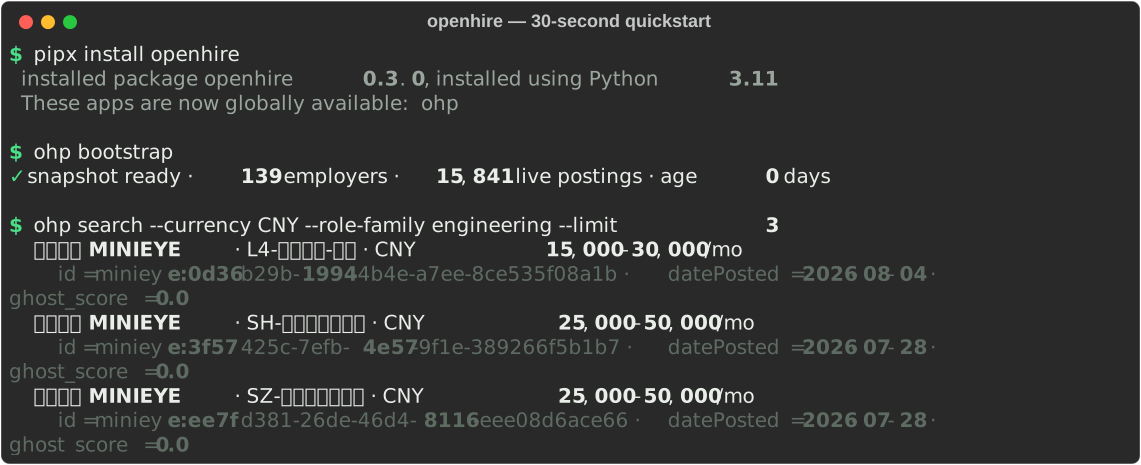
Real terminal output — install from PyPI, download the public index, search. No account, no signup.
An MCP server that turns your AI assistant (Claude, Cursor, Windsurf) into a private radar for AI / Infra, autonomous-driving and embodied-AI jobs — pulled straight from 139 employers' own career sites and public ATS APIs (Greenhouse / Lever / Ashby / 北森 Beisen / Moka), across the US, Europe and China (Waymo, Figure, Zoox — and Unitree, XPeng, UBTECH, Mech-Mind…). No account. No signup. No résumé upload. Ever.
Three things a job board won't do for you:
- Kills ghost-job noise. Every listing carries a
ghost_scoreaged off the employer's real posting date — the "2 days ago" a board shows you can be 300 days old in the ATS. - Structural privacy, not a pinky-promise. There is no résumé field in the protocol; a CI test fails the build if anyone adds one. Matching runs on your machine — only an anonymous fingerprint reaches the server.
- Ranking you can't buy. Order is a locked pure function of (match, freshness). No sponsored slots, no bidding — the signature is frozen by a test.
This is the 「哨兵 / Sentinel」 reference implementation — see
design_handoff_openhire_v01/README.md for the full protocol spec.
Quickstart — under a minute
# 1. Install (pipx keeps it isolated and puts `ohp` on your PATH)
pipx install openhire

# 2. Get a job index. Default: download the public snapshot, then refresh it live.
ohp bootstrap                    # 139 employers · ~16k live postings · no account

# 3. Use it directly…
ohp search --required-skills rust,k8s --remote --role-family engineering
ohp search --currency CNY --role-family engineering   # e.g. CN autonomous-driving / robotics roles

# …or connect it to an MCP client:
ohp serve
Then point your MCP client at it — see Works with below.
Works with
All clients use the same MCP entry. If you ran pipx install openhire, use ohp; otherwise
uvx openhire serve fetches and runs it with no prior install (needs uv).
Claude Desktop — %APPDATA%\Claude\claude_desktop_config.json (macOS: ~/Library/Application Support/Claude/); quit & reopen after editing:
{ "mcpServers": { "openhire": { "command": "ohp", "args": ["serve"] } } }
Cursor — ~/.cursor/mcp.json (or a project .cursor/mcp.json):
{ "mcpServers": { "openhire": { "command": "uvx", "args": ["openhire", "serve"] } } }
Windsurf — ~/.codeium/windsurf/mcp_config.json:
{ "mcpServers": { "openhire": { "command": "uvx", "args": ["openhire", "serve"] } } }
Run
ohp bootstraponce first so the index has data. On Windows Claude Desktop from the Microsoft Store, the config is under…\Packages\<Claude package>\LocalCache\Roaming\Claude\.
What it does
| Tool | What it gives you |
|---|---|
search_jobs | Hard-filter the live index; every result carries verified_at, datePosted, days_open, ghost_score, remote_scope, eligible_regions, apply_channel. Filter by required_skills (AND), role_family, remote_scope, min_salary + currency. |
watch_intent | Register a standing intent once — new matching jobs are waiting next time you check, even after you close the terminal. Accepts required_skills / role_family so sales / solutions roles stay out. |
check_watches | Pull the matches that are new since your last check (client-pull; stdio has no push). |
authorize_application | One explicit confirmation per job. It records your authorization and returns the employer's own application URL — you apply as yourself. It cannot accept a résumé. |
get_company_info | Aggregate, anonymous trust signals for one employer (ghost_score_avg, active_jobs, index_built_at). Never any candidate data. |
Optional, entirely local: ohp init --scan <dir> derives a skill fingerprint from your
own repos. You never write a résumé; the code never leaves your machine — only an anonymous
vector does.
The five protocol fields
Every listing is valid schema.org/JobPosting, plus:
verified_at— last moment confirmed live on the employer's own sitesource—employer_site | ats_public_api(never a job board)ghost_score— 0–1 listing-activity signal, aged off the real posting date (lower = fresher). A noise filter, not an accusation: long-open listings are often evergreen talent pools or slow pipelines — the score simply lets agents down-rank low-activity noiseresponse_sla_days— employer's committed response window (v0.1: always null)apply_channel— always the employer's own application URL, deep-linked to the specific job
Privacy model
| Résumé / PII upload | never — matching runs locally; a résumé never transits the server, and we never store one |
| What the server sees | one anonymous, client-generated fingerprint + hard filters |
| Repo scan | local-only · personal projects · explicit consent · opt-out anytime |
| Job sources | first-party only: employer career pages + public ATS APIs (Greenhouse / Lever / Ashby) |
First-run data — the snapshot vs. fresh
ohp bootstrap (default) downloads a small public index snapshot (a GitHub Release
asset — companies + jobs only, zero user data) and then runs one incremental crawl to
refresh verified_at / delisting. --fresh skips the snapshot and crawls the public ATS from
scratch with the free offline heuristic extractor. Either way: no account, no PII.
Three rules this project will never break
- Your résumé stays on your machine — it never transits the server, and we never store it.
- Ranking is not for sale — it is only
f(match_quality, freshness), a locked pure function. - Employers pay only for authorized, delivered outcomes — never for exposure. (v0.1 has no billing at all.)
These are enforced by CI (tests/test_privacy.py, tests/test_ranking.py,
tests/test_snapshot.py).
Development
python -m venv .venv && . .venv/Scripts/activate   # Windows
pip install -e ".[dev]"
pytest        # privacy red lines + ranking + snapshot must be green
Set OPENHIRE_DATABASE_URL=postgresql+psycopg://… to run against Postgres instead of the
default local SQLite file (~/.openhire/openhire.db).
Roadmap
- v0.2 – v0.3 (shipped) — CN ATS adapters (北森 Beisen + Moka) · weekly auto-refreshed
public snapshot ·
ghost_scorepublic beta · 139 employers across US / EU / China - next — Employer claim + verified badges — employers can reserve their claim today via a corporate-identity GitHub issue (zero-cost now; badges + listing-status control ship next) · response-SLA enforcement (7-day auto-delist) · redacted proof-of-fit — an anonymous, candidate-authorized match summary that travels with an application (skills overlap only; identity never included, résumés still never transit the server)
- v1.0 — Open, vendor-neutral schema extension for AI-readable job postings
FAQ
Where does the job data come from?
Directly from 139 employers' own public ATS APIs (Greenhouse, Lever, Ashby, 北森 Beisen, Moka) — the
same endpoints that power their careers pages. No scraping, no third-party job boards. source is
always ats_public_api, and verified_at records the last time we confirmed each posting live.
The public index is auto-refreshed weekly, so a fresh ohp bootstrap starts from recent data.
Why should I trust ghost_score?
It's a pure, open, unpurchasable function — min(1, 0.15·relist_count + staleness) aged off the
real ATS posting date, not our crawl date. The formula lives in pipeline/ghost_score.py,
is unit-tested, and takes no money as input (red line #2). Long-open, repeatedly-relisted
postings score higher; you can always re-rank client-side. Read it as signal-to-noise, not
bad faith: plenty of high-scoring listings are legitimate evergreen talent pools. Employers
who want their listing activity represented accurately can claim their tenant (see Roadmap).
Does my résumé actually go through the server — really?
No. There is no résumé anywhere in the protocol. authorize_application has no résumé/file
parameter (it structurally cannot accept one), matching runs on your machine, and the only thing
that ever transits the server is a short anonymous fingerprint like #a3f9. This is enforced by
tests/test_privacy.py, and the published snapshot carries zero user data (tests/test_snapshot.py).
Does it support China (中国区)?
Yes — this is what sets OpenHire apart. Employers on 北森 Beisen (<tenant>.zhiye.com) and
Moka (app.mokahr.com) are indexed: 20+ autonomous-driving / robotics / embodied-AI
companies including 宇树 Unitree, 小鹏 XPeng, 优必选 UBTECH, 梅卡曼德 Mech-Mind, 速腾聚创 RoboSense,
元戎启行 DeepRoute, 星海图 Galaxea, 傅利叶 Fourier, 普渡 Pudu. Pay published as 月薪 keeps its real
period (salary_period), so a salary floor no longer silently drops Chinese roles.
飞书招聘 (Feishu Hire) is not supported and won't be: it signs its job-list requests with a
ByteDance _signature and gates them behind a captcha SDK, so its listings are not publicly
readable. We don't break anti-bot measures. Moka is on the roadmap.
How do I get a company added?
Open a Company inclusion request issue (title it with the company + its ATS URL) — this is
the best way to contribute. If you code, add it to src/openhire/seed/candidates.py (company
slug + ATS vendor/tenant) and open a PR; the seeder validates tenants against the live API.
License
MIT © OpenHire Protocol · PRs welcome.
Built by a non-coder PM-ing Claude Code — full acceptance reports in reports/.