


Your folders show your architecture. Your imports decide it. archy turns a Python import graph into something an agent can use: blast radius before an edit, the tests that edit affects, the modules most at risk. And it fails when the graph disagrees with the layers you declared. Same graph either way, as a CLI and an MCP server, every session and in CI.
[!IMPORTANT] Status, 2026-09-02: active again, on one question.
archy is back in development after five weeks in maintenance. The focus is narrow and it is not the original one: coding agents running a small model on local hardware. A DGX Spark carries 128 GB of unified memory, which puts roughly 70B to 200B models within local reach at 4-bit, but their usable context stays far below a frontier API model's and degrades faster across it. Under that constraint a structural answer to "what does this change reach, and what breaks if it is wrong" may substitute for context the model cannot hold at all.
This is a bet, not a finding, and the difference matters here. Everything in the section below still stands: I measured this tool's premise four times and the problem it prevents is rare, the one real effect was capped at 12% by how seldom the mistake happens, and two token-reduction propositions came back null. Every one of those studies ran against an agent with a large context window and strong long-range code reasoning - the population where a structural index has the least to add, because the model can often just read the code. A small local model is a different population. That is the one reading of the prior nulls that does not require reinterpreting them, and it might still be wrong.
So the discipline does not relax because the project is active again. The thresholds are pre-registered in #408, no treatment arm has been scored, and any result, including another null, gets published in
docs/WHAT_DIDNT_WORK.mdlike the other four. Nothing archy ships today claims a local-model benefit;archy brief(v0.46) shipped explicitly on judgment ahead of that measurement rather than on one.What is not changing. The original use case is still supported and still works: layer governance in CI, blast radius and affected-tests for a frontier agent, the MCP server. This is an adjacent focus, not a replacement, and nothing is being removed or renamed to make room for it. Bugs still get fixed, pull requests still get reviewed, and the
good first issuetickets are still deliberately left open.
Read this first: I measured the premise, and it was wrong
I built archy after watching coding agents produce changes that passed review and rotted the import graph underneath. Then I measured whether that happens, and it barely does.
| measurement | subject | rate |
|---|---|---|
| 25 live agent runs on the riskiest SWE-bench tasks | cycles or declared-layer violations | 0% (95% upper bound 12%) |
| 1,072 human commits, 11 repos | cycles introduced | 0.5% per commit |
| 151 commit pairs in projects that declare an architecture | contract violations | 0.66% per commit |
| 107 samples of those same projects over time | rules going stale, coverage eroding | null on all four pre-registered signals |
| 25 agents each building a backend to a specified architecture | wrong dependency direction | 12%, and a checker in the loop took it to 0% |
So: the problem is real (I have watched a developer's own architecture rule get broken in the wild), and it is rare, for agents and humans alike. "Agents will rot your import graph" is a claim I made and have retracted. Nobody has measured what one occurrence costs, so I cannot argue "rare but expensive" either.
The last row is the one that says what archy is for. All 25 unaided agents produced the four layer directories correctly. Every failure was an import going the wrong way: entities reaching down into data access. They got the layout right and the direction wrong, and a directional rule caught all three cases at no cost to the API's behaviour.
That is the shape of the whole thing. Layout is visible in a file tree. Direction, transitive reach and cycles are visible nowhere, at any zoom level, in any single file. And a separate study found that once one of these lands it is never repaired: zero violations were resolved across the sampled corpus, and 2 of 14 repositories sat on broken contracts indefinitely. Rare and permanent, not rare and self-healing.
What that means for the roadmap: it is closed. Feature work premised on "agents will wreck your architecture" went off the table when that premise was retracted. What survives is narrower and now has a number behind it: directional rules, transitive contracts and cycle detection, checked every session. That is a real job and archy does it, but four studies produced no evidence that more of it is worth building, and the honest reading of four headroom-limited results is that the next feature is not the missing piece.
So archy is finished rather than abandoned. It is maintained, bugs get fixed, and contributions are welcome. There is no roadmap left to publish.
The full write-up, including the six measurement artifacts that nearly turned a failed study into a success story, is in docs/WHAT_DIDNT_WORK.md. If you only read one thing here, read that.
The failure it catches
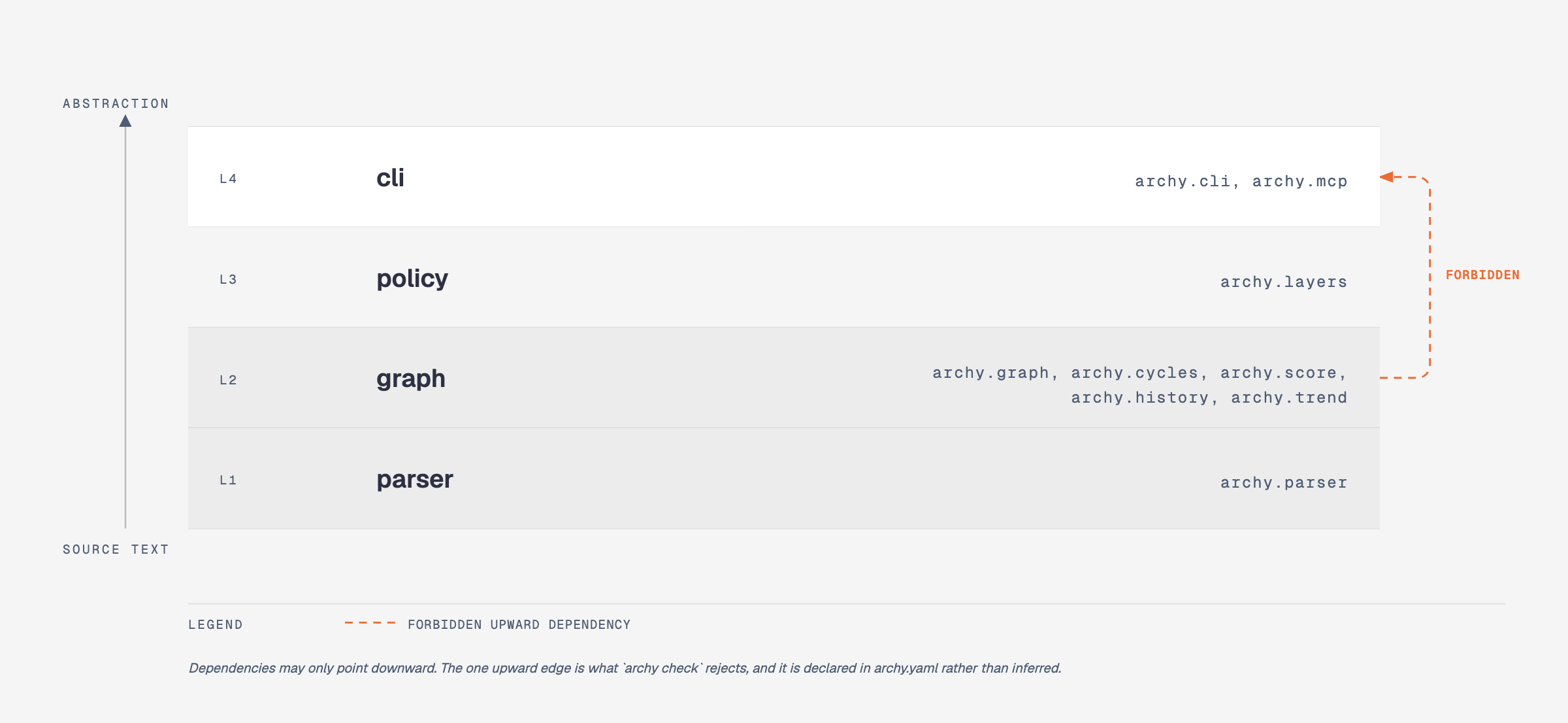
Nothing in that picture is derived. Which layer a module belongs to, and which direction is forbidden, are facts you write down in archy.yaml; archy only checks that the source still agrees with them.
Here is the failure it was built for, compressed into one line. This is archy's own source, under archy's own layer rules, with a single import of the kind an agent adds when it needs a helper and the nearest one is upward:
# src/archy/graph.py
from archy.cli import main    # convenience import. The diff looks harmless.
$ uvx archy check .
# 1 layer violation(s) (config: archy.yaml)

graph -> cli (forbidden):
  archy.graph -> archy.cli  (line: 21)

$ echo $?
1

$ uvx archy cycles .
# 1 cycle(s) found

Cycle of 8 module(s):
  - archy.cli
  - archy.conventions
  - archy.duplicates
  - archy.graph
  - archy.index
  - archy.mcp
  - archy.simulate
  - archy.watcher

$ uvx archy score .
# archy score: 0.647          (0.656 before the edit)
...
acyclicity:  0.942  (1 cycles, tangle=0.058)
# graph: 139 modules, 264 edges     (263 before the edit)
One import, one edge. A forbidden layer edge, an eight-module cycle, and the score down 0.009. Nothing in the diff itself says any of that, and no amount of reading the file reveals it, because the rule that makes it a violation is not in the source. You supplied it.
Note the size of the score move. 0.009 is small, and that is the honest shape of this problem: no single edit looks alarming on the number. The cycle count going 0 to 1 and check exiting 1 are the signals that matter here, and the score is what catches the version of this that happens forty times over six weeks. Read docs/SCORING.md before treating the composite as a quality gate.
That example is a direct forbidden import, which is the easy case: an agent that reads archy.yaml first can catch it without archy. The harder and more honest case is a transitive violation, where the edit adds no forbidden import at all and reading the config tells you nothing. docs/WALKTHROUGH.md is a one-command reproduction of that, and it states plainly which archy surfaces catch it (one) and which miss it (three).
Reproduce the example above on a checkout: add that import to src/archy/graph.py, then run the three commands with the uvx prefix. It has to be a separate archy, because that one import is a genuine runtime import cycle, and an editable-installed archy can no longer start to report on itself. archy check exits 1, which is what it does in CI and what the MCP server reports to an agent before it commits.

What archy is not: a code-navigation tool. It will not help an agent find and read code faster; that job belongs to symbol-level, multi-language graph tools like codegraph, and they are better at it. archy answers the other question: you declared this codebase should have these layers, no cycles, and this score; is the agent's edit about to break that, and has the trend been sliding for six weeks? Nothing in a navigation graph carries that intent, because intent is not in the source, you supply it.
The sharp version, re-checked against codegraph on 2026-07-27: it ships no cycle detection, no config in which to declare layers or forbidden edges, and no command that exits non-zero on a violation. It will happily show you that models imports repositories if you ask the right question. It cannot tell you that is wrong, because wrongness needs a declaration and there is nowhere to put one. Descriptive tools answer questions; archy makes an assertion that breaks the build. The two are both local MCP servers and compose fine; run them together. See docs/research/CODEGRAPH_COMPETITIVE_ANALYSIS.md for the full comparison, including where archy loses and why this distinction is a choice they made rather than a wall they hit.
Start in one command
uvx archy install # detects Claude Code, Cursor, Codex, opencode, Continue and wires each one up
Nothing lands on your PATH: the config it writes runs uvx archy mcp on demand. Prefer a real install? pip install archy, uv tool install archy, or pipx install archy. Either way, try it on a project without installing anything:
uvx archy score .        # one-shot architectural health number
uvx archy cycles .       # import cycles, Tarjan SCCs plus self-loops
uvx archy check .        # layer rules from archy.yaml; exits 1 on violation
Free, MIT licensed, no commercial version planned. One maintainer, Python only. Built by Alex Lee.
Status: v0.46.2, working, installed and maintained; in active development on the local-model line (see the top of this page). Usable today via:
| Mode | Command |
|---|---|
| Inspection | archy graph, archy cycles |
| CI governance | archy check (reads archy.yaml; --contracts nests the transitive import-linter verdict in the same output, reported, never gated) |
| Transitive contracts | archy contracts (reads .importlinter (canonical) or falls back to archy.yaml; requires archy[contracts]) |
| One-shot score | archy score |
| Trended score | archy score --record + archy trend |
| Refactor priority | archy hotspots (CC x git churn), archy what-to-refactor-next (fused hotspots + edit-risk) |
| Duplicate detection | archy duplicates (two-tier: likely duplicates vs demoted variants - same-class/boilerplate/test/vendored; advisory, not a score axis) |
| House style | archy conventions (naming families by home module, kind families by transitive base, NAME = Ctor(...) registries, mirrored surfaces, a gate inventory kept separate from user-error exits, model census, and the members a project's own __all__ or docs leave out - derived from the source, so an agent stops guessing conventions; advisory, exits 0 on a successful report, and --module NAME switches to a complete, unranked lookup on one module - what it imports, what imports it, and whether it was set aside - which answers a negative the ranked report cannot; --emit-headers derives a per-module block (what it owns, what mirrors it, whether a finding here gates) from that same report and prints it, --write puts it in the module docstring, and --check exits 1 when one is stale) |
| Change coupling | archy coupling (module pairs that co-change in git history but share no import/call edge - hidden dependencies; source-only, advisory) |
| CI impact lookup | archy affected (git diff -> impacted modules + tests, depth-capped) |
| Human-facing export | archy render --view dsm|trend (one self-contained HTML file: no JS, no CDN, offline, byte-stable) |
| Pre-task briefing | archy brief (one screen composing conventions, layer coverage and the gate inventory for an agent to read BEFORE it starts, plus optional --contracts; advisory, always exits 0) |
| MCP server | archy mcp (cached: warm graph builds in seconds even on 10k+ module repos) |
| Parse cache | archy index sync / archy index clear (persistent .archy/index.db; transparent under the MCP server) |
| Agent install | archy install / archy uninstall (auto-detect Claude Code, Cursor, Codex, opencode, Continue; wire in or cleanly remove the MCP server) |
How the score is computed and how to read it: docs/SCORING.md. Benchmarks against pydantic, fastapi, flask, pytest, and archy-on-archy: docs/CASE_STUDIES.md. Design rationale and comparison with sentrux: docs/LEARNINGS.md.
In the wild
ADOPTERS.md is empty and no issue has yet been filed by anyone but me. Outside pull requests are a different story and recent: three landed on 2026-07-25, two merged. Good-first tickets are labelled and deliberately left for others.
If you are running archy on a real codebase I would like to hear what it found, especially if the answer is "nothing useful" - that answer is now supported by measurement rather than merely possible.
Why
The failure at the top of this page is the whole reason archy exists: I wanted a single number per commit that would have caught it.
AI agents generate code at machine speed, and the reasoning went: without a feedback loop on structural health (module coupling, import cycles, layer violations), codebases drift architecturally even when every individual change looks fine in review.
That reasoning is the part I tested and could not support. Twenty-five agent runs produced zero structural regressions, and human commits break their own declared rules on 0.66% of commits. The drift may still be real over long horizons, which is not what a per-edit measurement can see, but I have no evidence for it and I am not going to assert it. The rest of this section is the case as I originally made it, kept because the citations are accurate even where my inference from them was not.
Where a feedback loop did pay is narrower, and it is the moment code is written rather than the patrol afterwards. Building a new backend to a specified architecture, 3 of 25 unaided agents got the dependency direction wrong; with a checker in the loop, none did, and the API behaved just as well. That is one model, one framework, and the mildest of the Constraint Decay paper's conditions, so it is not a general claim. It does say the loop is worth having at generation time, where the mistake is cheap to prevent and, per the decay study, never repaired afterwards.
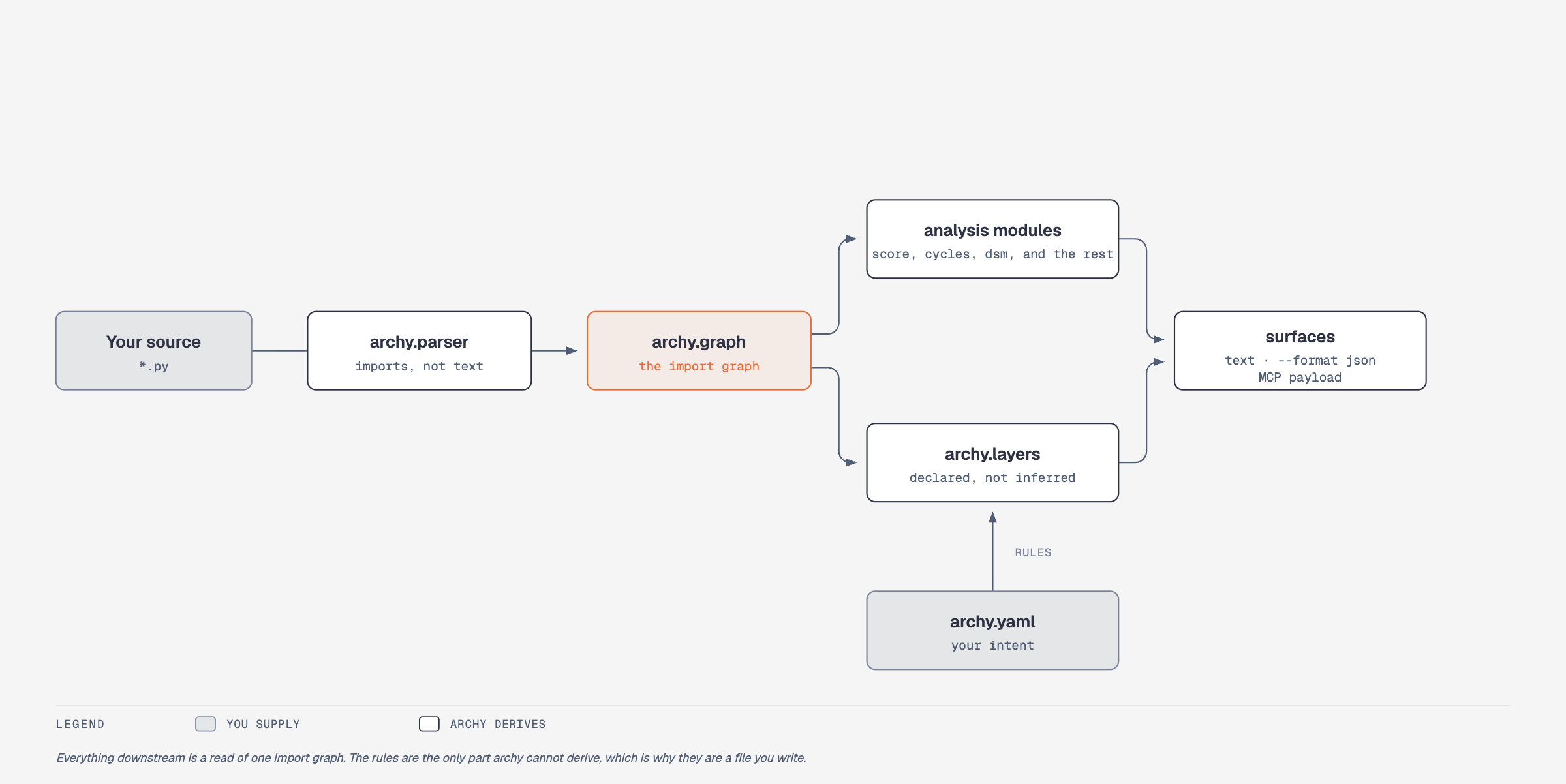
What that buys you is placement: it runs in CI, in pre-commit, and as an MCP server (archy mcp), so a coding agent can read its own architectural impact before it commits rather than after review.
The agent-feedback framing is empirically supported by 2025-2026 research: the Navigation Paradox paper shows large LLM context windows do not eliminate the need for structural graph navigation, LocAgent's ablation finds graph edges materially improve code-localization accuracy, the Constraint Decay paper (arxiv:2605.06445) finds agents lose ~30 points in pass rate as architectural constraints accumulate (Clean Architecture layering alone costs -9.1 points, on the open and mid-tier models tested) and that its ground-truth layer/dependency-direction verifier is essentially archy check, and the coding-agent failure-mode literature names the specific patterns (scope drift, cross-file reasoning failure) that an architectural feedback loop is built to catch. Citations, a failure-mode-to-archy-capability mapping, and the resulting roadmap priorities are in docs/research/RESEARCH_METRICS.md §14c.
The underlying mechanism
Beneath the empirical case is a structural one. Anthony Hobday, writing about software quality, names it precisely: "as the number of things goes up, the number of relationships goes up even faster. Eventually it's impossible for people to properly consider all of those relationships." Coherence is the state where those relationships still hold together; entropy is its steady loss as a system grows. A single author keeps a codebase coherent by remembering every edge. An agent generating code at machine speed cannot, and neither can a team past a certain size.
That relationship load is exactly what archy reads. Coupling, the DSM, import cycles, and change-coupling are all measures of how far the graph has drifted from "one person can hold it in their head." archy externalizes that memory into a number and a trend, so the growth in relationships stays visible instead of being discovered during a refactor that blows up.
Scope
- Python only. The cross-language story belongs to sentrux; that division is settled. archy goes deep on Python (transitive contracts, SDP, NCCD,
if TYPE_CHECKING:semantics) rather than broad across languages; seedocs/LEARNINGS.md§"Competitive landscape". - Tree-sitter powered. Robust to in-flight edits and partial files; survives syntax errors that would crash
ast. - Score that trends over time. A single number per commit, persisted, plotted. Trend matters more than the absolute value.
- Rules as YAML. "Layer X cannot import Y." No DSL, no plugins (yet).
Non-goals
- Multi-language analysis
- Replacing linters, type checkers, or test runners
- Generating code or auto-fixing violations
Quick start
Covered above in Start in one command; this section is the detail behind it.
Requires Python 3.10+ (archy depends on mcp>=1.28.1 which is 3.10-only). If you only have system Python 3.9 or older, install a newer Python first or use uv, which manages versions for you and is what uvx comes from.
pip install archy
# or: uv tool install archy
# or: pipx install archy
# or nothing at all: prefix any command with `uvx`, e.g. `uvx archy score .`
Using archy as an MCP server inside an AI coding agent? Skip the manual config and run uvx archy install, which wires it into Claude Code, Cursor, Codex, opencode, or Continue automatically and writes a config that invokes uvx archy mcp, so archy never needs to be on your PATH. See docs/INSTALL.md.
All examples below use the installed archy command. If you're working from a checkout, prefix them with uv run (e.g. uv run archy graph .).
See docs/SIXTY_SECOND_TOUR.md for the copy-paste path from zero to first score.
Inspect the graph
archy graph path/to/project --internal-only
archy graph path/to/project --format json > graph.json
archy graph path/to/project --format dot | dot -Tsvg > graph.svg
Find import cycles
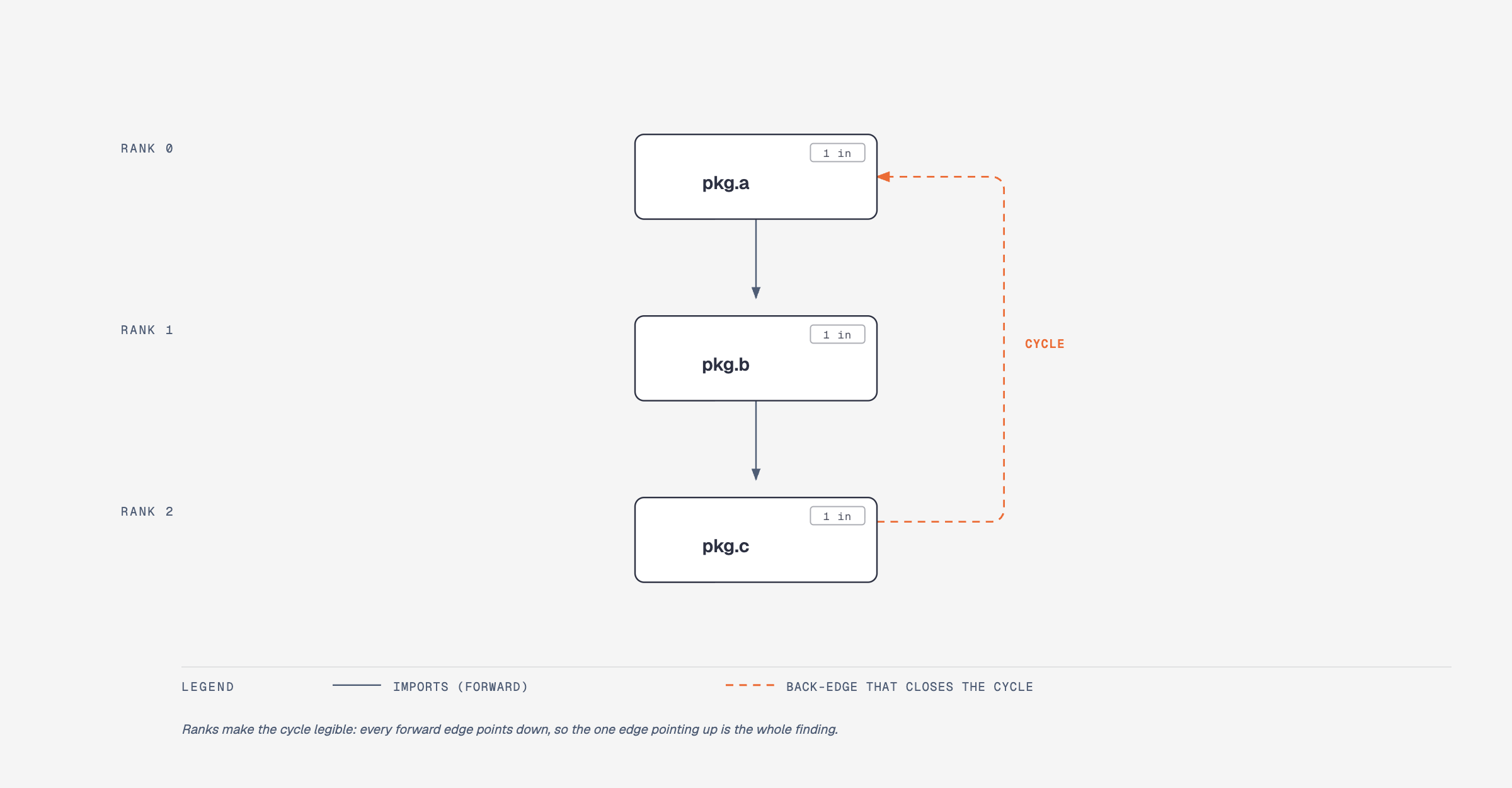
Ranking the modules is what makes a cycle visible: every ordinary import points down a rank, so the one edge pointing back up is the entire finding.
Tarjan SCCs of size >= 2, plus self-loops (a module importing itself). Use --strict in CI to fail on any cycle.
archy cycles path/to/project
archy cycles path/to/project --format json
archy cycles path/to/project --strict
Enforce layer rules
Reads archy.yaml from the repo root. Exits 1 on any violation. See Layer rules below.
archy check path/to/project
archy check path/to/project --format json
archy check path/to/project --config custom.yaml
Transitive contracts (archy contracts)
archy check only sees direct edges. archy contracts wraps import-linter so the same layer story is enforced transitively (A → B → C still counts as A reaching C). It is the strictness upgrade for projects whose layers leak through indirect paths.
pip install 'archy[contracts]'
archy contracts path/to/project
archy contracts path/to/project --format json
archy check --contracts runs this same transitive verdict inline, nested under the check output. It never changes check's own exit code: a flag that can turn a passing check into a failing one because an optional dependency is absent would be unsafe to leave on in CI. Use the standalone archy contracts when the transitive result should itself gate the build.
A kept contract is not automatically protection. A contract whose module expressions match nothing in the graph holds no matter what the code does, so all_kept calls it kept while nothing was ever checked. archy contracts exits non-zero on verified (evaluated and held), not on all_kept, and archy check --contracts reports transitive_checked: false for the same reason: a rule that could not have failed was not evaluated. The text output marks such a contract ?? rather than OK and names the expressions that matched no module; --format json adds top-level verified and unverifiable alongside kept/broken, and per-contract matched_nothing and unmatched_expressions. A .importlinter type = layers contract needs no such flag: import-linter itself refuses to run when a required layer's module is absent, which archy reports as a config error, and an optional layer (written (name)) is absent by design.
Config resolution. archy contracts reads, in order:
- The
--configargument if passed. .importlinterin the project root: the canonical contracts config.archy.yaml: best-effort fallback. Eachforbid:rule becomes one Forbidden contract checked transitively. Emits aUserWarningbecause this path cannot expressignore_imports, so any legitimate transitive edge (e.g., a service layer reachingpsycopgthrough a sanctionedapp.libs.db.*module) will be reported as a violation with no way to whitelist it.
Two configs, one concern each:
archy.yamlowns layer definitions, direct-edge gating (archy check), required-reach rules (required:),sdp:,exclude:, androots:..importlinterowns transitive contracts: all five contract types (Forbidden, Layers, Independence, Protected, AcyclicSiblings) andignore_importswhitelists.
Reach for .importlinter as soon as you need transitive enforcement at all; the archy.yaml fallback is a zero-config onramp, not a feature target. See .importlinter in this repo for a real-world example, and the import-linter contract types reference for the full grammar.
Common case: forbid services from reaching psycopg but allow the sanctioned db library to do so:
[importlinter]
root_package = app

[importlinter:contract:services-must-not-reach-psycopg]
name = services must not reach psycopg
type = forbidden
source_modules =
    app.services
forbidden_modules =
    psycopg
ignore_imports =
    app.libs.db.engine -> psycopg
Compute a quality score
Composite of modularity, acyclicity, depth, equality, and complexity (geometric mean of five axes). See docs/SCORING.md for formulas and how to interpret the breakdown. These five axes were chosen after surveying ~15 alternatives from the package-metrics literature (Martin's I/A/D, Lakos's NCCD, MacCormack propagation cost, Structure101 fat/tangle, reflexion models, cognitive complexity, hotspots, logical coupling, dead/duplicate-code detection); Martin's I and the Stable Dependencies Principle check are also shipped as a per-module diagnostic and an archy check rule. See docs/research/RESEARCH_METRICS.md for the full validation, what was shipped, and what was deferred and why.
archy score path/to/project
archy score path/to/project --format json
Track score over time
Persist per-commit scores to .archy/history.jsonl and chart the trend.
archy score path/to/project --record
archy trend path/to/project
archy trend path/to/project --last 30 --format json
Regression gate
Fail if the current score drops more than --strict-tolerance (default 0.02) below the most recent recorded run.
archy score path/to/project --strict
archy score path/to/project --strict --record           # check then record
archy score path/to/project --strict --strict-tolerance 0.0
Blast radius
List internal modules that transitively depend on a given file. Useful before refactoring or removing a module.
archy impact path/to/project --file app/libs/db.py
archy impact path/to/project --file app/libs/db.py --file app/services/auth.py --format json
Affected tests (CI gating)
archy affected is the CI-shaped cousin of archy impact: given changed files, it returns the impacted modules pre-classified into tests and other downstream code, with a depth cap (default 5 hops) so a one-line edit doesn't fan out to thousands of nodes on a monorepo. Pipes naturally from git diff:
git diff --name-only HEAD | archy affected . --stdin
git diff --name-only HEAD | archy affected . --stdin --quiet | xargs pytest
archy affected . src/foo.py --filter "tests/integration/**" --json
Test classification defaults to pytest conventions (test_*.py, *_test.py, anything under a tests/ directory); override with --filter <glob>. Internal modules only; vendored or third-party code is not traced.
Design Structure Matrix (archy dsm)
The DSM puts modules on both axes in a chosen ordering, and cell (row=source, col=target) is non-empty when source imports target. Reading positionally exposes properties any single scalar would hide: block-diagonal cohesion under community grouping, above-diagonal back-edges under topological ordering, off-block layer leakage under layer grouping. Visualization-only (docs/research/DSM_EMPIRICS.md for why no scalar joins the score).
archy dsm path/to/project --group community     # block-diagonal orientation
archy dsm path/to/project --group topological   # back-edges sit above diagonal
archy dsm path/to/project --group layer --weight calls   # cross-layer call traffic
archy dsm path/to/project --focus pkg.module --focus-depth 1   # focal neighborhood
archy dsm path/to/project --format json > .archy/dsm-before.json
# ... edit code ...
archy dsm path/to/project --group topological --diff .archy/dsm-before.json
# prints any new back-edges the edit introduced
archy dsm refuses ASCII rendering for projects larger than --max-nodes (default 80) with an actionable error pointing at --focus, --package, or --format json.
Static HTML export (archy render)
Every other archy surface targets the agent. archy render targets the human reviewing what the agent did: a single self-contained HTML file to attach to a PR, drop in docs, or open offline. No JavaScript, no CDN, no vendored bundle, no server, and byte-stable for a fixed input, so two exports diff cleanly.
archy render path/to/project --view dsm --out dsm.html     # the matrix, flagged cells in red
archy render path/to/project --view dsm --group topological --out cycles.html
archy render path/to/project --view trend --out trend.html # five axes over .archy/history.jsonl
archy render path/to/project --view dsm                    # HTML to stdout
What red means follows the ordering you asked for, because only one ordering encodes it: under --group=topological red is a back-edge (a cycle seed), and under --group=community or --group=layer, where block order is not a dependency order, red is an edge crossing a block boundary. The DSM view refuses matrices larger than --max-nodes (default 300) rather than writing an unreadable file.
There is no graph view. A node-link diagram is the one view that needs a vendored layout engine, and it is also the lowest-signal of the three; it stays deferred behind a usage signal (see docs/SPEC_VISUALIZATION.md).
Snapshot and diff (agent feedback loop)
Capture a baseline at the start of an editing session, then diff after edits to see exactly which cycles or layer rules changed. See docs/AGENT_LOOP.md for the full playbook (also available via the MCP server's loop prompt).
archy snapshot path/to/project   # writes .archy/baseline.json
# ... edit code ...
archy diff path/to/project       # risk-weighted summary + score deltas + added/resolved cycles & violations
Run as an MCP server
Stdio transport, so AI agents can call archy directly. See MCP server below.
archy mcp
MCP server (archy mcp)
The server is backed by a persistent parse cache (.archy/index.db): each tool call re-parses only the files whose content changed since the last call, so warm graph builds stay in the low seconds even on very large repos (benchmarked: 21.5s cold to 2.5s warm on Home Assistant's 17,299 modules). The cache is transparent and disposable; deleting .archy/index.db only costs one cold rebuild. The graph is always re-derived from the current files, so a cached result is never stale. archy index sync warms it explicitly; archy index clear removes it.
archy mcp exposes thirteen tools and one prompt to MCP-aware AI agents (Claude Code, the Anthropic API, etc.):
| Tool | Purpose |
|---|---|
archy_score | Compute the five-metric score (modularity, acyclicity, depth, equality, complexity, geometric mean); optional record=True and strict=True for the same regression-gate behaviour the CLI offers. Pass record=True to record a start-of-session baseline (replaces the removed archy_record_baseline). view="history" returns the recent score history from .archy/history.jsonl (up to last_n rows, oldest-first, for comparing deltas over time; replaces the removed archy_trend). |
archy_cycles | Find import cycles. |
archy_check | Run direct-edge layer rules from archy.yaml. Pass contracts=True to also run the transitive import-linter contracts (Layers, Forbidden, Independence, Protected, AcyclicSiblings; stricter than the direct edges), nested under the contracts field (replaces the removed archy_contracts; requires archy[contracts], and degrades to available=false with an advisory if the extra is absent). Contracts are skipped when no archy.yaml is found (you get a CheckErrorPayload first). Always returns coverage: how many modules and import edges the rules actually reach, so passed=true can be told apart from a config that governs almost nothing. transitive_checked says whether this run actually evaluated the forbid rules transitively; it is false when contracts were never requested, when they produced no verdict, and when any contract could not have failed, since none of the three evaluated the rules. transitive_unverified_reason then says which, naming archy_check(contracts=True) if it was never requested, the actual failure if it produced no verdict, and how many contracts matched nothing if that is what happened. So a clean pass is never silent about having seen direct edges only. min_layers_present: in archy.yaml also gates passed here, not just the CLI exit code. required_violations reports unsatisfied required: rules (module X must transitively reach Y, counting the implicit package-__init__ import), and gates passed too; fix by adding the missing import, not by deleting the rule. Within contracts, read verified, not all_kept: a contract whose module expressions match nothing in the graph is kept because it could not have failed, unverifiable counts those, and each one carries matched_nothing and unmatched_expressions naming the patterns that matched no module. |
archy_impact | Given changed file paths, return what they affect. mode="blast" (default) returns the modules that transitively import them (blast radius), plus chains: the shortest import path back to a changed module (with line numbers) explaining why each is impacted. mode="affected" (replaces the removed archy_affected) is the CI-shaped lookup instead: modules pre-classified into impacted_tests and impacted_modules, depth-capped (default 5 hops) so a single-line edit doesn't fan out to thousands of nodes; test_filter overrides pytest test detection with a recursive glob. co_change=true (blast mode, opt-in) adds a co_changed list: modules that historically co-change with the edit in git but have no import/call edge to it, so the structural blast radius misses them (archy coupling scoped to your edit; source-only, best-effort, the only path that reads git). |
archy_snapshot | Capture score, cycles, and violations to .archy/baseline.json. Call at session start. Also returns an invariant_brief (declared layers, forbidden edges, declared required: reach rules, acyclic invariant, baseline score, load-bearing modules) to read before the first edit. |
archy_diff | Compare current state against the snapshot; returns added/resolved cycles & violations, per-component score deltas, and a risk-weighted summary whose items carry a prompt reframing each delta as a judgment question ("new cycle a -> b; intended, or invert an edge?"). |
archy_simulate | Counterfactual pre-edit check: given a proposed import-edge delta (add/remove of {from, to} pairs), return the would-be cycles, back-edges, layer/SDP/required-reach violations, per-axis score delta, and blast-radius change, with no file written. Test a refactoring hypothesis before committing to it. |
archy_graph | Inspect the dependency graph. With no focus, response_format="summary" (default) returns the top-N overview by fan-in / fan-out / PageRank plus top external deps (replaces the removed archy_graph_summary; top_n controls N); response_format="full" returns the complete node/edge dump matching archy graph --format json, refusing graphs larger than max_nodes (default 500) with an explicit GraphTooLargePayload. Pass focus=[...] (replaces the removed archy_graph_focus) for a bounded subgraph around one or more modules (qualnames or file paths): depth caps hops, direction is in/out/both, each edge carries import line numbers, and response_format/max_nodes/top_n do not apply. |
archy_what_to_refactor_next | Ranked refactor-priority list (replaces the removed archy_hotspots and archy_high_risk_modules via lens). lens="fused" (default) sums the behavioral lens (CC x churn) and the structural lens (edit-risk: central+fragile) into a priority, so a module flagged by both generally outranks a comparable single-lens one (a dominant single-lens signal can still rank first). lens="behavioral" ranks CC x churn hotspots only (needs git); lens="structural" ranks the edit-risk composite only (git-free; pass min_risk=0 for no floor). Each entry names which lenses fired and carries a one-line rationale. An empty list plus a note is a real answer. |
archy_dsm | Design Structure Matrix view of the import graph. response_format="summary" (default) returns a compact overview (block structure, counts, back-edges, cross-block coupling) without the full cell list. response_format="full" returns the positional matrix (cell (row=source, col=target) non-empty when source imports target), refusing matrices over DEFAULT_MAX_DSM_CELLS cells with a DSMTooLargePayload. group_by controls row/col ordering (community for block-diagonal cohesion, layer for layer-violation forensics, topological to localize back-edges). weight is imports or calls. Narrow large projects with focus=<qualname> + focus_depth or package=<prefix>. When baseline_path is provided, returns a structured diff (regardless of response_format) whose new_back_edges field flags cycles the edit just introduced. Visualization-only; see docs/research/DSM_EMPIRICS.md. |
archy_duplicates | Cluster functions with identical normalized body shape into two tiers: duplicates (likely-real, investigate) and variants (demoted likely-intentional clusters - same-class / boilerplate / test / vendored / independent, each with a variant_reason). co_change=true (default, needs git) adds the independent demotion: copies in actively-maintained files that never co-change (deliberately parallel implementations), the principled precision lever that lifts the primary tier above the ~50% syntactic ceiling (§12f). Within the primary tier, exact=true marks byte-identical (Type-1) clusters, the highest-confidence subset. near_miss=true (opt-in, slower) adds a lower-confidence near_miss tier: Type-3 (gapped) clones the exact shape-hash misses, found by token-multiset overlap (§12h). response_format="summary" (default) returns ranking fields + one sample member per cluster; "full" returns member lists. Advisory surfacer, not a score axis: refactorability is a semantic call (see docs/research/RESEARCH_METRICS.md §12c/§12f/§12h). min_nodes (default 30) skips trivial stubs. |
archy_conventions | Report the project's own house style, derived from its source: naming (class-name suffix families grouped by home module, so the module you are about to edit shows its own patterns), surfaces (mirrored helper sets like _x_to_text/_x_to_json, plus names defined in several modules - the "wire all of these together" list), gates (sites where a failed finding exits non-zero, each with its literal exit code and controlling lever: flag:--strict, config:<attr>, param:<name>, hardcoded), errors (the separate user-error exits - bad config, missing file - kept apart so the gate count stays meaningful), models (base-class / frozen / tuple-vs-list census), bases (kind families grouped by what they derive from transitively, counting only bases the project defines, with suffix agreement reported so a family whose name is not the rule says so), registries (NAME = Ctor(...) families and the distribution of every keyword passed - how a project declares codes or flags when it does not use classes), export_gaps (members absent from an __all__, or from a from .x import Y as Y block, that already lists their siblings) and doc_gaps (members the project's own .rst/.md surface does not name). Call before adding a class, field, or command to a project you do not know. Advisory: never fails, mutates nothing. min_family (default 2) raises the reporting floor; include_tests censuses test modules too (default false, because test fixtures dilute a real family). |
archy_module_view | Everything known about ONE module, complete and unranked - the lookup counterpart to archy_conventions's ranked report. Because the report truncates, a module's absence from it means nothing; every list here is complete for the module named, so absence is the answer to "does risk import hotspots" or "does anything still reach layers". Returns imports_internal (relative imports resolved), imported_by (counting test importers even when tests are otherwise set aside, because a module imported only by tests is imported), classes, functions, exports (null when the module declares no __all__ and no explicit re-exports - different from an empty one), suffix_families, gates, and status, which says whether the module was censused or set aside and why, so an empty view is never mistaken for "nothing to report". An unknown module name raises rather than returning an empty view. Advisory: never mutates. |
The server also exposes a loop prompt with the agent feedback-loop playbook (snapshot at start, impact before edit, diff after edit). Discoverable via the standard MCP prompts/list call. See docs/AGENT_LOOP.md for the human-readable version.
The archy mcp server still keeps a debounced filesystem watcher warming .archy/index.db so graph builds stay fast, and every tool syncs on demand so a result is never stale. The index-freshness readout that used to be the archy_status MCP tool is now the CLI archy index status (#267): freshness is diagnostic plumbing an agent rarely needs mid-task, not a per-edit decision.
Tool output contract (structured output)
Every tool declares an outputSchema (JSON Schema, derived from its return model) in tools/list, and every tools/call returns both a structuredContent object (validated against that schema) and a text block with the same JSON, per the 2025-06-18 MCP structured-output spec. All tools are also annotated readOnlyHint: true (closed-domain, idempotent, non-destructive), so trusted clients can auto-approve archy's calls instead of prompting on every read. Sequence returns (archy_cycles, archy_score(view="history")) and union returns (archy_diff, archy_graph, archy_dsm) are wrapped under a top-level result key since structuredContent must be a JSON object; for unions every branch (including the in-band *ErrorPayload shapes) is a conforming anyOf member.
Error model (recovery contract)
archy maps failures onto MCP's two error mechanisms with one convention, so an agent has a single recovery contract:
- Usage error →
isError: true(a raised exception): an invalid argument value (e.g.response_format="xml",last_n=0), a malformedarchy.yaml, or a project over the scan ceiling. The caller must fix the call or the environment. - Recoverable / advisory → in-band result (
isError: false): an expected precondition that isn't met but is recoverable, or a valid-but-degraded result. These are normal results the agent branches on. Either a union variant when there's no usable result (no baseline →DiffErrorPayload, output too large →*TooLargePayload, no config →CheckErrorPayload, no DSM snapshot →DSMErrorPayload), or an advisory field on an otherwise-valid payload (ContractsPayload.available=false,WhatToRefactorPayload.git_available/WhatToRefactorPayload.note). The marker for a "no usable result" variant: a payload with anerrorfield and no success data. - Protocol error (JSON-RPC): unknown tool or a missing/mistyped required argument, handled by the framework.
Wiring it into your agents
One command detects your installed clients (Claude Code, Cursor, Codex CLI, opencode, Continue) and wires each one up:
uvx archy install        # detect, confirm, register the MCP server in each client
uvx archy uninstall      # the exact inverse; --dry-run to preview
This registers the uvx archy mcp server, drops a short rules file so the agent knows when to call the tools, and (on Claude Code) seeds the permissions.allow allowlist. It does not install a binary or the Claude plugin. The full guide, including the per-client path matrix, the manual stanza for unknown clients, plugin-vs-installer guidance, and troubleshooting, is in docs/INSTALL.md.
The lowest-friction path specifically on Claude Code is the bundled plugin at plugins/claude/: /plugin marketplace add hslee16/archy then /plugin install archy@archy from inside Claude Code (or claude --plugin-dir /path/to/archy/plugins/claude from a checkout). See docs/INSTALL.md for when to prefer it over the installer.
Regression-gate semantics
--strict reads the last row from .archy/history.jsonl and compares the current score against it. Drops beyond the tolerance fail with exit code 1. The default tolerance (0.02) matches the threshold sentrux's gate uses. This gives archy parity with sentrux's regression-gate use case while keeping the long-term JSONL history for archy trend.
CI integration
GitHub Action
archy ships a composite action you can drop into any workflow:
- uses: hslee16/archy@v0.46.2
  with:
    command: score      # score | check | cycles
    path: .
    strict: "true"      # fail on regression (score) or any cycle (cycles)
Inputs (all optional unless noted):
| Input | Default | Notes |
|---|---|---|
command | score | score, check, or cycles |
path | . | Project root to analyze |
strict | true | score/cycles: fail on regression / any cycle |
strict-tolerance | 0.02 | score --strict tolerance |
record | false | score: append result to .archy/history.jsonl |
config | (auto) | check: path to archy.yaml |
python-version | 3.10 | Python to install |
Pre-commit hook
Add to .pre-commit-config.yaml:
repos:
  - repo: https://github.com/hslee16/archy
    rev: v0.46.2
    hooks:
      - id: archy-check          # layer rules from archy.yaml
      - id: archy-score-strict   # regression gate against last recorded score
      - id: archy-cycles         # fail on any import cycle
archy-score-strict reads .archy/history.jsonl; commit a baseline first with archy score . --record.
Layer rules (archy check)
Drop an archy.yaml at the repo root declaring layers and forbidden directions:
layers:
  domain:
    modules:
      - "myapp.domain.**"
  application:
    modules:
      - "myapp.application.**"
  infra:
    modules:
      - "myapp.infra.**"
      - "myapp.adapters.**"

forbid:
  - {from: domain, to: application}
  - {from: domain, to: infra}
  - {from: application, to: infra}
Pattern syntax. Dotted-name globs: * matches one segment, ** matches zero or more. myapp.domain.** covers the package itself and every descendant. Modules must belong to at most one layer.
Required reach (required:). The inverse of forbid:. A forbid rule catches an edge that should not exist; a required rule catches one that should exist and does not, which forbidding cannot express:
required:
  - source: "app.commands.*"
    must_reach: app.core.database.model_registry
    reason: standalone entrypoints need the full mapper registry
Every module matching source must transitively reach must_reach, counting the implicit package-__init__ import Python guarantees (importing a.b.c runs a/b/__init__.py first). So one import in app/commands/__init__.py satisfies the rule for every command module, which is usually the correct fix -- a direct-import rule would report all of them as violations after that fix.
This came from a production incident: 34 command modules run standalone, each needing a SQLAlchemy model registry imported before first mapper configuration. 11 imported it, 21 crashed at runtime, and 2 passed only because they happened to reach it through unrelated imports. Those 2 are why the rule is defined over reach rather than imports.
reason is carried into every output surface, because "X does not reach Y" is a fact about the graph and not an explanation, and a rule nobody can justify gets deleted rather than satisfied. A rule whose patterns match nothing is reported as a violation, not passed over. Note pkg.** includes pkg/__init__.py itself; use pkg.* to scope the rule to submodules.
Be honest about what this does: archy cannot derive such a requirement (that is framework semantics, not graph structure). Someone has to know the constraint and write it down. What the rule then does is find every other module that violates it and stop the next edit from undoing the fix -- a ratchet, not a detector.
Excluding directories. Add an optional exclude: list of directory basenames to skip codegen output, vendored code, etc. Each name is matched anywhere in the project tree (same mechanism as the built-in skips for .venv, node_modules, __pycache__):
exclude:
  - baml_client
  - generated
exclude: applies to every analysis (graph, cycles, score, check) and the equivalent MCP tools.
Scan-size guard (max_modules:). archy refuses to start a scan of a tree with more modules than a ceiling, so a stray vendored, cache, or generated directory that the named exclude: skips do not cover cannot silently wedge a scan for minutes. The default (10,000) sits well above the largest real projects; a scan that trips it stops with a message pointing at exclude: / a narrower path. Override or disable it:
max_modules: 25000   # raise the ceiling for a genuinely large monorepo
# max_modules: 0     # disable the guard entirely
Namespace packages (roots:). archy discovers packages by walking __init__.py files. PEP 420 namespace packages (no __init__.py) are invisible by default. Declare them as roots so descendants get qualified names:
roots:
  - app           # `app/main.py` becomes `app.main`
  - src/service   # `src/service/db.py` becomes `service.db`
Without roots:, a project like app/libs/db.py (no app/__init__.py) is either skipped entirely or shows up as a top-level libs.db, which makes layer rules like app.libs.** match nothing.
Layer presence (min_layers_present:). Forbidding edges between layers says nothing about whether the layers exist. A codebase that collapsed four layers into one module satisfies every forbid rule by having no cross-layer edges at all, and passes silently. Set a floor to catch that:
min_layers_present: 3 # at least 3 of the declared layers must contain a module
Empty declared layers are reported either way, because every rule naming one is dead:
#   layers present: 2 of 4 declared; empty: repositories, models
#   FAIL: 2 layer(s) present, min_layers_present is 3
Unset by default, so existing configs keep their exit codes. The shape is taken from the Constraint Decay paper (arxiv:2605.06445), whose architecture verifier pairs a dependency-direction rule with exactly this presence floor ("at least 3 of the 4 canonical layers present as distinct directories"). bench/fixtures/conduit_clean/ reproduces its three cases.
It is a backstop, not the main event, and the measurement says so. Across 50 agent-generated backends, every single one produced all four layer directories: this check never fired once, while the direction check caught every failure. Keep it for the collapsed-into-one-module case it is named for, but if you are deciding where to spend effort in a config, spend it on forbid rules.
Discovery. archy check walks PATH upward to find archy.yaml unless --config is given. Exits 1 on violation.
Coverage. Every check reports how much of your code the rules actually reach, on a pass as well as a failure:
$ archy check .
# No layer violations (config: archy.yaml).
#   layer coverage: 9 of 42 modules (21%), 16 of 117 internal edges (14%); 33 module(s) match no layer (`archy check --show-unlayered`)
That line exists because a rule set that cannot fire is indistinguishable from a clean codebase: without it, a config governing 14% of your import edges prints the same "No layer violations" as one governing all of them. The edge percentage is the one to watch, since a config can put most modules in layers while ruling almost none of the edges between them. Coverage is scoped to the root packages your patterns name, so scripts and benchmarks sitting beside your package are counted separately rather than dragging the number down. --show-unlayered lists the modules no layer matches.
The numbers above are archy's own, and they are not flattering. They are printed here because the alternative is not knowing.
archy enforces its own architecture this way; see archy.yaml at the repo root and the archy check . step in .github/workflows/ci.yml.
Stability check (sdp:). Optionally enable Robert Martin's Stable Dependencies Principle: a module should not import one that is less stable than itself. Stability is I = Ce / (Ce + Ca) where Ce is outgoing internal imports and Ca is incoming, so I = 0 means "depended on, depends on nothing" (most stable) and I = 1 means "depends on lots, nothing depends on this" (least stable).
sdp:
  enabled: true
  tolerance: 0.0   # ignore violations within this I gap; default 0
  mode: error      # 'error' fails the gate (default); 'warn' reports but exits 0
When enabled, archy check flags every internal import edge whose target's I strictly exceeds the source's (plus tolerance). Per-module I is also surfaced in archy graph --format json whether or not sdp: is enabled, so you can audit before turning enforcement on.
Gradual adoption. Existing codebases will often have SDP violations on day one. Set mode: warn to report violations in the output (and archy_check's sdp_violations payload) without failing the gate, then flip to mode: error once the count is at zero. Layer-rule violations always fail the gate regardless of sdp.mode.
Development
uv sync                    # install runtime + dev deps from uv.lock
uv run ruff check          # lint
uv run ruff format         # format
uv run ty check            # type check
uv run pytest              # tests
One pytest case (test_pagerank_matches_networkx_when_available) compares archy's hand-rolled _pagerank against nx.pagerank, which needs numpy/scipy. The dependency is intentionally not in the default install (archy stays scientific-stack free); to run that test locally, sync the optional parity group:
uv sync --group parity     # pulls in numpy + scipy for the parity test
uv run pytest              # the test now runs instead of being skipped
Roadmap
This roadmap is closed. Nothing below is planned. See the status note at the top of this page; docs/ROADMAP.md and docs/FUTURE.md carry the same closure and the reasoning behind it.
Both phases of the index-and-install work shipped (Phase 1 install-DX in v0.25.0 / v0.26.0, Phase 2 persistent index + watcher in v0.27.0). What follows is kept as a record of what was considered and why, not as a plan. Several items rest on a premise that has since been retracted, so read docs/WHAT_DIDNT_WORK.md before picking one up. Anyone is welcome to.
Considered and never started:
- Per-module score breakdown so an agent can ask "did my edit make this module worse?" rather than "did the project overall regress?". Pairs with
archy_diff. - Opt-in agent hooks (
archy install --hooks): register a lifecycle hook in the agent client (ClaudeStop, CursorafterFileEdit, ...) that runs the archy gate automatically after edits, so the loop fires whether or not the agent remembers to call the tools. Spec:docs/SPEC_INSTALL_HOOKS.md. - Static fragility proxy (high-instability x high-fan-in) as a git-free hotspot stand-in. Advisory, not a score axis. (Duplicate-function detection has shipped as the
archy duplicatesCLI command: a two-tier surfacer with a primary "likely duplicate" list and a demoted "same-class / boilerplate variant" list. A literature review confirmed ~50% refactorability precision is the expected ceiling for any similarity-only detector, so the semantic call is left to the agent; change-history co-change is the precision layer, shipped asdemote_independent(#242) on the change-coupling machinery #131. Exposed on both the CLI (archy duplicates) and MCP (archy_duplicates, the 14th tool).)
Shipped:
Foundations
- Tree-sitter import graph;
__init__.pyre-export resolution; Tarjan cycle detection. - YAML layer rules (
archy check); composite score (archy score); JSONL history +archy trend. - MCP server (
archy mcp); GitHub Action + pre-commit hooks.
Agent loop
- Blast-radius:
archy impact. - Snapshot/diff:
archy snapshot/archy diff+ MCPloopprompt. - Import-linter contract wrap:
archy contracts,archy[contracts]. - Graph-navigation MCP tools:
archy_graph_focus,archy_graph_summary,archy_graph(design indocs/SPEC_GRAPH_MCP.md). - Per-module
edit_riskcomposite +archy_high_risk_modulesMCP tool: geometric mean of propagation cost, normalized fan-in, and instability; surfaced on every graph payload. - v0.24, risk-weighted
archy_diffsummary: additiveDiffSummary(headline,top_regressions,top_improvements) ranked byedit_riskso the loop-closer reads one sentence instead of re-ranking raw deltas. - v0.25,
archy affected: depth-capped reverse-impact walk mapping changed files to impacted modules and test files (git diff --name-only HEAD | archy affected . --stdin -q | xargs pytest); CLI +archy_affectedMCP tool. - v0.27, persistent index + file watcher: SQLite parse cache (
.archy/index.db) keyed by content hash (7-9x warm-path speedup, byte-identical to a cold build) plus awatchdogobserver that keeps the index warm insidearchy mcp; newarchy_statusMCP tool (17th) reportslast_synced_at. - v0.28, causal-framing reframes: archy's output now reads as causal claims and judgment prompts, not just structure.
archy_impactreturnschains(the shortest import path back to a changed module, with line numbers, explaining why each dependent is impacted);archy_snapshotreturns aninvariant_brief(declared layers, forbidden edges, the acyclic invariant, baseline score, and load-bearing modules) so an agent is told the constraints before its first edit; and eacharchy_diffsummary item carries apromptreframing the delta as a reviewer question ("new cycle a -> b; intended, or invert an edge?"). No new tool, axis, or graph; packaging over already-computed data (#152, #153, #154). - v0.29,
archy_simulate(18th tool): counterfactual pre-edit check. Given a proposed import-edge delta (add/removeof{from, to}pairs), it returns the would-be cycles, new back-edges, layer/SDP violations, per-axis score delta, and blast-radius change before any file is written, so an agent can test a refactoring hypothesis and reshape a plan that introduces a cycle before touching code. Mostly composition over the diff/DSM/propagation machinery; empirically validated (oracle 315/315 on real repos, 96% fidelity,SIMULATE_ORACLE_EMPIRICS.md, #156). - v0.30,
archy_what_to_refactor_next(19th tool): one ranked refactor-priority list fusing the behavioral lens (archy_hotspots, CC x churn) and the structural lens (archy_high_risk_modules, edit-risk). The two normalized lens scores are summed into apriority, so a module flagged by both generally outranks a comparable single-lens one, while a dominant single-lens signal (a giant hotspot at the import-graph leaves) can still rank first. Each entry names which lenses fired and carries a one-linerationale; one call replaces two-plus-synthesis. Pure aggregation over the two existing primitives. Honest null: an empty list plus anotewhen nothing is both complex+churned and nothing is central+fragile above themin_riskfloor, rather than manufacturing a phantom #1 (#130). - v0.36, MCP tool consolidation (#227): shrank the
archy mcpsurface from 19 tools to 13 by clean removal (no aliases), folding each removed tool into a survivor via a mode/lens/param switch:archy_impact(mode="affected")absorbs the oldarchy_affected;archy_graph(focus=...)andarchy_graph(response_format="summary")absorbarchy_graph_focusandarchy_graph_summary;archy_what_to_refactor_next(lens="behavioral"|"structural")absorbsarchy_hotspotsandarchy_high_risk_modules; andarchy_score(record=True)replacesarchy_record_baseline. A smaller, less-overlapping surface costs fewer always-in-context tokens and improves tool-selection accuracy. BC-breaking, so the plugin pin moved toarchy>=0.36,<1.0. The CLI is unchanged. Closes the #230 modernization tracker (#227). - v0.35, MCP surface modernization: brought the
archy mcptools up to current MCP best practice (2025-2026 spec) without changing the tool set (still 19, no plugin-pin bump). All tools now declarereadOnlyHint/titleannotations so trusted clients can auto-approve archy's read-only calls instead of prompting on every read (#225); every tool declares a structured-outputoutputSchemaand returns conformingstructuredContentalongside the text block (#228); the token-heavyarchy_dsmandarchy_graphare concise-by-default with aresponse_format="summary"|"full"enum and a truncation cap (DSM summary ~89% smaller than the full matrix) (#226); and a single three-tier error model gives agents one recovery contract (isError:truefor usage errors, in-band result variants for recoverable conditions like no-baseline / too-large / no-config) (#229). No new tool, axis, or graph; MCP-DX over the existing surface. Tracker #230. - v0.37, duplicate-function detection (#133/#242): a new CLI command
archy duplicatesand MCP toolarchy_duplicates(14th) that cluster functions with an identical normalized body shape (tree-sitter AST-shape hashing, folded into the existing complexity walk, no new parse). Output is a two-tier surfacer: a primary "likely duplicate" list and a demoted "same-class / boilerplate variant" list (a semantic de-noiser using same-class /@overload/ trivial signals), withexact=trueflagging byte-identical (Type-1) clusters as the highest-confidence subset. Advisory only, never a score axis. Deliberately framed as a surfacer, not a precision oracle: a 94-source literature review + a 12-repo false-positive validation established that ~50% refactorability precision (~63% on the exact tier, ~74% on non-test source) is the expected ceiling for any similarity-only detector, so the semantic call is left to the reader/agent. Change-history co-change (#131), path-scoping (#247), and a Type-3-tolerant primitive (#246) are the queued precision/recall follow-ups. Additive tool, so the plugin pin staysarchy>=0.36,<1.0. Empirics:RESEARCH_METRICS.md§12b-§12d. - v0.38, change coupling (#131): a new CLI command
archy couplingthat ranks module pairs which co-change in git history but have no import/call edge - behavioral (temporal) coupling the structural graph can't see (Tornhill / CodeScene lineage, reusing the `archy hot