Listed from the MCP registry; nobody on Odel publishes it.
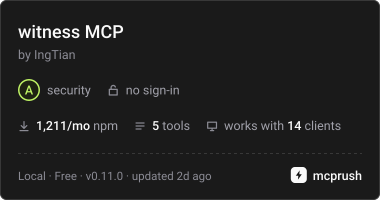
witness
Distills your sessions or any text corpus into a dated history of how its subject changed.
Runs on your machine from its package; the steps are below.
What it does
- Reads
- Writes
- High impact
At most: moves money, runs code or commands, deletes data, or sends messages for you.
What it costs
FreeOdel charges nothing per call. The publisher may charge for its own service.
Runs locally over stdio
This server isn't hosted — your MCP client launches it from a package registry. Use one of the commands below, or drop the config into your client (e.g. Claude Desktop).
Run
npx -y @witness-ai/opencode
MCP client config
{
  "mcpServers": {
    "witness": {
      "command": "npx",
      "args": [
        "-y",
        "@witness-ai/opencode"
      ]
    }
  }
}witness — a distillation engine that keeps the history of how things changed.





witness turns a stream of text into a dated record of how its subject changed. Feed it your AI coding sessions and it tracks how you think and work. Feed it market commentary, research notes, or any document stream and it tracks how that changed instead. One pure-Go binary, a local SQLite archive plus plain markdown, served to your agent over MCP.
The thing it is built around is change over time, with provenance. When an attribute's value changes, witness does not overwrite it — it closes the old value with a date and opens a new one, and records which source records drove the shift. So the archive answers "how did this get here", not just "what is true now".
"Aah, you were at my side, all along. My true mentor... My guiding moonlight..." — Ludwig, the Holy Blade
Two ways people use it
1. Watch your own growth as you work with AI. Install it into Claude Code, OpenCode or Codex and it captures your sessions in the background — no prompting, no ritual. It distills how your thinking, workstyle, habits, and blind spots shift over months, with evidence for every claim. This is the setup witness ships configured out of the box.
It is reflection-oriented, not clone-oriented: the point is to let your agent understand you, and to leave you a re-readable record of how you thought and grew. It is a pure tool, not a coach — it captures, structures, and serves. Building a coach on top ("you've done this three times…") is left to other projects that read its output.
2. Build a change-history over any text corpus. Write a lens — a prompt describing what to notice
and which dimensions to track — point witness ingest at NDJSON records, and the same four-stage
engine runs. Nothing about the machinery is person-specific: raw records → observations → dated
facets → narrative.
A worked example, run end to end while writing this section. A regime lens over market commentary,
in an archive with no person lens enabled at all: 7 news records became 22 observations and 13
facets. Then the regime flipped hawkish→dovish, and the archive recorded it as history rather than
replacing it:
inflation/core_trend
  "Disinflation has broken rather than paused: core CPI reaccelerating…"   valid_to 2026-06-…
  "Core is disinflating persistently rather than reaccelerating…"          (current)
Five facets closed and reopened that way in one review. The generated brief even flagged that its own earlier sequencing thesis had been falsified by the new data — which is the whole point of keeping the history instead of the latest snapshot.
At full size, examples/carney-market reads Canada's Prime Minister as a
market variable: 188 hand-curated articles → 392 observations → 52 facets, with the lens, the
unedited output, and the list of sources (examples/trump-market is its
pair, 200 → 558 → 83).
Honest caveat: the engine is general, but what witness runs by default is person-shaped — the
built-in default lens and the summary prompts say "notice things about the person". For a
non-person corpus you write your own lens (three files; start from
prompts/lens/corpus-example or one of the examples) and, if you want,
override the summary prompt with one file. Three built-in prompts no lens can override are still
written about a person: the facet claims the review reads, witness compact's merge judge, and the
portrait-source resolver.
Is this you?
witness is the answer if you've ever wanted to:
- Remember what you learned across your AI coding sessions — Claude Code, OpenCode, Codex — instead of losing it when the context window resets.
- Have a second brain / AI memory for your thinking, workstyle, and habits, queryable by your agent.
- Track how you grow as a developer over time — the traps you fall into and climb out of — with provenance for every recorded change.
- Keep a journal / retrospective of how you thought and changed, re-readable months later.
- Distill a corpus you care about — market news, a knowledge base, research notes, meeting logs — into a dated history of how its state changed, not a pile of summaries. Feed it NDJSON with
witness ingest. - Query any of the above from your agent, over MCP, instead of re-explaining context every session.
It will not tell you much on day one. witness measures change, so it needs weeks of material before there is anything to show — and it captures and tracks rather than advising or grading.
Contents: What it produces · Install · Connect your tools · Using it · Your data · How it works · Commands & config
What it produces
Say a session contains this exchange:
you: the migration keeps failing on prod but passes locally — I'll just run it by hand and move on
you: …wait, what's actually different about prod? let me diff the two schemas before I touch anything
It's captured verbatim, then mined into one evidence-anchored noticing:
[thinking] Caught the urge to hand-patch around a failure and redirected to isolating the
           prod/local difference before acting.
  evidence: "run it by hand and move on" → "what's different about prod? diff before I touch anything"
  poignancy: 6    lens: default
After several such moments, an evolving attribute — with its history kept:
default · thinking · diagnoses_before_acting                        confidence 0.82
  2026-05 → now       Catches the reflex to work around a failure and isolates the
                      mechanism first; gates action on understanding the cause.
  2026-02 → 2026-05   Tended to apply the first workaround that unblocked the task.   (superseded)
And the narrative you actually read (witness profile):
You've been converging on a diagnose-first way of working. A few months ago the pattern was to reach for whatever unblocked the task; now you routinely catch that urge and turn to isolating the mechanism before you touch anything…
Nothing is pushed into your sessions. You read it when you want it, or your agent pulls the relevant facet on demand.
Install
git clone https://github.com/IngTian/witness && cd witness
./install.sh claude      # or: opencode, codex
The target is required. The script builds the binary, fetches the embedding model (~448MB, once),
provisions the archive, and wires that tool. Idempotent — safe to re-run after a git pull.
Wiring more than one is just running it again: ./install.sh codex after ./install.sh claude
adds Codex to the same archive.
Or grab a binary from releases. Windows users want
the self-contained .zip — see Windows install.
OpenCode users can install from npm instead: npm i -g @witness-ai/opencode — see
the npm package README.
Connect your tools
witness captures from four sources at once, into one archive and one set of lenses. Sessions are namespaced per source, so none can corrupt another's data.
| source | setup |
|---|---|
| Claude Code | witness wire claude |
| OpenCode | witness wire opencode |
| Codex | witness wire codex, then approve the hooks with /hooks inside Codex — see Codex capture |
| Files / documents | witness ingest --file records.ndjson — you convert your notes, articles or logs into NDJSON records first; witness owns the record format, not your data |
witness wire sets up capture only and never prompts, so it is safe in CI or from a hook.
(witness install is a different thing: it provisions a bare archive at a --path, for keeping
an independent archive per data source. It does not wire any editor.)
Then just work. Capture runs in the background — no prompting, no ritual. Check it any time with
witness doctor.
Using it
witness profile              # the narrative, across everything
witness profile math         # one lens
witness facets               # the structured attributes behind it
witness compact              # consolidate a grown-over profile (shows the plan, then asks)
witness doctor               # health check
Your agent reads the same archive over MCP — get_profile, get_facets, search_observations.
Everything is per-lens: a lens is a prompt pair plus config that decides what gets noticed and how it's synthesized. The default one tracks personal growth; write your own to track anything else. See How it works.
Your data is yours
- Local by default. One SQLite file plus markdown under your data dir (
witness doctorprints the path). No telemetry, no account, no cloud key. - Local embeddings. Multilingual (English and Chinese) embeddings run pure-Go on your machine.
- Distillation uses your own tooling — your existing Claude Code or OpenCode auth, whichever you bound. Nothing goes anywhere you haven't already chosen.
- Readable and deletable. Plain SQLite and plain markdown; delete the data dir and it's gone.
- Portable.
witness export --all <dir>snapshots the whole archive — the database, your config and your lenses. On a fresh machine, pointWITNESS_HOMEat that directory. On one that already has its own archive,witness merge <dir>brings yours in without replacing anything: it shows what would arrive, asks, backs the archive up first, and prints how to undo.
Where to look for things
| I want to… | go here |
|---|---|
| install it and connect my editor | Install · Connect your tools above |
| understand the four layers and what each produces | How it works |
| know why a confidence number changed on its own | Confidence, and why it moves |
| track something other than myself — notes, research, a market, a knowledge base | Writing a lens |
| see a full-size run on a non-person corpus | examples/carney-market · examples/trump-market |
| tune what gets noticed, or test a prompt before committing to it | Writing a lens → the loop |
| look up a command or a flag | Commands |
| change the model, cadence, or concurrency | Configuration |
| set up Codex capture | Codex capture |
| set up OpenCode, or install from npm | OpenCode support |
| install on Windows | Windows install |
| back up or move my archive | witness export --all <dir> |
| move to a machine that already has an archive, without replacing it | witness merge <dir> |
| shrink a profile that has grown unwieldy | witness compact |
| know where my data lives and how to delete it | Your data is yours above |
| contribute, or understand the invariants | AGENTS.md |
Single binary, no runtime
One self-contained Go binary — no Python, no external services, no vector DB. CGO_ENABLED=0, so
it cross-compiles cleanly and has no shared-library surprises.
License
MIT — see LICENSE.