Listed from the MCP registry; nobody on Odel publishes it.
Quipu
Local knowledge graph memory for agents. SHACL rules refuse bad facts; SPARQL and time travel.
Runs on your machine from its package; the steps are below.
What it does
- Reads
- Writes
- High impact
At most: creates or changes data: records, files, settings.
What it costs
FreeOdel charges nothing per call. The publisher may charge for its own service.
Runs locally over stdio
This server isn't hosted — your MCP client launches it from a package registry. Use one of the commands below, or drop the config into your client (e.g. Claude Desktop).
Run
docker run -i --rm ghcr.io/intigraph/quipu:0.19.5
MCP client config
{
  "mcpServers": {
    "quipu": {
      "command": "docker",
      "args": [
        "run",
        "-i",
        "--rm",
        "ghcr.io/intigraph/quipu:0.19.5"
      ]
    }
  }
}
Quipu
Governed knowledge your agents can read, reuse and share







Quipu is a governed, bitemporal knowledge store for AI agents and the people who run them. It keeps facts, decisions and work history in one graph, checks what is written against your rules, and can answer what was true at any earlier point. Use it from the command line, REST, MCP, Python or a Rust application.
It is also the central graph and base for many tools: see the stack. The full case is in Why Quipu.
What it does today
| Capability | What you get |
|---|---|
| A history of every fact | Facts are appended, never overwritten. Each one carries when it was true and when it was recorded, so you can query the graph as it stood at any transaction. The temporal model |
| Standard graph data and queries | RDF data, SPARQL 1.1 queries, stored queries and typed query builders. SPARQL from zero, conformance results |
| Governed writes | SHACL shapes and policies are checked at the write gate. A write that breaks your vocabulary is refused with a reason. Governance |
| Provenance on ingestion | Episodes record a batch of entities and relationships together with their source, and entity resolution matches new mentions to the nodes you already have. Episode ingestion |
| Named graphs with trust labels | Separate bodies of knowledge, composed into overlays and datasets, labelled by trust and frozen when they must not change. Named graphs |
| Reasoning | An OWL layer and a rule engine that says when an answer is unknown instead of guessing. The reasoner |
| Search | Keyword search with no model to download, semantic search once an embedding model is installed, and hybrid ranking over both. Embeddings and search |
| Verified sharing | Export a signed share, verify it in quarantine, then promote what you admit. Conflicts come back as decisions, not silent merges. Sharing and federation |
| A change stream | Committed changes are published in order, so other tools react to the graph without polling. Committed feed streams |
| Files from the graph | Render graph data into files such as agent instructions and configuration. Render |
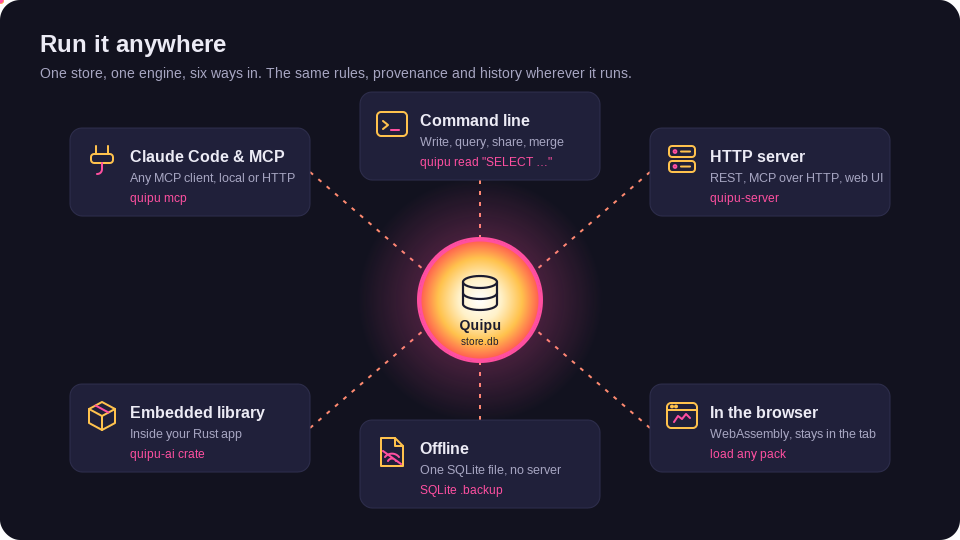
| Runs where you are | One store behind a CLI, an HTTP server with a graph explorer, an MCP server, a Rust library, a Python client and WebAssembly. It works offline. |
What is planned
Month-level targets, in order. The stack-wide plan is the Intigraph roadmap.
| When | Planned |
|---|---|
| Now (December 2026) | Faster reads: the slow tail of board-shaped queries, anti-joins and aggregates under one second. |
| A store per graph: each named graph gets its own store file and writer, composed into one read view. Design | |
| Fluents: frequently changing values kept as append-only observations with a derived current value, so they merge without conflict. Contract | |
| Next (January and February 2027) | Read standby: a follower of the change stream that takes reads if the primary stops. |
| Subscription filters: by class, predicate and subject, so a consumer hears only what it asked for. | |
| Local sync: a scoped copy that stays fresh from the stream, works offline and reports how stale it is. Design | |
| Search v2: keyword and semantic ranking with a configurable balance. | |
| Pendants that write files: a pendant, the cut of the graph handed to one job, declares the files an agent needs, and the client writes them with a receipt. | |
| Later (March to May 2027) | Merge-back: a signed changeset from a local copy, merged three-way, with a conflict returned as a decision for a person. |
| A data map: Quipu as the catalog of where data lives, with a read-only tool that joins those locations and keeps provenance. |
Install
curl -fsSL https://raw.githubusercontent.com/intigraph/quipu/main/install.sh | sh
Linux and macOS, x86_64 and arm64; requires Python 3.9+ and curl.
The installer verifies the published archive checksum and executable version.
Then run quipu --version. Install, upgrade or remove Quipu.
For the whole stack, use Tambo's guided onboarding.
First success: insert a fact, watch the graph change
Write one fact in plain Turtle, knot it into a local store, and ask for it back:
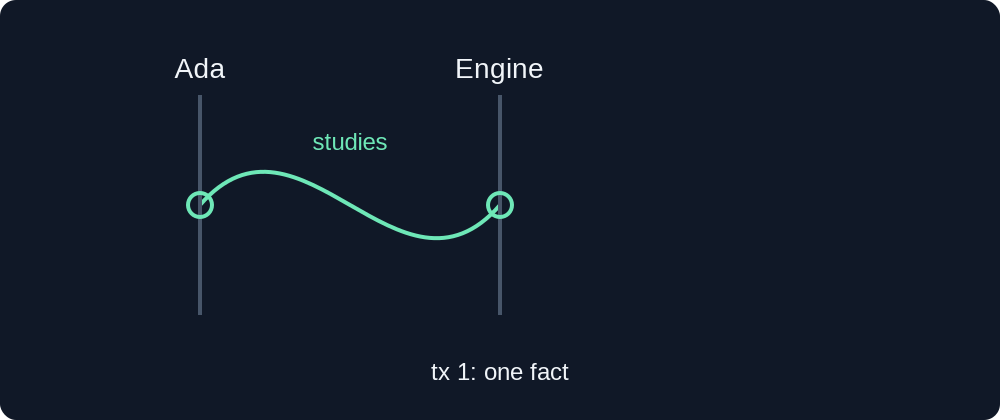
printf '@prefix : <urn:demo:> .\n:Ada :studies :Engine .\n' > ada.ttl
quipu knot ada.ttl --db demo.db
quipu read 'SELECT ?who ?what WHERE { ?who <urn:demo:studies> ?what }' --db demo.db
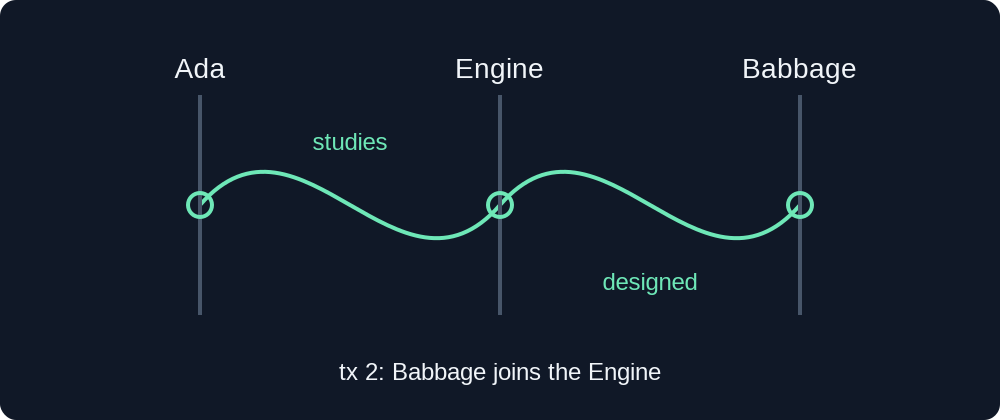
Add a second fact and the graph grows. The first version is still there to query:
printf '@prefix : <urn:demo:> .\n:Babbage :designed :Engine .\n' > babbage.ttl
quipu knot babbage.ttl --db demo.db
quipu read 'SELECT ?s ?p ?o WHERE { ?s ?p ?o }' --db demo.db
quipu read 'SELECT ?s ?p ?o WHERE { ?s ?p ?o }' --tx 1 --db demo.db
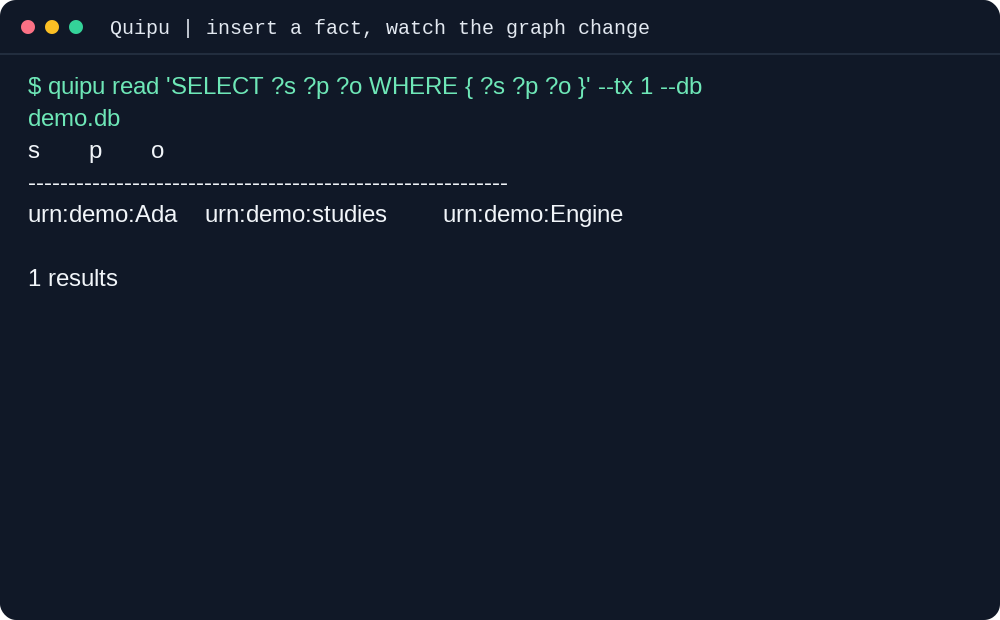
| After the first fact | After the second fact |
|---|---|
 |  |
Transcript, tool version and reproducible capture.
On your own code
Keep project facts, decisions and relationships together instead of pasting the same context into each agent.
| You want to | Start here |
|---|---|
| Load facts and apply your vocabulary | Quick Start |
| Ask about current or historical knowledge | SPARQL and time |
| Share a governed knowledge bundle | Verified sharing |
| Prepare domain knowledge and shapes | Camayoc |
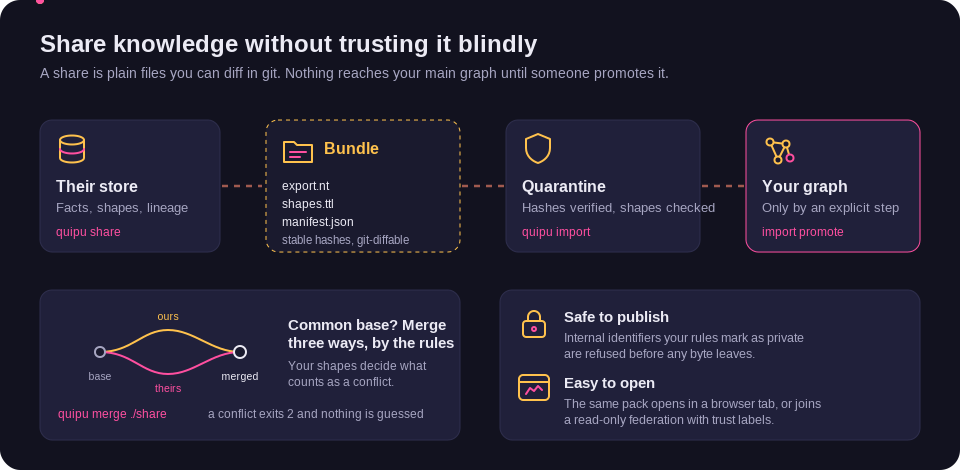
The latest release includes a repository pendant,
checksum and provenance. Verify them together, then use quipu import SHARE_DIR --db repository.db;
import stages knowledge and leaves ROOT unchanged. Follow the verified import workflow.
Wire it into your agent
For Claude Code, connect the local MCP server to your database:
claude mcp add quipu -- quipu mcp --db /path/to/knowledge.db
The MCP Registry identifier is mcp-name: io.github.intigraph/quipu.
Other clients, HTTP MCP and credential configuration: Agent Setup.
Use Tambo to configure and verify the tools together.
Before you start
- The CLI runs locally;
quipu-serversupplies the network API and explorer. - Fresh stores support keyword search without downloading a model.
quipu search "your terms"uses keyword search until an embedding provider is configured; explicit--mode semanticstill requires a model and vectors. Install the pinned default model withquipu model install --db graph.dbin a full build. This also prepares up to 1,024 existing ROOT subjects in bounded batches; larger stores receive a resume cursor. Check readiness withquipu doctor search --db graph.db. - Configuration covers storage and server settings.
What's next
- The Quipu book: tutorials, concepts and references.
- Quick Start: governed local examples.
- Domain shapes: producer-owned vocabulary.
- Intigraph roadmap: what is planned across the stack.
- Stack README format.
🧺 The stack
Tambo installs these together and proves each one works; every tool also stands alone. Use each tool's README for its own installation and first success.
The Quipu stack is built around a governed, bitemporal knowledge store: shared facts, decisions and work history your agents can query. Quipu can check writes against your rules, records where each fact came from, and answers what was true when.
| tool | what it gives your agents |
|---|---|
| tambo | 🧰 Agent Platform Toolkit - installs and configures the quipu stack |
| quipu | stores shared facts with provenance and history; can check writes against your rules |
| camayoc | prepares knowledge and vocabulary for Quipu, with checks before it is admitted |
| quechua | shared vocabulary and shapes for interoperable knowledge |
| chaski | reacts to graph changes and delivers governed notifications |
| bobbin | indexes your codebase and injects context from that index and Quipu knowledge |
| yupana | shows code impact and can read policies from Quipu to govern agent actions |
| desire-path | turns agent mistakes into feature requests; works on its own without Quipu |
| seeds | a work item tracker backed by the Quipu knowledge base |
| shantytown | runs crews of AI agents on work items, triggered by hand, on a schedule or by events; can share work and memory through Quipu |
| rikuy | live brief: status, graphs, watches and signed decisions over Quipu |
| shuttle | runs signed agent workflows and keeps their records in Quipu |
Contributing
See CONTRIBUTING.md. The repository's checks are:
just check
just docs check






