Listed from the MCP registry; nobody on Odel publishes it.

Engram
Durable memory for AI agents: fact extraction, hybrid retrieval, temporal graph. SQLite/Postgres.
Runs on your machine from its package; the steps are below.
What it does
- Reads
- Writes
- High impact
At most: moves money, runs code or commands, deletes data, or sends messages for you.
What it costs
FreeOdel charges nothing per call. The publisher may charge for its own service.
Runs locally over stdio
This server isn't hosted — your MCP client launches it from a package registry. Use one of the commands below, or drop the config into your client (e.g. Claude Desktop).
Run
docker run -i --rm ghcr.io/jamjet-labs/engram-server:0.5.0
MCP client config
{
  "mcpServers": {
    "engram": {
      "command": "docker",
      "args": [
        "run",
        "-i",
        "--rm",
        "ghcr.io/jamjet-labs/engram-server:0.5.0"
      ]
    }
  }
}⚡ JamJet
The action-control plane for AI agents. One policy file. One audit trail. Across hooks, guardrails, MCP gateways, SDKs, and custom runtimes.






jamjet.dev · Quickstart · Docs · Examples · Blog · Discord


Write the safety policy once. Run it everywhere your agents can act.
JamJet sits underneath your agent (Claude Code, OpenAI Agents SDK, MCP clients, LangChain, CrewAI, ADK, Spring AI, custom code) and enforces what prompts cannot:
- 🛡️ Block unsafe tool calls at runtime: database deletes, payments, file writes
- ✋ Pause for human approval on risky actions, durably
- 💸 Cap cost per agent, per run, per project
- 📒 Record an audit trail of every decision, with approvals signed and hash-chained
- ⏪ Replay or resume crashed runs from the last checkpoint
Keep your agent framework. Add JamJet where tool calls need control.
See it in 60 seconds
pip install jamjet
jamjet demo unsafe-tool-call
No API key. No Docker. No cloud account. The model is mocked; the policy check is the SDK's own evaluator. The demos run in process and do not start the runtime. Three more demos run the same way:
jamjet demo approval        # pause-for-approval flow
jamjet demo budget-cap      # $0.05 cost cap
jamjet demo mcp-tool-policy # policy on an MCP-shaped request (no MCP server involved)
Run an agent with no API key
Set model="scripted/<path to a YAML file>" and each model call is answered from
the file. Only the model is scripted. Policy, approval, budget and durability are
the real ones.
# scripts/book.yaml: turn N answers the agent's Nth model call
turns:
  - tool_calls:
      - name: search_venues
        arguments: {city: Lisbon, date: "2026-12-11"}
  - tool_calls:
      - name: check_dates
        arguments: {venue: Casa do Rio}
  - tool_calls:
      - name: pay_deposit
        arguments: {venue: Casa do Rio, amount: 500}
  - content: "Booked Casa do Rio in Lisbon for 11 December. The 500 deposit is paid."
# book.py
import asyncio
from jamjet import Agent
from venue_tools import search_venues, check_dates, pay_deposit  # plain `def` functions under @tool

agent = Agent(
    "venue-booker",
    model="scripted/scripts/book.yaml",
    tools=[search_venues, check_dates, pay_deposit],
    instructions="You book event venues. Use the tools.",
    strategy="react",
    policy={"require_approval_for": ["pay_deposit"], "blocked_tools": ["cancel_*"]},
)

result = asyncio.run(agent.run_durable("Book a venue in Lisbon for 2026-12-11."))
print(result.output, result.execution_id)
A relative script path is resolved from the working directory of the process that
reads it. Run jamjet dev from your project folder, or give an absolute path.
Run jamjet dev --modules venue_tools in one terminal and python book.py in
another. The run waits at pay_deposit. Then:
jamjet executions                    # every run
jamjet approvals                     # every run waiting for approval
jamjet approve <id> -d approved --as <name>
jamjet audit <id>
On a real run, jamjet audit ended with:
pay_deposit ran 1 time, approved by tester at 03:09:24
The full walkthrough, with the output of each command, is in the
Python guide. Python 3.11 or newer.
pip install jamjet is enough for in-process runs on the scripted model.
jamjet dev and durable runs need pip install 'jamjet[sidecar]'.
Real providers need jamjet[model] as well.
Watch it built
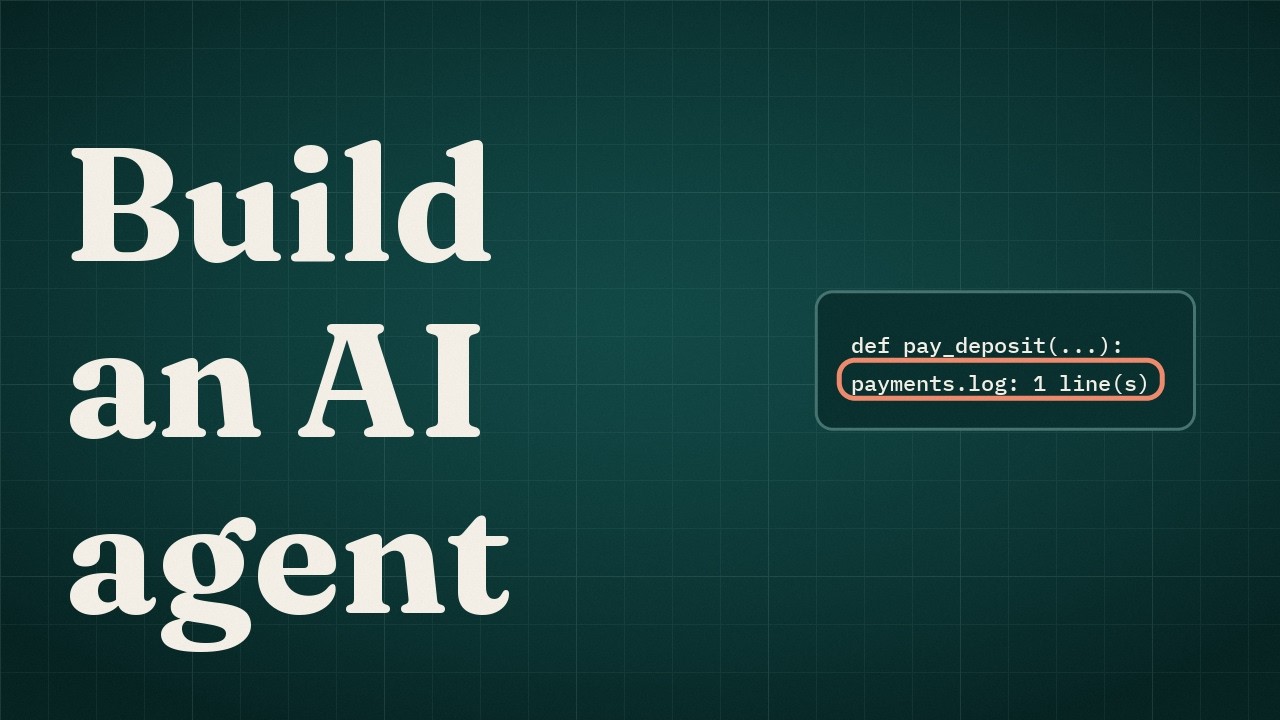
Build Your First AI Agent with JamJet is part 1 of the code-along, seven minutes long. It builds this venue-booking agent from an empty folder: an agent with instructions, two tools, then a pay_deposit tool that pays because the prompt said so. The code is in examples/venue-booking-agent, one folder per step. The later steps there add approval before the payment, a blocked tool, and an engine killed while the payment waits.
Works alongside Claude Code · OpenAI Agents SDK · MCP clients · LangChain · CrewAI · ADK · Spring AI · LangChain4j.
On the JVM
JamJet Java Runtime embeds durable execution directly in your JVM process: Java 21, no Docker, 8.9× faster than calling out to a REST sidecar (benchmark and launch post). Works with Spring AI, LangChain4j, and Google ADK.
→ See a Spring Boot agent survive kill -9 mid-run in examples/loan-underwriter-agent: resumes from disk checkpoints, gates disbursement on human approval, emits a signed receipt bundle.
To record Spring AI calls on this runtime over HTTP instead, see jamjet-spring. Its 0.1.0 release on Maven Central calls routes this runtime does not serve and records nothing.
The same policy, everywhere
Every agent toolchain is inventing its own safety layer. JamJet gives you one policy file and one audit trail across all of them.
| Adapter | Install | Host |
|---|---|---|
@jamjet/claude-code-hook | npm i -g @jamjet/claude-code-hook | Claude Code PreToolUse hook |
@jamjet/mcp-shim | npx -y @jamjet/mcp-shim ... | Any MCP client (Claude Desktop, Cursor, …) |
@jamjet/openai-guardrail | npm i @jamjet/openai-guardrail | OpenAI Agents SDK tool guardrail (TS) |
jamjet.integrations.openai_guardrail | pip install jamjet | OpenAI Agents SDK tool guardrail (Python) |
jamjet | pip install jamjet | Python SDK + runtime |
dev.jamjet:jamjet-spring-boot-starter | Maven / Gradle | Spring AI ChatClient advisors |
@jamjet/cloud | npm i @jamjet/cloud | TypeScript SDK + shared engine |
@jamjet/cli | npm i -g @jamjet/cli | Unified jamjet audit show / jamjet approve |
All adapters load the same policy.yaml. All emit conformant audit JSONL to ~/.jamjet/audit/. Run jamjet audit show to tail every decision across every adapter in one chronological view.
JamJet does not replace the hook points these platforms give you. It makes them do more: Claude Code's PreToolUse hook gets a real policy engine, approval flow, and audit trail, and the same rules carry unchanged to OpenAI Agents SDK, MCP clients, Spring AI, and your own Python or TypeScript code.
One policy, every adapter
# ~/.jamjet/policy.yaml
version: 1
rules:
  - { match: "*delete*", action: block }
  - { match: "payments.*", action: require_approval }
  - { match: "shell.exec", action: block }
Drop this file in ~/.jamjet/. Every adapter listed above uses it automatically.
Prompts are not a security boundary. The runtime is.
→ Read When AI Deletes the Database for why this is a runtime architecture problem, not a model problem.
Policy in your own code
Drop a policy beside your agent code. The runtime checks every step against it before a worker runs the step: a blocked_tools match fails the step, and a require_approval_for match holds it until a reviewer decides. For a Python step the patterns match its handler (module:function, or the same path with dots) and its node id. The request and the decision are stored, so a restart loses neither. Outside dev mode the person who started a run cannot approve it.
# workflow.yaml
policy:
  blocked_tools:
    - "*delete*"
    - "payments.refund"
  require_approval_for:
    - "database.*"
    - "payment.transfer"
    - "user.suspend"
Python, with the hosted control plane:
import jamjet
jamjet.cloud.configure(api_key="jj_...", project="my-agent")
jamjet.cloud.policy("block", "*delete*")
jamjet.cloud.policy("require_approval", "database.*")
# Gated in this process: sync OpenAI chat.completions create/parse/stream and
# Anthropic messages and beta.messages create/parse: *delete* tools are
# stripped, and a database.* tool call waits for approval. OpenAI's Responses
# API, Anthropic's messages.stream(), async clients, batch APIs and raw
# streamed responses are not enforced and refuse to run while a block or
# approval rule is set.
→ Runnable approval workflow in examples/hitl-approval · Cloud Quickstart
Where JamJet sits
            Your Agent / Framework
   (LangChain · CrewAI · ADK · custom · MCP client)
                     │
                     ▼
  ┌───────────────────────────────────────────────┐
  │            JamJet Safety Layer                │
  │   policy · approval · budget · audit · replay  │
  └───────────────────────────────────────────────┘
                     │
                     ▼
        Tools · MCP servers · APIs · DBs · Agents
Use JamJet when your agent can…
- call MCP servers or arbitrary tools
- write to a database
- send emails or Slack messages
- trigger payments or external API calls
- access customer data or PII
- run for minutes/hours and needs to survive crashes
- spend real model budget at scale
- delegate to other agents
What JamJet adds
| Without JamJet | With JamJet |
|---|---|
| Agent crashes lose progress | Resume from the last checkpoint |
| Tool calls rely on scattered app logic | Runtime policy blocks unsafe actions |
| Human approval is custom glue | Approval is a durable workflow step |
| Costs are discovered after the bill | Budgets enforced per agent / per run |
| Audit evidence is stitched from logs | Append-only event log per run; approvals sealed into a signed, hash-chained audit log |
| Memory is framework-specific | Pair with Engram for portable memory (MCP · REST · Python · Java) |
| Frameworks stay siloed | One policy file across hooks, MCP clients and SDKs; the runtime is also an MCP server (/mcp) |
A full runtime underneath
The safety layer runs on a durable, event-sourced execution engine. When you want more than enforcement, it's already there:
- Durable execution. Event log, snapshots and crash recovery: after a restart a run picks up where it stopped, and steps that already completed do not run again.
agent.run_durable(...)inexamples/react-agent-durable. - Sessions and memory. Persistent
Sessionthreads across runs and restarts, with a governed Engram retrieve/record loop.examples/session-memory. - Multi-agent.
Sequential,Parallel, coordinatorTeam, andLoop; each sub-agent runs as its own governed durable execution.examples/team-multi-agent. Declare whole fleets in YAML with cron schedules:examples/fleet. - Evaluation. Batch eval with LLM-judge scoring (
examples/eval-harness) and trajectory regression diffs (examples/trajectory-eval). - Deploy.
agent.deploy(runtime="local" | "self-host" | "cloud")ships the same compiled IR to any runtime.examples/deploy-an-agent. - Dev loop.
jamjet createscaffolds a project;jamjet devruns the whole local stack with one command. - Web Companion. A UI embedded in the runtime binary: graph view, timeline and state inspector.
Works with your stack, not a replacement
JamJet does not replace LangChain, LangGraph, CrewAI, Google ADK, Spring AI, or your custom agent code. Use those to build agent behavior. Use JamJet to control what happens at runtime.
| You're using | Keep it for | JamJet adds |
|---|---|---|
| LangChain · LangGraph · CrewAI · Google ADK · AutoGen | Authoring agent behavior | Runtime safety: policy, audit, replay, approvals |
| LangSmith · Arize · Weights & Biases | Observability and evaluation | Active enforcement (block at runtime) + durable recovery |
| Temporal · Orkes · DBOS | General durable workflows | Agent-native primitives: policy on tool calls, MCP/A2A, memory |
| Google · AWS · Azure agent platforms | Cloud-native ecosystems | Open-source, cloud-neutral governance that works on-prem |
Want to build the official integration for your framework? Claim a slot: 8 slots open, the first 10 merged contributors get JamJet swag.
Examples
| Example | What it shows |
|---|---|
01-block-unsafe-tool | A destructive tool call blocked before execution |
venue-booking-agent | The video code-along: one agent in nine steps, from a first tool to approval, a blocked tool and kill -9 |
hitl-approval | Human approval as a first-class workflow primitive |
react-agent-durable | A ReAct agent on the durable engine: event log, replay, park-on-429 |
team-multi-agent | Multi-agent Teams, each sub-agent its own governed run |
loan-underwriter-agent | Spring Boot agent that survives kill -9 and gates on human approval |
claims-processing | Insurance pipeline: 4 specialist agents + HITL + audit |
eval-harness | Batch evaluation with LLM judge scoring |
Engram
Engram is the JamJet ecosystem's memory layer for agents. Where JamJet provides durable execution (process can crash and resume), Engram provides durable memory (facts persist across runs and version cleanly via supersede()). Temporal knowledge graph, hybrid retrieval, conflict detection. Ships as a Rust crate, an MCP server (Docker · GHCR), a standalone Python library (github.com/jamjet-labs/engram, 71% on LongMemEval-S), a Python client for the MCP server, and a Spring AI ChatMemoryRepository. Comparison with Mem0/Zep → java-ai-memory.dev.
Architecture
Stack diagram
┌──────────────────────────────────────────────────────────┐
│                     Authoring Layer                      │
│    Python SDK  |  Java SDK  |  TypeScript SDK  |  YAML   │
├──────────────────────────────────────────────────────────┤
│                 Compilation / Validation                 │
│           Graph IR  |  Schema  |  Policy lint            │
├────────────────────────────┬─────────────────────────────┤
│      Rust Runtime Core     │      Protocol Layer         │
│  Scheduler  |  State SM    │  MCP server (/mcp)          │
│  Event log  |  Snapshots   │  Agent discovery            │
│  Workers    |  Timers      │                             │
├────────────────────────────┴─────────────────────────────┤
│                        Governance                        │
│    Policy  |  Approvals  |  RBAC  |  Signed audit log    │
├──────────────────────────────────────────────────────────┤
│                     Runtime Services                     │
│    Model adapters  |  Model sidecar  |  External workers │
├──────────────────────────────────────────────────────────┤
│                         Storage                          │
│             SQLite  |  In-memory (ephemeral)             │
└──────────────────────────────────────────────────────────┘
Documentation
Full docs at docs.jamjet.dev. The guides in docs/guides are versioned with the code:
Quickstart · Concepts · Python SDK · Java SDK · YAML Reference · Human-in-the-Loop · Security · Deployment · Observability · MCP · A2A · Eval · REST API · CLI
Contributing
Contributions welcome. See CONTRIBUTING.md.
Looking for a starter task?
- Build a framework integration: 8 slots open, first 10 contributors get JamJet swag
- Browse good first issues
- Join the conversation in Discord
Community
GitHub Discussions · Issues · Discord
License
Apache 2.0. See LICENSE.
Hosted control plane available at app.jamjet.dev: traces, approval queue, audit retention, team projects. Optional. The runtime, all SDKs, and Engram are Apache-2.0 with no usage limits.
⭐ Star JamJet if you believe agents need a runtime safety layer
Built by Sunil Prakash · © 2026 JamJet Labs · jamjet.dev · Apache 2.0







