Listed from the MCP registry; nobody on Odel publishes it.

Rqwstr
AI-native HTTP security testing MCP server — 17 tools with raw HTTP/1.1 + HTTP/2 control
Runs on your machine from its package; the steps are below.
What it does
- Reads
- Writes
- High impact
At most: moves money, runs code or commands, deletes data, or sends messages for you.
What it costs
FreeOdel charges nothing per call. The publisher may charge for its own service.
Runs locally over stdio
This server isn't hosted — your MCP client launches it from a package registry. Use one of the commands below, or drop the config into your client (e.g. Claude Desktop).
Distributed as an MCP bundle (`https://github.com/Kjopstad-IT/rqwstr-mcp/releases/download/v1.1.0/rqwstr_1.1.0_universal.mcpb`) — download it and import the bundle in your MCP client.
AI-native HTTP security testing toolkit, shipped as an MCP server. It gives an AI agent low-level control over HTTP/1.1 and HTTP/2 — raw framing, connection pinning, intruder-style fuzzing, request racing, OOB detection, and multi-step chains — on its own Go engine, rather than wrapping a high-level HTTP client.
rqwstr is free: every tool works right after install, with no account, key or sign-up.
This repository hosts the release binaries and Claude Desktop .mcpb bundles. The source is proprietary. Docs: rqwstr.com.
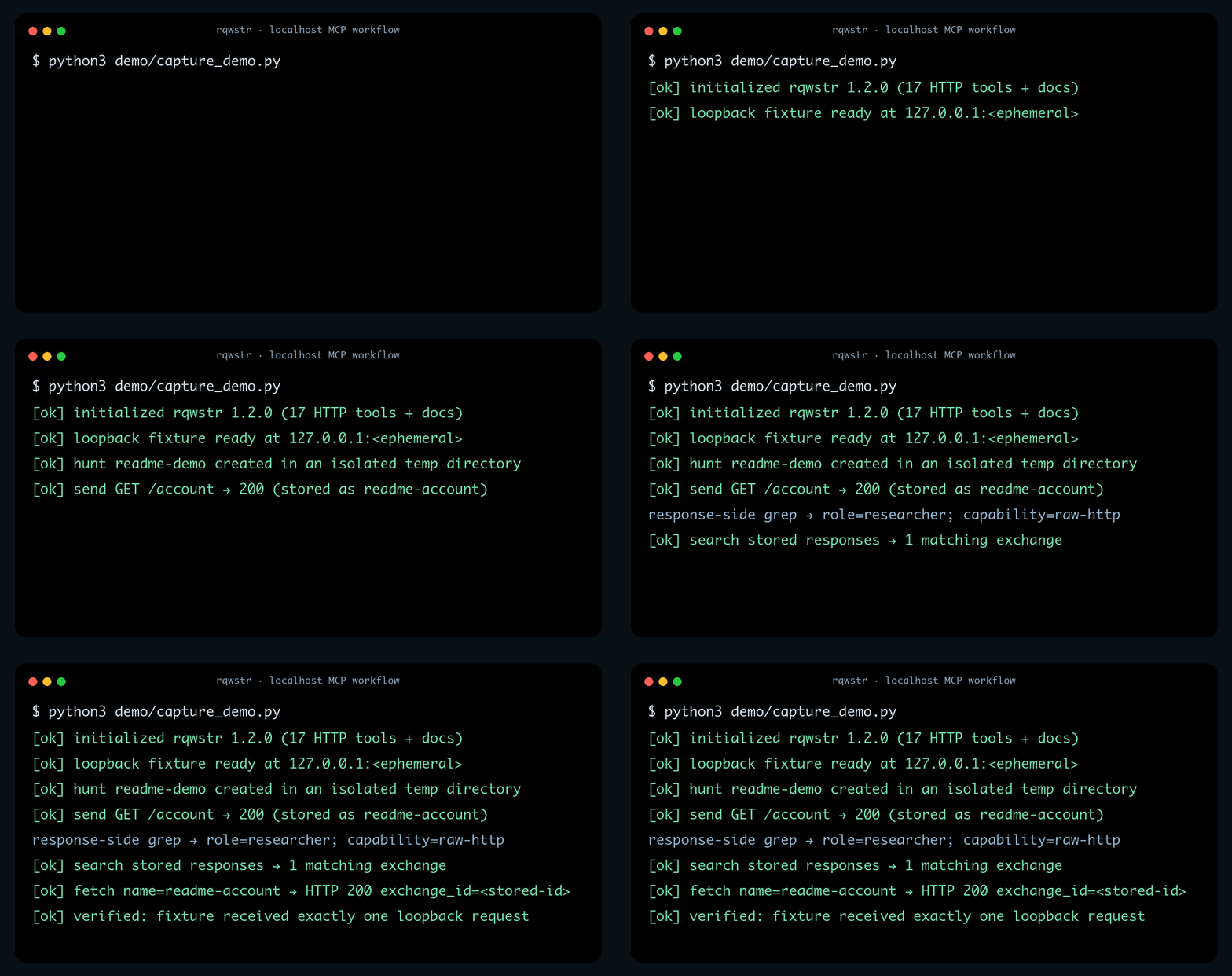
Real v1.2.0 MCP session against a synthetic loopback fixture: one request, response-side
filtering, stored search, and named retrieval. The capture and renderer are reproducible
from demo/ against v1.2.0; no live target is involved.
Install
Claude Desktop (one-click)
Download the .mcpb for your platform from the latest release and double-click it to add rqwstr as a Claude Desktop extension.
- macOS — Apple silicon (
darwin_arm64) or Intel (darwin_amd64) - Linux —
linux_amd64orlinux_arm64 - Windows —
windows_amd64
Standalone MCP server
Download the binary for your platform from the latest release, then point your MCP client at it:
{
  "mcpServers": {
    "rqwstr": {
      "command": "rqwstr",
      "args": ["serve"]
    }
  }
}
rqwstr serve runs the MCP server on stdio. Add a scope rule before sending (scope action=add type=include host_pattern=...); requests go direct unless you configure a proxy.
Tools
17 HTTP tools:
send · send_h2 · fetch · intruder · race · chain · oob · parallel ·
scope · session · encode · export · save · search · hunt · profile ·
import
Workflows
The HTTP tools cover:
- Traffic —
send(HTTP/1.1),send_h2(HTTP/2),fetch,import(Burp / HAR),export(curl / python / requests) - Hunt lifecycle —
hunt,scope,save,search,session,profile - Attacks —
intruder(sniper, battering ram, pitchfork, cluster bomb),race(single-packet),chain,parallel - OOB —
oobwith Interactsh integration - Encoding —
encode(URL, base64, JWT, and more)
Agents discover workflows through the rqwstr_docs tool. Per-hunt state lives in SQLite. Every tool is available to everyone.
Upgrading from v2
v3.0.0 removes rqwstr setup, logout and license; an old config's [license] section is ignored. Requests now go direct unless a proxy is configured. Set [defaults] proxy = "http://127.0.0.1:8080" in ~/.rqwstr/config.toml to keep routing through Burp or Caido.
Verify a download
Each release includes checksums.txt. Verify before running:
# Linux
sha256sum -c checksums.txt

# macOS
shasum -a 256 -c checksums.txt
Privacy Policy
rqwstr's data collection, usage, storage, sharing, retention, and contact practices are documented in the Privacy Policy.
License
Proprietary. © Kjøpstad IT. See rqwstr.com for terms.