Listed from the MCP registry; nobody on Odel publishes it.

HydraScope MCP
Structural graph context, temporal SUPERSEDES lineage, and 4-axis ontology MCP on HydraDB.
Runs on your machine from its package; the steps are below.
What it does
- Reads
- Writes
- High impact
At most: creates or changes data: records, files, settings.
What it costs
FreeOdel charges nothing per call. The publisher may charge for its own service.
Runs locally over stdio
This server isn't hosted — your MCP client launches it from a package registry. Use one of the commands below, or drop the config into your client (e.g. Claude Desktop).
Run
npx -y hydrascope
MCP client config
{
  "mcpServers": {
    "hydrascope-mcp": {
      "command": "npx",
      "args": [
        "-y",
        "hydrascope"
      ]
    }
  }
}HydraScope



Live Agent Context Layer (Skills, 64 MCP Tool Definitions, Resolved Entities, and Multi-Hop AST/ADR Lineage) Built on Self-Hosted HydraDB (v0.4.0)
Launch Live Demo (https://hydrascope.krusch.dev) · Watch Loom Walkthrough (4m 45s) · Read Architecture Write-Up (krusch.dev) · Read Ontology Triad Paper (krusch.dev)
Most agent stacks preload dozens of MCP tool schemas into every prompt window (12,000+ tokens before Turn 1) or bolt on a flat cosine vector store that retrieves deprecated v1 tools, misses mandatory post-check tools that share zero vocabulary with the user prompt, and repeats entity-lookup round-trips on every run.
I built HydraScope on the open-source HydraDB (v0.4.0) graph engine (hydra-db/hydradb) as a live, self-sharpening context store for AI agents. HydraScope stores an agent's Skills, MCP Tool Definitions, Resolved Entities, and Code/ADR Lineage in HydraDB, traverses only the structural subgraph each task requires, and writes newly resolved entity aliases and co-executed tool paths back into HydraDB after every run.
Architecture: How HydraDB Powers the Context Layer
flowchart LR
    P["Agent Task Prompt"] --> G["Pre-Flight Ontology Gate (0 LLM Tokens)"]
    G -->|"Ungrounded subsystem"| B["Block Hallucination Trap"]
    G -->|"Grounded"| H["HydraDB v0.4.0 OpenCypher Traversal"]
    H --> S["Skills -> Active MCP Tools -> Mandatory Post-Checks"]
    H --> E["Resolved Entities (:RESOLVED_TO) + 2-Hop AST & Active ADRs (:SUPERSEDES)"]
    S & E --> C["Compact Agent Slice (~520-721 Tokens)"]
    C --> W["Post-Run Writeback: MERGE Resolved Entities & Tool Shortcuts into HydraDB"]
    W --> H
Why Plain Vector Stores and Tool Preloading Fail Here
- Zero-Lexical-Overlap Tool & Code Dependencies: Refunding a disputed Stripe invoice (
stripe_v2_idempotent_refund) requires running double-entry cent conservation (ledger_verify_cent_conservation) and appending an HMAC receipt (audit_append_signed_receipt). In1024dembedding space (snowflake-arctic-embed2), those mandatory post-check tools score< 0.20cosine similarity to"partner invoice refund"and are missed100%of the time. HydraDB walks(Skill)-[:IMPACTS*1..2]->(McpTool)deterministically. - Temporal Supersession Poisoning (
:SUPERSEDES): Deprecated tools (stripe_v1_legacy_charge_refund) and retired Architecture Decision Records (ADR-003: SHA-1 webhook check) often share more surface keywords with user prompts than their v2 replacements (ADR-014: HMAC-SHA256), causing vector stores to inject retired rules at rank#1. HydraScope traverses:SUPERSEDESedges to block retired tools/ADRs atHEADwhile supporting exactasOfhistorical time-travel replay. - Continual Entity & Path Compression Across Runs: A flat vector store has no structural memory of entities resolved on prior turns (
"Acme Logistics" -> acct_partner_99281), forcing repeated lookup tool round-trips. HydraScope persists:RESOLVED_TOentity nodes and compressed tool chains into HydraDB via OpenCypherMERGE, collapsing multi-turn fan-out chains into a single pass. - Zero-Token Pre-Flight Answerability Shield: When asked about subsystems absent from the architecture (
Kafka,Kubernetes), vector stores still returntop-kneighbors (cosine ~0.50), tempting the model to fabricate configurations. HydraScope grounds domain nouns against the HydraDB ontology first and halts ungrounded traps at0tokens.
Measured Benchmarks, Baselines, and Continual Learning
All benchmarks are reproducible via npm run continual, npm run bench, and npm run load against self-hosted ghcr.io/hydra-db/hydradb:0.4.0 and real 1024d snowflake-arctic-embed2 dense embeddings (with a deterministic 256d hashed n-gram cosine fallback when running offline).
1. Track 2 Agent Context Layer: 64 MCP Tools + Continual Learning (Epoch 1 -> Epoch 4)
Workload: 8 MCP servers (stripe, ledger, redis, pagerduty, vault, postgres, github, audit = 64 tool schemas totaling 12,412 preload tokens) across multi-turn operational tasks with recurring organization/cluster entities and retired v1 tool traps.
| Context Strategy | Tool Recall | Tool Precision | Tool F1 | Single-Turn Ready | Deprecated Tool Poison | Mean Round-Trips | Mean Prompt Tokens |
|---|---|---|---|---|---|---|---|
| Baseline 1: Preload All 64 MCP Tools | 100.0% | 4.7% | 9.0% | 0.0% | 100.0% | 2.50 | 12,412 |
Baseline 2: Dense 1024d Vector Top-5 | 33.3% | 20.0% | 25.0% | 0.0% | 100.0% | 5.00 | 1,132 |
| HydraScope Epoch 1 (Cold Graph) | 100.0% | 75.0% | 85.7% | 0.0% | 0.0% | 2.50 | 883 |
| HydraScope Epoch 2 (+Resolved Partner) | 100.0% | 87.5% | 93.3% | 50.0% | 0.0% | 1.75 | 802 |
| HydraScope Epoch 3 (+Resolved Cluster) | 100.0% | 93.8% | 96.8% | 75.0% | 0.0% | 1.38 | 761 |
| HydraScope Epoch 4 (Converged Graph) | 100.0% | 100.0% | 100.0% | 100.0% | 0.0% | 1.00 | 721 (-94.2%) |
2. Multi-Hop Code AST + Temporal ADR Suite (8 Scenarios)
| Retrieval Arm | Scenario Pass Rate | Critical Multi-Hop Recall | Temporal Poisoning | Trap Block Rate | Mean Prompt Tokens |
|---|---|---|---|---|---|
| Full-Repo Stuffing | 50.0% (4/8) | 100.0% | 100.0% | 0.0% | 4,813 |
Dense 1024d Vector Top-K (k=4) | 12.5% (1/8) | 77.8% | 100.0% | 0.0% | 1,257 |
HydraScope Structural Graph (hydradb:0.4.0) | 100.0% (8/8) | 100.0% | 0.0% | 100.0% | 520 (-89.2%) |
3. Self-Hosted hydradb:0.4.0 Concurrent OpenCypher Load Test
- Workload:
64concurrent mixed OpenCypher multi-hopMATCHtraversals and 1-hopMERGEmutations across8parallel workers onghcr.io/hydra-db/hydradb:0.4.0. - Measured Result:
64 / 64(100%) succeeded,~409 ops/sec,P50 = 11.7ms,P95 = 40.6ms,P99 = 58.7ms, verified via monotonicsgk:1:...read-epoch bookmarks.
How I Use HydraDB & @hydradb/selfgraph Across My Daily Stack
Across my local multi-node Linux workstation and GPU servers, my coding agents and background SRE daemon coordinate 8 MCP servers (40+ tools) and dozens of active repositories. Preloading every tool schema burned 10k+ tokens before Turn 1, while 1024d cosine vector search repeatedly surfaced retired ADRs or missed mandatory 2-hop verification tools that shared zero keywords with my prompt. Running self-hosted hydradb:0.4.0 together with @hydradb/selfgraph (src/connectors/selfgraph-store.js) solved three concrete bottlenecks across my stack:
- IDE & Fleet Coding Context (
hydrascope-mcponHydraDBStore+KuzuStore): My global IDE MCP config mountshydrascope-mcpagainst self-hostedhydradb:0.4.0(supportingHydraDBStoreover Bolt:7687as well as embeddedKuzuStorefor zero-daemon local CLI/worktree sessions). Personalized PageRank (strategy: "ppr") walksSkill -> McpTool -> CodeSymbol -> AdrRulesubgraphs inside a520-750token budget at$0LLM extraction cost,contradiction: "supersede"(max_count: 1onACTIVE_RULE_FORandRESOLVED_TO) retires outdated rules automatically on write while keepingasOf/knownAthistory queryable, andSelfGraph.readiness()+graph.diff(since, until)audit orphan symbols and recent graph mutations after repository compiles. - Bi-Temporal Personal Knowledge Graph in
krusch-companion: In my daily local-first personal assistant, flat SQLite notes and vector chunks struggled whenever single-valued facts changed over time (who works where, current primary contractor/vendor, current address) or when voice notes created duplicate contact mentions ("M. Chen"vs"Maya Chen"). Embedding@hydradb/selfgraph(KuzuStorealongsidecompanion.db, zero extra daemon or GPU VRAM overhead) gave me automaticmax_count: 1supersession onWORKS_AT,LIVES_IN, andPRIMARY_VENDOR_FOR, owner-certified ground-truth relations (relations.certifyso background note re-ingestion never overwrites verified facts), and reversible entity merges (entities.unmerge). - CLI, HTTP, MCP & Upstream Contributions: You can run
npm run selfgraph -- "Update per-item partner fee rounding in calculatePartnerFee", hitGET /api/selfgraph/statusorPOST /api/selfgraph/retrieve(live onhttps://hydrascope.krusch.dev), or passengine: "selfgraph"tohydrascope_traverse_contextover stdio MCP. Dogfooding SelfGraph against real ontologies in both repos surfaced subtle cross-SDK edge cases around multi-endpointmax_countsupersession, schema alias canonicalization,known_atprovenance, and explicit stopword/single-character entity terms incheck_answerable, which I fixed and contributed back upstream across9PRs (#149,#156,#157,#167,#179,#180,#208,#215, and#243).
4-Axis Brick Ontology Bridge & The Common Ground · HydraScope · DEADBOLT Triad
HydraScope serves as Pillar 2 of the Common Ground · HydraScope · DEADBOLT Ontology Triad, bridging organizational context from MIT-licensed 0xANUSHKA/common-ground-8090, sealed multi-stack blueprints from @krusch/toolkit (brick-exchange), and Stage-4 deterministic verification in kruschdev/deadbolt:
- 4-Axis Structural Ontology (
src/engines/brick-ontology-bridge.js): Compiles sealed Brick Exchange bundles and organization profiles into deterministic 48-bit SHA-256surrogateIdvertices across four orthogonal axes:SoftwareStack(TARGETS_STACK/USES_STACK),DataPort(CONSUMES_PORT/PRODUCES_PORT/REQUIRES_PORTwith strict<namespace>:<port>collision isolation soslack:channel_idnever composes intodiscord:channel_id),Channel(BRIDGES_CHANNEL/LISTENS_CHANNEL), andMoEProfile(ROUTES_TO_MODEL). :GOVERNSRepository AST Merging & Temporal:SUPERSEDESIsolation: Merges compiled brick ontologies non-destructively into repository AST graphs (brick:<id>@<sha256> -[:GOVERNS]-> file:bricks/<id>/index.js -> downstream AST callers), enforces same-organization (orgId), 64-hexsourceHash, and cycle guards on:SUPERSEDESretirement chains, and exposesPOST /api/ontology/ingest+POST /api/ontology/queryalongsideruntime.ingestBrickOntology/runtime.queryBrickOntology(covered across22/22automated tests innpm test).
Real HydraDB v0.4.0 Engineering Details
HydraScope talks directly to the open-source ghcr.io/hydra-db/hydradb:0.4.0 HTTP OpenCypher query engine (POST /v1/graphs/{graph_id}/query with X-Graph-Namespace and Authorization: Bearer) in src/connectors/hydradb-client.js:
- Collision-Free 48-Bit Integer Surrogate Keys: Maps string logical IDs (
tool:stripe_v2_idempotent_refund,adr:ADR-014) via SHA-256 to deterministic safe integers (1000..9007199254740000) matching HydraDB's native integer vertex ID requirement. - One-Hop Directed
MERGEDialect Alignment: HydraDBv0.4.0's query engine executes one-hop edge patterns inMERGE(MERGE (root:WorkspaceRoot {id: 1000})-[:CONTAINS]->(n:GraphNode {...})andMERGE (a:GraphNode)-[:IMPACTS]->(b:GraphNode)) while strippingnullparameter fields. - Typed Cell Unwrapping & Epoch Bookmarks: Decodes HydraDB typed row envelopes (
{"type":"string","value":...}) and surfaces liveread_epochandsgk:1:...consistency bookmarks directly in the UI inspector.
Go-To-Market: Who Buys HydraScope
- Target Customer: Engineering and SRE organizations running internal coding, incident-response, or finance operations agents across
5+MCP servers (40-200tools) where prompt-window bloat drives$2k-$15k/moin wasted frontier token spend and deprecated tool calls cause production incidents. - Bottom-Up PLG Wedge (
npx hydrascope bench): Any developer can point HydraScope at a local repo in 30 seconds to quantify their exact 2-hop blind spots and token waste against vector search, then deploy self-hosted HydraDB (docker compose --profile hydradb up -d) + the HydraScope MCP Server (hydrascope-mcp) across Claude Code, Cursor, Codex, and Windsurf.
Quick Start
Agent-Assisted Setup
Ask your coding agent (Claude Code, Codex, Cursor, Windsurf, or Antigravity):
Read https://raw.githubusercontent.com/kruschdev/HydraScope/main/INSTALL.md and set up HydraScope on this machine.
cp .env.example .env
npm install
npm run build
npm test
npm start
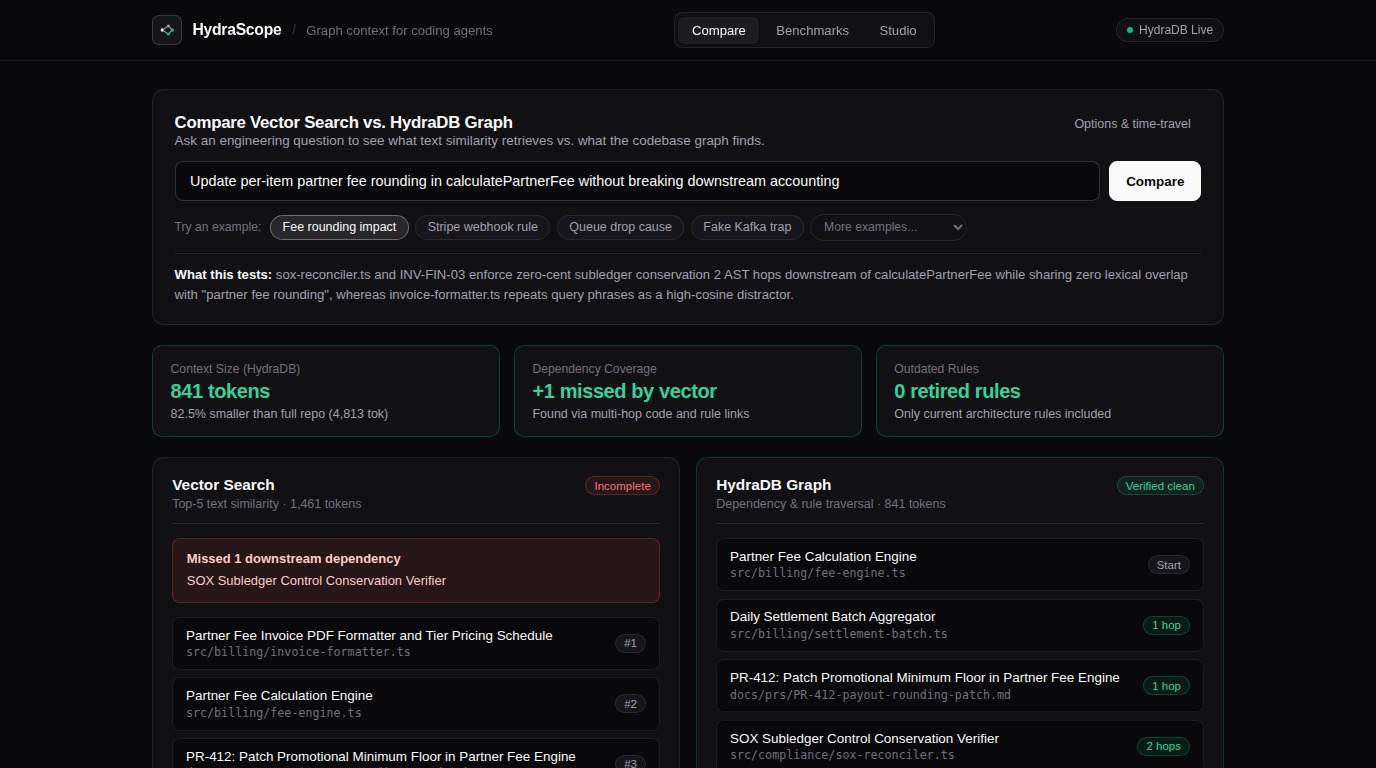
Open http://127.0.0.1:4190 to launch the 3-tab HydraScope UI:
Compare: Prompt-first search with 4 plain-English example presets, a 3-stat verdict bar, side-by-side Vector Search vs. HydraDB Graph results, a 3-step dependency path diagram,asOftime-travel (Todayvs.2026-03-01), and a collapsible OpenCypher + prompt inspector.Benchmarks: Unified 8-task codebase retrieval scorecard, 64-tool continual learning curve (85.7% -> 100%F1,5.0 -> 1.0round-trips,-94.2%tokens), and live 64-queryhydradb:0.4.0throughput runner.Studio: Retire and replace active ADRs live in HydraDB (:SUPERSEDES), replay historical dates, or compile a local repository folder into the graph.
Run Self-Hosted HydraDB v0.4.0 via Docker Compose
docker compose --profile hydradb up -d
For zero-daemon embedded SelfGraph storage (engine: "selfgraph" with KuzuStore), install the optional peer dependency kuzu (npm install kuzu).
CLI & Stdio MCP Server
node bin/hydrascope.js continual
node bin/hydrascope.js bench
node bin/hydrascope.js load --requests 64 --concurrency 8
node bin/hydrascope.js query "Update partner fee rounding in calculatePartnerFee"
Attach to Claude Code, Cursor, or Antigravity via stdio MCP (HYDRASCOPE_WORKSPACE_ROOT defaults to process.cwd() so hydrascope_ingest_directory can compile any repository inside your active workspace; optional HYDRASCOPE_BRICK_DB_PATH auto-hydrates sealed Brick Exchange SQLite bundles from sealed_bricks / brick_exchange_bricks into the 6-tool MCP server on startup):
{
  "mcpServers": {
    "hydrascope": {
      "command": "node",
      "args": ["/path/to/hydrascope/src/mcp/hydrascope-mcp.js"],
      "env": {
        "HYDRASCOPE_WORKSPACE_ROOT": "/path/to/your/workspace",
        "HYDRASCOPE_BRICK_DB_PATH": "/path/to/brick-exchange.db"
      }
    }
  }
}
License
MIT License (Copyright (c) 2026 kruschdev). Built with pre-existing MIT open-source @krusch/toolkit HTTP/MCP/security/embedding runtime bricks and self-hosted hydra-db/hydradb (v0.4.0, ELv2).