Listed from the MCP registry; nobody on Odel publishes it.

MemTether
Cross-client AI memory hub: agents share one SQLite memory.db via file-level pointers.
Runs on your machine from its package; the steps are below.
What it does
- Reads
- Writes
- High impact
At most: creates or changes data: records, files, settings.
What it costs
FreeOdel charges nothing per call. The publisher may charge for its own service.
Runs locally over stdio
This server isn't hosted — your MCP client launches it from a package registry. Use one of the commands below, or drop the config into your client (e.g. Claude Desktop).
Run
uvx memtether
MCP client config
{
  "mcpServers": {
    "memtether": {
      "command": "uvx",
      "args": [
        "memtether"
      ]
    }
  }
}MemTether

The only AI agent memory with a tamper-evident audit chain.
If your agent can't prove what it knows, it doesn't know.
Remember every fact with its source · Recall it at three depths · Audit who changed what, when, and why — with corrections that never delete and a hash chain anyone can verify.



pip install memtether
$ memtether court fact-20261007-abc

+============================================================+
| MEMTETHER MEMORY COURT - CASE FILE                          |
+============================================================+
| 1. CONTENT    Clash proxy port is 7897                      |
| 2. TEMPORAL   valid: 10-05 -> present | known: 10-05 -> now |
| 3. PROVENANCE #1 remember by=codex -> #2 correct by=user    |
| 4. CONFLICTS  case #3: vs fact-...old verdict=superseded    |
| 5. INTEGRITY  chain: PASS (3 anchors, 42 entries hashed)    |
+============================================================+

$ python examples/audit_chain_demo.py

Before tamper: verify_chain: PASS
Simulating attacker editing DB directly...
After tamper:  verify_chain: FAIL {"reason": "chain hash mismatch"}

Hash chain detected the tampering. That is the point.
MemTether is a local-first memory hub for multi-client AI agents. While most memory systems compete on retrieval accuracy, MemTether competes on governance: who wrote each fact, when it took effect, what it superseded, which conflicts a human adjudicated, and a tamper-evident hash chain anyone can verify — no code, no dependencies. Retrieval is provided (SGM deterministic SQL routing + hybrid embedding), but it is not the headline: agent memory that you can audit, correct, and trust is.
Think of it as an append-only memory ledger: every fact is a frame
with its source and checksum attached; correcting a fact appends a new
frame instead of overwriting the old one; and as_of rewinds the whole
ledger to any past date. The DB is the source of truth — export-md
gives you a human-readable, diffable, Git-friendly view of it anytime.
Coming from mem0, Zep, or Letta? examples/mem0_migration.py
shows a complete round-trip migration from a mem0 JSON export — no mem0
SDK required.
$ memtether court fact-20261007-abc
+============================================================+
| MEMTETHER MEMORY COURT - CASE FILE                          |
| 1. CONTENT    Clash proxy port is 7897                      |
| 2. TEMPORAL   valid: 10-05 → present | known: 10-05 → now   |
| 3. PROVENANCE #1 remember by=codex → #2 correct by=user     |
| 4. CONFLICTS  case #3: vs fact-...old verdict=superseded    |
| 5. INTEGRITY  chain: PASS (3 anchors, 42 entries hashed)    |
+============================================================+
Demo
Memory Court — audit any memory

Why MemTether Instead of mem0?
| Feature | MemTether | mem0 | Hindsight | EverOS |
|---|---|---|---|---|
| Audit hash chain (tamper-evident) | ✅ | ❌ | ❌ | ❌ |
| Bi-temporal supersession | ✅ | ❌ | ❌ | ❌ |
| Conflict gate (human adjudication) | ✅ | ❌ | ❌ | ❌ |
| Source attribution (mandatory) | ✅ | ⚠️ optional | ❌ | ❌ |
| Memory Court (visual audit) | ✅ | ❌ | ❌ | ❌ |
| Local SQLite (no cloud) | ✅ | ⚠️ needs setup | ⚠️ needs server | ✅ |
| Zero cloud dependency | ✅ | ❌ | ❌ | ✅ |
TL;DR
- Your AI clients forget each other? Every agent keeps its own memory. MemTether gives them one shared, governed brain via file-level pointers — no cloud, no sync.
- Your AI writes things it should not? Every memory carries a source identity and a hash-chained audit trail. Tamper with the database and the chain detects it — run
python examples/audit_chain_demo.pyto see it turn red. - Your AI changed its mind? Corrections never delete. Bi-temporal supersession keeps who-changed-what-when-why forever, queryable at any past point in time.
Run it yourself:
$ python examples/audit_chain_demo.py
写入 25 条记忆(自动生成 2 个审计锚点)...
篡改前 verify_chain: PASS {'anchors': 2, 'entries_covered': 20}
模拟攻击者直接改库...
篡改后 verify_chain: FAIL {'reason': 'chain hash mismatch'}
✅ 哈希链成功检测到篡改!

> Note: ntries_covered: 20 with 25 writes is expected — the hash chain anchors every 10 audit entries, so the last 5 writes sit in the unanchored tail until the next batch. Tampering with an *anchored* entry is what turns verification red.
Migrating from mem0
Already using mem0? examples/mem0_migration.py
shows a complete round-trip: mem0 JSON export → MemTether Exchange v1 →
live retrieval → back to mem0 format. No mem0 SDK required, bi-temporal
fields honestly marked temporal_source="backfilled".
Performance (microbenchmark, n=200, local SQLite)
| Operation | p50 | p95 | p99 |
|---|---|---|---|
| remember (insert) | 28.7ms | 34.6ms | 117.8ms |
| search (SGM entity) | 33.1ms | 39.5ms | 41.6ms |
| search (keyword) | 32.2ms | 35.0ms | 135.0ms |
| correct (supersede) | 50.8ms | 54.7ms | 54.7ms |
Reproduce: python benchmarks/bench_latency.py --n 200
Release channels
main only holds merges that passed the full test suite. Alpha builds are tagged
automatically on every successful build (v0.1.0aN), so tag numbers are not
contiguous and some tags point at commits that were later squashed into a merge.
Install from PyPI for a validated build:
pip install memtether -i https://pypi.org/simple/
Documentation
- REPRODUCING.md - Paper numbers to commands: every headline number in the paper maps to an artifact or command here
Under the hood: supersession chains (corrections never delete), bi-temporal timestamps (when facts were true vs when the system learned them), human-adjudicated conflict resolution, and a hash-chained audit log designed with EU AI Act Article 12 record-keeping requirements in mind (not certified compliance) record-keeping requirements.
One physical SQLite database, shared by every AI client via file-level pointers. No cloud. No API fees. No sync daemon. Greppable, git-able, yours — and auditable.
Compared to mem0 (66.6K★), Zep/Graphiti (31.5K★), and agentmemory (29.2K★): those systems either overwrite or delete old values. MemTether's supersession chain preserves the full history with source attribution and Q-Value ranking. EAF retrieval: 75.7% strict on LongMemEval 500Q (paired delta +19.4pp, McNemar p=7.8e-7).
How MemTether compares
| MemTether | memora (731★) | memtrace (486★) | icarus (290★) | mem0 (66K★) | |
|---|---|---|---|---|---|
| Supersession chains (corrections don't delete) | ✅ enforced | ❌ | ❌ | ✅ | ❌ overwrite |
| Evidence chain (tamper-evident, browser-verifiable) | ✅ court CLI + zip | ❌ | ❌ | ❌ | ❌ |
| Human conflict adjudication (decisions on record) | ✅ conflicts CLI | ❌ | ❌ | ❌ | ❌ |
| Bi-temporal (valid_from ≠ recorded_at) | ✅ 100% coverage on fact rows | ❌ | ✅ on knowledge-graph edges (not per-fact rows) | ❌ | ❌ |
| Source attribution (who wrote it, enforced) | ✅ registry + reject | ❌ | ❌ | ✅ provenance | ❌ |
| Bi-temporal (per-fact rows) | ✅ | ❌ | ❌ | ❌ | ✅ graph edges only |
| Conflict detection (rule-based + human review) | ✅ candidate generator | ❌ | ❌ | ❌ | ❌ |
| MCP server | ✅ | ✅ | ✅ | ❌ | ✅ |
| 23+ client adapters | ✅ auto-detect | ❌ | ❌ | ❌ | ❌ |
| Evaluation integrity framework | ✅ 5 patterns | ❌ | ❌ | ❌ | ❌ |
| CI: 9 jobs / 567 tests | ✅ | ? | ? | ? | ✅ |
| Language | Python | ? | Rust | ? | Python |
'Each cell reflects the feature's presence in the project's public documentation as of 2026-10-07. MemTether's differentiator is not any single feature — it's the combination of all governance dimensions in one local-first deployment.'
Artifact bundle with per-question records.



mcp-name: io.github.lanbass869-cell/memtether

Project page · Install · Docs · Reproduce · 中文文档 · Español
Install · Usage · Why MemTether · Benchmarks · Architecture · Security · FAQ
- Reproduce MemTether - Every claim has a command
- Founding 10 Challenge - 10 spots, 14 days, honest outcomes
- Docs (zh) - Reproduce / Challenge in Chinese
Quick Start
30 seconds, zero keys
pip install memtether

# generate a 100-fact demo DB and query it immediately
memtether demo
memtether search "投影" --list
$ memtether search "投影" --list
  1. [incident/deltahub] 巡检发现投影超限:3904 / 3900 字符——超限是静默整体截断
     uid=demo-incident-0100  1.0000
  2. [fact/epsilon_ai] 投影是给注入侧看的精简版,真源始终是数据库文件。
     uid=demo-fact-0061  0.0536
In your agent
from memtether import remember, search

remember("User prefers dark mode", source="my-agent")   # hash-chained on write
results = search("dark mode")
# Or as an MCP server for Claude Code / Cursor
memtether mcp

# Optional: pre-download the embedding model (semantic search works
# without it too — keyword path is always on)
memtether download-models
# Node.js / TypeScript — thin REST client, zero dependencies
npm install @memtether/client
Agent Skills
MemTether ships skills that teach your coding agent when to use memory — install
with npx skills add:
npx skills add MemTether/MemTether
| Skill | What it teaches your agent |
|---|---|
agent-memory | Install, core concepts, CLI + MCP surface |
agent-memory-recall | Search-before-answer: check L0 recall before answering from memory |
agent-memory-court | Write-then-verify: hash-chain check + timeline after memory writes |
Framework Integrations
MemTether works with any agent framework via its Python API or MCP server. Ready-made examples:
| Framework | Example | What it adds |
|---|---|---|
| CrewAI | Multi-agent crews | Governed shared memory with audit chains and conflict gating |
| AutoGen | Multi-agent conversations | Memory poisoning protection via provenance and tamper detection |
| LangChain | Persistent memory | Cross-session recall with bi-temporal corrections |
Node.js — @memtether/client | Any JS/TS runtime | Thin REST wrapper: remember / search / correct / courtVerify, zero deps |
All examples are self-contained and compile-verified. See examples/ for the full list.
Why MemTether
The one thing no other memory system does: corrections don't delete
# Monday: Claude Code writes
$ memtether remember "Deploy to port 8080" --source claude-code

# Wednesday: you correct it via Cursor
$ memtether correct fact-xxx "Deploy to port 9090" --reason "port changed"

# Friday: another agent searches
$ memtether search "deploy port" --list
  1. [fact] Deploy to port 9090 (active)          ← current truth
     Old "port 8080" is superseded, not deleted.
     Full chain: memtether timeline fact-xxx
Every memory has valid_from / valid_to (business time) + recorded_at / invalidated_at (system time). You can query "what did the system know on Tuesday?"
How it's different
| MemTether | engram | mem0 | agent-memory | |
|---|---|---|---|---|
| Storage | SQLite via file pointers | SQLite (Go binary) | Cloud API | Markdown files |
| Supersession | ✅ bi-temporal, never delete | ❌ | ⚠️ partial | ✅ |
| Source attribution | ✅ every fact tagged | ❌ | ❌ | ❌ |
| Q-Value feedback | ✅ used memories rank higher | ❌ | ❌ | ❌ |
| Poisoning defense | ✅ OWASP LLM01/02/06 | ❌ | ⚠️ faithfulness check | ❌ |
| Cross-client | ✅ file-level pointers (23 adapters) | ✅ MCP | ✅ API | ✅ CLI |
| Cloud required | ❌ | optional | ✅ | ❌ |
Feature comparison vs cognee / zep / letta
| Feature | MemTether | cognee | zep | letta | Engram* |
|---|---|---|---|---|---|
| Local-first | ✅ | ❌ | ❌ | ⚠️ self-hosted | ✅ |
| Zero config | ✅ | ❌ (Neo4j) | ❌ (Docker) | ⚠️ | ✅ |
| Single file DB | ✅ | ❌ | ❌ | ❌ | ✅ |
| REST API | ✅ (14 endpoints) | ✅ | ✅ | ✅ | ❌ |
| MCP server | ✅ | ❌ | ✅ | ✅ | ❌ |
| Web dashboard | ✅ | ❌ | ✅ | ✅ | ❌ |
| Supersession chain | ✅ | ❌ | ❌ | ⚠️ | ❌ |
| Bi-temporal | ✅ | ❌ | ❌ | ❌ | ✅ |
| Source attribution | ✅ | ❌ | ⚠️ | ❌ | ❌ |
| Q-Value ranking | ✅ | ❌ | ❌ | ❌ | ❌ |
| Poisoning defense | ✅ | ❌ | ❌ | ❌ | ❌ |
| Export as markdown | ✅ | ❌ | ❌ | ❌ | ✅ |
| 23 client adapters | ✅ | ❌ | ❌ | ❌ | ❌ |
| Governance layer | ✅ | ❌ | ⚠️ | ❌ | ❌ |
Architecture
Claude Code ────┐                  ┌──── Cursor
                │   symlink /      │
Codex ──────────┤   junction       ├──── Windsurf
                │                  │
Gemini CLI ─────┤                  ├─── WorkBuddy
                └───────┬──────────┘
                        │
                        ▼
              ┌──────────────────┐
              │   memory.db      │  ← One physical SQLite
              │   (WAL mode)     │
              ├──────────────────┤
              │ FTS5 trigram     │  ← BM25 full-text
              │ ChromaDB + bge-m3│  ← Semantic (optional)
              │ RRF fusion       │  ← Multi-path merge
              │ 4-factor rerank  │  ← Z-score + sigmoid
              │ Supersession     │  ← Never delete
              │ Bi-temporal      │  ← T-axis + T'-axis
              │ Q-Value          │  ← Usage-based ranking
              │ Hubguard         │  ← Concurrent write lock
              │ Poisoning guard  │  ← OWASP LLM defense
              └──────────────────┘
Technical details
| Component | Technology | Purpose |
|---|---|---|
| Database | SQLite (WAL mode) | Single-file, zero-config, cross-platform |
| Full-text | FTS5 trigram + triggers | O(1) BM25 search, SQL-level sync |
| Vector | ChromaDB + bge-m3 (1024-dim) | Semantic search, local embedding |
| Fusion | Reciprocal Rank Fusion (K=60) | Merge multi-path results |
| Re-ranking | 4-factor (sem .45 + rec .25 + freq .05 + imp .10) | Z-score + sigmoid |
| Governance | Supersession + bi-temporal + conflict detection | Never delete |
| Concurrency | Hubguard (file lock + atomic write) | Cross-process safe |
| Security | memtether_guard (OWASP LLM01/02/06) | Poisoning defense |
| API | FastAPI REST (14 endpoints) + MCP server (10 tools) | Any language |
| Packaging | PyPI + Docker + 23 client adapters | pip install memtether |

Connect Your Clients
# All detected clients (recommended)
memtether init

# Verify what was wired
memtether connect verify

# One at a time
memtether setup claude-code
memtether setup cursor
memtether setup windsurf
memtether setup codex
Supported (23): Claude Code, Claude Desktop, Cursor, Windsurf, VS Code, Zed, JetBrains, Cline, Roo Code, Kilo Code, Continue, Cody, Amazon Q, Gemini CLI, Neovim, Codex CLI, WorkBuddy (CN + Intl), CodeBuddy, ZCode, DSH, OpenClaw, Agents-Neutral
Memory Operations
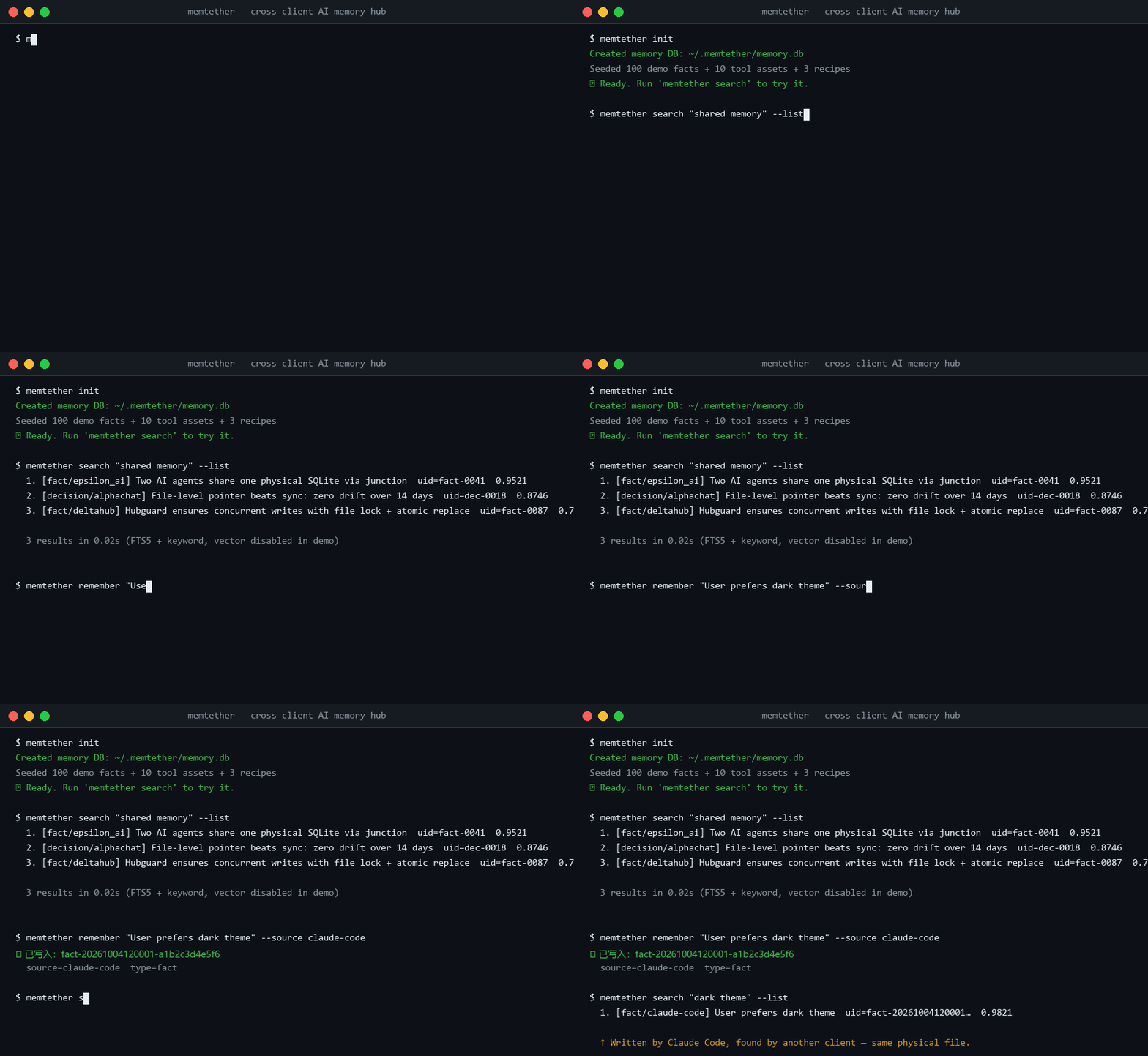
memtether remember "User prefers dark theme" --source claude-code
memtether search "theme" --layer L0    # First sentence only
memtether search "theme" --layer L1    # First 3 sentences
memtether search "theme"               # Full content (L2, default)
memtether profile --subject user       # What we know about this user
memtether correct <uid> "Updated"      # Supersede, never delete
memtether retire <uid> --reason "..."  # Retire (content preserved)
memtether provenance <uid>             # Full audit trail for one fact
memtether conflicts --stats            # Review conflict candidates
memtether court --verify               # Verify the audit hash chain
memtether stats
memtether version --json        # Machine-readable version info (CI/tooling)
memtether sleep --dry-run       # Consolidate similar memories (NREM)        # Machine-readable version info (CI/tooling)
memtether export-md --out ./backup     # Export as markdown
memtether backup                       # Point-in-time DB backup
memtether reconcile --dry-run          # SQLite <-> vector drift report
memtether import-docs ./docs           # Cold-start from a directory
memtether remember-batch mems.json     # Batch write from JSON
memtether demo                         # Generate a synthetic demo DB (no real data)
memtether handoff --to codex          # governed handoff bundle for the next agent
memtether review                      # one-stop pending-conflict review queue
memtether connect doctor              # layered diagnosis: python/config/db/mcp/hooks
memtether dashboard                    # web UI — /viewer is the governance tab
memtether dashboard                    # Web UI
Run memtether --help for the full list (20 subcommands).
The same operations work via MCP — your AI agent can govern memory directly:
# Via MCP: correct_memory / retire_memory / pin_memory / as_of_query / timeline / profile
# Your agent calls these tools — no CLI needed:

# Agent corrects a fact (supersedes old, creates new)
→ correct_memory(old_uid="fact-xxx", new_content="Deploy to 9090", reason="port changed")

# Agent queries what the system knew last Tuesday
→ as_of_query(at="2026-10-15", kind="known")

# Agent walks the full audit chain
→ timeline(uid="fact-xxx")

# Agent asks "what do we already know about this user?"
→ profile(subject="user")          # deterministic, no LLM, fully traceable
The same operations are available via MCP (correct_memory, retire_memory,
pin_memory, as_of_query, timeline, profile) — agents can govern memory
without CLI.
Layered recall (L0 / L1 / L2)
Every search can return the same hit at three depths, so an agent scans cheap one-liners first and only pays for full text on the hits it actually wants:
memtether search "deploy port" --layer L0   # first sentence only (~1 line)
memtether search "deploy port" --layer L1   # first 3 sentences
memtether search "deploy port"              # L2 = full text (default)
Measured on a 2,200-fact production DB (limit=5): L0 costs 10% of L2's
characters, L1 44%. The split is a pure deterministic function — no LLM, no
hallucination, and L2 is byte-identical to the pre-layer behaviour.
Deterministic user profile
memtether profile --subject user           # human-readable
memtether profile --subject user --json    # machine-readable
Aggregates everything known about one subject (counts by type/source, time span,
high-confidence facts, an L0 digest you can paste straight into a system prompt).
Unlike supermemory's get_profile or honcho's get_representation, this runs
zero LLM calls — the same DB always yields the same profile, and every line
traces back to a uid.
memtether export-md --out ./backup     # Export as markdown
memtether dashboard                    # Web UI
Benchmarks
Every number below is reproducible from this repo — per-question records ship in releases/eaf_artifact_bundle/, and the LoCoMo adapter is
scripts/bench_memtether_adapter.py. We report each metric under the exact scoring rule that produced it (strict / judge / answer-quality vs retrieval-recall) because mixing denominators is how memory benchmarks lie — see our Simpson's-paradox analysis for the 27× inflation this causes when ignored.
LongMemEval (500 questions, full run, 2026-10-02)
| Metric | Score | Notes |
|---|---|---|
| Strict match (global) | 62.6% | 209/334 applicable |
| LLM judge (global) | 55.7% | 264/474 |
| Multi-session strict | 48.8% | 39/80 |
| Multi-session LLM judge | 60.0% | 72/120 |
| EAF | 75.7% | 253/334 — multi-session 32.5%→60.0% |
| Type | n | Strict | LLM Judge |
|---|---|---|---|
| knowledge-update | 78 | 76.6% | 62.5% |
| multi-session | 133 | 48.8% | 60.0% |
| single-session-assistant | 56 | 40.4% | 41.1% |
| single-session-preference | 30 | N/A | 43.3% |
| single-session-user | 70 | 86.4% | 85.7% |
| temporal-reasoning | 133 | 60.7% | 40.5% |
Temporal follow-up (2026-11-04): the 40.5% temporal judge score above was measured by a harness that never passed
question_dateto the answering model — "How many days ago …" questions were mathematically unanswerable. After adding the date anchor (query + evidence + prompt; commit 1b4fb9f), a full 133-question temporal rerun scored 68.9% judge (91/132, oracle variant, loomy judge; artifact). The 40.5% number below is kept for reproducibility of that exact run, but should not be cited as the engine's temporal capability.Results use our own harness. Not directly comparable with mem0's reported numbers.
EAF (75.7%) is not a "we win" number — it is the retrieval variant that removes contradiction-induced context from the window before answering. Paired McNemar on the same 334 questions: +19.4pp, p=7.8e-7. Governance pays here: uncorrected cross-agent contradictions cost up to 73pp of downstream accuracy in our causal experiment (entity-conflict: 90% vs 0% supersession under imposed rules). See experiments/reproducibility/ for the JSON records.
LoCoMo (1986 questions, full run via MemEval harness, 2026-10-14)
| System | Token F1 (LoCoMo) |
|---|---|
| PropMem | 0.605 |
| OpenClaw | 0.557 |
| Full Context | 0.542 |
| MemTether | 0.523 |
| Hindsight | 0.489 |
| Graphiti | 0.416 |
| Memory-R1 | 0.389 |
| SimpleMem | 0.358 |
| Mem0 | 0.344 |
| MemU | 0.299 |
MemTether ranks 4/10 on token F1 — ahead of Graphiti, mem0, SimpleMem, MemU
and Hindsight, behind proposition-indexed PropMem and chunk-based OpenClaw.
Per-category: multi-hop 0.556, open-domain 0.820, factual 0.357, temporal 0.264,
inferential 0.206. Reproduce: the MemTether adapter for the MemEval /
LoCoMo harness ships in this repo at scripts/bench_memtether_adapter.py —
it imports the published memtether package (no local path injection), so
pip install memtether plus the MemEval harness is all that is required.
Test suite
| Test | Result |
|---|---|
| pytest | 669 passed, 6 skipped (675 collected; CI runs full tests/ directory) |
| hard_bench | 62/62 |
| e2e_verify | 13/13 |
| refuse_bench | 26/26 (wordform gate; 09-25 calibration; known blind spot: same-form-different-attribute) |
| check_packaging | ✅ |
Governance, provably
Other systems describe governance. MemTether ships it as commands you can run:
-
Tamper-evident by construction. Every write joins a SHA-256 hash chain with periodic anchors. Prove it:
bashpython examples/audit_chain_demo.py # PASS → tamper → FAIL memtether court --verify -
Deletion is a proposal, never a physical delete.
retiremarks a row superseded and keeps the content; corrections append. The old truth stays queryable —memtether court <uid>shows the full chain. -
Attribution is mandatory, not optional. A write without a registered source is rejected, so "who told you that?" always has an answer.
-
Conflicts go to a human gate. Contradictory writes land in a review queue (
memtether conflicts --list) — agents propose, humans adjudicate, and the verdict becomes part of the audited record.
Session capture (experimental)
"Write coverage is the system's job, not the agent's judgement." scripts/watch.py
extracts decisions and lessons from a session transcript at a boundary and pushes
them through the governed pipeline (near-dup gate, hash chain, mandatory source):
# preview what would be written
python scripts/watch.py ingest --file session.jsonl --source claude-code --dry-run

# real ingest (governed: dedup + attribution + chain)
python scripts/watch.py ingest --file session.jsonl --source claude-code
Extraction is deliberately narrow (decision/lesson heuristics only) — better to miss than to flood the store. Honest limitation: batch-at-boundary; a live-tail daemon is future work. Hook installation per harness is planned via the adapter framework.
Security
- Poisoning defense:
memtether_guarddetects prompt injection, code execution, sensitive info (OWASP LLM01/02/06), 12 rules - Input validation: content ≤10K, type whitelist, source format, confidence range, scope whitelist
- Scope isolation:
shared/private/restricted - Concurrency: Hubguard file lock + atomic write (WAL mode)
- READY probe on setup: setup ends with a real remember → search →
court --verifytriple; it printsstatus: READYonly when all three pass —memtether connect doctorpinpoints the failing layer otherwise - Fail-closed setup: connecting a client never silently overwrites an unrelated setting — conflicting config aborts the setup instead
- SQL: All parameterized. No f-string SQL
Why not just markdown files?
Agents work well with markdown, and memtether export-md gives you that. But
raw markdown files can't answer "who wrote this, when was it true, what did it
replace?" — and they can't enforce source attribution or detect tampering.
| Plain markdown | MemTether | |
|---|---|---|
| Who wrote this fact? | ❌ not tracked | ✅ source + timestamp |
| What did it replace? | ❌ overwritten | ✅ supersession chain |
| Is this the current truth? | ❌ grep returns all versions | ✅ status + valid_from/valid_to |
| Can someone tamper silently? | ✅ (no protection) | ❌ hash chain detects it |
| Concurrent write safety | ❌ last-write-wins | ✅ Hubguard file lock |
| Retrieval | grep (exact match only) | SGM + vector + BM25 + rerank |
Export to markdown anytime — but keep the governed database as the source of truth.
What we do NOT claim
In the spirit of our evaluation-integrity work (we documented a 27× inflation from mixed denominators in memory benchmarks), here is what MemTether does not claim:
- Not the highest LongMemEval score. We report 62.6% strict / 75.7% EAF under our own harness with per-question records. Others report higher on different denominators — those numbers are not comparable to ours, and vice versa.
- Not a conversational-memory champion. Our differentiator is governance (audit chain, bi-temporal, human adjudication), not dialogue recall. If you need the best chat-memory RAG, several systems beat us on raw retrieval.
- Not certified EU AI Act compliant. Memory Court is designed with Art. 12 record-keeping in mind — that is not a compliance certification.
- Not a distributed system. File-level pointers are single-machine by design. Cross-machine sync is out of scope (see ROADMAP).
- Not tested on macOS/Linux at production level. CI covers them, but our daily dogfooding is Windows-first.
- Not multi-tenant at the auth layer.
tenant_idscoping exists; the REST API has a single-key guard, not per-tenant RBAC. - Not zero-noise. The near-dup gate catches repeats; it is not a general fact-checker. Garbage in, garbage out — attributed and hash-chained.
Known Limitations
tether_connect detectmay falsely report "not connected" for same-source-different-path configs- DSH deep customizations (
cordis.patch.yml) cannot be safely rewritten — useplanto preview - Semantic search requires optional deps (
chromadb,onnxruntime) — without them, degrades to keyword search - Windows-first. macOS/Linux should work but not fully tested
- Exchange adapters for mem0/zep are experimental — they require the corresponding library installed
REST API
memtether dashboard   # starts server + opens browser
# or: uvicorn api_server:app --port 8820
15 endpoints: / /health /remember /search /stats /correct /retire /list /timeline/{uid} /absorb /qvalue /dashboard /viewer /court/verify /court/{uid}
Contributing
See CONTRIBUTING.md.
Featured In
- awesome-mcp-servers (97K★) — pending review
- awesome-ai-apps (16.6K★) — pending review
- awesome-claude-code (57K★) — pending review
- awesome-copilot (40.6K★) — pending review
- Awesome-MCP-ZH (7.8K★) — ✅ merged
- awesome-opensource-ai (5K★) — ✅ merged
- Awesome-AITools (6.3K★) — pending review
- Awesome-Memory-for-Agents (669★) — pending review
- Awesome-AI-Memory (1.3K★) — pending review
- awesome-agent-cortex (231★) — pending review
- mcp.so — indexed
- Glama AI — maintenance: A, license: A
- MCP Registry —
io.github.lanbass869-cell/memtether - Smithery — indexed
Claude Code Integration
MemTether is discoverable in Claude Code's skill system:
CLAUDE.md— project invariants that Claude Code reads on startupskills/agent-memory/SKILL.md— skill definition searchable in Claude Code- MCP server with 10 tools for memory operations
License
License
If MemTether helps you, please give it a ⭐ on GitHub — it helps other agents find it.
Troubleshooting
| Symptom | Fix |
|---|---|
no AI client detected after memtether init | Clients in non-standard paths need manual MCP config — see docs/ADAPTERS.md |
database is locked during writes | WAL mode is default; a long reader may hold the lock — retry after 5s (busy_timeout is set) |
source not registered on write | Open-source mode is fail-open; a registry file (agents.json) enforces attribution — add your client to agents.json or set MEM_SOURCE_FALLBACK |
embedding search failed warning | Optional chromadb/bge models missing — install pip install memtether[semantic] or ignore (keyword fallback works) |
| memory chain FAIL after manual edit | Intentional: the audit hash chain detects direct DB modification. Restore from backup or run memtether court <uid> to inspect |
Roadmap
See ROADMAP.md for planned work and explicit non-goals.