Listed from the MCP registry; nobody on Odel publishes it.

ModelPick
Pick the best-value model at every task node, with cost per solved task and the exact setup.
Runs on your machine from its package; the steps are below.
What it does
- Reads
- Writes
- High impact
At most: moves money, runs code or commands, deletes data, or sends messages for you.
What it costs
FreeOdel charges nothing per call. The publisher may charge for its own service.
Runs locally over stdio
This server isn't hosted — your MCP client launches it from a package registry. Use one of the commands below, or drop the config into your client (e.g. Claude Desktop).
Run
npx -y modelpick
MCP client config
{
  "mcpServers": {
    "modelpick": {
      "command": "npx",
      "args": [
        "-y",
        "modelpick"
      ]
    }
  }
}
ModelPick
The model router for AI agents — with cost per solved task.
Coding, image, video, 3D, and audio. One CLI, one MCP server, every agent.






Website · intro video (93s) · How value is defined · Ecosystem
Your agent can write code, call tools, and ship a feature. Then it picks one model for everything — a frontier model to classify a support ticket, to generate a barrel prop, to draft a thumbnail.
The result is predictable: 60–95% of the spend goes to work that did not need a frontier model, and the hard nodes still fail because the model was chosen for the wrong modality.
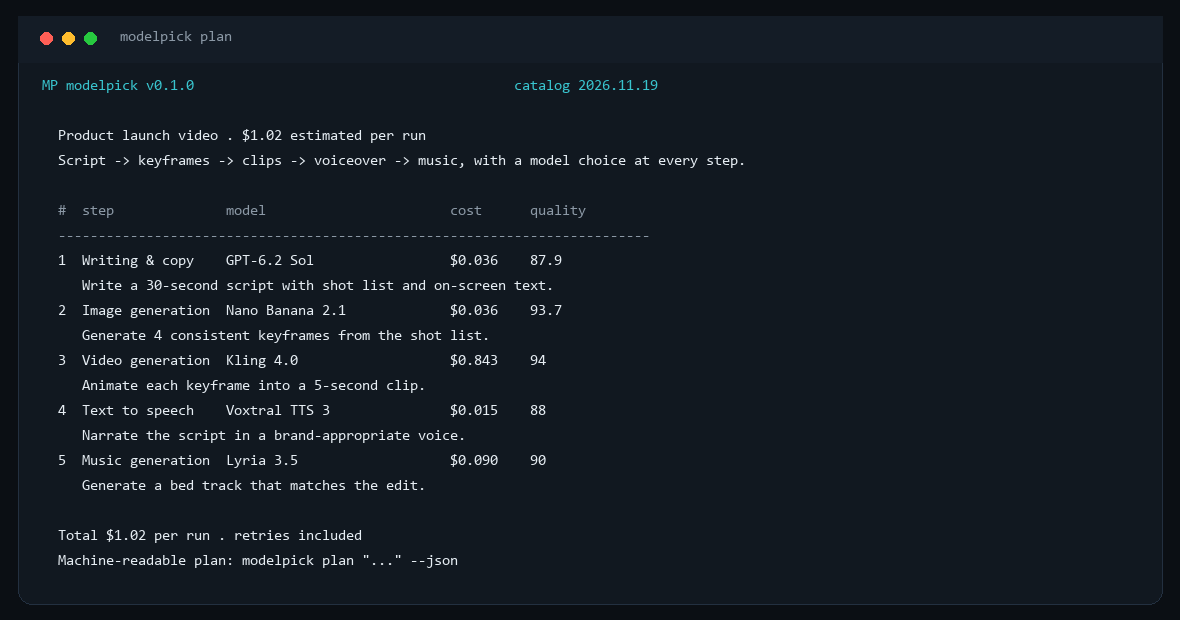
ModelPick is a router, cost calculator, and local-key executor — not another gateway. Before each node it answers four questions:
- Which model? Ranked for this exact task, with hard capability filters (context, text-in-image, rigging, clip length, open weights).
- What will it really cost? Cost per solved task — list price × expected attempts, not $/M tokens.
- How do I connect it? The env var, key URL, docs, and API model id.
- How do I run it?
run_modelexecutes text models with the key that stays on this machine; the main agent passes compressedsystem,messages,context, and an optional JSON output schema.
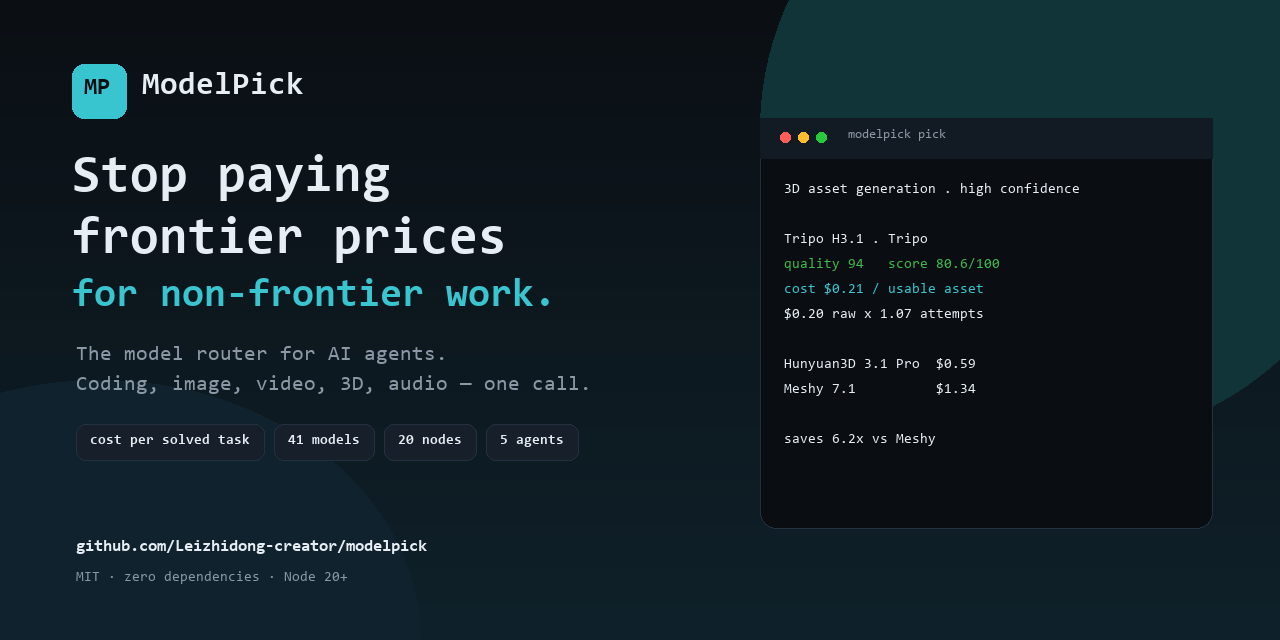
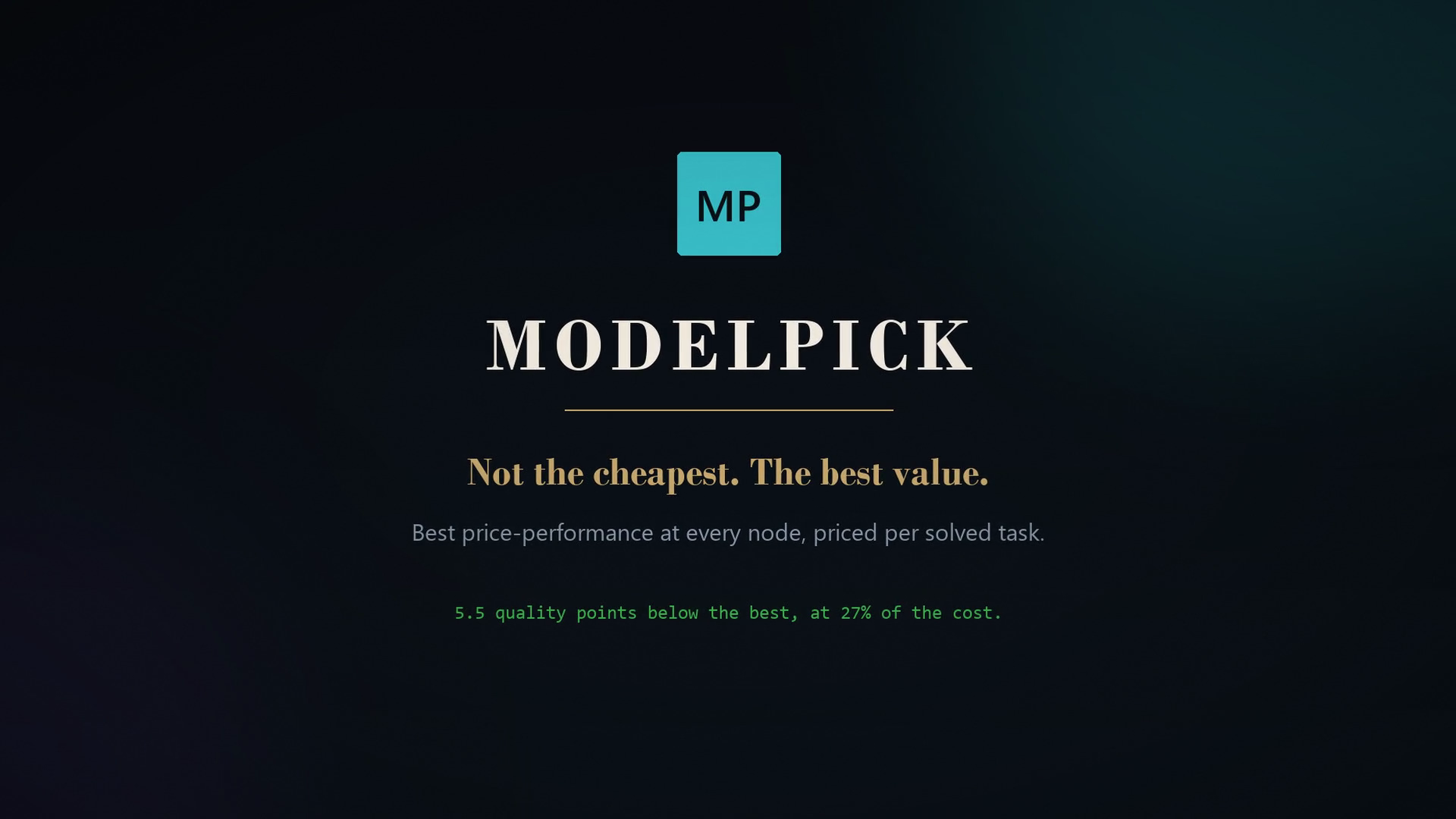
npx -y github:Leizhidong-creator/modelpick pick "create a stylized 3D sword for a Unity game"
▶ Watch the intro video with English + 中文 captions · direct MP4 · script & storyboard · English + 中文 captions
Start here
Four steps. The first two take about a minute.
| Step | Command | What happens |
|---|---|---|
| 1. Install | npm install -g modelpick | CLI + MCP server. Node 20+, zero runtime dependencies. |
| 2. Add a key | modelpick keys --ui | Local page. Pick a provider, click Get a key, paste, Save & test. Stored in ~/.modelpick/secrets.json (0600). |
| 3. Connect an agent | modelpick setup claude-code --global --write | One-time MCP registration. Cursor: setup cursor --global --write; Codex: setup codex --global --write. Restart the app. |
| 4. Run or ask | modelpick run "fix this bug" --task coding-agent | Or let the connected agent call pick_model / run_model. |
- No key yet? Recommendations work offline. Local Ollama works with no key:
modelpick run "hello" --local. - Guided install: https://leizhidong-creator.github.io/modelpick/install.html
- Key security:
docs/KEYS.md - All agent configs:
#works-with-the-agents-you-already-use
What executes today: text models through OpenAI, Anthropic, Gemini, DeepSeek, and OpenRouter, plus local Ollama. Image, video, 3D, and audio execution adapters are next; recommendations cover all five modalities now.
Why this exists
Three things are broken in model selection today:
1. Token prices hide the real bill. A model that is 10× cheaper per token but needs 1.8× the attempts and 2× the output tokens is not 10× cheaper. ModelPick computes the denominator that matters: dollars per usable output.
2. A coding agent defaults to one model, even for creative nodes. A 3D pipeline is not a text problem. Text-in-image is not image generation. A 30-second video is not a 5-second clip. ModelPick models 20 task nodes across 5 modalities, with capability filters that reject the wrong model before scoring.
3. Every tool is a new integration. ModelPick ships as a zero-dependency CLI, a stdio MCP server, a portable SKILL.md, and a Claude Code plugin. Same decision engine everywhere; no gateway, no lock-in, no key storage.
In one line: other tools route text prompts. ModelPick routes work — coding, image, video, 3D, and audio — and prices each node per solved task.
How is this different from a gateway or a coding router?
| Gateway (OpenRouter, LiteLLM, Portkey) | Coding router (claude-code-router) | ModelPick | |
|---|---|---|---|
| Optimizes | access, failover, provider margin | model switching inside a coding loop | best price-performance at each node |
| Modalities | mostly text; OpenRouter's live catalog is ~4% non-text | text | text, image, video, 3D, audio |
| Decision | route by price/availability | rules or a classifier | capability filters + benchmark-weighted utility |
| Keys | held by the gateway | local | local file/env only; you call the provider |
| Evidence | live prices | config | dated catalog + public benchmark + raw failures |
Gateways are useful, and ModelPick can recommend one as the setup path. But a gateway cannot tell you that a 3D node should use Tripo instead of Meshy, or that a "headline text" image needs a model with a text-rendering score above 90. That choice is what this tool makes.
More: research/competitive-landscape.md (15 products, 10 features, 53 sources).
30-second quickstart
Step-by-step start page: https://leizhidong-creator.github.io/modelpick/start.html
Guided install page: https://leizhidong-creator.github.io/modelpick/install.html
Windows: one command, no prompts
npm install -g modelpick
modelpick keys --ui
If global install is blocked by policy:
npx --yes --package=modelpick@latest modelpick keys --ui
Or double-click the launcher:
https://leizhidong-creator.github.io/modelpick/install.html
Do not paste bash comments (# ...) into CMD; CMD does not understand #.
macOS / Linux
npm install -g modelpick
modelpick keys --ui

# or no install
npx --yes --package=modelpick@latest modelpick keys --ui
Then
modelpick keys list
modelpick doctor
modelpick run "hello" --local --model qwen-local:latest
Why npm install modelpick alone is not enough
npm install modelpick installs into ./node_modules; it does not put modelpick on PATH.
npm install modelpick
npx modelpick keys --ui       # ✅
# modelpick keys --ui         # ❌ not on PATH
Install globally for a permanent command:
npm install -g modelpick
modelpick keys --ui
Official npm package: https://www.npmjs.com/package/modelpick
MCP Registry: https://registry.modelcontextprotocol.io/v0/servers?search=modelpick
Fallbacks if the registry is unavailable:
# GitHub, no npm auth
npx --yes github:Leizhidong-creator/modelpick pick "refactor this 40k-line repo, cheapest that works"

# static registry mirror
npm install modelpick --registry=https://leizhidong-creator.github.io/modelpick/npm/

# offline release tarball
npm install https://github.com/Leizhidong-creator/modelpick/releases/download/v0.2.2/modelpick-0.2.2.tgz
Works with the agents you already use
modelpick setup writes the files for the agent you use. It backs up existing config, keeps sibling MCP servers, and refuses to overwrite invalid JSON.
| Agent | Command | MCP file it uses |
|---|---|---|
| Claude Code | setup claude-code --global --write | ~/.claude.json |
| OpenAI Codex CLI | setup codex --global --write | ~/.codex/config.toml |
| Cursor | setup cursor --global --write | ~/.cursor/mcp.json |
| DeepSeek Harness | setup dsh --global --write --profile desktop | ~/.dsh/profiles/<profile>/cordis.patch.yml |
| GitHub Copilot CLI | setup copilot | .mcp.json |
| VS Code / Copilot agent mode | setup vscode | .vscode/mcp.json (servers) |
| Any MCP client | modelpick mcp | your client's stdio config |
Claude Code
modelpick setup claude-code --global --write
# writes ~/.claude.json plus the global skill
claude mcp list        # modelpick should appear
Restart Claude Code, run /mcp, and approve the global server. Then ask: pick a model for a 3D sword for Unity.
Plugin alternative, inside Claude Code:
/plugin marketplace add Leizhidong-creator/modelpick
/plugin install modelpick@modelpick
OpenAI Codex CLI
# writes the global MCP row with a backup
modelpick setup codex --global --write
codex mcp list
setup codex writes AGENTS.md and .agents/skills/modelpick/. Codex reads MCP servers from ~/.codex/config.toml, so --global --write appends the row or you can use codex mcp add:
codex mcp add modelpick -- modelpick mcp
Cursor
modelpick setup cursor --global --write
It writes ~/.cursor/mcp.json plus the global skill. Open Cursor → Settings → MCP and confirm modelpick is connected.
DeepSeek Harness
DSH has no .mcp.json. MCP servers are Cordis rows in the profile patch:
npx -y modelpick setup dsh --global --write --profile desktop
It writes the portable skill to ~/.dsh/skills/modelpick/, appends AGENTS.md, and adds one MCP row to ~/.dsh/profiles/desktop/cordis.patch.yml (backing the file up first).
Restart DSH after this. Then ask it:
Use modelpick pick_model for a low-poly sword for Unity. Show costPerTask and the key.
Without --write, setup dsh prints the row instead of editing a live profile. The MCP server itself can be tested without DSH:
node bin/modelpick.js mcp
# then send initialize + tools/list over stdio
GitHub Copilot CLI
npx -y github:Leizhidong-creator/modelpick setup copilot
copilot mcp list
It writes .mcp.json, .github/skills/modelpick/, and AGENTS.md. Restart Copilot and ask for a model pick.
VS Code / Copilot agent mode
npx -y github:Leizhidong-creator/modelpick setup vscode
It writes .vscode/mcp.json under servers (VS Code's schema, not mcpServers), the portable skill, and AGENTS.md. In VS Code run MCP: List Servers, start modelpick, then ask in agent mode. Sibling servers are preserved.
Any MCP client
{
  "mcpServers": {
    "modelpick": {
      "command": "npx",
      "args": ["-y", "github:Leizhidong-creator/modelpick", "mcp"]
    }
  }
}
Tools exposed: pick_model, run_model, get_decision_packet, plan_workflow, compare_models, get_setup, list_models, explain_task. Recommendations work without any provider key; the key is only needed to run the chosen model.
Portable skill: .agents/skills/modelpick/SKILL.md is read by Codex, Cursor, Copilot CLI, Devin/Windsurf, and DeepSeek Harness. Claude Code gets its own copy. The skill tells the agent when to call pick_model and how to report the result.
The number that matters: cost per solved task
raw cost per attempt = tokens × price (cache-aware)   OR   units × unit price
expected attempts    = 1 / (1 − 1.15 × (100 − quality) / 100)     capped at 4
cost per solved task = raw cost × expected attempts
Worked example — 80K input / 8K output, 60% cache hit, agentic coding:
| Model | quality | raw cost | expected attempts | cost per solved task |
|---|---|---|---|---|
| Claude Fable 5.2 | 92.3 | $0.59 | 1.10 | $0.64 |
| Gemini 4 Carbon | 87.3 | $0.15 | 1.17 | $0.17 |
| DeepSeek V4.1 Flash | 70.7 | $0.010 | 1.51 | $0.015 |
| Claude Haiku 5.5 | 68.8 | $0.008 | 1.56 | $0.012 |
The cheap model is 53× cheaper and 23.5 quality points worse. The interesting answer is the third row: mid-quality agentic coding at 2.3% of the frontier cost. The right answer depends on the node — which is why the tool shows both sides instead of hiding the trade-off behind a token price.
Quality is a weighted mix of public benchmark signals (BenchLM overall/coding, CursorBench 4.0, capability-specific scores). Expected attempts is a transparent model, shown on every result — not a promise. If a number is estimated, the CLI prints ~.
What it covers
40 models · 18 providers · 20 task nodes · 5 modalities. Current as of 2026-11-19; every price carries a source and read date.
| Modality | Nodes | Example models in the catalog |
|---|---|---|
| Text | coding, review, refactor, debug, plan, long-context, research, writing, translation, extraction, classification, data, computer-use | Claude Fable 5.2, GPT-6.2 Astra/Sol, Gemini 4 Carbon/Hydrogen, DeepSeek V4.1 Flash, Claude Haiku 5.5, Kimi K3.1 Pro |
| Image | generation, editing, text-in-image | Nano Banana 2.1/Pro, GPT Image 2.6, Seedream 5.5 |
| Video | text/image → clip, dialogue, 30s takes | Veo 3.1 / Fast (Vertex), Kling 4.0, Seedance 2.5 |
| 3D | text/image → game-ready asset, rigging | Tripo H3.1, Hunyuan3D 3.1 Pro, Meshy 7.1, TRELLIS 2 (open) |
| Audio | TTS, STT, music | Eleven v4, Voxtral TTS 3, GPT Transcribe, Voxtral Transcribe 3, Lyria 3.5, MiniMax Music 3 |
The catalog is a dated snapshot, not a live price feed. modelpick update refreshes from the repo; modelpick doctor warns when it is stale.
Tested decisions
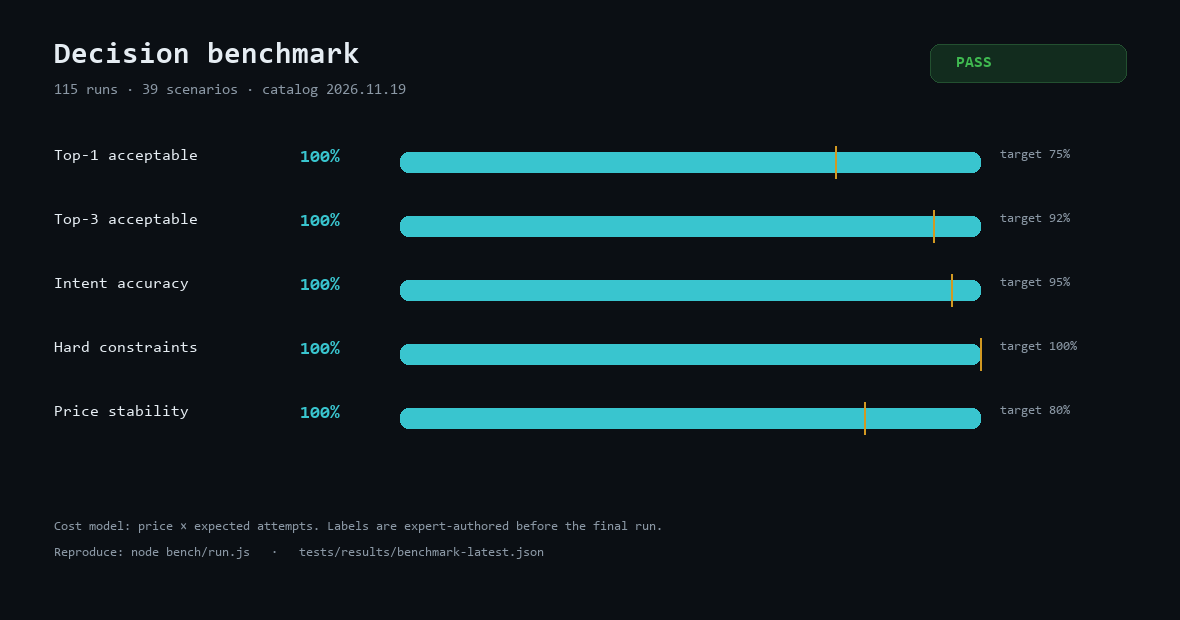
| Metric | Development set | Held-out set | Target |
|---|---|---|---|
| Top-1 acceptable | 100% (115 runs) | 100% (35 runs) | ≥75% |
| Top-3 acceptable | 100% | 100% | ≥92% |
| Intent accuracy | 100% (39 scenarios) | 100% (12 scenarios) | ≥95% |
| Hard constraint pass | 100% | 100% | 100% |
| Price stability (±20%) | 100% | 100% | ≥80% |
| p95 decision latency | 1.1 ms | 1.1 ms | ≤300 ms |
What this is: 39 expert-labeled scenarios expanded into balanced/cost/quality runs, plus a 12-scenario held-out set authored after the benchmark froze. Every run checks task detection, top-1/top-3 acceptability, hard constraints, cost regret, and stability under ±20% price perturbation.
What this is not: a live model-output benchmark. It does not call providers, and it does not prove quality labels are universally correct. Quality scores are derived from public leaderboards; expected attempts is a model. The full methodology, failures, and reproduction commands live in tests/TEST_PLAN.md, tests/results/, and bench/.
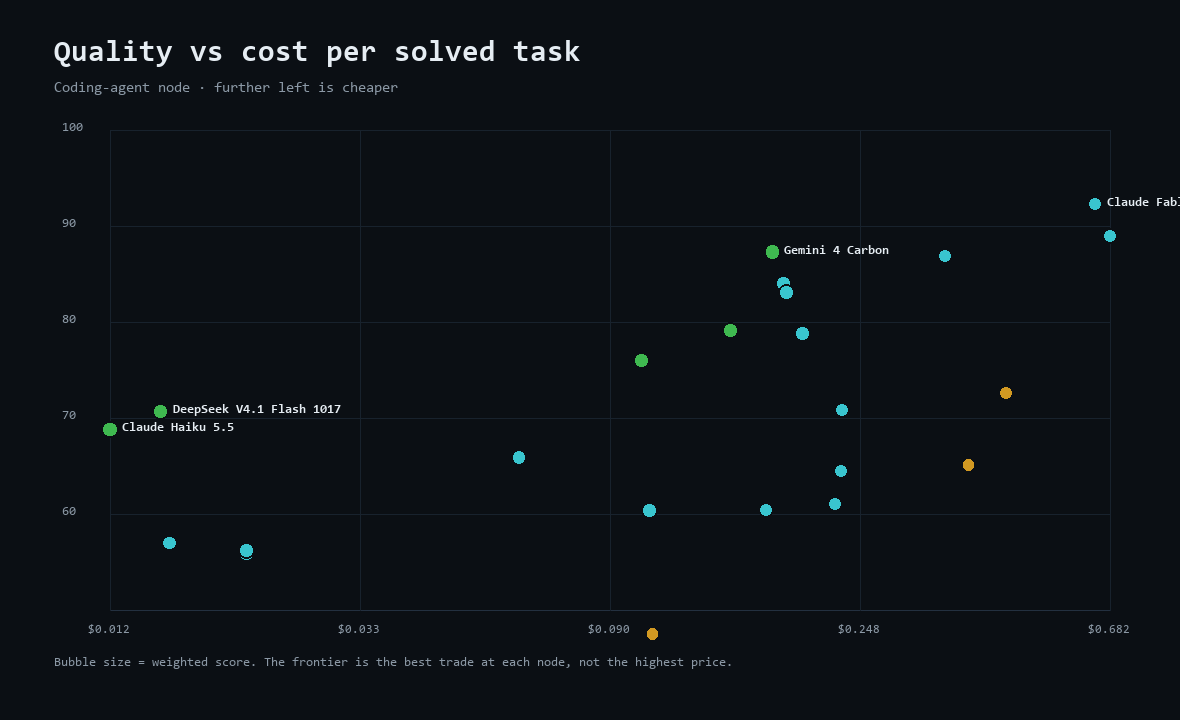
Full per-node tables: docs/LEADERBOARD.md.
Value, measured
node bench/value.js simulates 4,000 jobs per task across five task types, using catalog quality as first-pass success and the router's retry curve:
| Strategy | First-pass | Cost / solved | Quality parity | Cost vs frontier |
|---|---|---|---|---|
| Frontier always | 93.7% | $0.6417 | 100% | 100% |
| Value pick | 89.4% | $0.2563 | 95.4% | 41.6% |
| Cheapest always | 87.6% | $0.2060 | 93.5% | 39.1% |
The value pick keeps 95.4% of frontier first-pass quality at 41.6% of the cost. The cheapest model saves 2.5 cost points but loses 1.9 quality points and fails a 90%-parity bar on two of five tasks. This is synthetic; the arithmetic and the definition are in docs/VALUE.md, and the evidence behind every quality score is in docs/QUALITY.md.
Multi-dimensional scorecard
tests/results/SCORECARD.md combines six dimensions from committed evidence:
| Correctness | Cost | Robustness | Coverage | Safety | Operability | Composite |
|---|---|---|---|---|---|---|
| 100 | 84.2 | 100 | 100 | 100 | 100 | 96.8 / A |
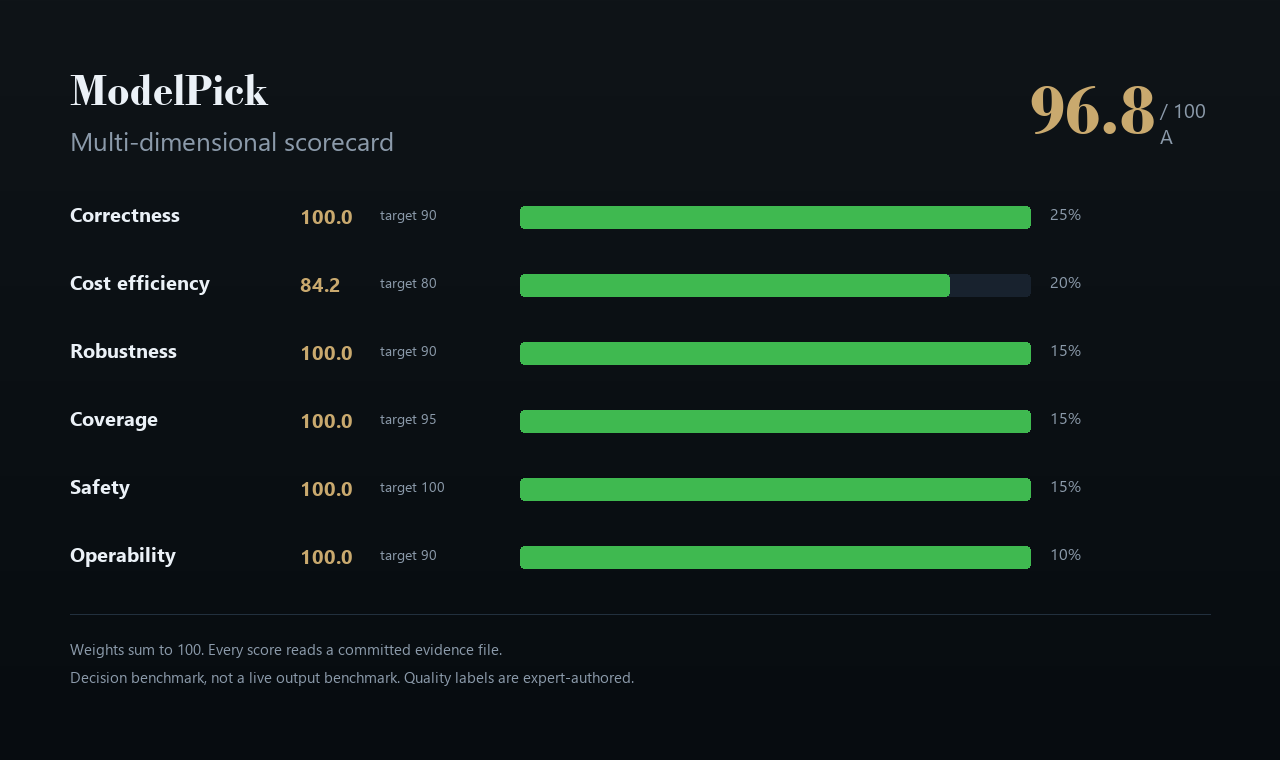
Correctness is the decision benchmark; it is not an independent output benchmark. Cost is regret plus the value simulation. Robustness is price perturbation, retry sensitivity, and determinism. Coverage is every task and model. Safety is the 25-case adversarial suite. Operability is p95 latency, modelpick verify, and line coverage (84.8%).
The decision engine
request
  │
  ├─ task detection (20 nodes, English + Chinese) ── explicit --task always wins
  ├─ intent parsing (cheap / fast / best / open-source / budget / exclude)
  ├─ hard requirements (context, text-in-image, rigging, lip-sync, clip length)
  │
  ├─ capability filter → candidates
  ├─ benchmark-weighted quality
  ├─ cache-aware cost × expected attempts
  ├─ latency + context fit
  └─ weighted utility → pick + alternatives + why + trade-offs + setup
Presets: balanced (task weights), value (price-performance), quality, cost, speed, privacy. Budgets and quality floors are hard constraints, not suggestions.
The default is a value decision, not a bargain hunt. The value pick is the cheapest model within 8 quality points of the best eligible model; if the band is empty, it falls back to the top recommendation. It is returned as picks.value and value, with the quality gap and the percentage of the best model's cost. The full definition, simulation, and sensitivity analysis are in docs/VALUE.md.
Every answer includes:
recommendation.slug,quality,costPerTask,expectedAttempts,latencySecwhy[]andtradeoffs[]setup.direct(env, key URL, docs, API model) and an OpenRouter fallback for text modelscatalog.version,stale,priceConfidence
Bring your own decision model
The deterministic router is the default. If you want a judge or decision model (Claude, GPT, Gemini, a Google decision model, or a local model) to re-rank the shortlist, keep it outside the key store:
modelpick decide "rigged 3D character for Unity" --json > packet.json
# send packet.prompt to your judge; save its JSON as verdict.json
modelpick pick "rigged 3D character for Unity" --verdict verdict.json

# Decision-model candidates with exact endpoints and prices:
modelpick judges
judges includes Jev (System One) (jev-latest, Venice, $0.042/1M input) and Gemini Decision 1 (gemini-decision-1, $0.10/1M input, zero output). They are decision models, not generation models.
The verdict can only reorder the shortlist, at most two positions, and cannot
invent a model or override a hard constraint. pick_model accepts the same
verdict object over MCP. The protocol, guardrails, and meta-evaluation
thresholds are in docs/JUDGES.md.
Commands
modelpick pick "<task>"            Rank models for one node
modelpick plan "<goal>"            Multi-step workflow, one model per step
modelpick compare <a> <b> --task   Side-by-side cost per solved task
modelpick models                   Browse the catalog
modelpick tasks                    List the 20 nodes
modelpick show <model>             Endpoint, auth, SDK, curl, and evidence
modelpick decide "<task>"          Build a portable decision packet for any judge
modelpick verify                   Verify catalog, evidence, benchmarks, hashes
modelpick eval <file>              Analyze your own pass/fail runs
modelpick add-model <file>         Add a private/custom model
modelpick setup [agent]            Install MCP + skill
modelpick mcp                      Run the stdio MCP server
modelpick keys                     Configure keys (wizard) or list status
modelpick keys --ui                Localhost-only key page
modelpick keys set OPENAI_API_KEY  Hidden-input key setup
modelpick keys test ENV            Live key check
modelpick keys remove ENV          Delete a local key
modelpick doctor                   Diagnose install, keys, freshness
modelpick update                   Refresh the catalog snapshot
modelpick bench                    Run the decision benchmark
Useful flags: --optimize, --max-cost, --min-quality, --open-weights, --context, --exclude, --task, --verdict, --json, --explain, --no-color.
# Machine-readable for any agent
modelpick pick "edit this product photo, remove the background" --json

# Quality floor + budget
modelpick pick "implement OAuth" --min-quality 85 --max-cost 0.25

# Open weights only
modelpick pick "refactor this repo" --open-weights

# Only models whose key is already in this shell
modelpick pick "refactor this repo" --available

# Need 400K tokens of context
modelpick pick "read this 400-page document" --context 400000
Configure keys locally
pick, plan, and compare never need a key. To execute a model, configure at least one provider.
modelpick keys                 # interactive wizard
modelpick keys --ui            # localhost-only page, opens in your browser
modelpick keys list           # status only; values are never printed
modelpick keys test OPENAI_API_KEY
modelpick keys remove OPENAI_API_KEY
Execute text models
# Auto-route from the prompt, then execute with the local key
modelpick run "refactor this function" --task coding-agent

# Pin a model
modelpick run "write a launch headline" --model gpt-6.2-sol

# Provider only (highest-quality text model for that provider)
modelpick run "review this diff" --provider anthropic

# No key at all: local Ollama
modelpick run "hello" --local --model qwen-local:latest
Context contract
The main agent owns the conversation and the repository. It compresses and selects the node context; ModelPick does not crawl files or build RAG.
run_model accepts:
{
  "system": "You are a senior TypeScript reviewer.",
  "messages": [
    { "role": "user", "content": "Here is the compressed diff..." },
    { "role": "assistant", "content": "I see the race." },
    { "role": "user", "content": "Fix it without changing the API." }
  ],
  "context": "Optional selected file excerpts, logs, or constraints",
  "output": {
    "format": "json",
    "schema": { "type": "object", "required": ["fix"], "properties": { "fix": { "type": "string" } } }
  }
}
systemis separate.contextis prepended to the first user message.output.format: "json"parses and validates the provider output before returning.- Token budget comes from the model context window minus
max_tokensand a safety margin. - If the budget is exceeded, ModelPick returns
ERR_CONTEXT_TOO_LARGEand does not silently truncate. - The response includes
context.estimatedInputTokens,inputBudget,outputReserved, andtruncated.
CLI equivalent:
modelpick run "fix the race" --task coding-agent \
  --system "You are a senior TypeScript reviewer." \
  --context-file diff.patch \
  --output json --schema schema.json
The key is read from the local store/env and is never accepted as an argument. Image, video, 3D, and audio execution adapters are next.
Run locally with no key
modelpick run "explain this function" --local
modelpick run --status
modelpick run "hello" --local --model qwen2.5:0.5b --json
This calls the local Ollama daemon at 127.0.0.1:11434. It is text-only, lower quality than cloud models, and requires the model to be pulled first. Cloud run_model execution is the next layer.
Keys are stored in ~/.modelpick/secrets.json with mode 0600; environment variables take precedence. They are not sent to ModelPick, telemetry, or the judge model. They are only sent to the provider you choose.
The page binds to 127.0.0.1 with a one-time token. It is not a remote service. See docs/KEYS.md.
No key at all? Use local Ollama for a text-only demo:
ollama pull qwen2.5:0.5b
modelpick keys list            # shows Ollama local status
modelpick pick "explain this function" --available
Ollama is a local runtime, not "Llama" itself; it can run Qwen, Llama, and other GGUF models. It is lower quality than cloud models and is not a 3D/video provider.
Only have a few API keys?
You do not need every provider. ModelPick separates the best decision from what you can run right now:
modelpick pick "refactor this repo"
! key missing: GEMINI_API_KEY, GOOGLE_API_KEY — recommendation is still valid
run now  GPT-6.2 Sol · $0.20 · quality 83.9 · key OPENAI_API_KEY
--availablerestricts ranking to models whose key exists (or any text model if you haveOPENROUTER_API_KEY).- The JSON always includes
availability.bestAvailable,availability.fallbacks, andrecommendation.availability.missing. - An
OPENROUTER_API_KEYis a universal fallback for text models;FAL_KEYcovers many media models. - If a capability has no accessible model, the tool says so instead of inventing a recommendation.
Add your own model
Bring a private endpoint, a self-hosted vLLM/Ollama model, or a provider the catalog does not cover:
modelpick add-model --example > my-model.json
# edit the slug, provider env var, pricing, and quality scores
modelpick add-model my-model.json
modelpick pick "refactor this repo"          # it is now a candidate
modelpick add-model --remove my-model
The model is written to ~/.modelpick/overrides.json, validated against the full catalog before saving, and never touches the repo. You can also add a whole list with { "models": [...] }.
Connect without guessing the endpoint
pick gives you the env var and key URL. show gives you the full connection card:
modelpick show tripo-h3.1
CONNECT
endpoint  https://api.tripo3d.ai/v2/openapi
model id  h3.1
auth      bearer · env TRIPO_API_KEY
platform  https://platform.tripo3d.ai
docs      https://developers.tripo3d.ai/en/docs
sdk       REST / MCP

example
curl -X POST "https://api.tripo3d.ai/v2/openapi/task" \
  -H "Authorization: Bearer $TRIPO_API_KEY" \
  -H "content-type: application/json" \
  -d '{"type":"text_to_model","prompt":"a stylized sword"}'
The same object is returned by the MCP get_setup tool. If an endpoint is a provider's common path rather than a freshly verified one, the card says so (typical vs verified).
Built to change
Model prices move weekly. New providers appear monthly. The engine is deliberately data-first:
| Layer | File | Change without code |
|---|---|---|
| Models, prices, IDs | catalog/models.json | catalog/quality.json + scripts/sync-catalog.js |
| Task nodes, weights, floors, anchors | catalog/tasks.json | edit JSON, run npm run validate |
| Retry curve, presets, anchors | catalog/policy.json | edit JSON |
| Your private models / price overrides | ~/.modelpick/overrides.json | add a full model object or patch a slug |
| Workflows | catalog/plans.json | add steps referencing task ids |
| Agent adapters | src/integrations/ | one function per agent |
Custom model example:
{
  "models": [
    {
      "slug": "my-private-model",
      "name": "My Private Model",
      "provider": { "id": "internal", "name": "Internal", "env": ["INTERNAL_KEY"], "keysUrl": "https://…", "docsUrl": "https://…" },
      "modality": "text",
      "contextWindow": 200000,
      "pricing": { "unit": "mtok", "input": 1, "output": 2, "currency": "USD" },
      "quality": { "overall": 88, "coding": 88, "codingAgent": 88, "reasoning": 88, "longContext": 80, "writing": 80, "multimodal": 60, "cheapWork": 70 },
      "speed": { "outputTps": 50, "ttftMs": 1000 },
      "tags": ["benchmarked"],
      "openWeights": false,
      "sources": [{ "name": "internal", "url": "https://…", "readAt": "2026-11-19" }]
    }
  ],
  "exclude": ["model-you-never-want"],
  "policy": { "presets": { "cost": { "quality": 0.35, "cost": 0.65, "speed": 0, "context": 0 } } }
}
No fork. No rebuild. modelpick doctor validates the result.
Data, honesty, and limits
- Prices: models.dev / OpenRouter for text; BenchLM media pricing, Google Vertex, OpenAI, fal, Tripo, Meshy, ElevenLabs for media. Read date on every source.
- Quality: BenchLM BenchAlign and CursorBench 4.0 for text; vendor specs plus public comparisons for media. Media quality is the least independently verified part of the catalog; it is labeled and dated.
- Known omissions: Veo is Vertex-only now; Sora 2 is discontinued; GPT-Image-1 and Imagen 4 are retired. These are deliberately not in the catalog.
- No telemetry. No key storage. Recommendations work offline.
keysreads presence only. - Not a gateway. ModelPick does not proxy requests, mark up tokens, or hold your data. You call the provider directly.
See docs/DATA.md for provenance and research/ for the underlying research.
Development
node scripts/validate.js       # catalog + policy + manifests
node --test "tests/**/*.test.js"
node bench/run.js              # decision benchmark -> tests/results/
node bench/holdout.js          # held-out decision benchmark
node bench/value.js            # cost-per-solved-task simulation
node tests/adversarial/run.js  # 28 adversarial cases
node scripts/live_smoke.js      # free/public endpoint smoke (network)
node scripts/check.js          # all of the above
node scripts/make_assets.py    # regenerate README/test images
Requirements: Node ≥ 20.11. Runtime dependencies: zero. Python + Pillow are only needed to regenerate images.
- Architecture
- Data provenance
- How value is defined
- Quality evidence
- Media evidence: the first independent correction
- Bring your own eval
- Self-hosting
- NPM mirror
- Live endpoint evidence
- Ecosystem and embedding
- Judge/decision models
- Publishing and launch runbook
- Growth playbook
- Per-node leaderboard
- Model applicability
- Multi-dimensional scorecard
- Adversarial review
- Test form: 20 tasks × 40 models
- Citation metadata
- Design partner program: 5 slots
- Test plan
- Benchmark methodology
- Contributing
- Security
- Changelog
Roadmap
- Publish to npm (
npx modelpick) and submit to MCP directories - Live price refresh from provider APIs with signed snapshots
- Community-contributed task nodes and quality evidence
- Router mode: optionally execute the recommended call through the user's own key
- Cost ledger: track actual spend per node across a project
- Windows-native MCP shim (no
cmd /c)
If ModelPick saves you money, star the repo — it is the only distribution channel for a tool with no VC and no telemetry.
MIT © 2026 Lei Zhidong · built with zero runtime dependencies and a healthy distrust of token pricing.