Listed from the MCP registry; nobody on Odel publishes it.

Agent Autofill
Local-first personal vault and MCP broker for AI agents on macOS
Runs on your machine from its package; the steps are below.

What it does
- Reads
- Writes
- High impact
At most: creates or changes data: records, files, settings.
What it costs
FreeOdel charges nothing per call. The publisher may charge for its own service.
Runs locally over stdio
This server isn't hosted — your MCP client launches it from a package registry. Use one of the commands below, or drop the config into your client (e.g. Claude Desktop).
Run
uvx agent-autofill
MCP client config
{
  "mcpServers": {
    "agent-autofill": {
      "command": "uvx",
      "args": [
        "agent-autofill"
      ]
    }
  }
}
Local encrypted autofill and 2FA broker for AI agents.
Give Claude, Cursor, Codex, and Antigravity your saved profiles, logins, payment cards, and live Mac Messages (zero Full Disk Access) or email OTP codes over local MCP — while keeping secrets encrypted on your Mac and form submission behind your confirmation.







Website · 1-command quickstart · Zero-FDA Mac Messages 2FA · Product tour · Interactive demo · Delivery modes · Docs
Try it in 10 seconds
Run the memory-only synthetic tour with a single command. It touches no database, Keychain, browser, mailbox, or Messages data:
uvx agent-autofill demo
Agent Autofill demo: ready
Passed: Read an approved profile field through the agent tool
Passed: Deliver a login through a one-time browser handoff
Passed: Revoke the agent and verify the next read is denied
Connect it to your MCP agent (Claude Desktop, Cursor, Codex, or Antigravity):
uv tool install agent-autofill
agent-autofill start                                 # create the Keychain-backed encrypted vault
agent-autofill mcp-install --client claude --write   # or cursor, codex, antigravity
Platform: macOS first (Keychain, Chrome intake, and Messages 2FA). Linux and Windows support are coming soon. Prefer to explore in a browser first? Open the zero-install interactive synthetic demo.
Tired of copy-pasting addresses, logins, and 2FA codes into agent sessions? Star this repo so other builders can find it.
Zero-Full-Disk-Access Mac Messages 2FA
Most macOS Messages tools ask you to grant Full Disk Access to your terminal or AI client — exposing ~/Library/Messages/chat.db and other protected data. Agent Autofill reads incoming SMS and iMessage verification codes in the background using read-only faster-mac-use (fmu-ax) Accessibility snapshots of Messages.app with zero Full Disk Access, zero focus theft, and no chat.db copies.
agent-autofill messages-add
agent-autofill messages-test
- Origin-matched by default:
request_messages_auth_codematches Apple WebOTP (@domain #code), domain, or brand first; passsenderororigin_policy="messages-read"for generic short-code texts. - Transient response only: extracted OTP codes are returned once to the requesting tool call and never written to logs or audit trails. Tapback reactions and calendar years (
1990–2099) are filtered out automatically. - Works with SMS from your iPhone: enable iPhone Settings > Apps > Messages > Text Message Forwarding and keep
Messages.apprunning in the background. Passing an explicit--databasepath or--backend dbkeeps read-onlychat.dbsupport available when needed.
Watch the 33-second product tour
Chrome remembers your details. Your agent can reuse the ones you approve. Watch or download the MP4, try the interactive web demo, or read what each scene shows. (Illustrated tour with synthetic data, AI narration, and original music; not a live browser recording.)
| ✦ Encrypted local vault SQLite encrypted at rest; keys and connector secrets stay in OS Keychain. | ✦ Selectable exposure Metadata-first matching, narrow fields, or one-time extension handles. | ✦ Live 2FA codes Zero-FDA Mac Messages AX, plus read-only Gmail and IMAP OTP retrieval. | ✦ Confirmation gate Agents fill forms; external submits and financial actions stay user-confirmed. |
Important
Agent Autofill is information-only and local-first. The broker never drives a browser, sends outbound messages, or submits forms. Selected values returned to a cloud agent enter that provider's context; the acting agent must pause for fresh user confirmation immediately before any external submit, and financial information always requires confirmation.
How the pieces fit
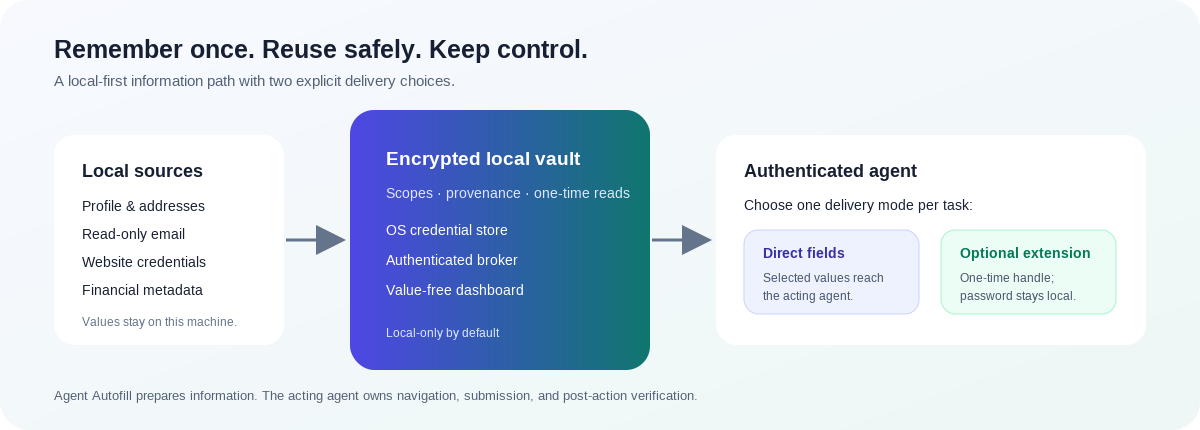
local sources (Chrome, Gmail/IMAP, Mac Messages)
        |
        v
encrypted broker (Keychain key, scopes, redaction, one-time OTP/handles)
   |         |                 \
Inbox    MCP stdio          optional Chrome extension
- Broker: validates scopes, matches metadata without exposing values, and owns one-time reads.
- Inbox (
inbox-web): loopback-only, read-only inventory and grant health view (What is stored?andWhat needs attention?). - MCP transport (
agent-autofill-server): authenticated local JSON-lines stdio server. Keychain-paired local services use their trusted local identity for read paths and reviewed writes; older or remote clients use explicit short-lived grants. - Optional extension: consumes an origin-bound credential handle locally so passwords never enter agent input.
LLM-guided record matching
Forms do not need a hard-coded profile schema. The acting agent sends only visible field metadata to match_form_fields, and Agent Autofill returns a ranked, value-free table:
| Step | What happens | Agent behavior |
|---|---|---|
| Rank | Candidate records are scored by label meaning, Chrome field semantics, and value-free learned mappings. | Try the first high-confidence row. |
| Clarify | Tied or missing rows include one focused question (such as which saved address to use). | Use page context first; ask the user only when ambiguous. |
| Remember | After confirmation or correction, record_form_mapping_feedback stores only field IDs, origin, purpose, and outcome. | Put that choice first next time. |
No profile value is sent merely to rank candidates, and matching never approves external submission.
Three safe agent workflows
Start with the three-part Agent Autofill skill (plus form memory, Chrome intake, and the Chrome seed onboarding guide).
| Workflow | What the agent does | User control and boundary |
|---|---|---|
| 1. Use saved data | Match metadata first (list_credentials with optional username_hint, semantic group resolution, match_form_fields), then request only fields needed for the current origin and purpose. | Values stay transient. Credential delivery is explicitly direct or extension; OTPs are one-time reads. Fresh confirmation before external submit, purchase, or account change. |
| 2. Propose new saved entries | Turn a user-supplied or verified stable value into a structured add/update proposal with sensitivity, scope, and confidence. | Nothing is written until the user approves exact rows. Passwords, full payment values, tokens, and OTPs never enter profile proposals; newly created website logins default to reviewed dual-save. |
| 3. Import from Chrome | Read structured autofill names, contacts, and addresses from a selected local Chrome profile, keeping source groups separate. | Local and read-only snapshots. Saved-password import (macOS v10/v11) is a separate local-only opt-in; v20/App-Bound Encryption and passkeys stop safely. |
When a form asks for a field that is not saved yet, the acting agent asks once in context — use once, save to Agent Autofill, or skip — showing one compact confirmation card so saving the reusable record and its narrow write scope happens in a single approval without approving form submission.
Choose your delivery mode
Agent Autofill supports two explicit ways to deliver a website credential. Direct CLI/MCP delivery is the default; the Chrome extension is optional.
| Mode | What crosses into agent input | Choose it when |
|---|---|---|
| Direct | Only approved selected fields | The acting agent is allowed to handle the value and complete the step. |
| Optional extension bridge | A short-lived, origin-bound handle; the password stays out of agent input | You want lower-exposure local password delivery after reviewing the grant. |
# 1. Inspect credential metadata without returning passwords
agent-autofill --db ~/.agent-autofill.sqlite3 \
  credentials list --target-origin https://example.test

# 2. Grant site access with an explicit delivery mode
agent-autofill --db ~/.agent-autofill.sqlite3 \
  grant-site agent-1 https://example.test "account setup" --delivery direct

# 3. Optional: start the loopback bridge and load browser_extension/ as an unpacked Chrome extension
agent-autofill --db ~/.agent-autofill.sqlite3 fill-server
Configure form-submission confirmation (always by default; non-financial allowed for ordinary forms, while financial forms always require confirmation):
agent-autofill --db ~/.agent-autofill.sqlite3 policy form-submission --confirmation non-financial
agent-autofill --db ~/.agent-autofill.sqlite3 policy form-submission --json
Security model
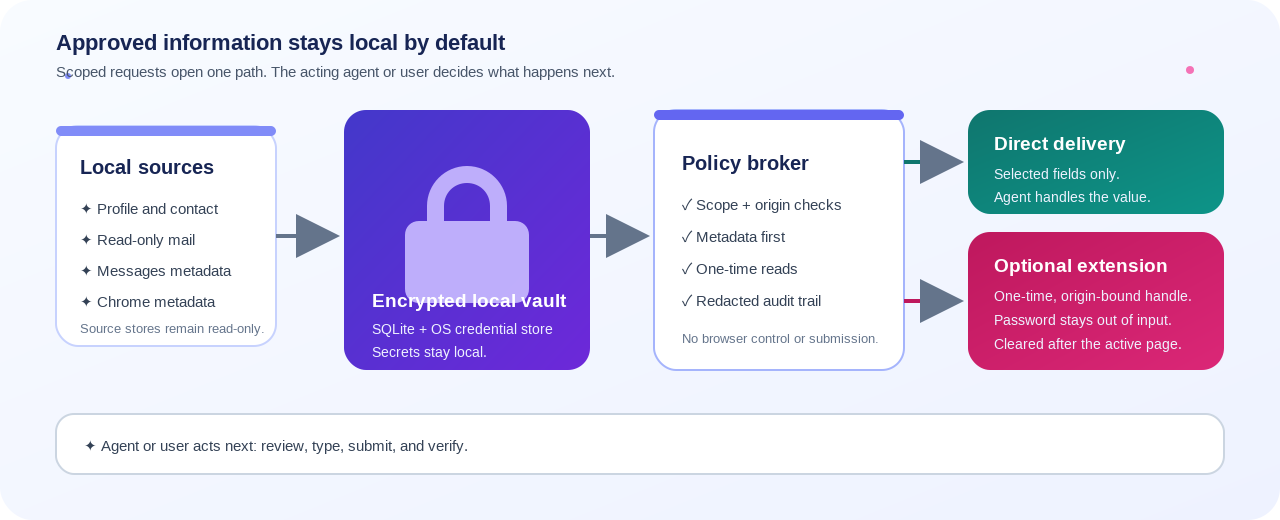
- SQLite values are encrypted with a key stored in the OS credential store (macOS Keychain).
- IMAP and OAuth connector secrets stay in Keychain — never in files, prompts, or environment variables.
- Local review and fill HTTP servers bind strictly to loopback (
127.0.0.1/localhost/::1). - Passwords, full payment numbers, security codes, mailbox tokens, message bodies, and OTPs never appear in logs, audits, listings, or diagnostics.
What the local vault can remember
Synthetic examples of what you can store and how agents access it:
| Record | Example stored data (synthetic) | What an agent can request |
|---|---|---|
| Identity | legal_name: "Synthetic Demo User"; date_of_birth: 1990-04-12; phone; primary & backup email | Only named fields for one origin and purpose |
| Addresses | Separate reviewed groups for home (100 Demo Way, 98101) and shipping | A selected address group or individual fields, with provenance |
| Preferences | Organization, dietary preference, accessibility preference, stable form answers | Named preference fields; asks when a form needs something new |
| Website credential | example.test username + encrypted password + optional note | Direct selected fields or a one-time origin-bound extension handoff |
| Payment card | Network, last four 4242, expiration 05/2031; encrypted card number & security code | Metadata matching first, then approved checkout fields only |
| Email source | Read-only IMAP or Gmail account (owner@example.test) | Scoped search/read, or one recent OTP via request_auth_code |
| Mac Messages source | Read-only macOS Messages via zero-FDA faster-mac-use AX (or explicit chat.db) | Origin-matched SMS/iMessage 2FA via request_messages_auth_code, plus scoped list_conversations / search_messages / get_message (no send/delete) |
Quick metadata CLI examples:
agent-autofill --db ~/.agent-autofill.sqlite3 email-match owner@example.test
agent-autofill --db ~/.agent-autofill.sqlite3 profile list --category identity --limit 20
agent-autofill --db ~/.agent-autofill.sqlite3 financial-records --kind payment_card --last4 1234
agent-autofill --db ~/.agent-autofill.sqlite3 grant-email codex email.otp owner@example.test --expires-in 600
Example agent journeys
6 end-to-end browser workflows Agent Autofill unlocks (hotel booking, job applications, 2FA account recovery, checkout, event registration, missing-field memory)
- Book a hotel without pasting a password or card number: Match the saved login by exact origin, fill via a one-time extension handle (password stays out of the transcript), pull
legal_name+ billing address + live email or Mac Messages 2FA code, match the card by last four, and pause for mandatory financial confirmation before checkout. - Complete a job application with scoped identity fields: Approve only name, phone, email, address, and birthdate for one recruiting origin; pause on optional demographic questions instead of guessing; confirm before submitting.
- Recover a support portal with an email or SMS code: Match the portal login, request one recent email OTP or zero-FDA Mac Messages code (
request_messages_auth_code), enter the code, and stop at any password change or security consent. - Check out online without standing grants: Match shipping address and card hints under a short-lived checkout grant, keep unrelated cards/addresses local, and require mandatory financial confirmation before purchase.
- Register for an event from reusable profile memory: Share only selected identity and preference fields (dietary, accessibility, org), fetch a verification code if prompted, and let the grant expire afterward.
- Save a new field mid-task without losing flow: When a form asks for an unsaved field like company name, the agent offers use once, save to Agent Autofill, or skip in one compact card, persists approved records via
write_records, and still pauses at the final submission gate.
Setup, CLI, and MCP configuration
Install with uv or pipx (or editable python3 -m pip install -e . for contributors):
uv tool install agent-autofill # or: pipx install agent-autofill
Inspect your vault before connecting an agent:
agent-autofill --db ~/.agent-autofill.sqlite3 init
agent-autofill --db ~/.agent-autofill.sqlite3 quickstart   # value-free readiness summary
agent-autofill --db ~/.agent-autofill.sqlite3 inbox-web    # loopback read-only review page
agent-autofill --db ~/.agent-autofill.sqlite3 setup        # guided identity & connector setup
agent-autofill --db ~/.agent-autofill.sqlite3 doctor       # Keychain, source, Messages & grant checks
Preview the MCP config before writing (mcp-install pairs a local service identity in Keychain):
agent-autofill mcp-install --client cursor
{
  "mcpServers": {
    "agent-autofill": {
      "command": "agent-autofill-server",
      "args": ["--service", "cursor"]
    }
  }
}
Documentation map
Start at the docs hub, or jump to a specific guide:
| I want to… | Read |
|---|---|
| Install and complete my first safe run | Getting started |
| Seed autofill and optionally saved passwords from Chrome | Chrome seed onboarding |
| Understand direct versus extension delivery | Access modes |
| Find the right command | CLI cookbook |
| Recover from Keychain, Chrome, Messages, or bridge issues | Troubleshooting |
| Understand the architecture and MCP surface | Architecture and operator guide |
| Check platform and feature coverage | Support matrix |
| Add code safely | Package guide |
| Use the optional Chrome extension | Extension guide |
| Run form-filling scenarios | Evaluation set |
Development
python3 -m pytest -q tests
node --test tests/agent_autofill/*.test.cjs
ruff check agent_autofill tests
mypy agent_autofill
python3 -m compileall -q agent_autofill tests
git diff --check
Cross-layer synthetic smoke test (memory-only; never touches Keychain, vault, browser, mail, or Messages):
python3 -m pytest -q tests/agent_autofill/test_workflows_e2e.py
Read the support matrix before integrating, and use SECURITY.md for responsible vulnerability reports. Use synthetic values only in tests, fixtures, screenshots, and documentation.
✦ Remember once. Reuse safely. Keep control. ✦
If Agent Autofill saves you time on local agent workflows, consider starring the repo or sharing an evaluation case.
License
Open source under AGPL-3.0-only, with the Section 7 attribution terms in ATTRIBUTION.md. Copies and modified versions must keep this credit in their README and --version or About output, mark their changes, and may not use the Agent Autofill name:
Based on Agent Autofill by lifan-builds (https://github.com/lifan-builds/agent-autofill)
Copyright © 2026 lifan-builds. Pull requests are welcome under CONTRIBUTING.md with a one-time CLA. For licensing outside AGPL, open an issue.