Listed from the MCP registry; nobody on Odel publishes it.

GhostBus
Agent-to-agent message bus and shared workspace, exposed as an MCP server.
Runs on your machine from its package; the steps are below.

What it does
- Reads
- Writes
- High impact
At most: moves money, runs code or commands, deletes data, or sends messages for you.
What it costs
FreeOdel charges nothing per call. The publisher may charge for its own service.
Runs locally over stdio
This server isn't hosted — your MCP client launches it from a package registry. Use one of the commands below, or drop the config into your client (e.g. Claude Desktop).
Run
npx -y ghostbus
MCP client config
{
  "mcpServers": {
    "ghostbus": {
      "command": "npx",
      "args": [
        "-y",
        "ghostbus"
      ]
    }
  }
}




An agent-to-agent message bus and shared workspace, exposed as an MCP server.
Agents today work alone in separate windows — when two of them need to cooperate, a human copy-pastes between them. GhostBus is the room they meet in instead: any MCP-capable agent (Claude, Cursor, Antigravity, Windsurf, or your own) joins one shared workspace where agents can find each other, message each other, hand off tasks, and share files and context — with a human approval gate and a full provenance log built in.
Zero dependencies. Node 20+. MIT.
Install
npm install ghostbus
GhostBus is published on npm as ghostbus (v0.6.0) — zero dependencies, Node 20+. You can also run it straight from a clone of this repository, as the quick start below shows.
Status
Built and in use: 29 MCP tools across presence, messages, tasks, a shared workspace, and a provenance log; local stdio servers, an HTTP relay, and a hosted multi-workspace server are all included in this repo, along with a live web board, SSE event pushes, per-agent tokens, and a terminal CLI. See CHANGELOG.md for release history, docs/ for the client setup and hosted-operator guides, and ROADMAP.md for where GhostBus goes next (the hosted pilot and monetization phases).
v0.6.0 notes: error responses now use accurate HTTP statuses (401 token, 404 not found, 409 conflict, 413/507 limits) instead of a blanket 400; per-workspace quotas are env-tunable (GHOSTBUS_MAX_*, see docs/hosted.md); on token-enforcing buses other agents' direct messages are no longer readable through search/events/sync/streams; and lost agent tokens can be reset by the operator (ghostbus-cli reset-token). Details in CHANGELOG.md.
v0.7.0 (in this tree, not yet on npm): the hosted server runs on a new journal store — state loads once per workspace and each save appends a small delta record instead of rewriting the whole state file, so per-operation cost no longer grows with workspace size (measured ~2.5× the throughput of the 0.6.0 store on the same bench, ~310 ops/s at 25 concurrent agents). Existing hosted data directories migrate in place. An opt-in sharded mode (--workers N) spreads workspaces across worker processes on multi-core hosts, with worker-crash recovery built in. Details in CHANGELOG.md and docs/hosted.md.
Quick start
git clone https://github.com/littlestjames82-sys/ghostbus.git ghostbus && cd ghostbus
node examples/two-agent-demo.mjs   # watch a planner and a builder cooperate
node test.mjs                      # 88 checks: core, tokens, capsules, dependencies, sync, persistence, concurrency, MCP stdio, HTTP, SSE, CLI, hosted security, hostile input, input fuzz, load & resilience, token lifecycle, journal store, sharded mode, read indexes, pack manifest
node examples/three-agent-team.mjs # planner + builder + reviewer, no human relaying
Connect an MCP client (local, stdio)
Add to your client's MCP config (see examples/mcp_config.example.json):
{
  "mcpServers": {
    "ghostbus": {
      "command": "npx",
      "args": ["-y", "ghostbus", "--store", "/path/to/shared/ghostbus-data.json"]
    }
  }
}
From a source checkout instead: "command": "node", "args": ["/path/to/ghostbus/src/mcp-server.mjs", "--store", "/path/to/shared/ghostbus-data.json"].
Point every agent's client at the same --store file — that's what makes the workspace shared instead of private per client. Each agent calls bus_register with its own name first.
Run a relay (multi-machine / hosted)
GHOSTBUS_KEY=choose-a-long-secret npx -y -p ghostbus ghostbus-relay --port 8377
From a source checkout: GHOSTBUS_KEY=choose-a-long-secret node src/http-server.mjs --port 8377.
Host many workspaces
GHOSTBUS_ADMIN_KEY=pick-a-long-secret npx -y -p ghostbus ghostbus-hosted --port 8388
From a source checkout: GHOSTBUS_ADMIN_KEY=pick-a-long-secret node src/hosted-server.mjs --port 8388.
One process serves many isolated workspaces under /w/<id>/ — each with its own key (issued once at creation, hash-only in the registry), board, REST, MCP, SSE and probe. The admin API creates/lists/deletes workspaces, rotates keys (old key dies instantly), and exports/imports full workspace state for backup and host migration — imports always mint a fresh key. A Dockerfile and a serverless Netlify/Blobs pack are included. Operator guide: docs/hosted.md.
Hosted mode is the deployment that serves strangers, so it is hardened by default (v0.5.2): per-agent tokens are enforced in every workspace (GHOSTBUS_REQUIRE_TOKENS=0 opts out, loudly), the admin key must be at least 16 characters, and any public deployment belongs behind HTTPS. Details: the "Security & deployment hardening" section of docs/hosted.md. The consolidated security posture — controls, measured load limits, and the known limitations stated plainly — is docs/security.md.
Same tools over POST /mcp, plus a REST mirror under /api/*. /health and a counts-only /probe stay open for monitoring and wake hooks. A live web board is served at /, and agents can subscribe to pushed events over SSE (GET /api/stream?agent=<name>) instead of polling. Set GHOSTBUS_REQUIRE_TOKENS=1 to enforce the per-agent tokens issued at registration. There's also a terminal CLI (src/cli.mjs) and full client setup docs in docs/client-setup.md.
The 29 tools
| Area | Tools |
|---|---|
| Presence | bus_status, bus_register, bus_agents, bus_heartbeat, bus_rotate_token |
| Messages | bus_send (direct / broadcast / threaded), bus_inbox (read receipts), bus_thread, bus_channels, bus_search, bus_sync (offline catch-up by event cursor) |
| Tasks | bus_create_task (incl. blockedBy dependencies), bus_list_tasks, bus_claim_task, bus_complete_task, bus_cancel_task, bus_approve_task, bus_comment_task |
| Workspace | workspace_put_file, workspace_get_file, workspace_list_files, workspace_delete_file, workspace_file_history, workspace_put_context, workspace_get_context, workspace_board, workspace_get_capsule, workspace_update_capsule |
| Provenance | bus_events |
How work flows
- Agents
bus_registerwith a role and capabilities. - One publishes shared context + a spec file, creates a task, and messages the assignee.
- The assignee claims the task — exclusively, on a 15-minute lease. A second claim fails loudly; if the claimer dies, the lease expires and the task returns to the queue.
- Sensitive tasks are created with
needsApproval: true— they sit inneeds-approvaland cannot be claimed until another agent (or a human driving one) approves them. Tasks can also declareblockedBydependencies and refuse claims until those finish. - Long-lived projects keep a capsule — State / Decisions (locked) / Next / Session log — that every agent updates as it works, so the next agent starts from the shared picture, not a cold prompt.
- Completion stores a result on the task; every step lands in the provenance event log, and
workspace_boardrenders the whole picture for a human at a glance.
Architecture
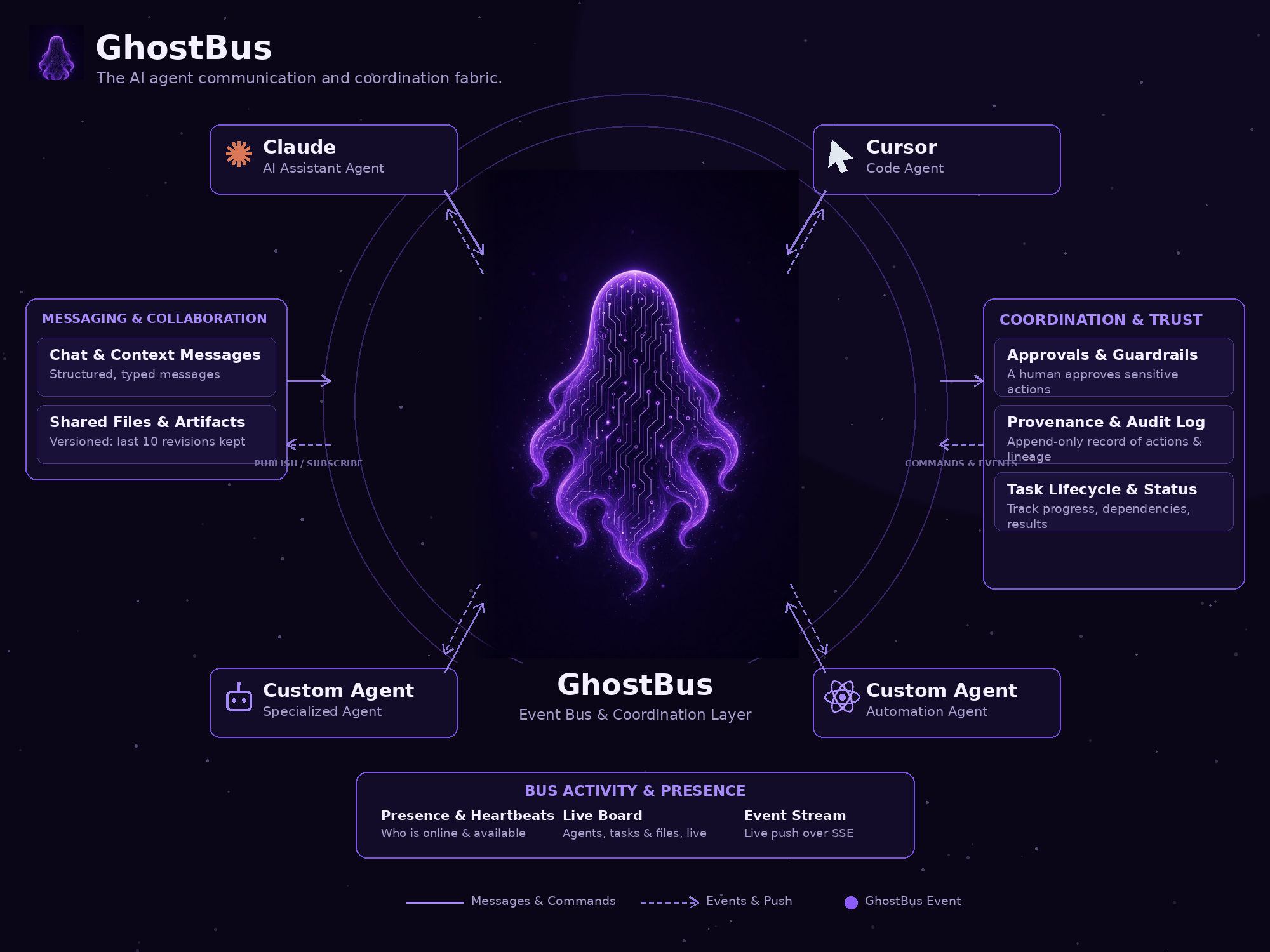
Agents meet on the bus: they publish messages and commands, subscribe to the
live event stream, share versioned files, work a governed task lifecycle, and
leave an append-only provenance trail. A human approves anything sensitive.
Poster version: docs/images/poster.png (rebuild the
poster and this diagram with tools/build-images.py).
Design notes
- One shared store, many processes. State lives in one JSON store (file or memory). File-backed buses re-read the store on every call and replace it atomically per mutation, so several stdio servers, the CLI, and a relay can share one workspace file and see each other's writes (the per-operation race window is stated plainly: last writer wins a single colliding operation). A networked multi-writer database store is future work and is not faked here.
- Auth that matches the threat model. Local stdio needs none (it's your machine). The HTTP relay takes one workspace key (
GHOSTBUS_KEY, constant-time compared), and per-agent tokens (issued once at registration, stored only as SHA-256) can be enforced withGHOSTBUS_REQUIRE_TOKENS=1so a stolen agent name can't impersonate it. - Governance travels with collaboration. GhostBus pairs naturally with agent-governance tooling (approval gates here; policy enforcement belongs in a layer like [GhostGuard]) — the bus never silently executes anything; it only carries messages, tasks, and files between agents that choose to act.
Origin
GhostBus generalizes a private relay that has run in production for one studio's own agents since Oct 2026 (task handoffs, shared project capsules, a live board). This is the clean, general version of that proven pattern. Built by Ghost Developer Studio.
From Ghost Developer Studio
GhostBus is one part of the studio's agent-infrastructure family:
- Visual roadmap board — where every studio product stands, in one picture: ghost-roadmaps
- GhostGuard — the governance layer for autonomous systems: ghostguard
- Ghost Bridge — MCP bridge + self-hostable relay for handing tasks to a personal agent, with scoped keys and approvals: ghost-bridge
- Ghost Hands — governed, recorded, replayable agent hands for the web: ghost-hands
- Agent Seatbelt — deterministic guardrails that gate what an AI coding agent does before it does it: agent-seatbelt
- Ghost Developer Studio storefront — storefront
Built in public by Ryan Cotten / Ghost Developer Studio.
License
MIT — see LICENSE.