
CiteGuard
Open watchdog for retracted & problematic citations: Retraction Watch, OpenAlex, Crossref.
Runs on your machine from its package; the steps are below.
What it does
- Reads
- Writes
- High impact
At most: only reads or looks up information.
What it costs
FreeOdel charges nothing per call. The publisher may charge for its own service.
Runs locally over stdio
This server isn't hosted — your MCP client launches it from a package registry. Use one of the commands below, or drop the config into your client (e.g. Claude Desktop).
Run
uvx retractguard
MCP client config
{
  "mcpServers": {
    "citeguard": {
      "command": "uvx",
      "args": [
        "retractguard"
      ]
    }
  }
}
CiteGuard


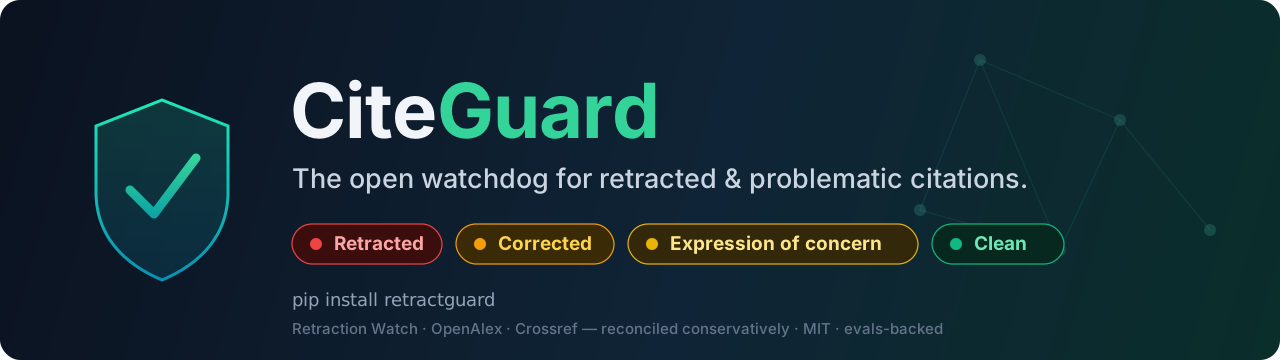
The free, open, OpenAlex-native watchdog for retracted and problematic citations.
CiteGuard tells you — and keeps telling you — when your references, your authors, or your institution's papers cite research the community has flagged as retracted, corrected, or subject to an expression of concern.
It exists because the existing options each fall short: scite is proprietary and paywalled,
RetractoBot had to license Scopus (no open citation database existed at the time), and
OpenAlex collapses all editorial status into a single is_retracted boolean that can't tell
a retraction from a correction — and has produced false positives in the past.
Now that the Retraction Watch dataset is open (via Crossref) and the OpenAlex citation graph is CC0, CiteGuard can do this fully in the open, for free.
Status: early development. Building the MVP. See
GOAL.mdfor the mission andCLAUDE.mdfor the build guide.
What it does
- Check a reference list. Paste a DOI or upload a
.bibfile → get a per-reference status: retracted, corrected, expression of concern, hijacked-journal, or clean. - Nuanced status, not a boolean. Every flag carries its source (Retraction Watch / OpenAlex / Crossref), an evidence link, a date, and a confidence note. When sources disagree, CiteGuard surfaces the conflict instead of silently guessing.
- Watch an institution. Point it at a ROR ID → get a digest when any of that institution's works cites (or becomes) a newly-flagged paper.
- Use it from an AI agent. An MCP server exposes the same logic as tools
(
check_references,get_editorial_status,watch_institution) for Claude, Cursor, and any MCP-compatible client.
Why it's trustworthy
Integrity tooling can do real harm if it's wrong — a false "retracted" flag damages a real
author. CiteGuard is conservative by design: it corroborates before flagging, prefers
the documented editorial notice, and marks a work UNKNOWN rather than guess. Every core
capability ships with a published eval reporting precision and recall on a gold set.
Who it's for
- Research-integrity officers and journal editors screening submissions
- Academic librarians at OpenAlex-adopting institutions
- Systematic reviewers (one retracted included study can invalidate a review)
- Developers and meta-scientists building on the MCP server
- Authors checking their own bibliography before submission
Architecture
One core, two surfaces.
                 ┌─────────────────────────────┐
   OpenAlex ─────▶                             │
   (CC0 graph)   │   editorial-status model    │──▶  MCP server
                 │   + resolution logic        │      (check_references,
   Retraction ──▶│   (conservative)            │       get_editorial_status,
   Watch (open)  │                             │       watch_institution)
                 │                             │──▶  reference-list checker
   Crossref ─────▶                             │      (DOI / .bib → statuses,
   (DOI norm.)   └─────────────────────────────┘       thin web UI)
Repository layout:
src/citeguard/
  openalex.py         # keyed, rate-aware, ID-lookup-first OpenAlex client
  retractionwatch.py  # ingest + normalize the Retraction Watch dump
  status.py           # the EditorialStatus model + resolution logic (core)
  checker.py          # reference-list checker (DOI / .bib -> statuses)
  mcp_server.py       # MCP server exposing the three tools
tests/                # pytest unit + functional tests
evals/                # gold sets + precision/recall harness
data/                 # local RW dump + cached lookups (gitignored)
Design constraints (important)
- Free-tier-aware. OpenAlex API keys are required (since Feb 13, 2026); the free tier is small and search costs ~10× a record lookup. CiteGuard resolves to IDs first and looks up by ID; bulk work uses the free monthly snapshot, and the live API is reserved for incremental checks.
- Open and reproducible. CC0 ethos, with proper attribution to Retraction Watch and OpenAlex, thorough docs, and a Zenodo DOI.
Getting started (dev)
Requires Python 3.11+ and uv.
uv sync                                   # install dependencies
export OPENALEX_API_KEY=...               # your OpenAlex key
export CITEGUARD_MAILTO=you@example.org   # polite-pool contact

uv run pytest                             # run tests
uv run python -m evals.run                # run the eval harness (precision/recall)
uv run python -m citeguard.mcp_server     # launch the MCP server locally
Connect it as an MCP server
CiteGuard exposes get_editorial_status, check_references, and watch_institution
to any MCP client. After pip install retractguard (or uv tool install retractguard),
the retractguard-mcp command launches the stdio server.
Claude Desktop — add to claude_desktop_config.json:
{
  "mcpServers": {
    "retractguard": {
      "command": "retractguard-mcp",
      "env": {
        "OPENALEX_API_KEY": "your-key",
        "CITEGUARD_MAILTO": "you@example.org"
      }
    }
  }
}
Cursor / other clients — point them at the same retractguard-mcp command (stdio
transport). Running from a checkout instead of an install? Use
"command": "uv", "args": ["run", "retractguard-mcp"] with "cwd" set to the repo.
On first call the server downloads the Retraction Watch dump (~65 MB, free) into
CITEGUARD_DATA_DIR (default ./data). Editorial-notice lookups (Retraction Watch,
Crossref) need no key; OpenAlex corroboration and watch_institution do.
The web checker
A thin web UI for people who don't live in an editor — paste DOIs or drop a .bib file,
get a per-reference status table.
retractguard-web            # then open http://127.0.0.1:8000
# or from a checkout: uv run python -m citeguard.web
Add Accept: application/json to POST /check to get the results as JSON instead of a
table. It reuses the same conservative resolution logic as the MCP server — no separate
code path, no separate trust model.
Roadmap (MVP)
status.py— the normalized editorial-status model (foundation)retractionwatch.py— ingest + normalize the Retraction Watch dumpopenalex.py— keyed, ID-first clientchecker.py— DOI /.bib→ statusesmcp_server.py— expose the three toolsevals/— gold set + precision/recall harness (running from step 2 onward)
Credits & data
- OpenAlex — CC0 scholarly metadata and citation graph.
- Retraction Watch — retraction database, made openly available via Crossref.
- Crossref — DOI infrastructure.
CiteGuard is independent and not affiliated with these projects; it builds on their open data with gratitude.
License
MIT (see LICENSE) — permissive and maximally reusable, in keeping with the
open-science ethos in GOAL.md.
The code is CiteGuard's. The data it builds on is not and carries its own terms:
Retraction Watch (via Crossref) and OpenAlex/Crossref metadata. CiteGuard redistributes
only a tiny evaluation extract (see evals/fixtures/ATTRIBUTION.md); anything at scale
should be fetched from the upstream sources under their licenses.




