
LuxAlgo MCP
LuxAlgo for AI agents: the Library, prop firms, Market Trackers, Edge Stats, and your Trade Journal
One address for any MCP client. No sign-in needed on this server.
What it does
23 read4 act15 other
Grouped by tool name. At most: creates or changes data: records, files, settings.
What it costs
FreeOdel charges nothing per call. The publisher may charge for its own service.
Tools
42 · grouped by tool name · checked 19 Oct 2026Read · 23Look things up
- library_search
- library_get_concept
- library_get_indicator
- library_get_source_code
- library_list_concepts
- library_list_indicators
- library_list_tags
- library_list_families
- library_get_family
- propfirms_search
- propfirms_get
- propfirms_search_challenges
- propfirms_search_offers
- propfirms_list_simulatable
- propfirms_compare
- propfirms_validate_strategy
- trackers_query
- journal_list_accounts
- journal_list_trades
- journal_get_trade
- journal_get_day
- journal_list_tags
- journal_search_notes
Act · 4Change something
- journal_add_trade
- journal_update_trade
- journal_write_note
- journal_update_note
Other · 15Neither hinted nor named
- propfirms_challenge_rules
- propfirms_simulate
- propfirms_optimal_risk
- propfirms_simulate_trades
- propfirms_pass_rates
- trackers_datasets
- trackers_latest
- trackers_ticker
- edge_symbols
- edge_presets
- edge_report
- luxalgo_account
- journal_overview
- journal_calendar
- journal_breakdown

LuxAlgo MCP


Library · Brokers · Edge Stats · Market Trackers · Challenge Simulator · Prop Firms · Vela for Developers · npm · Endpoint
LuxAlgo MCP is a LuxAlgo open-source project. Overview and setup: luxalgo.com/mcp.
It puts the LuxAlgo ecosystem behind a single MCP server: an encyclopedia of trading and technical analysis, your LuxAlgo trade journal, read-only access to your own brokerage accounts, hosted session statistics with a sample size on every number, the public record of US markets (congressional trades, insider filings, lobbying, contracts, patents and more, with a primary-source link on every row), a Monte Carlo challenge simulator, and a live prop-firm directory. No API key for anything hosted: the public tools are free and read-only, the Trade Journal and account tools use your LuxAlgo sign-in, and the local broker tools use your own keys and never send them anywhere.
claude mcp add --transport http luxalgo https://mcp.luxalgo.com/mcp
What's inside
| Area | What you get |
|---|---|
| Library | The encyclopedia of trading and technical analysis: hundreds of concept pages with formulas, the full indicator catalog organized by family and concept, and Pine Script® sources where publicly served. |
| Trade Journal (sign-in) | Your own journal in the LuxAlgo app: the dashboard (metrics, Edge Score, equity curve), the P&L calendar, breakdowns by weekday / hold time / symbol / tag and more, every trade with its fills and annotations, day notes — and the writes that keep it alive: log fills by hand, annotate trades (tags, mistakes, rating, stop and target, review), write notes. Always as you, on your data; the app owns the rules. |
| Brokers (local only) | Read-only access to your own accounts across 22 brokers and exchanges via broker-sdk: balances, positions, trade history, FIFO performance stats. Keys live in your MCP client config as env vars and never leave your machine. The hosted endpoint does not carry these tools, on purpose. |
| Edge Stats | Hosted session statistics from the open-source edge-stats engine: how often a setup actually worked (gap fills, opening-range breakouts, day-of-week effects, event days) with the sample size and a Wilson 95% confidence interval on every number. A nightly build runs the real engine over free market data and publishes only derived statistics; these tools serve them verbatim. |
| Market Trackers | The public record of US markets from primary sources only: congressional trades, insider (Forms 3/4/5) transactions, 13F holdings, federal contracts and grants, lobbying filings, FINRA short-sale volume, granted patents, clinical trials, FDA drug events, CFTC positioning, federal bills, FEC campaign finance, hearing transcripts, Federal Reserve communications, committee assignments, Wikipedia pageviews. Read straight from the pipeline's CC0 dumps — live tree plus deep-history archives — with provenance.sourceUrl on every row. Data only: no signals, scores, or predictions. |
| Challenge Simulator | The open-source prop-firm-sim Monte Carlo engine, running locally inside the server. Your stats, or your real R-multiple trade series, through a firm's exact ruleset: pass probability with confidence intervals, expected attempts and cost, EV over the funded horizon, optimal-risk sweeps, cross-challenge comparison. Deterministic under seed, every assumption disclosed. |
| Prop Firm Directory | The live data the simulator draws from: firms, funded-account challenges with their full rulebooks (account sizes, fees, steps, profit splits, drawdown modes, trading restrictions), and current offers. |
| Charts (your browser) | Not a tool: the chart you draw with what the tools return. The open-source core of Vela by LuxAlgo runs the Pine Script® that library_get_source_code hands back and paints the fills that broker_trades lists, in a browser tab, on your machine. How the loop works. |
Install
The hosted server is one URL:
https://mcp.luxalgo.com/mcp
Claude (web, desktop, mobile)
Customize → Connectors → Add custom connector, URL https://claude.mcp.luxalgo.com/mcp, and under Authentication choose Required when the server asks. Claude connects anonymously, every keyless tool works right away, and the sign-in card only appears the first time you call an account tool. This Claude-only address exists because Claude.ai otherwise opens the OAuth window at connect time for any server whose OAuth metadata it can discover (claude-ai-mcp#1013); it serves the same tools with that metadata hidden until a sign-in is actually needed. Every other client uses https://mcp.luxalgo.com/mcp.
Claude Code
claude mcp add --transport http luxalgo https://mcp.luxalgo.com/mcp
Cursor
Use the Install in Cursor button above, or add this to .cursor/mcp.json:
{
  "mcpServers": {
    "luxalgo": {
      "url": "https://mcp.luxalgo.com/mcp"
    }
  }
}
Any other MCP client
Point your client's MCP config at the hosted URL:
{
  "mcpServers": {
    "luxalgo": {
      "url": "https://mcp.luxalgo.com/mcp"
    }
  }
}
Where each client keeps its config
| Client | Where to add it |
|---|---|
| Cursor | .cursor/mcp.json, or the install button above |
| Claude Desktop | claude_desktop_config.json |
| VS Code | Install button above, or MCP settings |
| Windsurf | ~/.codeium/windsurf/mcp_config.json |
| Zed | settings.json under context_servers |
| Warp | Settings → Agents → MCP servers |
| LM Studio | mcp.json |
| OpenCode | opencode.json |
| Gemini CLI | ~/.gemini/settings.json |
Local (stdio)
Runs every hosted tool locally, and unlocks the broker tools. Set read-only credential env vars for the brokers you use. Any subset works: a broker connects when all of its vars are set, and with no vars at all the broker tools simply stay unconfigured.
{
  "mcpServers": {
    "luxalgo": {
      "command": "npx",
      "args": ["-y", "@luxalgo/mcp"],
      "env": {
        "BROKERS_ALPACA_API_KEY": "…",
        "BROKERS_ALPACA_API_SECRET": "…",
        "BROKERS_KRAKEN_API_KEY": "…",
        "BROKERS_KRAKEN_API_SECRET": "…",
        "BROKERS_HYPERLIQUID_WALLET_ADDRESS": "0x…"
      }
    }
  }
}
Env var names derive from each broker's credential fields: BROKERS_<BROKER>_<FIELD> (for example BROKERS_OKX_PASSPHRASE, BROKERS_IBKR_FLEX_FLEX_TOKEN). The broker_setup tool lists every supported broker, its exact variables, and a one-line guide to creating each key with read-only scope, which is all this server ever needs.
Signing in with LuxAlgo (optional)
Almost everything here is keyless and works without an account. The tools in the Account and Trade Journal sections below need to know who you are; they use your LuxAlgo account through standard OAuth 2.1, with app.luxalgo.com as the authorization server. Nothing is required up front: every client can connect, list tools and use the public ones anonymously, and sign-in is only requested when you first call an account tool.
Hosted (ChatGPT, Claude, Cursor, any remote connector). The server advertises its protected-resource metadata and answers an unauthenticated account-tool call with a 401 + WWW-Authenticate challenge; MCP clients handle the rest (discovery, PKCE, consent screen in your browser) and keep the token for you. Each tool also declares its policy in tools/list (securitySchemes: noauth for public tools, oauth2 for account tools), so ChatGPT's per-tool linking works as well. Clients may identify themselves via Client ID Metadata Documents or Dynamic Client Registration — the app accepts both. One client-side exception: Claude.ai/Desktop connectors sign in at connect time whenever OAuth metadata is discoverable, regardless of their Authentication setting, so they get their own address, https://claude.mcp.luxalgo.com/mcp, whose metadata is only reachable from the 401 (see Install).
Local (stdio). The server running on your machine is itself the OAuth client. Sign in once:
npx -y @luxalgo/mcp login     # opens your browser; tokens are stored under your user config dir (0600)
npx -y @luxalgo/mcp status    # who is signed in, token expiry
npx -y @luxalgo/mcp logout
Tokens live in ~/.config/luxalgo/mcp-auth.json (%APPDATA%\luxalgo\mcp-auth.json on Windows, or LUXALGO_MCP_AUTH_FILE), are refreshed automatically, and are only ever sent to the LuxAlgo app. If your MCP client supports URL-mode elicitation (MCP 2026-07-28), you can skip the command: the first account-tool call asks the client to open the sign-in page and continues once you approve. Otherwise the tool answers with the challenge and the login hint.
What the token is for. This server never decides what you are entitled to — its code is public, so any such check would be decorative. Instead, once you are signed in, every request a tool makes to the LuxAlgo app carries your token, and the app resolves your account and plan from it exactly as it does when you use the web app. Public tools work without it; with it, the app can tailor what they return. When the app declines — no valid sign-in (401) or a feature outside your plan (403) — the tool reports that, naming the permission involved.
Tools
Library
| Tool | Description |
|---|---|
library_search | One search over concepts (alias-aware) and indicators |
library_get_concept | Full concept page as markdown |
library_get_indicator | Indicator detail: body, family, concepts, source code availability |
library_get_source_code | Source code, fetched only on demand: in full when publicly served, or the start of it (complete: false) for indicators the app previews to signed-out users; chart_url opens the indicator on a Vela chart |
library_list_concepts | Paginated concept roster, optionally per family |
library_list_indicators | Filtered, paginated browse (family, concept, platform, tier) with server-side sort |
library_list_families | The taxonomy backbone with counts |
library_get_family | A family hub as markdown plus concept roster |
Library outputs are compact JSON with canonical urls for citation. Concept and family pages are also directly fetchable as markdown: append .md to any concept URL.
Account (sign-in required)
| Tool | Description |
|---|---|
luxalgo_account | The signed-in user's plan tier, entitlements (alerts, historical bars, AI credits, …) and profile basics — so an agent can tailor answers to what the plan actually allows |
Trade Journal (sign-in required)
Your own trade journal in the LuxAlgo app — the same accounts, trades, annotations and notes the app shows — read and written as you. Dates are YYYY-MM-DD day keys in your journal timezone (journal_list_accounts reports it); account filters take ids from the same call.
| Tool | Description |
|---|---|
journal_list_accounts | Journal accounts (broker-synced, imported or manual; currency, initial balance, lot method, last sync, archived state) and the journal timezone — the first call, since every accounts filter takes these ids |
journal_overview | The dashboard for a window: performance metrics, Edge Score, per-day P&L, equity curve, open positions, accounts and settings; compare adds the previous equal-length window |
journal_calendar | One month of the P&L calendar: day cells, weekly and monthly totals, trading and winning days |
journal_breakdown | Closed trades grouped by weekday, time of day, hold time, symbol, side, position size, tag, rating and asset class — where the P&L comes from |
journal_list_trades | Trade summaries, keyset-paginated; filter by accounts, open-day window, symbol, direction, status, tag; sort by opened/closed time, net or gross P&L, duration, quantity, symbol or rating, either direction |
journal_get_trade | One trade in full: fills (reported values, corrections, hidden), per-exit P&L, every annotation |
journal_get_day | A single day's stats, trades and notes |
journal_list_tags | The user's annotation vocabulary — tags, mistakes, playbooks with usage counts — so new annotations reuse existing words |
journal_search_notes | Day notes and trade notes as one newest-first stream; text query, day window, symbol and account filters, paginated |
journal_add_trade | Log a trade by hand: its fills into a manual or import account; returns the resulting trade(s) |
journal_update_trade | Annotate a trade: notes, tags (replace or add/remove), mistakes, playbook, rating, stop loss, profit target, reviewed |
journal_write_note | Add a note to a day |
journal_update_note | Replace a day note's text or move it to another day |
The journal tools and luxalgo_account are the only tools that need a LuxAlgo account; see Signing in with LuxAlgo. Without a sign-in they return an OAuth challenge instead of data — never a silent fallback. The write tools act only as the signed-in user and only on that user's journal; the app validates and owns every change.
Brokers (local stdio only)
| Tool | Description |
|---|---|
broker_setup | Supported brokers, their env vars (set or unset, never values), read-only key guides |
broker_accounts | Connected accounts: broker, currency, equity, cash |
broker_positions | Open positions with market values, asset class, entry price; negative quantity means short |
broker_trades | Trade history, newest first; filter by broker or symbol |
broker_stats | Total equity, equity by broker, top positions, FIFO win rate and realized PnL |
broker_refresh | Bypass the 5-minute cache and re-fetch now |
Read-only by construction: the SDK's root export has no trading endpoints, the server never writes secrets anywhere, and per-broker failures are reported alongside results, never silently dropped.
Edge Stats
Hosted session statistics from the open-source edge-stats engine, precomputed nightly:
| Tool | Description |
|---|---|
edge_symbols | What the hosted store covers: symbols, session calendars, coverage windows, last build |
edge_presets | The catalog of precomputed questions, each stating in plain language what its number means |
edge_report | One result in the engine's full honesty envelope: estimate, N, Wilson 95% CI, minimum-sample guards, stability split, per-year counts, distribution, disclaimer |
Every number arrives with its sample size — the engine has no code path that returns a percentage without one. Results are historical conditional frequencies, never predictions. For arbitrary composed queries or your own market data, run edge-stats locally; its own MCP server exposes the full engine over your local store.
Market Trackers
| Tool | Description |
|---|---|
trackers_datasets | The catalog: every dataset's row count, freshness, years with data (live vs deep-history archive), ticker-searchability; pass dataset for its field roster, filterable paths, caveats, per-year coverage, source health and dump URLs |
trackers_query | Search one dataset by ticker, free text, exact field values (where, dot paths) and event-date range, choosing which years to read; newest/oldest ordering with paging |
trackers_latest | The newest daily delta of a dataset (today's insider filings, this week's congressional disclosures), optionally narrowed by ticker or text |
trackers_ticker | One ticker across every ticker-bearing dataset for a year: per-dataset counts with the newest rows — a public-record dossier |
The data is the CC0 output of LuxAlgo/market-trackers, published daily to LuxAlgo/market-trackers-data: year-sharded gzipped JSON in the repository's live tree, plus deep-history shards attached to the data repo's GitHub Releases and indexed in its archives.json. The server streams shards row by row (never loading a whole file) under a per-call budget of compressed bytes, so a deep-history year (often 30–60 MB compressed) is read one at a time. Amounts disclosed as ranges stay ranges; ticker mappings for contracts, lobbying, trials, FDA events and patents are best-effort against a curated map of public companies; every row keeps its primary-source deep link.
Challenge Simulator
Runs locally inside the server:
| Tool | Description |
|---|---|
propfirms_list_simulatable | Every simulatable firm and challenge in the live directory, provenance-disclosed |
propfirms_challenge_rules | One challenge's full encoded ruleset (drawdown modes, consistency, payout gating, citations), editable and re-simulatable inline |
propfirms_simulate | Monte Carlo of your stats (win rate, avg win, trades/day, risk sizing) through a firm's exact ruleset and funded horizon: pass probability with CI, which rule kills attempts, expected attempts and cost, EV, payout probability |
propfirms_simulate_trades | Same, from your real R-multiple trade series; block bootstrap preserves your streaks |
propfirms_optimal_risk | Risk sweep: pass-optimal vs EV-optimal risk per trade (they differ) |
propfirms_compare | Same trader across up to 12 challenges, EV-sorted (not a ranking) |
propfirms_pass_rates | The site's reference-archetype odds, recomputed live (seed 42, 10k paths) |
propfirms_validate_strategy | Screen one strategy across every simulatable challenge against an explicit pass bar |
Every simulation result carries its assumptions, unsimulated-rule flags, seed, and engine version. Results are distributions under stated assumptions, never promises. The engine runs locally; firm rules adapt live from the directory, and inline specs simulate fully offline.
Prop Firm Directory
The live directory the simulator draws from, queryable directly:
| Tool | Description |
|---|---|
propfirms_search | Search firms; firm filters (platforms, markets, payments, Trustpilot, country availability) compose with nested challenge and offer filters, and include nests matching children |
propfirms_get | One firm's full dossier: profile, every challenge, live offers, written overview |
propfirms_search_challenges | Search challenges by rules (size, fee, steps, profit split, drawdown, trading restrictions) and parent firm; can attach applicable live offers |
propfirms_search_offers | Current discounts and promo codes, resolvable per firm or per challenge |
Charts, in your browser, with Vela
Every tool above returns text and JSON. When the answer wants a chart, draw it with the open-source core of Vela by LuxAlgo (@luxalgo/vela, Apache-2.0, GitHub), the charting library behind Vela: a headless chart with its own WebGL2 renderer that takes bars you already have, or fetches them from keyless public providers, and runs indicator scripts through pluggable engines. Pine Script® lives in the @luxalgo/vela-pinets addon, which is what closes the loop with the Library: library_get_source_code hands an agent an indicator's exact Pine source, and Vela's open-source core executes that source on a chart.
To open an indicator on Vela, LuxAlgo's next-generation charting platform at vela.luxalgo.com/chart, give the user the chart_url that library_get_source_code returns when the indicator's code runs only on LuxAlgo.

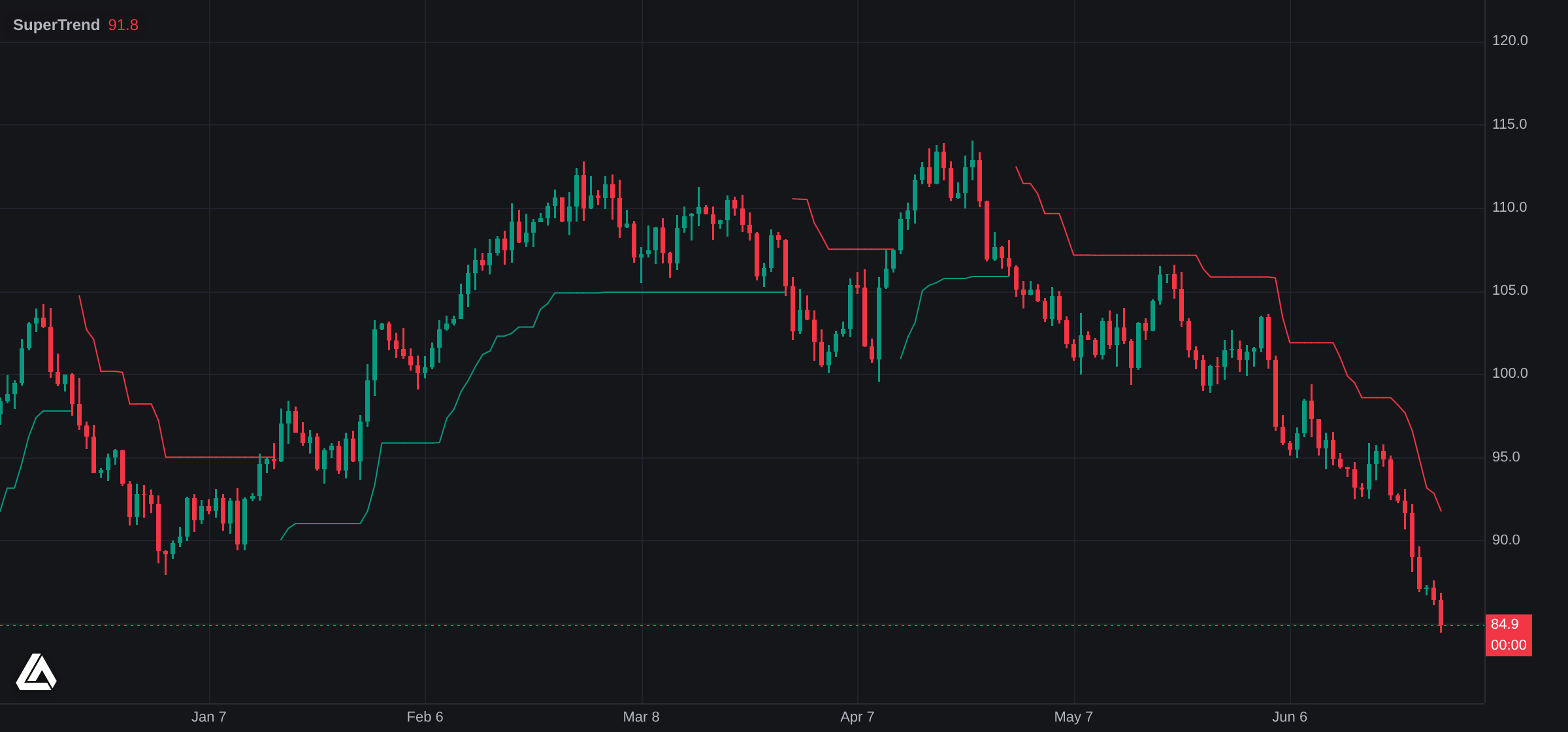
Not a mockup: the Library's SuperTrend source as returned by library_get_source_code, executed by @luxalgo/vela-pinets on a @luxalgo/vela 0.6 chart and screenshotted in headless Chromium. The bars are a labelled synthetic sample; point data at your own or register a provider for live ones.
The whole demo is two script tags and five lines. source is the source field of a library_get_source_code result:
<div id="chart" style="height: 480px"></div>
<script src="https://cdn.jsdelivr.net/npm/@luxalgo/vela@0.6.15/dist/vela.global.min.js"></script>
<script src="https://cdn.jsdelivr.net/npm/@luxalgo/vela-pinets@0.2.10/dist/vela-pinets.global.min.js"></script>
<script>
  const chart = new Vela.Vela('#chart', { data: bars, timeframe: '1D', theme: 'dark' }); // bars: [{ time, open, high, low, close, volume? }]
  chart.registerEngine('pine', new VelaPinets.PineEngine());
  chart.addIndicator(source);
</script>
With a bundler it is the same three calls over import { Vela } from '@luxalgo/vela' and import { PineEngine } from '@luxalgo/vela-pinets'; see Vela's quickstart. The same chart paints your own trades: Trade Journal takes the shape broker_trades returns and draws entries, exits and P&L labels through Vela's native-indicator API, engine-free, in one component you can lift as is.
Where each piece runs. This matters because it is the opposite of how the rest of this server works:
| Piece | Where | Notes |
|---|---|---|
| Vela | A browser tab on your machine (Canvas 2D or WebGL2). | Never inside this server, hosted or stdio, and never in an MCP response. An agent gets the Pine source and the trades as text; the chart is what you build with them. |
| Bars | Yours, via data, or Vela's keyless Binance, Coinbase and Hyperliquid providers, fetched by the browser. | This server serves no market data, so a chart needs no LuxAlgo key and makes no LuxAlgo request. |
| Pine Script® | @luxalgo/vela-pinets, which executes the PineTS runtime. | AGPL-3.0, licensed separately from Vela's Apache-2.0 and this server's MIT. Vela itself ships no engine and carries no Pine code. |
| Attribution | Vela's mark, bottom-left of every chart. | Stays on unless you show equivalent attribution next to the chart; see Vela's NOTICE. |
Vela already draws the charts in Trade Journal and on the hosted Market Trackers, and velacharts.dev runs a live one.
Development
npm install
npm run build
npm start            # stdio
npm run start:http   # streamable HTTP on :3333/mcp
npm test               # smoke suite over stdio (hits live endpoints); --only library,edge for a subset
npm run test:http      # the same suite against a running HTTP entry on :3333
npm run test:parity    # simulator tools vs upstream package + raw engine
npm run test:trackers  # offline checks of the Market Trackers streaming engine
Layout — one directory per concern, one directory per tool domain:
src/
  index.ts            the `luxalgo-mcp` binary → entries/stdio.ts
  entries/            stdio.ts (local), node-http.ts (plain Node), hosted.ts (shared by node-http and api/server.ts)
  server/             manifest.ts (the list of tool modules; protected / local-only derived from it),
                      create-server.ts (registration shared by every entry), version.ts (serverInfo)
  tools/<domain>/     index.ts exports a ToolModule (name, tool names, protected, localOnly, register);
                      api.ts wraps the domain's endpoints; the rest is the domain's own
  tools/_shared/      result/format helpers and the ToolModule contract
  auth/               OAuth: config, gate, verify, metadata, challenge, runtime, protected-tool, local/ (stdio client)
  platform/           app-client.ts (the one HTTP client for the LuxAlgo app), analytics.ts
api/server.ts         the Vercel function
test/                 smoke.mjs runner + smoke/<domain>.mjs suites, parity.mjs, trackers-check.mjs
Adding a tool domain: create src/tools/<domain>/index.ts exporting a ToolModule and list it in src/server/manifest.ts; registration asserts the module registers exactly the tools it declares. Mark tools that need a signed-in user in protectedTools (and register them with registerProtectedTool), and modules that read local credentials with localOnly.
Optional env: LUXALGO_APP_ORIGIN and LUXALGO_SITE_ORIGIN point the server at non-production environments; LUXALGO_CHART_ORIGIN (default https://vela.luxalgo.com) is where chart_url opens the chart; MARKET_TRACKERS_DUMPS_ORIGIN (default https://raw.githubusercontent.com/LuxAlgo/market-trackers-data/main) and MARKET_TRACKERS_DATA_REPO point the Market Trackers tools at another dumps tree.
OAuth env (see src/auth/config.ts): the authorization server is always LUXALGO_APP_ORIGIN + /api/auth; MCP_RESOURCE (default https://mcp.luxalgo.com/mcp) is this server's resource identifier and token audience — it must equal the app's LUXALGO_MCP_SERVER_RESOURCE. For local end-to-end work: LUXALGO_APP_ORIGIN=http://localhost:3001 MCP_RESOURCE=http://localhost:3333/mcp npm run start:http, with the app running on 3001 and the same MCP_RESOURCE exported for npx -y @luxalgo/mcp login / the stdio server. LUXALGO_AUTH_CHALLENGE=result makes the hosted entries let an anonymous protected call reach the tool (which answers the in-band _meta["mcp/www_authenticate"] challenge) instead of short-circuiting with HTTP 401 — the default; invalid tokens are always a 401. The Claude-only host is MCP_RESOURCE's host with claude. in front (http://claude.localhost:3333/mcp locally, where the smoke suite reaches it through X-Forwarded-Host); it must match the app's getLuxalgoClaudeMcpServerResource(). npm test covers the anonymous paths and the advertised securitySchemes on both transports; npm run test:http adds OAuth discovery on both hosts.
Disclaimer
Nothing this server returns is investment advice. Simulation outputs are modeled estimates under stated assumptions, not predictions or guarantees. Verify balances and performance numbers against your broker's own statements, and a prop firm's own page is authoritative for its current rules.
License
Code is MIT © LuxAlgo Global, LLC. Library content and Pine Script® sources served by this server keep their own licenses; see NOTICE.
The LuxAlgo name and logo are trademarks of LuxAlgo Global, LLC; see TRADEMARKS.md. To report a vulnerability, see SECURITY.md.