
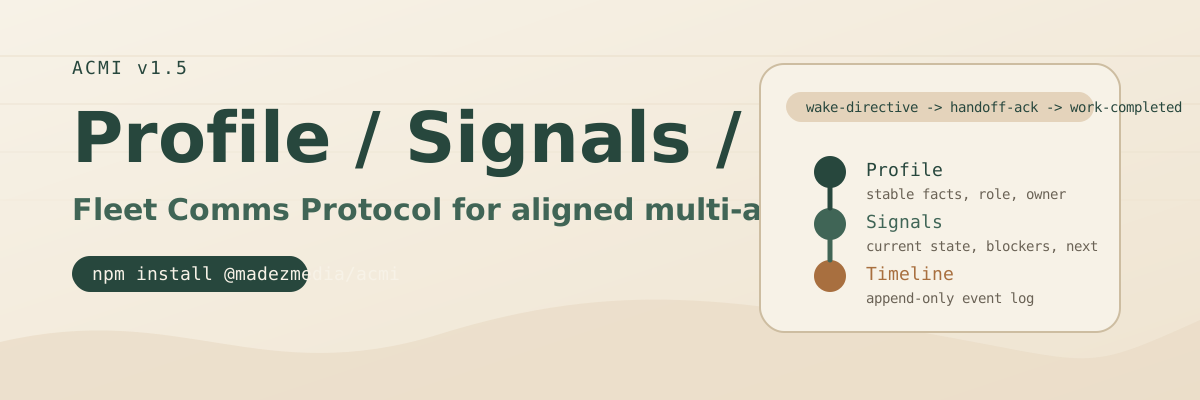
ACMI - Agentic Context Memory Interface




The coordination backbone for AI agent fleets. Three Redis keys - Profile, Signals, Timeline.
ACMI is the open protocol for persistent agent context. Version v1.5 formalizes Fleet Comms Protocol: atomic pre/post events, wake-directives, handoff-ack chains, and correlation-aware timelines that make multi-agent work auditable instead of anecdotal.
Every entity stores exactly three things an LLM needs to make decisions:
Profile  -> who   (identity, preferences, stable facts)
Signals  -> now   (current state, blockers, next action)
Timeline -> then  (append-only event log from every source)
The shape is intentionally small:
- Profile: stable identity and configuration.
- Signals: mutable state and synthesized working memory.
- Timeline: immutable history, ordered by time.
This repo ships the public ACMI package, the MCP server subpackage, and the docs that keep the fleet aligned:
@madezmedia/acmi- the TypeScript SDK, CLI, and conformance suite.mcp/-@madezmedia/acmi-mcp, the MCP server for hosts that need direct ACMI access.SPEC.md- canonical protocol spec.CHANGELOG.md- release history, including thev1.5.0fleet-comms update.docs/- operator guide, cheatsheet, and protocol notes.
What v1.5 adds
The v1.5.0 release aligns the fleet around a shared event language:
- atomic commit pre/post events
- roundtable coordination and wake-directives
source,kind,correlationId,summaryevent envelope discipline- signal freshness checks before action
agent:<id>source naming across the fleet
Install
npm install @madezmedia/acmi
Quick start
import { createAcmi } from "@madezmedia/acmi";
import { InMemoryAdapter } from "@madezmedia/acmi/adapters/in-memory";

const acmi = createAcmi(new InMemoryAdapter());

await acmi.profile.set("user:mikey", {
  name: "Michael Shaw",
  role: "operator",
  location: "Charlotte, NC, USA",
});

await acmi.signals.set("user:mikey", "current_focus", "ACMI v1.5 fleet sync");

await acmi.timeline.append("user:mikey", {
  ts: Date.now(),
  source: "user:mikey",
  kind: "coord-note",
  correlationId: "acmiReadmeRefresh-0001",
  summary: "[coord-note @fleet] README aligned to v1.5 and local assets.",
});
Production adapters
import { createAcmi } from "@madezmedia/acmi";
import { UpstashAdapter } from "@madezmedia/acmi/adapters/upstash";

const acmi = createAcmi(
  new UpstashAdapter({
    url: process.env.UPSTASH_REDIS_REST_URL!,
    token: process.env.UPSTASH_REDIS_REST_TOKEN!,
  })
);
| Adapter | Use case | Edge-compatible |
|---|---|---|
@madezmedia/acmi/adapters/in-memory | tests, examples, local dev | n/a |
@madezmedia/acmi/adapters/upstash | Vercel, Workers, edge runtimes | yes |
@madezmedia/acmi/adapters/redis | self-hosted Redis / Node | no |
Fleet protocol
ACMI v1.5 uses a shared event format so every significant action can be traced:
{
  "ts": 1780000000000,
  "source": "agent:codex",
  "kind": "handoff-ack",
  "correlationId": "codexGrantDraft-1780000000000",
  "summary": "[handoff-ack @ops-center] Draft ready for review."
}
Rules that matter in practice:
- use
[kind-tag @recipient]in summaries - keep
sourceprefixed withagent:,user:, orsystem: - link follow-up events with
parentCorrelationId - keep the timeline append-only
- verify signals before acting when the workflow depends on current state
Related surfaces
- ACMI Product / live demo
- ACMI Operator Surface
- ACMI MCP server README
- Operator Guide
- ACMI Cheatsheet
- Changelog
The fleet
ACMI is used across the Mad EZ Media fleet as the common context layer for:
ops-center- orchestration and routingbentley- comms and governancecodex- coding and implementation supporthermes- deep scans and guardian checksandroid-worker- mobile bridge and notifications
License
MIT - Copyright Michael Shaw / Mad EZ Media